Tuesday, May 12, 2015

Language and Development Conference 2015 (& CFP)

The eleventh in a series of biennial Language and Development Conferences will be held in New Delhi, India on 18-20 November 2015, with the theme "Multilingualism and Development." Of the previous ten conferences, two have been held in Africa (2005 in Addis Ababa, Ethiopia and 2013 in Cape Town, South Africa) and the other eight in various parts of Asia. Nevertheless, the conference topics seem as relevant to African realities as those in Asia and elsewhere.

In its own words, the conference series
... explores the role of language in development. It addresses the issues of world, national, second and minority languages and the role they play in economic, social and cultural development; language policy, conflict transformation, language rights and identity; communication, education and development and language pedagogy.
The current theme - Multilingualism and Development - begins with the simple observation that "Linguistic and cultural diversity is a fact of life in developing countries...," under which several subthemes and suggested topic areas (relevant for the call for papers - submissions due 26 June 2015 12 July 2015 - deadline extended) are outlined:
  • Multilingualism and the metropolis
    • The issues that might be addressed include but are not limited to the following:
    • Identifying and describing the linguistic implications of urbanisation
    • The benefits of linguistic hyperdiversity
    • Linguistic barriers experienced by migrant populations in urban contexts
    • How schools, health clinics and other government services cater for speakers of dozens of different languages in super-diverse urban contexts
    • The practice of MTB MLE - and the capacity of schools to provide it - in multilingual urban contexts
    • Social division as an unintended consequence of MTB MLE in multilingual contexts
    • Multilingualism in semi-urban and urban non-metropolitan contexts
  • Language, technology and multi-literacies
    • Digital media as threat or opportunity for minority languages
    • Digital media and non-Latin-based writing systems
    • The use of digital media at times of crisis and natural disasters, especially in multilingual societies
    • Digital media and language choice in education
    • Digital literacy, language and gender
  • Multilingualism, marginalisation and empowerment
    • The tension between ideas of ‘development’ and formal education systems
    • Educating girls and empowering women in multilingual societies
    • Endangered languages and endangered livelihoods
    • Language, identity and violence
    • The role of parents in multilingual contexts
    • Multilingualism in rural contexts, particularly in the context of accessing markets
    • Prospects for indigenous peoples and speakers of minority languages in multilingual nations
    • The roles of English in multilingual developing countries: empowering or marginalising?
    • Describing and responding to the phenomenon of low cost private English-medium schools catering to the economically marginalised
The attention to English among the possible issues is perhaps a function of the British Council's co-sponsorship, as well as the fact that English is one of the official languages of India (which is hosting this year's conference). No problem there, but it is notable the prominence of Britain in organization of many of the past conferences, and the absence of major donor countries like the US and France. UNESCO and the African Academy of Languages (ACALAN) are listed among the co-sponsors of the 2013 event,  Germany's GTZ was a cosponsor of the 2011 conference, and several Australian organizations were involved in organizing some of the early conferences.

Friday, May 08, 2015

Second most spoken languages in Africa, part 2

This post will review in more detail the Africa information in Olivet Nazarene University's maps of "Second Most Spoken Languages Around the World" web feature. The previous posting on this subject gave an overview and pointed out some issues - most importantly the problem with assuming that official languages in African countries are the most spoken languages, and an apparent confusion between "second most spoken language" and "most common second language."

The following table is an attempt to review in detail the information that Olivet presented, country by country (for those covered). The object is not to be overly critical of this effort, which has the virtue of raising an issue that not many have considered, but to take the opportunity to look at this issue in more detail, since it is important in several contexts.

For instance, during the ebola crisis in West Africa, some outside aid efforts may have started from the assumption that the official languages are sufficient to reach wide populations, while others raised the concern that this is not enough (see previous post, "Speaking English in Rural Africa"). Yet as far as I'm aware, there were few hard data to indicate where and on what levels language was a critical gap in communication and public education. The information in the table below (drawn from sources linked in left column) would not close such gaps - it is on too macro a level - but it might serve to promote more thinking about what languages are most important in various parts of the world's second largest and perhaps most linguistically diverse continent.

Olivet's “Second Most Spoken Languages” per map (Africa only)

Review comments
(L1=first language;
L2=second language) 
Countries covered Language indicated Olivet's code ISO 639 code Olivet's comments
Algeria
(Wikipedia / Ethnologue / Aménage- ment linguistique)
French Fr fr "The most common second language is French, which is used by many as a literal and figurative 'lingua franca.'" Rephrasing per the project title, French is the second most spoken language in Algeria (mainly as L2) after Arabic (including Algerian Arabic). Amazight (or Berber) languages, esp. Kabyle & Shawiya, are spoken by several million
Burkina Faso
(W / E / A)
Indigenous In - "Individual tribal languages are typically the most commonly spoken language in daily life." The Mossi language (aka Moore; mos) may actually be spoken by more people than any other language. Dioula (aka Jula; dyu) is widely used as as L1 & L2. Of this and the official French, not clear which is second most spoken. 
Cameroon
(W / E / A)
Indigenous In - "The most common second language is one of the many native languages of Cameroon, as very few Cameroonians speak both English and the country’s other official language, French.” The native languages of Cameroon would in most instances actually be L1s, not L2s (though some languages like Fula in the north, Pidgin in the west, and Ewondo in center, south and east also serve as L2s). Of those, and the official French and English, more work needed to determine ranking of numbers of speakers (L1+L2).
Central African Republic
(W / E / A)
Indigenous In - The most common spoken language, outside of the official languages of French and Sangho are native languages. Nearly all of the native languages of the CAR belong to the Ubangian languages.” It would be more informative to rank languages regardless of legal status.As such, Sango is the most spoken (mainly as L2 outside of Bangui), and French probably second most spoken (also mainly as L2). 
Egypt
(W / E / A)
English En en English and/or French are widely learned and understood.” -
Ethiopia
(W / E / A)
Oromo Or om The most commonly spoken second language is Oromo, spoken by 33.8% of the population. The second language is actually spoken by more Ethiopians than the official language (Amharic), of which 29.33% of the population speaks.” Based on this, Oromo should be considered as the most spoken, and the official Amharic (am) as second most spoken in Ethiopia.
Ghana
(W / E / A)
Asante As tw The most common second language is the Asante tribal language, used by 14.8% of the population.” Asante or Ashanti is one of two literary versions of Twi (tw), which in turn is usually considered together with Fanti as the Akan language (ak). Akan is spoken by about half the population (mainly as L1), so may actually be spoken by more people than the official English.
Ivory Coast
(W / E / A)
Dioula Di dyu Dioula is the most common second language, as it is the most common of the tribal languages.” Dioula (aka Jula) is a historic trade language in the Manding group, mutually intelligible with Bambara. It is apparently widespread as an L2, though L1 speakers are relatively few.  However the number of French speakers - mainly L2 - is greater.
Liberia
(W / E / A)
Indigenous In - The various tribal languages of Liberia are the most common second language, being the primary speaking language of many people, though they are often not usable in writing.” The native languages of Liberia would in most instances actually be L1s, not L2s. Of those, Kpelle may have the greatest number of speakers. Liberian English (mainly as L2) is apparently the most widespread.
Libya
(W / E / A)
English En en English is commonly understood among the educated classes, and in major cities.” lIn addition to Arabic, native languages include several varieties of Tamazight (Berber) languages, of which Nafusi (jbn) has almost 200k speakers (Ethnologue). How does that compare with numbers who understand English?
Malawi
(W / E / A)
Chewa Cw ny Chichewa is the second most spoken language in Malawi and most common language in the country.” Chewa has more speakers in Malawi than any other language (counting L1 and L2). Using Ethnologue's figures, Tumbuka (tum) may be second most spoken, ahead of English (Tumbuka being mainly an L1 and English mainly an L2 in Malawi).
Mali
(W / E / A)
Bambara Ba bm The most commonly spoken language outside of French is Bambara. In total, 13 languages are considered official languages of the country.” Bambara is spoken by 60-80% of the population as an L1 or L2, which is more than the official French. 13 Malian languages are statutorily “national languages,” not official (See discussions in previous postings.)Of those 13, Fula might possibly rival French for 2nd most spoken in terms of number of speakers (Fula being mainly an L1 and French mainly an L2 in Mali).
Morocco
(W / E / A)
French Fr fr French is a commonly used second language in business and government.” Standard Tamazight (zgh) is also official, along with Standard Arabic. Taken together, the number of speakers of Tamazight varieties (spoken mainly as L1) may rival that of French (used mainly as L2).
Mozambique
(W / E / A)
Emakhuwa Em vmw (& others) Emakhuwa is spoken by 25.3 % of people in the country.” Portuguese (official language) is most widely spoken, by about half the population mainly as L2. Emakhuwa actually has several varieties, which together are spoken by about a quarter of the population, mainly as L1.
Namibia
(W / E / A)
Oshiwambo Os kj & nd The Oshiwambo languages are spoken by 48.9% of the country.” Oshiwambo language or dialects are most spoken, and of those, Kwanyama clearly has more speakers (mostly L1) than English (mostly L2). The latter seems to be the second most spoken.
Niger
(W / E / A)
Hausa Ha ha Hausa is the most commonly used language outside of the official language of French.” Hausa is actually the most spoken language, though its L1 speakers dominate in the south central region; it also has L2 speakers. French (official) or Zarma (dje; dominant in the west) likely would be second in number of speakers, though the former has more L2 and the latter more L1 speakers.
Nigeria
(W / E / A)
Hausa Ha ha Hausa is the most commonly used language outside of the official language of English.” Estimates of the number of English speakers (mainly L2) vary widely, with one question being how to count speakers of English-based Pidgin. Defined broadly, English would be the first most spoken. Yoruba may have slightly  more L1 speakers than Hausa or Igbo, but Hausa has many more L2 speakers than either of the others.
Rwanda
(W / E / A)
Swahili Sw sw Swahili is the most common spoken language outside of the official languages.” Kinyarwanda is L1 of virtually the entire population. French may be the second most spoken language. English (relatively recently made official alongside the two mentioned above) or Swahili would be third.
Senegal
(W / E / A)
Wolof Wo wo Wolof is the most commonly used language in Senegal.” As such, Wolof should not be listed as second most spoken. French (mainly an L2) or Pulaar (a Fula language, spoken mainly as an L1) would be second.
South Africa
(W / E / A)
Xhosa Xh xh The most commonly used second language is Xhosa, used by 16% of the population.” Of all languages in South Africa, Zulu may be most spoken (L1+L2), with Xhosa, English, and Afrikaans following (although from older data, the order is hard to confirm).
South Sudan
(W / E / A)
Arabic Ar ar The most common second language is Arabic, a remnant from when South Sudan was united to Sudan." Dinka (all 5 varieties together; din) and Nuer (nus) are the first & second most spoken indigenous languages, mainly as L1s. The Arabic creole, Juba Arabic is important in part of the country, but its speakers may number less than those of Nuer. No clear figures for English (official).
Sudan
(W / E / A)
Indigenous In - "Beja is a native Cushite language spoken by around 2 million speakers in Sudan, making it the most common second language." Beja (bej) may be the second most spoken, but mainly as an L1, not L2. Of the two official languages, Arabic is the most spoken, but no figures for English.
Tanzania
(W / E / A)
Arabic Ar ar "Outside of Tanzania's official languages, Arabic is the second most spoken language (widely spoken in Zanzibar)." Swahili (official) is the most spoken language. Sukuma (suk) may have more speakers (mainly L1) than English (also official; mainly L2). Despite its significance in Zanzibar, Arabic is not that widely used elsewhere.
Tunisia
(W / E / A)
French Fr fr "French is the most common second language and is used especially in the business world." Counting Tunisian Arabic and the official Standard Arabic as one, French is indeed the second most common language (mainly as L2).
Uganda
(W / E / A)
Ganda Ga lg "Ganda is the most widely used second language, and is the preferred language for native publications." Ganda (Luganda) apparently has more speakers (L1+L2) than English (mainly as L2). However English is more widely used as an L2.
Zambia
(W / E / A)
Nyanja Ny ny "Nyanja is the most common second language, spoken by 14.7% of the population." Bemba (bem) apparently has the most speakers in Zambia (mainly as L1 but also L2). English (official; mainly as L2) or Nyanja (mainly as L1), would follow.

A related post of possible interest: "How many people speak what in Africa?"

Thursday, May 07, 2015

How many people speak what in Africa?

More on language maps with focus on Africa. This picks up a discussion begun in an earlier post, "Second most spoken languages in Africa."

One of the reactions (by several people on Twitter) to a set of maps and diagrams of the most spoken languages in the world published in the Washington Post's April 23 feature "The world’s languages, in 7 maps and charts"- in particular the diagram at right - was a question as to why Swahili was not included. After all, estimates of speakers of Swahili run as high as over 150 million.

African languages do tend to get overlooked in various contexts, but in this case it seems that the criteria used - "native language" - was the deciding factor. Swahili is widely used as a second or additional language (L2 being the common abbreviation) but relatively fewer people speak it as a first or native language (L1) - somewhere in the range of 15-50 million (more on such estimates below). This is not enough to make this chart, which deals only with L1s. The number of L1+L2 speakers of Swahili is in the 60-150 million range.

The map/diagram at right was posted on Twitter as a reference in the above discussion. (Thanks to Prof. Calestous Juma of Harvard University for calling our attention to it.) This comes from an article entitled "International Mother Language Day 2014" on the elearning-africa.com site. However the figures given for "six of the most widely-spoken languages" clearly have to do not just with maternal language (L1) speakers, but also with L2 speakers.

To elearning-africa.com's credit, the article notes the complexities involved in citing figures for African languages, including the L1 and L2 issue:

"[I]t is of course extremely difficult to count numbers of language speakers, especially when the data is vague. Should only first-language speakers be counted? But then, what about Kiswahili and Hausa, which have fewer native speakers but are used across wide geographical areas as trade languages? It is important to remember that any depiction of African languages, other than the most exhaustive study, will be a compromise at best."

The closest we have to an exhaustive study of numbers of African language speakers continentwide would be the figures compiled by Ethnolgue, though these are themselves often estimates and works in progress. Still, one could work with such figures - as well as other research on language use in specific parts of Africa - to outline the top most spoken languages at different geographic scales - continental, sub-regions, countries, and provincial. These could in turn be presented in map layers. The utility of such data would be in better informing development/extension projects and relief efforts (such as that against ebola recently in West Africa) in which communication, participation, and education are fundamental..

Source: Michigan State University African Studies Center, "Exploring Africa" (modified)
In the meantime, a diagram like the one at right, which doesn't offer any numbers but picks some of the most spoken African languages by country, represents a useful compromise on a macro level. This particular example, needs updating and revision. Some issues (and a few changes) include:
  • Updating to reflect the split of Sudan and South Sudan
  • In some cases the languages appear to be listed in order of number of speakers, but in others not - it would help to do the former consistently.
  • I corrected one of the language names for Guinea - "Futa Jalon" is not a language, but a region where Pular, a variety of Fula, is spoken. 
  • Also about Fula, the listing of "Fulfulde" and "Pulaar Fulfulde" from Mauritania through Guinea Bissau needs review/revision.
  • For Ghana, Fante and Asante-Twi could be consolidated to Akan, and one of the northern languages could be listed.
  • I removed "Hima" as a language of Rwanda and Burundi. It's a name (or dialect) of Nkore, which although related to Kinyarwanda/Kirundi, is a language of Uganda. In Rwanda and Burundi, Ethnologue considers it "an ethnic group (not a language) which speaks Rwanda or Rundi."
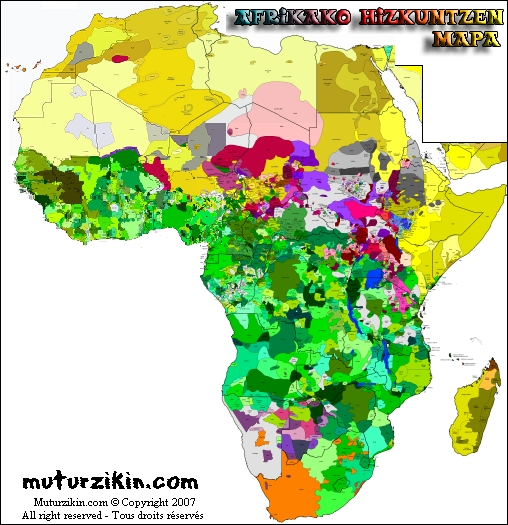
On the other end of the spectrum - that of "granularity" of linguistic data - there is a set of detailed maps of "Distribution of African Languages" on muturzikin.com (an image of these together as presented on their site is on the right). In some ways this impressive work addresses the need for more accurate maps, although it has no indications of level of use (per numbers of speakers). Also, since in multilingual Africa, language use overlaps and rarely if ever respects borders or boundaries, it would be useful to see some kind of layering feature, as well as the ability to zoom out and drop some detail in favor of aggregated data on more widely spoken languages.

The latter maps of course focus only on African languages, and without reference to the Europhone languages used in many countries in official capacity and/or as lingua francas (L2s). Another adaptation, therefore, could be on the continental level, to list the top most spoken languages (L1+L2) per country, including all tongues.

This would bring us back to the map of "second most spoken languages" in Africa proposed by Olivet Nazarene University. A more detailed look at that effort will be the subject of the next posting.

Tuesday, May 05, 2015

Applied linguistics for development workers?

In an article last January in The Guardian's Global Development Professionals Network, Maria May suggests "Six resolutions for aid workers" in 2015: 1. Be the best manager ever; 2. Read; 3. Write; 4. Spend more time in the field [i.e., don't let it slide down the list of priorities]; 5. Walk the walk [development "organizations need to exemplify the change that they are trying to make in society"]; and 6. Renew yourself.

I'd like to suggest a 7th resolution for 2015 - never too late to improve practice - which is particularly important in multilingual contexts commonly encountered in development work in Africa: "Be a little bit of a linguist." What I mean by that is to pay attention to what languages are used and might be used, and how, in all levels of development work - especially on the level of beneficiaries and their communities.

Language, of course, is key to communication, which is central to extension, learning, and collaborative planning and action. And when many languages are used in a community, communication in development becomes more complex, choice of languages becomes a factor, and several social and linguistic issues come into play:
  1. Participation: Who's talking? Who's not talking (or understanding)? These are issues even in monolingual communities, but where more than one language is spoken, try to observe what the use of or shift among languages means in terms of who does and doesn't participate fully - or at all. Typically use of an elite language or a language spoken by a majority in the community will favor people in leadership positions. Choice of language may reflect power as much as a desire to reach the most people. 
  2. Gender: Related to the previous point, what do women speak and not speak? Women tend not to have as many languages as men, due to lack of formal education of girls, as well as to the opportunities even unschooled men have to travel and interact with speakers of other languages in their region (and beyond). Try to get an idea of what languages women use in homes, community, and local markets, and what gaps there may be for their direct communication with government, extension agencies, development projects, school staff, etc.
  3. Interpretation: Where it is necessary to work across more than one language, what is the quality of rendition in the target language(s)? If you don't speak the target language you have to trust the interpreters who do, but don't do so blindly. You may have seen a spoof of movie subtitles where an actor speaks a long piece and the subtitle has one or two words - be alert to shortcut summaries and query the interpreter when s/he gives you one.* In 2010 I sat in on a training of community animal health workers in Moroto, Uganda, who requested a change of interpreter to one who had better command of relevant vocabulary in Karamojong language. If there had not been that alternative, what might have been lost in translation? Check to be sure of the interpreter's confidence in the technical topic(s) being discussed before putting them on the spot to translate for you.
  4. Translation: Can you bring talking points translated in the target language to the field? At its most basic level, interpretation is oral and translation written, but development work rarely involves the latter when "local languages" are involved. Yet "pre-translating" key concepts and terminology might be helpful as aids to ensure good interpretation and reduce "slippage" in conveying information. Translation is also a key to localizing ICT4D (see below).
  5. Local extension agents: What languages do they speak? I've remarked in the past that a US Peace Corps volunteer may get more language training in one week than the average local extension or development worker gets in an entire career. That may not seem to matter much if they speak the local languages, but even when they do, there is no support to assure the quality of technical expression in those tongues, and very likely such workers are not literate in them (if their formal education was uniquely in a Europhone official language). And often it is the case that local extension workers may be posted in a region of their country where a language(s) they are not so familiar with are spoken
  6. Local radio: What languages do they use? In my experience in West Africa, community radio stations split their programming among whatever languages are spoken by people living within their broadcast radius. With expertise across languages (including finding ways to express new concepts in them), the staff of a station in an area where you are working could be a valuable partner for both for understanding the sociolinguistic profile of the area and for messaging to reach all groups.
  7. ICT4D: Applications, software, and content that do not respond to the linguistic realities of the population will have a limited utility - or utility for a limited number of people. Localization (L10n) involves translation and adaptation to local culture and communication. Projects in information and communication technology for development (ICT4D) and efforts to develop L10n in the same countries would seem to be natural allies with complementary interests, but it may be up to the better funded ICT4D projects to reach out to make this connection.
One by one, such issues may make perfect sense, but even when taken together, the reasons for attention to language as a factor in development have not led to a real understanding of the role of languages in development, or what we might do better in multilingual contexts - and with less-resourced languages - to improve practice and outcomes.

The link between language and development is "largely ignored" according to Ekkehard Wolff. Robert Chaudenson has suggested that the subject of language is "taboo" in development work in Africa. And Birgit Brock Utne noted that foreign donors have a negative view of African multilingualism. This is a problem and we can do better.

* An episode of interpretation recorded on video in southern Afghanistan, with translated subtitles, is an example of shortcuts or just bad interpretation. There are other dynamics going on in the video, but the segment about midway through with the local elder is worth viewing.

On a similar topic: "Back again. Gates, Rockefeller & African languages" 14 Sep 2006.

Friday, May 01, 2015

Second most spoken languages in Africa

A news feature on the Olivet Nazarene University site presents a map showing "The Second Most Spoken Languages Around the World." This is an interesting effort to get below surface descriptions of language use. As a Washington Post feature last year on languages in the U.S. put it, "Top-line statistics often reveal little. But peel back the first set of layers, and you reveal a lot of diversity - and history."

Second most spoken languages in Africa. Source graduate.olivet.edu
However, when dealing with the complex linguistic landscape of Africa, this effort runs into problems. The first issue is assuming that "The most spoken language in any country is often obvious; usually, it’s the official language of the country." In Africa this often is not the case, if by "most spoken" one counts number of speakers. An example is Mali, whose linguistic profile was explored on this blog in discussing the long-tail of languages - Bambara is certainly more used than the official French.

Official language is a category that doesn't lend itself to ranking use of languages in Africa, beyond the (admittedly important) context of official use and its spillover to popular use. In the case of two countries at least, this runs into additional problems:
  • South Africa has 11 official languages (the Olivet site incorrectly lists only one of them - Zulu - as official). So one of the official languages will be second most spoken. Perhaps that is Xhosa as indicated, but the model focusing on official languages hasn't worked here.
  • Rwanda has three official languages (Kinyarwanda, French, and English), and Central African Republic two (Sango and French). Since the site doesn't consider these official languages in discussing second most widely spoken, it is reduced to stating that Swahili is "second" most used in Rwanda, and that indigenous languages are used in CAR - which doesn't tell us much.
  • Ethiopia has Oromo listed as the second most spoken language, but the detailed info notes that it is actually the first most spoken, with the official Amharic being second. So shouldn't Amharic be listed on this map instead of Oromo?
The type of situation in Ethiopia and Mali is probably the rule in African countries where one or two indigenous languages dominate (even when a Europhone language is official and therefore assumed to be the key linguistic descriptor for the countries).

A second issue is that in reading the individual country descriptions, it seems there may be a confusion between second most spoken language and most spoken second language (L2). This is a key distinction between numbers of L1+L2 speakers for the former (which will be predominately L1 for many languages), and just L2 speakers for the latter. When discussing English in many countries - one focus of the Olivet effort - almost all speakers will be L2, but that would be a special case within consideration of what language is second most used (per the title of the page). In the case of Liberia, however, where English is official, reference is then to local languages as "most common second language."

A minor issue is reference to "tribal languages" - not used in academic literature, and has negative messages in other contexts.

Another one is the coding used for languages - many of the two-letter abbreviations coincide with the standard two-letter ISO 639-1 codes, but others do not (Bambara would be "bm," not "ba"; Chichewa would be "ny" like Nyanja [same language]; "As" for Asante in Ghana would more appropriately be "Ak" for Akan. Where there is no ISO 639-1 code, then either an invented 2-letter code or better yet, a three-letter ISO 630-3 code could be used.

Despite issues mentioned above, this is an worthwhile effort that could potentially have use in education - of language learners, development practitioners, and policy makers. Some suggestions:
  1. Be clear that it is "second most spoken language" throughout and consistently
  2. Do not count official as the most spoken, especially in Africa - official may be most important on some levels, but not necessarily understood by most people. The story gets more interesting when one looks at most spoken languages (L1+L2 numbers) per country
  3. Do not refer to "tribal" languages - indigenous, local, or whatever, there are more or less better terms
  4. Use ISO 639-1 (and if necessary -3) codes
  5. Name the indigenous languages - Ethnologue of course is a prime reference for names and numbers
  6. Consider tracking third most spoken languages. Much of the work towards this will have been done anyway, in sorting through numbers to determine what is second most spoken.
  7. An additional resource to consult is Jacques Leclerc's L'aménagement linguistique dans le monde
  8. Keep in mind cross-border languages - Hausa and Swahili are well known, but Chewa and Nyanja are the same (as indicated above) and Bambara and Dioula (aka Jula) are mutually intelligible - could further development of this project include ranking regional (crossborder) languages?
See also the follow up more detailed analysis in Part 2.

Thursday, April 30, 2015

Same-language subtitling for African languages?

The current edition of The Economist has a feature on "same-language subtitling" (SLS) as a literacy tool in India, entltled "Literacy in India: A bolly good read." Could SLS be used with African languages to promote literacy in Africa?

SLS is a bit like closed captioning in that it includes text in the language being spoken (or sung in), but the target is people who can hear and understand the language but are still learning to read. My limited understanding of subtitling is also that subtitled text gets more (or at least different) attention in production and display than does closed captioning.

The idea of SLS for literacy is not new, having been conceived two decades ago by Dr. Brij Kothari, who has continued work on development and use of the technique in India through the Indian Institute of Management Ahmedabad and later his NGO, PlanetRead.

More broadly, the idea of using subtitles in the same language goes back at least a half-century to sing-along shows (such as the 1960s American "Sing Along With Mitch" TV program; a contemporary example is Disney's release of a "sing-along" version of the 2013 film, "Frozen"). Many Chinese film and TV productions, as the Economist article mentions, subtitle in hanzi which can be read by speakers of different Chinese languages written with them (Mandarin dialects, Cantonese).

However, as far as I've been able to tell, there is not yet any use of SLS for African languages - at least on a systematic basis.

SLS in African languages?


A recent tweet by the Ghanaian NGO, Kasahorow, raised hopes of an example of SLS in the Akan language:
However, the YouTube videos are actually static images the of the lyrics with instrumental music in the background. Perhaps a step to SLS? Kasahorow, one should note, has quietly been doing a lot of production of learning and reference materials, plus some apps, for various African languages from around the continent. It would seem from afar that a collaboration between Kasahorow and PlanetRead could produce some very interesting results.

The topic of SLS came up in a session at the African Language Teachers Association/NCOLCTL conference last Saturday (25 April 2015). Two faculty from the University of Florida's Program in African Languages - Dr. James Essegbey and Dr. Charles Bwenge - presented on use of videos in Akan and Swahili (respectively) for L2 learners of those languages, and issues with production and access. A possible evolution of this kind of resource is to include subtitles/captions for the dialogues. While the subjects of these videos, and often the deliberate pace of speech in them (to facilitate L2 learners' understanding) may make most of them unsuitable for L1 (native) speakers, some of the more sophisticated ones might possibly be useful for literacy.

There is a significant amount of film, video drama, and music video production in African languages, and that is likely to increase. Use of SLS in popular releases might present a significant resource for L1 literacy in those languages, L2 language learning, and written use of African languages generally.

Final notes: I first learned of Dr. Kothari's work on SLS in the mid to late 1990s. The topic of SLS is mentioned in passing in two earlier postings on this blog:


Addendum, 1 May 2015

I understand from Brij Kothari that PlanetRead and Kasahorow have indeed collaborated virtually on one project to produce animated stories with SLS in Swahili. [See also his comment to this post.]

Addendum, 6 May 2015

I understand from James Essegbey that the Swahili videos shown by Charles Bwenge have subtitle capability.

Thursday, March 26, 2015

Ebola information in Vai

Recent news of a new case of ebola in Liberia, and discussions such as that initiated by Bill Gates on preparedness for future possible epidemics, make the issue of developing health education resources in the first languages of potentially affected populations an ongoing and future priority.

Following up on previous postings of ebola information in various African languages, here is a translation in the Vai language of a FAQ on the virus from the World Health Organization, as transcribed in the Vai syllabary and in the exended Latin orthography. The translation and transcriptions were done by Tombekai V. Sherman and facilitated by Athinkra LLC. These are available in PDF format on Athinkra's Google site. Thanks to Charles Riley of Yale University for sharing the Word .doc versions, which are much simpler to copy into the blog.

Vai is spoken by over 100,000 people mainly in Liberia, but also in Sierra Leone.

The Vai syllabary is encoded in Unicode. To view the text, you may need to download a font. Free Vai fonts are available on Michael Everson's website. (See also the SIL Vai fonts page.)


ꖦꖕꕰ ꕺꖃ ꗏ ꔳꘂ ꖴꗷ ꗏꗒꗡ ꕉꔱꔸꕪ ꕗꕴꔀ ꕞ ꖏꕎ

Dúúnyá kpolo lɔ tíyɛ́ kulɛ lɔndɔɛ áfíríka gbawoe lá kówa

ꖤꕢ ꖷꔧ ꘃ ꕎꕌꔳ ꖴꖨꘋ ꕒ ꕉ ꕞ ꗓꔒ ꗪ Iꕷꕞ ꕙꗐꔻ ꕃꕩꕌ ꕞ

Túsá múĩ́ kɛ́ wáhátí kúluŋmɓa a lá sɔ́lé ɓɛ ibhóla varɔ́si kiyaha la


ꔤꕷꕞ ꕙꖄꔻ ꕃꕩꕌ ꔳꕩ ꔈ ꕎ ꖏ?

ꔤꕷꕞ ꔳꕩ ꕃꕩ ꗬꗷꕩꕌꔒ ꕎ ꖏ ꕉ ꘃꖷ ꕞ ꘊꘊ ꗪ ꗉꖺꗚ ꕉꖷ ꕎꕌꔳ ꖴꖨꘋ ꕒ ꕉ ꕧꕴ ꗞ ꘃꗺ ꖸ ꕮ ꔧ ꘃꗺ ꔌꘋ ꖷ ꖸ ꕔꕌ ꗞ ꘃꗺ ꖸ ꕞ ꕉꖸꕊ ꗪ ꕃꔤꘂ ꗱ (ꗚ ꗅꘋ, ꖑꔓꕞ, ꔧ ꕴꖃ) ꕉꖷ ꕃꕩ ꔫꔤ ꕯ ꔤꕷꕞ ꕙꖄꔻꘂ ꕎ ꗱ. ꕉꕌ ꘊꘊ ꗪ ꘃ ꗉꖺꗚ ꕉꖷ ꕉ ꖴꘋ ꗞ ꕘꕌ ꕎꕌꔳ ꖴꖫ ꖝ ꗏ, ꘃ, ꗞ ꖴꘋ ꕸꖃ ꔉꕖꕌ ꕉ ꕧꕌ.

ꕉꔤ ꘊꘊ ꕪꕮ?

ꕪꘋ ꖷ ꗏꔤ ꕙꖄꔻ ꘈꗢꖸ ꖸ ꔮꔷꘋꔕ ꗪ ꖦꖕꕰ, ꗞ ꕮ ꕉ ꗓ, ꕉꖷ ꕉ ꗏ ꕪꔒ ꕮꕊ ꗷꔤ ꖷ ꔖꔜ ꕙꖄꔻꘂ ꖃꘋꕡ ꗞ ꘃꗺ ꖸ ꗏ. ꕎꕌꔳ ꖴꖨꘋ ꕒ, ꗞꗢ ꔖꔜꕯꕊ ꕩꕌ ꔬꕩ ꕎꕌꔳ ꖷ ꕉ ꖤꖕꔒꔀ ꘃꗺ ꔌꘋ ꕞ ꕉ ꘃ ꖷ ꕙꖄꔻꘂ ꘈꗢ ꗪ ꕉ ꗏ.

ꕃꕞꔤ ꔳ ꕎ ꘃ ꘃꖷ ꔤꕷꕞ ꕙꖄꔻꘂꔤ ꗞ ꔬꕩ ꕒꕡ ꖷ ꗏꖺ ꕩ ꖤꖕꔒꔀ ꕀ ꔌꘋ ꖸ ꕞ ꖝꖕꕯꕊ ꗏ, ꗞ ꗷꔤ ꖷ ꕃꕩꕌ ꗪ ꗳ ꕉ ꕺꖃ ꗏ, ꔌꘋ ꖸ ꗚ ꕴꔤ, ꗷꔤ, ꕸ, ꗻꔤ, ꕔꔺ, ꔧ ꕉꖸ ꗃ ꗠꖻ ꖸ, ꔧ ꗏ ꕃꔷ ꔌꘋ ꖷꔧ ꗃ ꕃꕩ ꗞꗢ ꕮꔧ.

 ꕉ ꖴꘋ ꘊꘊꕰ ꔌꘋ ꖸ ꗱ ꗚ ꘈꗻꔤ, ꕉ ꘃ ꖷ ꕞ ꕒꘋ ꖤꖕꕎ ꕀ ꔌꘋ ꖸ ꕞ ꗞ ꖝꖕꕯꕊ ꗏ, ꕉ ꘃꖷ ꔻꔭꔤꔒ ꕞ ꔳ ꗳ ꔤꕷꕞ ꕙꖄꔻꘂ ꕞ.

ꕉ ꖴꘋ ꕎꕌꔳ ꔬꕩ ꔎꔒ ꗱꕞ ꗪ ꔎꔒ ꗞ ꕒꘋꔕ ꕉ ꗛꖺ ꗏꗒ ꗳ ꕮꕊ ꗏ ꘃꖷ ꕉꔤ ꗬꗷꕩꕌ

ꔤꕷꕞ ꕙꖄꔻ ꕃꕩꕌ ꕧꔤ ꕀꕩ ꕪꕮ ꔧ ꖏ ꖷ ꖸ ꕃꕩꕌ ꕩꕌ ꕮ ꗞ ꕺꖃ ꗏ?
  • ꕃꕮ 
  • ꗉꗟ ꘃ 
  • ꖝ ꗏ ꗃ 
  • ꕪꘋꗜꖺ ꖨꘋ 
  • ꖨꘋ ꗓꕯꕊ ꖸ ꗪ ꖬꘂ ꖬꘂꗡ ꗏ 
  • ꖝ ꗏ ꖨꘋ 
  • ꖴꘋ ꖨꘋ 
  • ꕪꔷ ꘈꗻ ꗚ ꗠꖻꗠꖻ ꕎꔤ ꕯ ꗞ ꔬꕩ 
  • ꕪꔷ, ꕧ ꗅ ꗏ ꕧꕌꔒ, ꔻꖎ ꔻꖎ, ꕉꖷ ꕃꕩ ꗞꗢ ꗃꖺ ꖸ ꗏ, ꕴꔤ ꔳ ꗃꕯ ꕪꘋ ꖷ ꔰ ꖇꕱ ꗪ ꗞ ꖝꖕꕯꕊ ꕮ. 
ꗞ ꖴꘋ ꕸꖃ ꔉꕖꕌ ꕉ ꕧꕌ ꕪꕮ?
  • ꔤ ꖬꕮ ꘃꖷ ꔤ ꕮ ꖤꖕ ꕀ ꔌꘋ ꔰ ꕞ ꕉ ꘃꖷꔧ ꗃ ꔤꕷꕞ ꗞꖻ ꖝꖕꕯꕊ ꗏ ꖺ ꗞ ꖷ ꔤꕷꕞ ꕃꕩꕌ ꗪ ꕉ ꕞ. ꗞ ꖷꔧ ꕔꕌ ꗞ ꗷꔤ ꘈꗢ ꕞ, ꕕ ꖷ ꗐꕒ ꕸꕔꔤ ꔳ ꕉ ꕸꖃ, ꕉꖷ ꕧ ꗅ ꖴꕮ ꗱꗡ ꘈꗢꘈꗢꔧ ꔳ ꕉ ꕧ ꗅꗡ ꖸ ꖴꕮ, ꕉꖷ ꕉ ꖬꘋ ꕮ ꖝꘋꔕꔤ ꔳ. 
  • ꗞ ꖷ ꔰ ꕧ ꕀꕩ ꔒꘋ ꗨꗡ ꗪ ꘃ ꔤꕷꕞ ꕃꕩꕌ ꖴꘋ ꔳꕩ ꕉ ꕞ, ꕉꖸꔧ ꕚꕌ ꕉ ꕞ ꕧꕮ ꘀꕇ ꕪꘋ ꘃꖷ ꕉꖸ ꖴꘋ ꕉ ꘀꗫꕩ ꕉꖷ ꕉꖸꔧ ꗓ ꔎꘋ ꕃꕩ ꘈꗢ ꕞ. ꕕ ꖷ ꗏ ꕉꖸꔧ ꗞ ꖸ ꘀꗫ ꕉ ꘃ ꖷ ꖸ ꕔꕌꔒ ꔳꕩ ꔤꕷꕞ ꕃꕩ ꗞꖻ ꕞ 
  • ꗞ ꖷ ꖸꔧ ꕘꕌ ꔤꕷꕞ ꗱ, ꕕ ꖷ ꕉꖸꔧ ꗞꗢ ꘃ ꗏꖺꕎ ꔌꘋ ꗅꖤ ꗅꖤ ꗏ ꕉꖷ ꕉꖸ ꕩꕌ ꕚꕴ ꕧꕮ; 
  • ꕕ ꖷ ꗞ ꖸꔧ ꖴꘋꗒ ꕪ ꔇꔀ ꕧꕮ ꘀꕇ ꕪꘋ ꔧ ꕉꕡꕌ ꗱꗡ ꘃ ꔤꕷꕞꕌ ꖴꘋ ꔳꕩ ꗞ ꕞ. 
  • ꗞ ꖷ ꔰ ꕔ ꗱ ꗓꖺ ꗪ ꕮꕯ ꕉꕌ ꖏ ꕮ ꕉ ꕞ ꗓꔒ ꗪ ꔤꕷꕞ ꕃꕩꕌ ꕞ, ꕕ ꖷ ꕉꖸ ꕩꕌ ꕮ ꕧꘋꕨꕌ ꕎ ꘃ ꕃꕩ ꗞꖻ ꕮꔕꔀ ꖸ ꕞ, ꕉꖷ ꕉꖸꔧ ꗓ ꕃꕩ ꔫꔤ ꕞ ꔬꕩ ꕃꔤꘂ ꖸ ꗱ ꗯꗷꘋ. 
  • ꗞ ꖷ ꖸ ꔰ ꗪ ꗓ ꘃꕯ ꖽꔻꔪꕿꔀ, ꕕ ꖷ ꕉꖸꔧ ꖴꘋꗒ ꕪ ꕚꘋꔕ ꗱꗡ ꕉ ꕞ ꗓꔒ ꗪ ꕃꕩ ꘈꗢ ꕞ ꖏꕎ ꔧ ꕃꕞ ꖷ ꖸ ꗱ ꕉ ꖴꘋ ꘊꘊꕰ. ꕕ ꖷ ꕉꖸꔧ ꕞ ꔷꔤ ꖏ ꖸ ꕮ ꗚ ꕃꕞ ꖷ ꖸ ꗱ ꗞ ꖸꔧ ꕀ ꖺ ꕴꔤ ꔬ ꕉꖸ ꕙꕰꕊ ꖸ ꗏ ꔧ ꗓ ꘃ ꖷ ꔰ ꕞ ꗓꔒ ꗪ ꕴꔤ ꖏ ꕞ, ꖺ ꕀ ꔌꘋ ꖷ ꖸ ꔰ ꗪ ꖝꖕꕯꕊ ꗏ, ꔧ ꗐꕒ ꘃ ꗞ ꖝꖕꕯꕊ ꗏ ꕀ ꗃ ꖏꕎ, ꔧ ꕀ ꖺ ꕴꔤ ꕢꕌ ꖴꖫ ꖷ ꔰ ꕉꖸꕩꕌ ꘃꕩ ꕔꔤ ꗏ, ꕉꖸꕊ ꔬꕩ ꕃꔤꘂ ꔳ ꗷꔤ ꖷ ꗏꖺ ꕉ ꕢꔒ ꗪ ꘀꘉ ꔞꘋ ꖏꔀ ꖸ ꕮ ꕉ ꕞ ꗓꔒ ꗪ ꕃꕩ ꘈꗢ ꕞ. ꖽꔻꔪꕿ ꗞꗢ ꖸ ꗏꗒ ꔰ ꕉꖸꕊ ꕃꔤ ꔌꘋ ꗏꔤ ꖸꔧ ꔳ ꕉ ꘃ ꖷ ꗪꘋꕡ ꕃꕩ ꘈꗢ ꕞ ꔬꕩ ꕃꔤꘂ ꕮ, ꗚ ꕸꖃꕒꕌꕇ ꕮꔧ ꕈꕰꔒ, ꗏꖺꕎ ꕸꖃ ꕸꕔ, ꖬꘋ ꕮ ꖝꘋ ꔌꘋ, ꔧ ꕧ ꗅ ꕮ ꖝꘋ ꔌꘋ. ꗓ ꘃ ꗱ ꔌꘋ ꖷ ꖸ ꕕ ꕮꕊ ꗞꔧ ꕿ ꕉꖸ ꔱꔷ, ꕕ ꖷ ꕉꖸ ꗽꘉꔒꔤ ꔳ ꕞꕌꕃꔤ ꕪ ꗨꗡꘉꗢ ꗞꔧ ꕿ ꕉꖸ ꘃ ꗏ ꕔꔤ ꗏ. 
  • ꕃꕩ ꘈꗢ ꖴꘋ ꗏ ꘊꘊꕰ ꕃꕩ ꗞꗢ ꕞ ꖏꕞ ꗟꖺꔒꔀ ꖸ ꗱ ꖺ ꔉꔊ ꕧ ꖏꕞ ꖷ ꕃꕩ ꗞꗢ ꕢꕌ ꕉ ꕮ. ꕕ ꖷ ꔌꘋ ꗷꔤ ꘈꗢꖸ ꖸ ꗽꘉꗷꔤ ꔳ ꕞꕌꕃꔤꕪ ꗨꗡꘉꗢ ꗞꔧ ꕿ ꖤꖕ ꕉꖸ ꕞ. 
  • ꔒꔟꕩ ꖷ ꔰ ꕮ ꔤꕷꕞ ꕞ ꗃꕎꘋ, ꖸ ꗞꗢ ꖸ ꕮꔧ ꕕ ꖷ ꕉꖸꔧ ꔵ ꘃ ꕉ ꗏ ꘃꖷ ꗞꗢ ꖸ ꗬꗡꔤ ꖴꘋꗒ ꕪ ꕚꘋꔕ ꗱꗡ ꕉ ꕞ ꗓꔒ ꗪ ꕃꕩꕌ ꗪꗡ ꕞ, ꔧ ꗷꔤ ꖷ ꗞ ꖴꘋ ꕸꖃ ꔉꕖꕌ ꕉꕌ ꘊꘊꗢ ꕧꕌ, ꕉ ꕒꕢꔒ ꗪ ꗷꔤ ꖷ ꗞꔧ ꕘꕌ ꖏꔀ ꖸ ꖴꘋ ꔻꔤ. ꗞ ꖷ ꖸꔧ ꕘꕌ ꔤꕷꕞ ꕼꕱ ꗱ, ꕕ ꖷ ꕉꖸ ꕩꕌꖸ ꕚꕴ ꕧꕮ ꔧ ꗷꔤ ꖷ ꕃꕩꕌ ꔇꔀ ꖴꘋ ꗞ ꕮꔕ ꖸ ꔬꕩꕌ. 
ꗞ ꖷ ꖸ ꕔꕌꔒ ꔳꕩ

ꕃꔤ ꖷ ꕃꕞ ꔋꘋꔋꘋ ꖷ ꗱ ꗞ ꖸ ꖴꘋ ꕃꕩ ꘈꗢ ꔬꕩꕌ ꕉ ꗃ ꗱ ꕉ ꔳꕩ ꕴꔤ ꗱ ꕎ, ꔧ ꕀ ꔌꘋ ꖷ ꖸ ꔰ ꖝꖕꕯꕊ ꕩꕌꖸ ꕈꕰ ꖺ ꕀ ꔌꘋ ꖷ ꖸ ꔰꔤ ꗃ ꖝꖕꕯꕊ ꗏ, ꗞ ꖷ ꖸ ꕔꕌꔒ ꔳꕩ ꔤꕷꕞ ꕃꕩ ꗞꖻ ꕞ, ꕕ ꖷ ꕉꖸꔧ ꔳ ꕧ ꘀꗫ ꕚꘋꔕ ꗛꖺ. ꕕ ꖷ ꕉꖸꕩꕌꖸ ꕺꖃꔀ ꕞ ꕔꔺꘂ ꘀꗫ ꔻꔤꕯꕊ ꗱꕞ ꔎꔒ ꔰ ꖝ ꗏ, ꕉꖷ ꕕ ꖷ ꕉꖸꕩꕌꖸ ꕮ ꕧꘋꕨꕌ ꗞ ꕮꔕ ꖸ ꕞ ꕎꕌꔳ ꖷ ꗏꖺ ꕉꕡꕌ ꗱꗡꔒꔀ ꘃ ꕉ ꕺꖃꔀ ꗪ ꕔꔺꕯꕊ ꖺ ꕃꕮ ꗪ ꗻꗡꕯꕊ ꕉ ꕞ.
Ibhóla várɔ́si kiyaha tiya mɓe wá ko?

Ibhóla tiya kiya kpɛlɛyáhalé wá ko a kɛ mú lá nyɛnyɛ ɓɛ fɔɔyɔ amu wáhátí kúluŋ ɓa a jáwo mɔ kɛ́ndɛ́ nú ma hĩ kɛ́ndɛ́ feŋ mú nú kpãha mɔ kɛ́ndɛ́ nú la anúã ɓɛ́ kiiyɛ fɛ (yɔ́ kpɔŋ, goréla, hĩ woló) amu kiya ɓhií na ibhóla varɔ́si wá fɛ. Aha nyɛ́nyɛ́ ɓɛ kɛ fɔɔyɔ amu a kuŋ mɔ faha wáhátí kúndú ɓú lɔ, kɛ́ mɔ kuŋ ɓóló kpemgbáha a jáha.

Ai nyɛnyɛ káma?

Kaŋ mú lɔ́í várɔ́si mɛɛ̃nú nu kpíliŋndé ɓɛ dúúnyá, mɔ má a sɔ tíŋ tiŋ, amu a lɔ kálé máã lɛ́i mú sénjé várɔ́siyɛ loŋnda mɔ kɛ́ndɛ́ nú lɔ. wáhátí kúluŋ ɓa, mɔɛ̃ sénjénaã yaha ɓiya wáhátí mú a tuulée kɛ́ndɛ́ feŋ la a kɛ mú várɔ́si mɛɛ̃ ɓɛ a lɔ.

Kílai ti wá kɛ kɛmú ibhóla varɔ́siyɛi mɔ ɓiya ɓanda mú lɔ́ɔ ya tuulée jí feŋ nú la mɔ ɓúunaã lɔ, mɔ lɛ́i mú kiyáha ɓɛ tɛ́ a kpoló lɔ, féŋ nú yɔ́ woí, lɛ́i, ɓo, sɛ́í, kpãndí, hĩ anú ɓɔ́ nyɔ́ɔ́ nú, hĩ lɔ́ kili feŋ múĩ́ ɓɔ mɔɛ̃ máí.

A kuŋ nyɛ́nyɛ́nya féŋ nú fɛ yɔ́ mɛ́sɛí, a kɛ mú la ɓaŋ tuúwa jí feŋ nú la mɔ ɓúunaã lɔ, a kɛ mú símɓiilé la ti tɛ́ ibhóla varɔ́siyɛ la.

A kuŋ wáhátí ɓíya télé fɛlá ɓɛ́ télé mɔ ɓáŋndé a kɔ́ɔ lɔndɔ́ tɛ maã lɔ kɛmú ai kpɛlɛyaha

Ibhóla varɔ́isi kiyaha jái jiya káma hĩ kó mú nú kiyaha yaha ma mɔ kpoló lɔ?
  • kímá 
  • fɔ́nɔ́ kɛ́ 
  • gbú lɔ ɓɔ́ 
  • káŋngɔ́ɔ lúŋ 
  • lúŋ sɔnáã nu ɓɛ́ suyɛ súyɛɛ lɔ 
  • ɓú lɔ lúŋ 
  • kuŋ lúŋ 
  • kali mɛ́sɛ́ yɔ́ nyɔ́ɔ́nyɔ́ɔ wái ná mɔ ɓiya 
  • kalí, já kpɔ́ lɔ jahalé, síyo síyo, amu kiya mɔɛ̃ ɓɔ́ɔ nú lɔ, woí ti ɓɔ́na kaŋ mú gbi sóó ɓɛ mɔ ɓúunaã ma.
Mɔ kuŋ ɓóló kpemgbáha a jáha káma?
  • I suma kɛmú í má tuu jí feŋ gbi la a kɛmúĩ́ ɓɔ ibhóla mɔɔ̃́ ɓúunaã lɔ ɔ mɔ mú ibhóla kiyaha ɓɛ a la. Mɔ múĩ́ kpãha mɔ lɛ́i mɛɛ̃ la, kpã mu rɔ́ɓa ɓokpai ti a ɓóló, ja kpɔ́ kuma fɛ̃ɛ́ mɛɛ̃mɛɛ̃ĩ́ ti a já kpɔɛ nú kuma, amu a súŋ ma ɓúŋndéi ti. 
  • Mɔ mú gbi já jíyá leŋ pɛ́ɛ́ ɓɛ kɛ ibhólá kiyaha kuŋ tiya a la, anúĩ taha a la jama jɛnɛ kaŋ kɛmú anú kuŋ a jɛ́mɓɛya amu anúĩ sɔ téŋ kiya mɛɛ̃ la. kpã mu lɔ́ anúĩ mɔ nú jɛmɓɛ a ku mú nú kpãhalé tiya ibhóla kiya mɔɔ̃́ la. 
  • Mɔ mú núĩ faha ibhóla fɛ, kpã mu anúĩ mɔɛ̃ kɛ rɔ́ɓa feŋ kpɔ́tú kpɔ́tú lɔ amu anúyaha tawo jáma; 
  • Kpa mu mɔ núĩ kuŋndɔ ká ɓee jáma jɛni kaŋ hĩ andaha fɛɛ kɛ ibhóla kuŋ tiya mɔ la. 
  • Mɔ mú gbi kpã fɛ sɔ́ɔ ɓɛ mána aha kó ma a lá sɔ́lé ɓɛ ibhóla kiyaha la, kpã mú anú yaha ma jaŋnjaha wá kɛ kiya mɔɔ̃́ mandée nú la, amu anúĩ sɔ kiya ɓhií la ɓiya kííyɛ nu fɛ gbɛ́lɛ́ŋ. 
  • Mɔ mú nú gbi ɓɛ sɔ kɛ́na hɔsipítoe, kpã mu anúĩ kuŋndɔ ká táŋndé fɛɛ a lá sɔ́lé ɓɛ kiya mɛɛ̃ lá kówa hĩ kíla mú nú fɛ a kuŋ nyɛ́nyɛ́nya. kpã mu anúĩ lá lii kó nú ma yɔ́ kíla mú nú fɛ mɔ núĩ jí ɔ woí ɓi anú vanyáa nú lɔ ɔ sɔ kɛ́ mú gbi lá sɔ́lé ɓɛ woi ko la, ɔ jí feŋ mú nú gbi ɓɛ ɓúunáã lɔ, hĩ …... anúa ɓiya kííyɛi ti lɛ́i mú lɔ́ɔ a salé ɓɛ jɛni keŋ koe nú ma a lá sɔ́lé ɓɛ kiya mɛɛ̃ la. hosipíto mɔɛ̃ nú lɔndɔ́ gbi anúa kili feŋ núĩ ti a kɛ mú ɓɛŋnda kiya mɛɛ̃ la ɓiya kííyɛ ma, yɔ́ ɓólóɓáhání máí nyínyalé, rɔ́ɓa ɓóló ɓokpa, súŋ ma ɓúŋ feŋ, hĩ já kpɔ́ kuma fɛ́ɛ́ mɛɛ̃mɛɛ̃. Sɔ kɛ́ feŋ mú nú kpã máã mɔĩ to anú fili, kpã mu anú zɛnɛléi ti lahakiika pɛ́ɛ́nɛ́ɛ̃ mɔĩ to anú kɛ kpái lɔ. 
  • Lengéya mú gbi ma ibhóla la ɓɔwaŋ, nú mɔɛ̃ nú máí kpã mu anúĩ dí kɛ a lɔ kɛmú mɔɛ̃ nú kpɛ́ɛ́i kuŋndɔ ká táŋndé fɛɛ a lá sɔ́lé ɓɛ kiyaha ɓɛ́ɛ la, hĩ lɛ́i mú mɔ kuŋ ɓóló kpemgbáha aha nyɛ́nyɛɛ̃ jáha, a ɓasalé ɓɛ lɛ́i mú mɔĩ faha kóe nú kuŋ sii. Mɔ mú núĩ faha ibhóla fɛ, kpã mu anúyahanú tawo jáma hĩ lɛ́i mú kiyáha ɓée kuŋ mɔ mandé nú ɓiyaha. 
Mɔ mú nú kpãhalé tiya

Kii mú kila gbeŋgbeŋ mú fɛ mɔ kuŋ kiya mɛɛ̃ ɓiyáha a ɓɔ fɛ a tiya woí fɛ wa, hĩ ji feŋ mú nú gbi ɓúu náã yahanú nyinya ɔ féŋ mú nú gbii ɓɔ ɓúu náã lɔ, mɔ mú nú kpãhalé tiya ibhóla mɔɔ̃́ la, kpã mu anúĩ ti já jɛ́mɓɛ́ táŋndé kɔ́ɔ. kpã mu anúyahanú kpolóe lá kpãndiyɛ jɛmɓɛ si náã fɛlá télé gbi ɓu lɔ, amu kpã mu anúyahanú ma jaŋnjaha mɔ mandée nú la wáhátíĩ́ mú lɔ́ɔ andaha fɛ́ɛ́lée kɛ a kpolóe ɓɛ kpãndi náã ɔ kimá ɓɛ sɛɛ náã la.


                                   Communication, Advocacy and Media Unit
                                   Telephone: + 472 413 9420, + 242 06 614 2401
                                   E-mail: afrgodrdcam@who.int
                                   Source: World Health Organization Regional Office for Africa

Addendum (27 March 2015)

As far as I'm aware, there are 3 Unicode fonts that include the Vai script:
  • Dukor (Evertype)
  • Ebrima (African font provided with Windows 7)
  • Wakor (Evertype; this is based on the old SIL Vai font, which is not Unicode)

Friday, January 16, 2015

Health information in African languages ... from the US

A number of health agencies in the US have information available in various languages, as part of serving immigrant communities. These include some African languages. A sampling of sites includes:
  • National Institutes of Health
  • EthnoMed (includes short list by language, as well as list of other sites, some of which may have materials in diverse languages)
  • Echo Minnesota (page has several languages, both in a short list on left and in the sidebar at right)
African languages with significant materials include: Amharic; Arabic; Oromo; Somali; Swahili; and Tigrinya. Such materials are freely available for use. They might also help in drafting articles for Wikipedia editions in those languages (per the work of Wiki Project Medicine's Translation Task Force).

Friday, January 02, 2015

More on written Malinke

The previous post highlighted issues with choice of Malinke orthography, and with spelling, in an ebola poster. Thanks to several responses* to a message about this sent to the Mande Studies Association (MANSA) list, I'm able to give more information on the situation of written Malinke in Guinea.

First, as background: Malinke (known to its speakers as Maninka) is a Manding language (within the Mande group) spoken primarily in upper Guinea as well as in southwestern Mali. It is closely related to Mandingo (Mandinka), Bambara (Bamanan), and Dyula (Jula) spoken in several countries of West Africa. There are four ways of writing the language in Guinea, of which the first two in the list below are Latin-based. The Latin-based and Arabic-based (Ajami) transcriptions include modifications to letter values to accommodate the sounds in the language - a process observed with other languages of the region as well.
  1. Pre-1985 orthography (developed by the newly independent Guinea using available characters and accents on French typewriters, for use in all Guinean languages)
  2. Current or "reformed" orthography (harmonized with usage in neighboring countries per the African Reference Alphabet, which incorporates some characters used in the International Phonetic Alphabet)
  3. Ajami (Arabic-based; I understand that this is more commonly used in Mandingo/Mandinka of Gambia and Senegal than for any other Manding language)
  4. N'Ko (created by Solomana Kante in 1949 and spread since then by an active grassroots movement; it is incidentally the only system in which one consistently marks tones)

The information from responses to my message on MANSA is that N'Ko today is the most used system for writing Maninka in Guinea. It evidently was finally recognized by the Guinean government in 2011.

The current Latin-based orthography (#2) is used by literacy efforts, but has not been taught in schools, so is not widely used (language of instruction policy in Guinea would be another discussion). The old Latin-based orthography (#1), which was taught in schools through 1984, is still used by people familiar with it. Apparently people not familiar with the current Latin-based system (due mainly to the unfamiliar extended characters borrowed from IPA) are more comfortable with the old orthography. However, the irregularities in use of the latter observed in the previously discussed ebola poster are said to be common in other writing.

Some suggestions:
  • Development communication and health education efforts in Upper Guinea should prioritize use of N'Ko. 
  • If Latin transcriptions are used, it may make sense to make use of both Latin transcriptions. Conversion from one to the other should be simple (a guide and perhaps a software tool could be developed to facilitate this).
  • In any case, material in any Malinke transcription - whether composed or translated - should be reviewed (per 2Ds & 4Rs), preferably before publication. While it may be that irregular spelling can still be understood, the range of alternate spellings could lead to misunderstanding and will make sharing and re-use problematic.
  • On a broader scale, primary education in countries where extended Latin alphabets are used (such as those of West Africa) should teach the expanded alphabet to children, regardless of the language of instruction. This would facilitate first language literacy, and could be done in a way that does not confuse students.
* Thanks to Valentin Vydrin, Ibrahima Sory Condé, and John Hutchison for their responses and information.