Showing posts with label IMLD. Show all posts

Tuesday, February 22, 2022

Global Language Advocacy Day 2022 - some thoughts

Today, 22 February 2022, has been announced as the first Global Language Advocacy Day (GLAD22) by the Global Coalition for Language Rights (GCLR). I only learned of it yesterday, which was International Mother Language Day (IMLD), so have only some first impressions to offer. I'll share those below along with some quick thoughts on advocacy.

First, I think it is great to have another day after IMLD to continue to think about, discuss, and do something with and for diverse languages. GCLR apparently picked the date with something like that in mind. IMLD and GLAD22 contrast with and also complement each other, which may potentially be very positive if the new observance continues.

GCLR is a coalition of several organizations - companies, NGOs - involved in human rights or language work, plus at least one institution of higher learning. So GLAD22 is the creation of this association, and not an observation agreed upon by an international organization, as is the case with IMLD. That is the first of several differences between GLAD22 and IMLD.

Another difference is that while IMLD, which has been observed annually for over two decades now, is truly international, GLAD22 - its first year - apparently had no activities in or relating to Africa. One imagines this will change before a second Language Advocacy Day, but this lacuna is the main reason that I wanted to post about GLAD22 on Beyond Niamey (watch this space?).

Finally, at the risk of oversimplifying, it seems that IMLD is mainly for the speakers, and GLAD22 is largely for allies. The former is essential, and the latter is important - in some cases perhaps critically so - but also tricky.

Advocacy - and I accept that I would fall into the category of an advocate, for the work I've chosen to do relating to African languages over the years - can ideally help positive change. The down side of advocacy, as I see it, is the potential for bringing one's own agenda, personality, and even misunderstandings into others' space. That's especially problematic when there is a difference of power (position) of the advocate and those s/he advocates for. (In international development, for example, I've noted the dynamic where outside experts effectively dominate all positions in a discussion about others' way of life.)

Which is not to argue against advocacy, but rather to advocate (!) both for awareness of the contexts in which one is advocating (e.g., the power differential) and for as deep a familiarity as is possible with the realities of those (or that) for which one is advocating. (I'm still thinking about this particular set of issues.)

In any event, hopefully Global Language Advocacy Day will develop in a positive way, connect with Africa, and complement IMLD.

Also, it is perhaps not coincidental that GLAD22 was initiated in this, the first year of the International Decade of Indigenous Languages (IDIL). So one also hopes for constructive synergisms of effort and effect there as well.

Monday, February 21, 2022

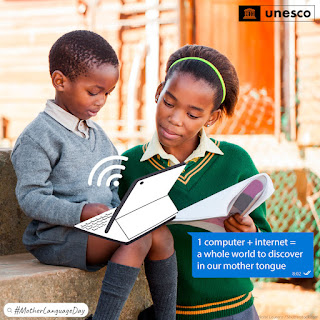
IMLD 2022: Using technology for multilingual learning

Source: IMLD2022 social media pack. (Yes, the laptop graphic is
superposed on the photo)

The theme of the 2022 edition of International Mother Language Day (21 February) is "Using technology for multilingual learning: Challenges and opportunities." According to UNESCO's homepage for IMLD 2022, the focus of this year's observation is "the potential role of technology to advance multilingual education and support the development of quality teaching and learning for all."

Having a long-time interest in languages, technology, and development (with learning fundamental in that nexus), I'm personally happy to see the highlighting of  multilingualism and technology in education.

At the same time, one is well aware that multilingualism is often not a relationship of equals. Some languages are "well-resourced" in terms of materials, support for use in information and communication technologies, policy agendae, and monetary budgets. Other languages, including the mother languages of Africa, tend not to have these benefits in the same measure or at all.

So while it is a positive step to have all languages be included in multilingual approaches - as opposed to being marginalized or excluded from education and public discourse - I see an implicit call in the theme of this year's IMLD for attention to strengthening the position of the "less-resourced" languages among them. It would be helpful to make that point explicit.

Sunday, February 21, 2021

IMLD 2021: What multilingualism means for inclusion

This year's International Mother Language Day (IMLD, 21 February 2021) has as its theme, "Fostering multilingualism for inclusion in education and society." Of the key terms in this expression, most need little if any explanation. But the meaning of one of them - inclusion - merits attention.

When we speak of - or speak - mother tongues and second (or additional) languages, as individuals, communities, and countries, that is "multilingualism." "Education" is often thought of as connected with schooling, but it also includes other modes of learning and sharing knowledge. These two concepts - multilingualism and education - along with specific attention to mother tongues, have been recurrent themes in IMLD observances over the years. And they are often discussed together - for example as "mother tongue based, multilingual education" (MTB/MLE).

"Society" seems impossibly broad, taking in pretty much everything we do. That's certainly appropriate in this context, as language and choice of languages are fundamental to our communication, interaction, and collective memory (not ignoring the tandem role of images and non-verbal.forms of communication). However I read a new and encouraging dimension to the mention of society in this year's IMLD theme: a link with sustainable development.

In an IMLD 2021 concept paper by the UNESCO Education Sector and the Organisation Internationale de la Francophonie, multilingualism is linked to the "Sustainable Development Goals’ focus on leaving no one behind" (which, by the way, actually has an acronym: LNOB). This IMLD concept paper also mentions the centrality of multilingualism for indigenous peoples' development - from which we can assume that where many languages are spoken, engaging constructively with that reality is fundamental for everyone's development.

Before coming to what I see as the key term in this year's IMLD theme - inclusion - note should be made of the action word at its beginning: "fostering." I hear this as calling out the importance of policies and planning, and the effective implementation of these. The issues of multilingualism need active attention from not only individuals, but also governments and organizations, without which we have words and no action (and in the end, no words either).

Whose inclusion?

"Inclusion" turns out to be a tricky concept. Although I accept that the intent of its use in the IMLD 2021 theme is positive - the notion that languages can facilitate education and full participation in society - this term can also carry some less positive meanings. Chief among these is the implication that there is an outside and an inside, and those inside define the terms for bringing the outsiders in. There's a potential inequality there that led one writer from a community development perspective to propose abandoning the word inclusion altogether.

In the context of schools, inclusion is often (at least in the West) used in the context of students with special educational needs (and within that setting, one writer identified eleven definitions!). This does not seem to be an appropriate analogue for promoting multiple languages in education.

In the context of language and languages in Africa, the question of inclusion seems to me to become more complex. Upon independence, most African states opted to keep the colonial languages as official, rather than promoting use of one or more among their indigenous languages. This in effect put various ethno-linguistic groups within their borders at the same disadvantage (no one "inside group" controlling power). However, it also gave those who were fluent in the official languages an advantage, which is maintained through a dynamic described by Prof. Carol Myers-Scotton as "elite closure" (in other words, an there's an inside group after all).

At the same time, as Prof. Ayo Bamgbose once observed, many states operated on the paradigm that "one language always unites and many languages always divide." So in effect inclusion or exclusion in education and society have been defined to a large degree (in linguistic terms) on the basis of use of the one official language.

It is possible to find "inclusion" on more shallow level, in a group or structure that does not fully value what one brings to it, or that requires higher sacrifice from some than of others. That's as true regarding mother languages as it is regarding other aspects of culture.

While acknowledging the utility of a common language (lingua franca), the fostering of multilingualism seems to me to have the potential to shift the basis for inclusion from something centrally controlled or defined by a limited group, to a dynamic with more entry points.

Friday, February 21, 2020

IMLD 2020: "Languages without borders"

The theme of this year's International Mother Language Day (IMLD2020; 21 February 2020) - "Languages without borders" - seems especially appropriate for Africa. So many (almost all?) African languages - or more accurately, populations having a common mother tongue - are divided by borders established during the colonial period (and prudently maintained in the interests of peace). And people on opposite sides of these borders continue to use their languages, which former Malian president Alpha Oumar Konaré once referred to as "sutures" linking neighboring African countries.

The African Academy of Languages (ACALAN), has had structures in place for some years to work on African "cross-border vehicular languages," which are larger in numbers of speakers and geographic extend of use. In her message on the occasion of IMLD2020, UNESCO Director-General Audrey Azoulay calls attention to all cross-border languages - all mother tongues that cross borders:
For IMLD 2020, UNESCO has chosen the theme of languages without borders to draw attention to the way in which all languages, including mother tongues, contribute to intercultural dialogue and peace. Indeed, throughout the world, numerous cross-border languages bring their speakers closer to one another, turning borders into bridges instead of barriers.

40% of people not educated in mother languages


In  her IMLD2020 message, Mme Azoulay also calls out another fact that is particularly relevant to Africa:
Moreover, mother tongues are valuable allies in our efforts to achieve quality education for all. In fact, as UNESCO studies have shown, studying in a language which is not one’s own interferes with learning and increases inequalities. Yet according to the most recent estimates, 40% of the world’s citizens find themselves in this situation. Bilingual or multilingual education based on students’ mother tongue not only encourages learning, but also contributes to understanding and dialogue among peoples.

As with all IMLDs, we hold out the hope that this observance may inspire more progress in use and development of the diverse languages that are productive and charished parts of our common human heritage.


Thursday, February 21, 2019

IMLD 2019 & IYIL 2019 in Africa

On this International Mother Language Day 2019 (IMLD 2019), which has as its theme "Indigenous languages matter for development, peace building and reconciliation," a question: What are "indigenous languages" in Africa?

The question arises also since we are over a month into the International Year of Indigenous Languages (IYIL 2019), an observation declared by the United Nations General Assembly in its 2016 resolution on the Rights of Indigenous Peoples. The purpose of the IYIL 2019 as stated in that resolution (under #13) is:

"to draw attention to the critical loss of indigenous languages and the urgent need to preserve, revitalize and promote indigenous languages and to take further urgent steps at the national and international levels"

I won't propose a definitive answer as to what counts as "indigenous language" as my understanding is that the themes of IMLD and IYIL are inclusive, but it seems to be an important issue to think about in the interests of encouraging wide participation in Africa.

With that in mind, it is worth noting that the South African Centre for Digital Language Resources (SADiLaR) calls for "Celebration of South African languages" in the context of IYIL 2019. Also of interest is that the January-February issue of the UNESCO Courier, themed "Indigenous Languages and Knowledge (IYIL 2019)," has an article on the Mbororo people of Chad, whose mother tongue is a variety of Fula (Fulfulde/Pulaar) - a language that originated in a region far to the west.

Some of the broader issues concerning indigenous languages of Africa I hope to come back to in a following article, but in the meantime wishing all a happy IMLD 2019!

Wednesday, February 21, 2018

International Mother Language Day 2018

This year's International Mother Language Day (IMLD), observed as always on February 21, is focusing on multilingualism and linguistic diversity, with mention of their importance for sustainable development and peace.

I would like to share the UNESCO director's message for IMLD, which makes some important points about why mother languages, linguistic diversity, and multilingualism are worth our attention in schooling, technology, and public life in general. With the mention of multilingualism, these points seem very relevant to the situations in African countries.

First, it important to remember that while UNESCO plays a central role in the annual observance of IMLD, having brought it to an international event from one originating in Bangladesh, IMLD is most importantly an occasion for local, national and regional communities around the world to celebrate the "unity in diversity" of human languages, beginning with those we first learn in families and communities. I hope it will be possible soon to compile some examples of IMLD events across Africa - or pass on the references if someone else takes that task on. 


Message from Ms Audrey Azoulay, Director-General of UNESCO, on the occasion of International Mother Language Day, 21 February 2018


Today, UNESCO marks the nineteenth International Mother Language Day. This is an opportunity to recall our Organization’s commitment to defending and promoting languages. 

A language is far more than a means of communication; it is the very condition of our humanity. Our values, our beliefs and our identity are embedded within it. It is through language that we transmit our experiences, our traditions and our knowledge. The diversity of languages reflects the incontestable wealth of our imaginations and ways of life. 

In order to preserve and vitalize this essential component of the intangible heritage of humanity, UNESCO has been actively engaged for many years in the defence of linguistic diversity and the promotion of multilingual education. 

This commitment concerns mother languages in particular, which shape millions of developing young minds, and are the indispensable vector for inclusion in the human community, first at the local level, then at the global level.

UNESCO thus supports language policies, particularly in multilingual countries, which promote mother languages and indigenous languages. It recommends the use of these languages from the first years of schooling, because children learn best in their mother language. It also encourages their use in public spaces and especially on the Internet, where multilingualism should become the rule. Everyone, regardless of their first language, should be able to access resources in cyberspace and build online communities of exchange and dialogue. Today, this is one of the major challenges of sustainable  development, at  the  heart of the United Nations 2030 Agenda.

Every two weeks, one of the world’s languages disappears, and with it goes part of our human history and cultural heritage. Promoting multilingualism also helps to stop this programmed extinction. 

In the wonderful words of Nelson Mandela, “If you talk to a man in a language he understands, that goes to his head. If you talk to him in his language, that goes to his heart”. On the occasion of this international day, UNESCO invites its Member States to celebrate, through a variety of educational and cultural initiatives, the linguistic diversity and multilingualism that make up the living wealth of our world.

Tuesday, February 21, 2017

IMLD 2017 & the Linguapax Prize

The theme of this year's International Mother Language Day (IMLD) celebration is again related to the importance of languages in education: "Towards Sustainable Futures through Multilingual Education." (See also the posting on this blog about IMLD 2016.)

Held annually on February 21, this is the 18th IMLD observance. IMLD is coordinated on the international level by UNESCO, but countries, communities, and associations organize local observances around the world. There have also been initiatives online, such as the Rising Voices "Mother Language Meme Challenge."

In a letter marking IMLD 2017, the African Academy of Languages is requesting information about local observances and initiatives in Africa after they are held.

Linguapax Prize


The Linguapax Institute announces the winner of the Linguapax Prize annually on IMLD. This year's award went to Dr. Matthias Brenzinger, who is described on the Linguapax site as:
A linguist of German origin, expert in African languages, pioneer in the study of endangered languages and linguistic revitalisation who stands out both for his theoretical contributions and his commitment to the field. He is an activist and promotes the training of linguists among the speakers of endangered languages. ...
Dr. Brenzinger is currently a professor at the University of Capetown, and has there founded the Centre for African Linguistic Diversity (CALDi) and The African Language Archive (TALA). The African languages he has worked on include (certainly an incomplete list): Borana, Khwe, Nǀuu, and non-Bantu click languages in general. For more information see his bio on LinguistList and his article "African language studies on the African continent."

Sunday, February 21, 2016

IMLD 2016 & education in Africa

The theme of today's observance of International Mother Language Day (IMLD) - "Quality education, language(s) of instruction, and learning outcomes" - seems to speak specifically to multilingual societies such as most of those in Africa. Indeed UNESCO's poster for IMLD 2016 (here and at right) highlights examples from Burkina Faso, Ethiopia, and Mali.

This year's theme connects with Sustainable Development Goal 4 ("Ensure inclusive and equitable quality education and promote lifelong learning opportunities for all") of the 2030 Agenda for Sustainable Development, and with UNESCO's Education 2030 Framework for Action.

Language and understanding


The main issue is the importance of schooling in first languages especially in early grades, which research shows leads to better educational outcomes. The poster and other publicity quote a report that as many as 40% of school children receive instruction in languages they do not understand.

Forty percent is an astounding figure. Even something say half that would indicate serious shortcomings in long-term efforts to promote "education for all."

The natural response to call for education that children can understand, however, highlights other questions: why policies have not done better, how to deal with multilingual classrooms (where there are several mother languages), where to get resources for materials and teacher training etc.

But the first step is to recognition of the issues, which the IMLD theme will hopefully help to promote.

The case of Zambia


One of many possible cases is the country of Zambia.

A recent brief on girls' education, literacy and numeracy by the Adolescent Girls Empowerment Program (AGEP) found:
Overall levels of literacy are quite low, with less than a third of younger girls and about half of older girls being able to read.
  •  When looking at literacy levels by number of years of schooling attained, it appears that only in secondary school do girls starting developing meaningful literacy skills.
  •  Math skills are also low. Out of a maximum of 10 possible correct answers meant to be completed by those with four years of schooling, not even those with secondary school could complete more than 75% Results are similar for girls in both urban and rural areas.
Surprisingly, however, MOI (language) does not come up as being a possible contributing factor to such low results. (No comparison with boys' levels.)

Of course girls' education presents some challenges that go beyond curriculum - hence a project like AGEP. But even out of school, might the MOI be an issue to the extent that language could limit mothers' involvement in their daughters' education?

More broadly, shortcomings of English-only instruction in Zambia have been noted for all students. In 2005, for example, the Basic Education Teachers Union of Zambia called for science to be taught in local languages, but framed that mainly as a need in rural schools. A 2014 paper by Rebekah Gordon notes recognition of low reading levels in Zambia, as well as efforts at reform over the years (the paper also has some historical background).

Language - MOI - is clearly a factor in the quality of education and the learning outcomes in a multilingual country like Zambia, but finding the ways to make that right is not always as straightforward a matter as it might seem.

Sunday, October 18, 2015

International Mother Language Day 2015 in Africa

Poster for IMLD 2015
Yes, the 16th annual International Mother Language Day was observed several months ago (21 February), but it's still worth highlighting a few of the IMLD 2015 events and articles in Africa. In the absence (as far as I've seen) of any comprehensive summary of IMLD activities on the continent, perhaps this can serve as a small way of facilitating exchange of information about the different kinds of activities that governments, NGOs, and universities have organized. (It's only 4 months until the next observance, by the way.)

The below list is only a selection, and not in any way comprehensive. A note about this posting is included at the end.

Angola:


"Culture Minister Calls Angolans for Natural Coexistence of Mother Tongues" (the Culture Minister, Rosa Cruz e Silva, called attention to the plurilingual nature of Angolan society. Theme of IMLD there was "United in the linguistic and cultural diversity in Angola, let's valorize our integrity")


Benin:


"16ème journée internationale de la langue maternelle : Pour une éducation inclusive à travers et par la langue" (summary of observance in Kétou commune, which featured several government officials including the minister of culture, as well as the Nigerian ambassador)


Cameroon:

"La Journée Internationale de la Langue Maternelle - Le 21 février 2015" (Ceremony at the Ministère de l’Éducation de Base in Yaoundé, including young students who were taking part in experimental bilingual classes of a project of ELAN-Afrique)


Congo (DRC):

"Le ministre de la Culture et des Arts Banza Mulakaly s’investit dans la promotion des langues maternelles" (the minister of Culture and Arts spoke at a ceremony organized by the Observatoire des langues)

From "International Mother Language Day 2015 Celebrations" compilation  (Shalom University of Bunia planned two half-day conferences with activities including presentations from eleven researchers involved with the region’s languages and speeches from academics and public officials about the value of the mother tongue.)

Ghana: 


"Ghana joins the world to celebrate International Mother Language Day" (observance at University of Education, Winneba, Ajumako Campus, featuring a talk by Dr. Avea Ephraim Nosh; alternate link here)

"EDUCATION: UEW students mark Int’l Mother Language Day" [website now offline] (another story on the above event, mentioning contributions to the discussion by Dr. Paul Opoku-Mensah, Prof. Samuel Asiedu Addo, and Mr. Samuel Donkoh)

"Radio broadcast in Akan, by Peter Essien" (calls for the same amount of attention to using Akan correctly on the air as is given to using English correctly)

"How Bible saved 8 Ghanaian languages" (highlights discussion by Rev. Erasmus Odonkor that translations of the Bible have played a key role in maintaining vitality of and literacy in several Ghanaian languages)

"Government urged to revive minority languages" (very brief item on observance in Accra in which experts called for language policy to promote mother tongue education for minority languages)

Kenya:

"International Mother Language Day: How well do you know your mother tongue?" (TV feature on IMLD including visit to classroom and interviews with people in the street)

"UoN Hosts International Mother Language Day" (a 2-day event hosted by University of Nairobi and co-organized by the Dept. of Linguistics and Languages, UNESCO, and an organization called Bible Translation and Literacy)

Madagascar:

"Tenin-dreny - La langue maternelle importe pour l'éducation" (highlights role of first lady Voahangy Rajaonarimampianina, the ministers of l'Artisanat, de la Culture et du Patrimoine [Brigitte Rasamoelina] and of Communication [Vonison Andrianjato] in the observance, which included, the awarding of the "Fantaro" prize; mention also of other events) 

Mali:


"Langues maternelles : UN LEVIER PRIVILEGIE POUR L’INTEGRATION SOCIALE" (Observance in Ouelessebougou, organized by l'Académie malienne des langues [AMALAN] and presided over by minister of education Kénékouo "Barthélemy" Togo)

Namibia:


"Chinamibia celebrates International Mother Language day" (Children of Namibia - ChiNamibia - and the Franco-Namibian Cultural Centre held an event including dance, drama, music, and poetry that was intended to highlight the importance of mother tongues)

Nigeria:


"NICO Supports International Mother Language Day Celebration 2015" (article on the National Institute for Cultural Orientation site about planning for a later observance of IMLD)

"Nwaozor - The Significance of Mother Tongue" (newspaper op-ed on IMLD in which the author discusses the importance of first languages and makes some policy recommendations)

Seychelles:


"International Mother Language Day – Discovering poetry in Seychelles" (Seychelles Writers’ Association, known locally as " Lardwaz" held a short ceremony on IMLD, in which they revealed their proposed calendar for 2015)


Somalia:


"International Mother Language Day marked in Mogadishu" (the president of Djibouti and government representatives from Ethiopia and Kenya joined the observance in Mogadishu; article also mentions laying the cornerstone of the Somali Language Academy, about which more here)

South Africa:

"Deputy Minister Rejoice Mabudafhasi observes International Mother Language Day, 21 Feb" (scheduled meeting with "future language practitioners" at University of Limpopo, Turf loop Campus, in Mankweng, Limpopo Province)

Tanzania:

"International Mother Language Day 2015" (blog posting by a Welsh person working in Tanzania, making connection between most children not speaking at home a language other than the Swahili used in school, and their lower scores in Standard 3 exams than native Swahili speakers)

Uganda:

From "International Mother Language Day 2015 Celebrations" compilation (Literacy and Adult Basic Education [LABE], a local NGO, planned language activities including reading and storytelling competitions in 6 post-conflict districts of northern Uganda)

Zimbabwe:

"Celebrate International Mother Language Day" (about preparations for celebrating IMLD by the San people in Tsholotsho)

Notes about this post & holding reserve posts


I actually started this post just after IMLD in February, but put it aside to focus on some other items. I added to it on a couple of occasions, and ultimately decided it was time to finish and publish.

As such this is a special case in an aspect of blogging I discovered over the years - having a number of drafts in the cooker, as it were. Some of those eventually I return to and complete more or less as planned, some change, and for others, the material in the draft might get repurposed. In this case, there was an obvious time limit on material related to an annual event (yours to decide if it already passed a more functional limit of utility). It turned out as intended, except that there was a second section to the original draft of this post that ultimately was not necessary, but that I may use later.

Friday, February 21, 2014

Language, Peace and Security

On this International Mother Language Day, the US Institute of Peace, the Alliance for Peacebuilding, the Center for Applied Linguistics, and SIL International have organized a "Symposium on Language, Peace and Security" at the USIP in Washington, DC. It is being webcast on the event page (in break as I write and post this).

A Twitter hashtag is being used for some live tweets: #langpeacesec. In one tweet, @USIP indicated that the proceedings will be made available online about a week after the symposium.

Description (excerpts from event page):
The role of language—both as a means of communication and as an expression of identity – is a vital consideration for any serious discussion of peace and security. The Symposium on Language, Peace, and Security, which marks UNESCO’s International Mother Language Day, will:
  • Look at the overlooked linguistic and educational dimensions of a simmering conflict pitting Pattani Malay-speaking Muslims against the government of Thailand.
  • Address the importance of ensuring linguistic human rights through educational policies and practices that value and promote linguistic diversity.
  • Consider language policy in education and how it may serve to exacerbate or mitigate violence.
Can careful consideration of language and communications in discussions of peace and security lead to real solutions to conflicts? How do issues of language, language complexity, and communication play out in peace-building efforts and ongoing security? How can language issues be identified and addressed effectively in policy planning and execution?
...

Keynote Presenters:

Patricia Friedrich
Associate Professor of Linguistics/Rhetoric and Composition
Arizona State University
Suwilai Presrirat
Professor of Linguistics and Founder of the Research Institute for Languages and Cultures of Asia
Mahidol University, Thailand
Terrence Wiley
President
Center for Applied Linguistics
Zeena Zakharia
Assistant Professor of International and Comparative Education
University of Massachusetts, Boston
George A. Lopez, Keynote Discussant
Vice President of the Academy for International Conflict Management and Peacebuilding
U.S. Institute of Peace
Peter Weinberger, Moderator
Senior Program Officer
United States Institute of Peace
Perspectives from the Grassroots
Community-based practitioners reflect on the relevance of language to peace and security.
Joel Trudell, SIL International; Unian Samoh, Mahidol University; Cecilia Ochoa, Save the Children; Micael Olsson, World Vision
Personal perspectives

The symposium topic and presentations helpful in expanding discussion of the importance of language(s) in planning and development-related work.

For some time I have discussed links among language, development, and information and communications technology. My work in support of localization and interest in applications of human language technologies address the language - technology connection. The connection between language and development, as others have observed, still needs more work. The connection between language on the one hand and peace and security on the other is an important complement to the latter.

Having in recent years worked more in relation to peace and security, I appreciated the opportunity to hear from others making the connections between those concerns and language planning.

Language is never the cause of conflict (as some scholars have pointed out in the past), but in some cases it might be a focus in conflict. Moreover, as several presenters showed, attention to first languages may be important in alleviating factors (such as social exclusion) that may lead to conflict.

Various interesting lessons and case studies in the symposium, with two presentations that explored the particular issues and approaches in southern Thailand. Some useful concepts included: "peace linguistics" (Dr. Friedrich); and "equity in learning" (Ms. Ochoa).

Wednesday, November 13, 2013

Looking back and looking forward

For those who have read this blog before, it would come as no surprise that there has been a hiatus in posting followed by another post like this, breaking the silence. So with this I'd like to catch up and look ahead.

I last posted over three years ago, just before the International Mother Language Day 2010 - something I've paid attention to over the years. IMLD is also the occasion on which the winner of the Linguapax Award is given in recognition of "actions carried out in different areas in favour of the preservation of linguistic diversity, revitalization and reactivation of linguistic communities and the promotion of multilingualism." In 2013, Africa had another awardee, the Mauritian organization Ledikasyon pu Travayer (education for workers in Morisyen, the French-based Indian Ocean islands creole language of Mauritius).

However, last year, the first two (very distinguished) African recipients of the Linguapax Prize passed away - Neville Alexander of South Africa (Linguapax Award 2008) in July 2012, and Maurice Tadadjeu of Cameroon (Linguapax Award 2005) a few months later in December.

When I last posted on this blog in early 2010, Niger was in a muddle, politically speaking, and Mali was apparently a model; now Niger seems stable and Mali is recovering from a terrible year. I do not plan to spend too much time in this blog on issues relating to governments and conflict, though in some cases such issues will be hard to ignore. However the focus will continue to be on African languages and the "information society," along with related aspects of development and education.

2010

During most of the rest of 2010 I was based in Djibouti, and had the opportunity to follow up on and observe some US military civil affairs projects in northern Uganda and eastern Ethiopia. From the point of view of African languages, what was particularly interesting was to note aspects of training of community animal health workers in Oromo language (''Oromiffa'') in the Harari region of Ethiopia, and in Karamojong (''ŋaKaramojoŋ'') in Moroto, Uganda (my third trip to that country). While English was also used in both cases, the first languages of the trainees (Oromo and Karamojong) were central to learning. (I compiled a list of veterinary and animal terms in Karamojong, cross-checked with several references.)

2011

From late 2010 was back in the US with family again, and focused on different work and home priorities. In 2011 there were two conferences of note that had particular importance for applied work with African languages:
  • Conference on Human Language Technology for Development (HLTD 2011), Alexandria, Egypt, 2-5 May 2011. This was organized by PAN Localisation and ANLoc, with support from IDRC and was hosted by the Bibliotheca Alexandrina. In a sense, this consideration of human language technologies (HLTs; understood to include a range of applications for manipulating and transforming languages) for development is the logical extension of efforts to localize software and internet content. It will be a key area to follow in coming years.
  • Action for Global Information Sharing 2011 (AGIS11), Addis Ababa, Ethiopia, 1-2 December 2011. This was co-sponsored by the Localisation Research Centre and UNECA, along with others. Although technically not the first time for meeting of African language localizers with members of the localization industry, as a smaller scale meeting happened at the 2005 LISA Cairo conference almost exactly 6 years earlier), this was evidently much more significant in scale.
2012

One noted with great interest the efforts of Translators Without Borders (TWB) in early 2012, which included a translation center in Kenya.

In July, I personally had the opportunity to participate in Wikimania 2012 in Washington, DC, including the Tech@State event on "Wiki.gov." On the Wikimania proper side of things, there was a renewal of discussion concerning African language Wikipedias, including some discussion of potential links with a medical translations project (which not surprisingly has connections with TWB).

2013

In 2013 I've been working in Asia for the first time in half a decade, this time in Afghanistan, coordinating survey research. This has obvious multilingual dimensions here, many of which are relevant to multilingual societies elsewhere in Asia and Africa. An aspect I've been particularly interested in exploring is "cross-language qualitative data analysis," which surprisingly (or maybe not so surprisingly, given how language is often a secondary consideration in other areas of endeavor, even when an obvious factor) has only relatively recently gotten serious attention.

Although I have limited time for it, have begun working again with the material from the Fulfulde Lexicon (1993). This entailed converting old files in WordPerfect 5.1 format (not as hard as it might seem, but not straightforward). A major part of the object is to prepare to integrate the material in Kamusi's online platform.

So with that brief retrospective, I'd like to resume but with a slightly different approach here on out - ideally shorter and more frequent posts, pivoting off of items of interest from diverse sources ...

Saturday, February 21, 2009

What did the International Year of Languages mean for Africa?

With the formal conclusion of the International Year of Languages (IYL) on International Mother Language Day, I'd like to take a moment to ask: What did the IYL mean for Africa?

With any such observances, any analysis right afterward will of course not be able to take account of long-term or latent effects (e.g., people or organizations whose awareness was raised and whose later action is somehow affected). Nevertheless it's worth at least looking at what has been done.

A glance at the calendar of events in and outside of Africa shows a diversity of observance (this list is far from comprehensive, so pointers to other events and more information are invited):

In addition there has been mention of the IYL in various press articles in different countries. A few have been linked on the AfricanLanguages list (try searching "International Year"). Special mention should be made of a blog posting and video entitled "Orphan's Lullaby" by South African author Alex Smith to mark the close of the IYL (note the various translations in text).

The IYL also marked the beginning of the African Network for Localisation (ANLoc), a 3-year project which succeeded the PanAfrican Localisation project. These are part of a program of the International Development Research Centre (IDRC) of Canada to support development of ICT in African languages.

African locales

Speaking of ANLoc, one of its subprojects that is working on compiling locales for African languages. A press release timed just before IMLD and the end of IYL appeals for help in this effort:

Thu, 19/02/2009 - 11:00
PRESS RELEASE: FOR IMMEDIATE RELEASE

Pan-African researchers unlock computers for African languages on Mother Language Day

In celebration of International Mother Language Day, a Pan African Network of computer and language experts is ensuring that computers are unlocked for mother tongue speakers.

ANLoc, The African Network for Localisation (pronounced Unlock), is a Pan-African network undertaking a number of projects to help eliminate technological barriers that prevent computers from being used by mother tongue speakers.

International Mother Language Day is hosted on 21 February each year by UNESCO and aims at raising awareness of mother tongue usage.

To celebrate International Mother Tongue Day the ANLoc locales sub-project is undertaking a special community driven push to enable African language technology. The locales sub-project is focused on creating 100 new African locales. A locale is a set of data that guides a computer to adapt to the local language and country. Locales contain information that instructs a computer on how to write essential basic information, such as the days of the week and month names in a given language, and how to write the monetary values for a given country. Once locale data is in place, Africans often enjoy a first class computer experience for the very first time. Locales impact how well a computer's spell checker works, finding and indexing of African language documents and searching using tools like Google.

The ANLoc Network is encouraging African language speakers in African and the diaspora to celebrate International Mother Language Day by helping to develop a locale for their language. Those wanting to contribute can visit http://o2.it46.se/afrigen to find out more about the importance and need for locales and how to contribute one for their language.

Information about the ANLoc Network and the various projects being undertaken to eliminate technological barriers for African language in the digital age can be found here at http://africanLocalisation.net.

Wednesday, February 27, 2008

What's up with the Bureau of Ghana Languages?

In the previous entry, I inserted a quote (from an article about International Mother Language Day in Ghana) about books being locked up in the warehouses of the Bureau of Ghana Languages (BGL). Actually the point of that was that the supply is there, but that somehow the demand is not connecting with it - so the books remain, presumably, boxed and stacked, in storage.

Another article from Ghana on IMLD (Accra Daily Mail, "Any hope for local Ghanaian languages ... As thousands of others worldwide face extinction?" 26 Feb 08) mentions the BGL in a way that raises another issue:

The Bureau of Ghana Languages is poorly resourced and exists all but in name. The sorry and dying state of the Bureau is a reflection of where Ghana's local languages are heading.

So, what's happening? BGL is producing materials that are evidently not flying off the shelves, and it is apparently underfunded and giving the impression - at least to the author of one article - of being moribund. I'm curious to hear any more about the situation.

At the same time I recently looked again at the website of another institution in Ghana, the Ghana-India Kofi Annan Centre of Excellence in ICT / Advanced Information Technology Institute. It has international attention and partnerships, adequate funding, and an apparent dynamism.
I presume that's a reflection, at least in part, of Ghanaian government and foreign donor priorities. BGL may not be able to command the same attention, but what about some sort of partnerships? KACE/AITI is apparently looking at some localization, and BGL presumably has the language expertise. BGL might do well to expand its perspectives beyond traditional printing, and KACE/AITI has expertise in ICT - the direction in which content development in all languages is going.

Anyway these are some questions and thoughts. Institutions and agencies like BGL in various African countries often struggle with little in the way of funding, technology, official support, and connection with their ultimate consumers / audience. It's probably time to look systematically at what their status is and ways to support their growth and success.

Thursday, February 21, 2008

International Mother Language Day


Today is the ninth annual observance of International Mother Language Day (IMLD) and the date of formal launching of the International Year of Languages (IYL). (See also my previous posting about the IYL on 31 Jan.)

A few mentions of IMLD in the African press:

  • In Gambia, the Banjul paper Daily Observer had an article entitled "2008 - the Year Ahead in Education." Dated on 16 January, it mentioned both IMLD and the IYL.
  • In South Africa, the African National Congress newsletter ANC Today (Vol. 8, No. 6 • 15-21 Feb. 2008) featured a letter from its president, Jacob G. Zuma entitled "Our Languages Matter!" (it can also be read here). He uses the occasion of IMLD & the launch of the IYL to highlight the importance of all the country's languages and ways in which their use should be supported.
  • In Ghana, the Daily Graphic of 20 Feb. 2008 included a feature article entitled "International Mother Tongue Day" (from the ModernGhana.com site; it can also be read here). It is a very interesting discussion of issues relating to use of Ghanaian languages, such as popular attitudes, policy, and education.

Saturday, February 21, 2004

Today is International Mother Language Day, an observance established by the UN in 1999. Apparently there will be some ceremonies chez UNESCO on Monday 2/23. More info at www.unesco.org/education/IMLD2004. En français à www.unesco.org/education/IMLD2004/fr/.

In the panorama of holidays, anniversaries, and observances it may seem quite minor, but it is one of the only events calling attention to 1) language loss and 2) the too often overlooked (esp. in Africa) importance of first languages in education.

A couple of brief articles give more info: UNESCO urges teaching from earliest age in indigenous mother languages and UN's Mother Language Day Focuses On Conserving World's Linguistic Heritage.

There is no observance that I'm aware of in Niamey. A colleague I mentioned this to a while back asked, but there was nothing. And no time to generate something. Unfortunately the advance support from UNESCO for this seems to be minimal - they pull things together nicely in time (webpage, ceremonies), but for advance planning there is little. I did get a nice letter in response to inquiries offering to send materials, but it was too close to the event to allow for mail to arrive.

Problème avec l'affichage du français ici! Sur un autre ordinateur que j'utilise d'habitude pour regarder ce blog j'ai remarqué que les caractères accentés sont transformés en autres choses... Cela arrive je crois parceque ce page est en UTF-8, et selon la configuration du browser, les entités indiqués par caractères accentés veut transmettre d'autres informations que celles qu'on a esperé. A faami?? Franchement, je ne sais même pas si moi je comprends complètement. Une solution est de mettre, par exemple, & e a c u t e ; (sans les espace intercalés) pour e accent aigu dans le texte (html) du "post" etc. - mais c'est gênant. Donc je chercherai une autre solution...

Enfin, a couple of things written to someone re an interesting survey of cybercafés in Nairobi. It seemed to me that the question re language was missing. In fact language of content and access seems to be given little energy by people promoting ICT. Here are excerpts from my two letters; I omit the nice brief reply (basically saying no) to the first letter that I received this morning:

(Thursday, November 20, 2003 6:51 AM)

Greetings! I saw the item on your Nairobi cybercafé survey in Balancing Act's News Update #183 and found it very interesting. Indeed, this is a topic deserving more research and I hope your effort encourages same.

In looking at the News Update piece and the summary at http://www.ccoak.net/cyber_survey.html I did not notice mention of any questions in what I think is an area of central interest, that of language. Maybe this subject was discussed in the full report, but I had trouble downloading it.

Some questions I would look for would include the languages people use in e-mail and websurfing (not sure how many sites in Kenya have Swahili, for instance, though there are a number in Tanzania of course) and whether users have any preferences in this regard that are not currently met with regard to content language (i.e., would they like to see more content in Kenyan languages). The latter question would seem to fit with the overall theme of the report that users sought more local content: does the language of the local content matter, to whom, in what ways, and to what extent?

This all would bridge to another set of questions re computer interfaces: although Swahili for example uses the ASCII character set, I understand that Gikuyu has some diacritic characters (see http://www.bisharat.net/A12N/KENYA-table.htm ) and that this may pose an inconvenience to people who might want to use this in, say, e-mail (see for example http://groups.yahoo.com/group/AfricanLanguages/message/73 ). Have cybercafés dealt with this question or even thought about it?

Thanks in advance for any feedback and all the best!


(Saturday, February 21, 2004 10:51 AM)

. . . Re language I think it's always important and the interest is definitely real. Three things tend to submerge the issue in various agendas/discourses (including those relating to ICT):

1) In my mainly West African experience, there are things close to the heart that people don't make a big thing of overtly.
2) Many Africans have more or less bought into the line that their languages are "tribal dialects" or in any event unsuited for science, technology, and learning. This has been reinforced by the formal education systems which at best assign a secondary role to indigenous languages and in too many cases (esp. in former French colonies)
3) Many Westerners tend to assume away African languages, even though their intent be benign, since they generally don't understand them, and the Africans they interact with the most tend to be able to get by in English or French.

ICT adds another dimension to this. The association of English (or French) with technology, opportunity, and the exciting world elsewhere is understandable, but there could and arguably should be the opportunity for some balance. Nobody is suggesting that Africans have to use their languages on computers and the internet, but the current approaches in many ways tell them that they can't - or shouldn't be so foolish as to think of it.

The latter may seem gratuitous, but I've been dumbfounded by some things I've heard occasionally mainly from Westerners working in development here - why would someone want to use something other than French if they can understand that? ; we're a decade and a half away from any localization for African languages ; the plurality of African languages (and the inability to initiate use in all of them) makes it better to stay with English or French...

Coming back to your cybercafé survey, language is worth the question(s). Especially in the case of Swahili, which of course is an important regional language that is even being considered as a medium for instruction in higher education. But even in the case of Kenya for other maternal languages - there has been some significant publication in Gikuyu, for instance, so why not use it on the internet, or why shouldn't speakers of that tongue be interested in seeing some web content in it? The main thing is that behind the apparent "lack of excitement" on the topic there may be, and likely is, a range of opinion and interest. It would be interesting to know what this is currently and also to follow its evolution, if you are planning to continue the study.

. . .


Last item for this entry - I had joked about agricultural linguistics with a couple of our trainees not long ago. It's not as far out a juxtaposition as it might seem: I just ran across the term environmental linguistics looking for something else yesterday. That has a couple of senses it seems - depending on whether it's the built environment or the natural one - a distinction that means more perhaps to us with ag. & NRM backgrounds than to linguists. The latter sense seems along the lines of the operating premises of the NGO Terralingua. I still think that there's a fertile area for research and practice on language and development in Africa, and linguistics needs to be brought into the mix more vigorously.