Showing posts with label first language. Show all posts

Wednesday, October 11, 2017

One's campaign for girls' education, & mother tongue-based teaching

Photo from One's girls' education petition webpage
Today is the International Day of the Girl Child, and the NGO One is using the occasion to highlight the fact that 130 million girls are not in school and promote a petition campaign to urge funding by world leaders.

This is an important issue and a laudable effort. It is also an issue that exists alongside the lack of instruction in first languages - and arguably efforts to increase the number of girls in school could work well in tandem with efforts to expand mother tongue based (and multilingual) education. One's campaign seems to miss this dimension.

Medium of instruction important for girls' education


In many countries in Africa school instruction is only in a Europhone official language (from day 1, or from early in primary school). This poses difficulties for all students, and also introduces a linguistic divide between daughters and mothers, who more often than fathers tend not to have facility in the school language.

A pair of UNESCO documents in 2005 for example spotlighted connections between girls education and first language instruction: "the learner's mother tongue holds the key to making schooling more inclusive for all disadvantaged groups, especially for girls and women." These are:

The toughest places


One also has produced a report "The Toughest Places for a Girl to Get an Education" which found that 9 of the 10 most difficult countries were in Africa (starting with the most difficult): South Sudan; Central African Republic; Niger; Afghanistan; Chad; Mali; Guinea; Burkina Faso; Liberia; and Ethiopia. This report, however, also does not mention language of instruction.

Education is one of the sectors in multilingual Africa in which the linguistic dimension of policy and action has been relatively well discussed - even if the quality of debate and policy results may vary. The question of language(s) of instruction is certainly also related to the issue of getting and keeping more girls in school, and it deserves explicit attention from outside organizations seeking to increase that number.

Thursday, May 07, 2015

How many people speak what in Africa?

More on language maps with focus on Africa. This picks up a discussion begun in an earlier post, "Second most spoken languages in Africa."

One of the reactions (by several people on Twitter) to a set of maps and diagrams of the most spoken languages in the world published in the Washington Post's April 23 feature "The world’s languages, in 7 maps and charts"- in particular the diagram at right - was a question as to why Swahili was not included. After all, estimates of speakers of Swahili run as high as over 150 million.

African languages do tend to get overlooked in various contexts, but in this case it seems that the criteria used - "native language" - was the deciding factor. Swahili is widely used as a second or additional language (L2 being the common abbreviation) but relatively fewer people speak it as a first or native language (L1) - somewhere in the range of 15-50 million (more on such estimates below). This is not enough to make this chart, which deals only with L1s. The number of L1+L2 speakers of Swahili is in the 60-150 million range.

The map/diagram at right was posted on Twitter as a reference in the above discussion. (Thanks to Prof. Calestous Juma of Harvard University for calling our attention to it.) This comes from an article entitled "International Mother Language Day 2014" on the elearning-africa.com site. However the figures given for "six of the most widely-spoken languages" clearly have to do not just with maternal language (L1) speakers, but also with L2 speakers.

To elearning-africa.com's credit, the article notes the complexities involved in citing figures for African languages, including the L1 and L2 issue:

"[I]t is of course extremely difficult to count numbers of language speakers, especially when the data is vague. Should only first-language speakers be counted? But then, what about Kiswahili and Hausa, which have fewer native speakers but are used across wide geographical areas as trade languages? It is important to remember that any depiction of African languages, other than the most exhaustive study, will be a compromise at best."

The closest we have to an exhaustive study of numbers of African language speakers continentwide would be the figures compiled by Ethnolgue, though these are themselves often estimates and works in progress. Still, one could work with such figures - as well as other research on language use in specific parts of Africa - to outline the top most spoken languages at different geographic scales - continental, sub-regions, countries, and provincial. These could in turn be presented in map layers. The utility of such data would be in better informing development/extension projects and relief efforts (such as that against ebola recently in West Africa) in which communication, participation, and education are fundamental..

Source: Michigan State University African Studies Center, "Exploring Africa" (modified)
In the meantime, a diagram like the one at right, which doesn't offer any numbers but picks some of the most spoken African languages by country, represents a useful compromise on a macro level. This particular example, needs updating and revision. Some issues (and a few changes) include:
  • Updating to reflect the split of Sudan and South Sudan
  • In some cases the languages appear to be listed in order of number of speakers, but in others not - it would help to do the former consistently.
  • I corrected one of the language names for Guinea - "Futa Jalon" is not a language, but a region where Pular, a variety of Fula, is spoken. 
  • Also about Fula, the listing of "Fulfulde" and "Pulaar Fulfulde" from Mauritania through Guinea Bissau needs review/revision.
  • For Ghana, Fante and Asante-Twi could be consolidated to Akan, and one of the northern languages could be listed.
  • I removed "Hima" as a language of Rwanda and Burundi. It's a name (or dialect) of Nkore, which although related to Kinyarwanda/Kirundi, is a language of Uganda. In Rwanda and Burundi, Ethnologue considers it "an ethnic group (not a language) which speaks Rwanda or Rundi."
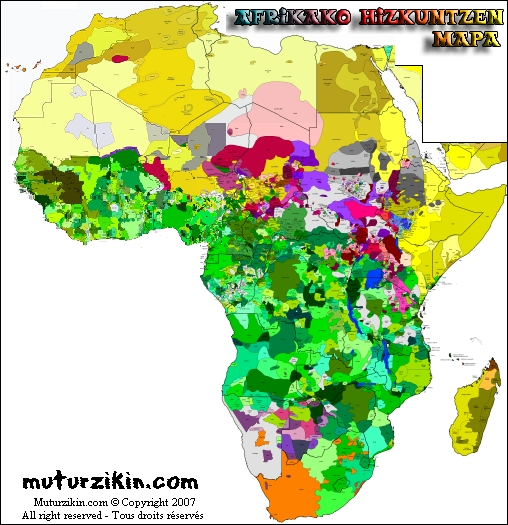
On the other end of the spectrum - that of "granularity" of linguistic data - there is a set of detailed maps of "Distribution of African Languages" on muturzikin.com (an image of these together as presented on their site is on the right). In some ways this impressive work addresses the need for more accurate maps, although it has no indications of level of use (per numbers of speakers). Also, since in multilingual Africa, language use overlaps and rarely if ever respects borders or boundaries, it would be useful to see some kind of layering feature, as well as the ability to zoom out and drop some detail in favor of aggregated data on more widely spoken languages.

The latter maps of course focus only on African languages, and without reference to the Europhone languages used in many countries in official capacity and/or as lingua francas (L2s). Another adaptation, therefore, could be on the continental level, to list the top most spoken languages (L1+L2) per country, including all tongues.

This would bring us back to the map of "second most spoken languages" in Africa proposed by Olivet Nazarene University. A more detailed look at that effort will be the subject of the next posting.

Wednesday, November 26, 2014

Keeping African languages out of African schools?

Humiliation of Ugandan students who speak their mother tongue in school, and Malawi's recent decision to move to an English-only instruction policy, reflect the continued low status of African languages in African education. In much of Africa, the first languages of students are formally excluded from African schools by national policies, and/or accorded low or even negative value in school culture. In the extreme, this situation can be seen in terms of denial of human rights (per work by Tove Skutnabb-Kangas), but in any event seems to run contrary to ample research on the benefits of  learning in the mother tongue and of bilingual education.

"Why are schools punishing children for speaking African languages?"


Punishment for speaking Luganda at school.
Image from Facebook via ThisisAfrica.me.
A recent article by writer and lawyer Bwesigye bwa Mwesigire called attention to ongoing practices in some Ugandan schools of humiliating students who speak African languages. A particular example is requiring students caught speaking a language other than English to wear a sack, until they catch one of their peers transgressing the English-only rule, who will then have to wear the sack.

This is not a new linguistic human rights issue, nor a practice limited to one country. It extends back to colonial rule, though enforcement of "no vernacular" has evidently moved from corporal punishment by teachers to humiliation and enforcement by students. I previously mentioned this in a 2008 blog posting entitled "Burning textbooks, beating schoolchildren."

New "English-only" policy in Malawi


In a decision made last March by then Malawian Minister of Education, Lucious Kanyumba, changed Malawi's longstanding bilingual education policy to one where students will be taught in English only from day one of their schooling. The stated object of the change, which is now implemented, was to improve English language levels of students.

Previous language of instruction policy (per a 2000 paper by Henri G. Chilora) had all students learning in the national language Chichewa for the first four grades, and then shifting to English. However this policy, adopted in 1968, had the effect of eliminating other Malawian languages from schools (see Chilora's paper, and one by Misheck Dickson Issa and Shoko Yamada on perceptions of language of instruction policy).

The decision to move to English-only has been controversial, with arguments against it citing advantages of MTB/MLE, lack of teachers prepared to instruct in English, and questions about equating good English with good education. It elicited an early protest from students of Chancellor College. A good summary of the debate - which begins by acknowledging the students' action - is provided by Steve Sharra (a later version of this article was highlighted by Ndesanjo Macha in his blog).

A study by Helen Abadzi, Radhika Iyengar, Alia Karim and Florie Chagwira of Columbia University's Center on Globalization and Sustainable Development found that even if the goal of education was good English, it would make sense to begin teaching reading in children's first languages (which happen to be written with orthographies where letters have more consistent values than in English).

Language of instruction policy in Malawi has moved away from use of its children's first languages in stages - first using only Chichewa (national language, first language of a majority, and also a second language for some number) in the name of national unity, and now to only English (official language, first language of almost no one, and a second language for some number) in the name of better job opportunities.

Language of Instruction (LoI) in Uganda and Malawi


In the process of researching this blog post, I came across an article (actually a book chapter) that examines and compares language in education policies in the two countries mentioned above: Ismail S. Gyagenda and Wardah M. Rajab-gyagenda, "Examining Ugandan and Malawian Language of Instruction Policies From a Linguistic Human Rights Perspective," in Zehlia Babaci-Wilhite, ed., Giving Space to African Voices: Rights in Local Languages and Local Curriculum (SensePublishers, Rotterdam, 2014). For now I'll just pass on the reference, but one passage from the content available online leaves us with a relevant perspective and question:
"In the human rights approach [to language policy], language is a manifestation of one's identity and cannot be willy-nilly suppressed without deep educational consequences for the students as well as society in general. How do the LoI policies of Uganda and Malawi over the years fare within this human rights perspective?"

Friday, February 21, 2014

Language, Peace and Security

On this International Mother Language Day, the US Institute of Peace, the Alliance for Peacebuilding, the Center for Applied Linguistics, and SIL International have organized a "Symposium on Language, Peace and Security" at the USIP in Washington, DC. It is being webcast on the event page (in break as I write and post this).

A Twitter hashtag is being used for some live tweets: #langpeacesec. In one tweet, @USIP indicated that the proceedings will be made available online about a week after the symposium.

Description (excerpts from event page):
The role of language—both as a means of communication and as an expression of identity – is a vital consideration for any serious discussion of peace and security. The Symposium on Language, Peace, and Security, which marks UNESCO’s International Mother Language Day, will:
  • Look at the overlooked linguistic and educational dimensions of a simmering conflict pitting Pattani Malay-speaking Muslims against the government of Thailand.
  • Address the importance of ensuring linguistic human rights through educational policies and practices that value and promote linguistic diversity.
  • Consider language policy in education and how it may serve to exacerbate or mitigate violence.
Can careful consideration of language and communications in discussions of peace and security lead to real solutions to conflicts? How do issues of language, language complexity, and communication play out in peace-building efforts and ongoing security? How can language issues be identified and addressed effectively in policy planning and execution?
...

Keynote Presenters:

Patricia Friedrich
Associate Professor of Linguistics/Rhetoric and Composition
Arizona State University
Suwilai Presrirat
Professor of Linguistics and Founder of the Research Institute for Languages and Cultures of Asia
Mahidol University, Thailand
Terrence Wiley
President
Center for Applied Linguistics
Zeena Zakharia
Assistant Professor of International and Comparative Education
University of Massachusetts, Boston
George A. Lopez, Keynote Discussant
Vice President of the Academy for International Conflict Management and Peacebuilding
U.S. Institute of Peace
Peter Weinberger, Moderator
Senior Program Officer
United States Institute of Peace
Perspectives from the Grassroots
Community-based practitioners reflect on the relevance of language to peace and security.
Joel Trudell, SIL International; Unian Samoh, Mahidol University; Cecilia Ochoa, Save the Children; Micael Olsson, World Vision
Personal perspectives

The symposium topic and presentations helpful in expanding discussion of the importance of language(s) in planning and development-related work.

For some time I have discussed links among language, development, and information and communications technology. My work in support of localization and interest in applications of human language technologies address the language - technology connection. The connection between language and development, as others have observed, still needs more work. The connection between language on the one hand and peace and security on the other is an important complement to the latter.

Having in recent years worked more in relation to peace and security, I appreciated the opportunity to hear from others making the connections between those concerns and language planning.

Language is never the cause of conflict (as some scholars have pointed out in the past), but in some cases it might be a focus in conflict. Moreover, as several presenters showed, attention to first languages may be important in alleviating factors (such as social exclusion) that may lead to conflict.

Various interesting lessons and case studies in the symposium, with two presentations that explored the particular issues and approaches in southern Thailand. Some useful concepts included: "peace linguistics" (Dr. Friedrich); and "equity in learning" (Ms. Ochoa).

Friday, December 06, 2013

Nelson Mandela and African languages

If you talk to a man in a language he understands, that goes to his head. If you talk to him in his language, that goes to his heart. (Nelson Mandela)

As South Africa, and indeed the world, mourns the passing of Nelson Mandela, a remarkable leader who the New York Times called the "Peaceful Liberator of a Torn South Africa," here is a quick look at his legacy as concerns languages in Africa. Actually a very quick look, as I don't personally know much on the topic  and find relatively little on line, other than the well-known quote above and some details below (so hopefully more information can be filled in via comments or a future post).

Mandela's first language was Xhosa, an Nguni language very close to Zulu, which he apparently also spoke. He learned English in school, and it was in school where his biography says he met his first non-Xhosa friend, a Sesotho speaker. Later he learned Afrikaans while a prisoner on Robben Island. It seems Mandela was as much a product of a multilingual society as he was of a multiracial and multiethnic one..

The process* leading to the inclusion in the new constitution of all 11 of South Africa's main languages as "official" happened during the country's transition to majority rule. While I don't find any discussion of Mandela's direct involvement in that process, a fellow former prisoner at Robben Island who he knew well - Neville Alexander - was prominent in it. I'm not sure how South Africans would see it, but from afar, it seems that the officially multilingual policy of the country is part of Mandela's legacy.

Other thoughts...

A couple of other thoughts not related specifically to language upon reflecting about aspects of Nelson Mandela's legacy. First, the NY Times obit (referenced above) has this passage and quote in the context of discussing leadership style:
In his autobiography, Mr. Mandela recalled eavesdropping on the endless consensus-seeking deliberations of the tribal council and noticing that the chief worked "like a shepherd."
"He stays behind the flock," he continued, "letting the most nimble go out ahead, whereupon the others follow, not realizing that all along they are being directed from behind."
Reading the analogy, I am reminded on a literal level about a dismissive comment about Fulani pastoralists I heard from some American development experts while in Mali in the 1980s - to the effect that the herders spent their lives looking at the rear ends of cattle. There are a lot of problems with a statement like that of course (misunderstanding of pastoralism and herd behavior, attitudes regarding development,etc.), but taking it all back to the level of analogy and leadership, it has me thinking about how outsiders (primarily Westerners) conceive of or misunderstand community leadership and decision-making processes, not only in Africa but also in Asia.

Second, I came across an article about how in April 1994, the then new South African president Mandela surprised the outgoing president DeKlerk's official staff when he arrived and they did not know what to expect. The article continues, "he drifted to one end of the room and started shaking hands with every single person present. ... Many a staffer who never had the opportunity to speak to a president was dumbfounded by the personal attention they received from the living legend." Yet this seems, from my limited experience elsewhere on the continent to be considered good form when joining a meeting** - although not expected of a high status person. But as the article implies, this was an example of Mandela's style of leadership.

One wonders if, in the brief conversations Mandela had with the staffers that day, there were any exchanges in the diverse languages of the country...


* The following paper has a lot of this history: Beukes, Anne-Marie, "Language policy implementation in South Africa: How Kempton Park's great expectations are dashed in Tshwane," Stellenbosch Papers in Linguistics, Vol. 38, 2008, pp. 1-26.
** It's a habit I personally got comfortable with after several years in West Africa. I remember in one gathering I joined shortly after returning to the US, realizing folks were dumbfounded as to why I, a living stranger, was shaking each person's hand.