Showing posts with label multilingual. Show all posts

Monday, February 21, 2022

IMLD 2022: Using technology for multilingual learning

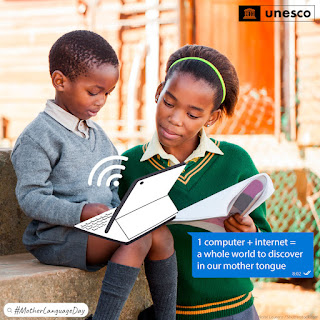
Source: IMLD2022 social media pack. (Yes, the laptop graphic is
superposed on the photo)

The theme of the 2022 edition of International Mother Language Day (21 February) is "Using technology for multilingual learning: Challenges and opportunities." According to UNESCO's homepage for IMLD 2022, the focus of this year's observation is "the potential role of technology to advance multilingual education and support the development of quality teaching and learning for all."

Having a long-time interest in languages, technology, and development (with learning fundamental in that nexus), I'm personally happy to see the highlighting of  multilingualism and technology in education.

At the same time, one is well aware that multilingualism is often not a relationship of equals. Some languages are "well-resourced" in terms of materials, support for use in information and communication technologies, policy agendae, and monetary budgets. Other languages, including the mother languages of Africa, tend not to have these benefits in the same measure or at all.

So while it is a positive step to have all languages be included in multilingual approaches - as opposed to being marginalized or excluded from education and public discourse - I see an implicit call in the theme of this year's IMLD for attention to strengthening the position of the "less-resourced" languages among them. It would be helpful to make that point explicit.

Sunday, February 21, 2021

IMLD 2021: What multilingualism means for inclusion

This year's International Mother Language Day (IMLD, 21 February 2021) has as its theme, "Fostering multilingualism for inclusion in education and society." Of the key terms in this expression, most need little if any explanation. But the meaning of one of them - inclusion - merits attention.

When we speak of - or speak - mother tongues and second (or additional) languages, as individuals, communities, and countries, that is "multilingualism." "Education" is often thought of as connected with schooling, but it also includes other modes of learning and sharing knowledge. These two concepts - multilingualism and education - along with specific attention to mother tongues, have been recurrent themes in IMLD observances over the years. And they are often discussed together - for example as "mother tongue based, multilingual education" (MTB/MLE).

"Society" seems impossibly broad, taking in pretty much everything we do. That's certainly appropriate in this context, as language and choice of languages are fundamental to our communication, interaction, and collective memory (not ignoring the tandem role of images and non-verbal.forms of communication). However I read a new and encouraging dimension to the mention of society in this year's IMLD theme: a link with sustainable development.

In an IMLD 2021 concept paper by the UNESCO Education Sector and the Organisation Internationale de la Francophonie, multilingualism is linked to the "Sustainable Development Goals’ focus on leaving no one behind" (which, by the way, actually has an acronym: LNOB). This IMLD concept paper also mentions the centrality of multilingualism for indigenous peoples' development - from which we can assume that where many languages are spoken, engaging constructively with that reality is fundamental for everyone's development.

Before coming to what I see as the key term in this year's IMLD theme - inclusion - note should be made of the action word at its beginning: "fostering." I hear this as calling out the importance of policies and planning, and the effective implementation of these. The issues of multilingualism need active attention from not only individuals, but also governments and organizations, without which we have words and no action (and in the end, no words either).

Whose inclusion?

"Inclusion" turns out to be a tricky concept. Although I accept that the intent of its use in the IMLD 2021 theme is positive - the notion that languages can facilitate education and full participation in society - this term can also carry some less positive meanings. Chief among these is the implication that there is an outside and an inside, and those inside define the terms for bringing the outsiders in. There's a potential inequality there that led one writer from a community development perspective to propose abandoning the word inclusion altogether.

In the context of schools, inclusion is often (at least in the West) used in the context of students with special educational needs (and within that setting, one writer identified eleven definitions!). This does not seem to be an appropriate analogue for promoting multiple languages in education.

In the context of language and languages in Africa, the question of inclusion seems to me to become more complex. Upon independence, most African states opted to keep the colonial languages as official, rather than promoting use of one or more among their indigenous languages. This in effect put various ethno-linguistic groups within their borders at the same disadvantage (no one "inside group" controlling power). However, it also gave those who were fluent in the official languages an advantage, which is maintained through a dynamic described by Prof. Carol Myers-Scotton as "elite closure" (in other words, an there's an inside group after all).

At the same time, as Prof. Ayo Bamgbose once observed, many states operated on the paradigm that "one language always unites and many languages always divide." So in effect inclusion or exclusion in education and society have been defined to a large degree (in linguistic terms) on the basis of use of the one official language.

It is possible to find "inclusion" on more shallow level, in a group or structure that does not fully value what one brings to it, or that requires higher sacrifice from some than of others. That's as true regarding mother languages as it is regarding other aspects of culture.

While acknowledging the utility of a common language (lingua franca), the fostering of multilingualism seems to me to have the potential to shift the basis for inclusion from something centrally controlled or defined by a limited group, to a dynamic with more entry points.

Friday, July 05, 2019

A life lesson in Fulfulde & the internal voices of a multilingual

After another hiatus in posting here, will begin again. More on all that below, but I wanted first to take the opportunity to share a couple of short items relating to my experience with some African languages.

"God knows his friends..."


I still remember a particular session of Fulfulde instruction in Moribabougou, Mali, back in 1983. As in all Peace Corps language classes - whatever the country, it seems - we were seated in a small hut, big enough for maybe 4-5 people plus a blackboard. On the particular day I'm remembering, someone passed behind the hut - nothing extraordinary in that given the layout of the training facilities beween the village and the school. Our instructor, Mady Kamanta, asked "Giɗo Alla?" Literally, "Friend of God?" which is actually a kind of "Who goes there?" The unseen person answered "Ko min, __" (and his name), basically, "It's me, ___." It was a village elder.

Short greetings followed and after the elder had gone, Mady said that the proper way to answer "Giɗo Alla?" was actually something like "Alla anndi giɗo mun. Min ko ___." Basically, God knows who's his friend. I'm ___." (I think it could also have been "Alla anndi yiɗɓe mun..." - "God knows his friends...")

A simple turn of phrase but a whole culture behind it. In pulaaku or pulaagu (basically Fula culture*), to the extent I can claim to understand it, there is a certain amount of humility and avoidance of presumption. (But as in any culture, I find there's also duality in which one sometimes encounters the apparent opposite.)

By the response you not only know the identity of the person, but also get a measure of them. In Moribabougou that day, the elder was a Bambara, and however wise he may gave been, or steeped in the context of Manding language and culture he was, could not be expected to have mastered all the nuances of a second or third language. So without knowing anything more about him, you'd learn something just from his response. From my later (and admittedly still limited) experience with varieties of Fula, I recall there were other small ways in which native speakers of the language (especially in central Mali) would test your knowledge in it.

As a turn of phrase, the "proper" form of response to "Giɗo Alla?" is is a great example of answering a question while deftly stepping aside from the premise of the question (whether implicit as in this case, or explicit, as perhaps in the case of some forms of argument). Something potentially useful in many contexts and cultures.

So for some reason I recalled this recently - which does not mean I had forgotten it in the meantime - and thought I'd share it here.

The words that come to mind (multilingual version)


A recent article on multilingualism and perception (published in June 2019 in On Biology then in slightly revised version in Psychology Today) had me thinking of the internal verbal generation in response to stimuli. That is, the words that come to mind in diverse situations, when one speaks more than one language. In my case those are sometimes words or phrases in Fula or Bambara (which are very different from each other).

Here I don't mean the kind of code-switching you do when speaking, and a word in a different language just says it better (or maybe you didn't know the term in the language of the conversation). I'm referring to the internal voice when you think of something or react to a situation. Occasionally the words I think of in certain situations are not in my first, or even second (French), language.

I'm assuming this must be common among multilinguals, but am not aware of any research on it. The closest I've seen as a non-specialist in linguistics relates to the perception of sounds, and how one interprets those as meaningful utterances, as mentioned for example in the article linked above.

Multilingualism is of course more common than monolingualism, but since linguistics and psychology arose in monolingual (sub)cultures, multilingual experience is described somewhat incompletely, and treated as if it were somehow unusual.

One would hope that as African research and scholarship in these areas becomes more prominent, multilingualism will be treated more as the norm, and monolingualism as the exception.

15 years of Beyond Niamey


Since I began this blog as an experiment in January 2004, there have been periods where I've written more often, and periods where I've posted nothing. A year ago - last summer here in the northern hemisphere - I anticipated a more substantial "reboot" than actually happened (the linked post - which opens in a new tab - is still a good statement of my current thinking on this blog, aside from the 2018-specific section, and blogging in general, which I've come to appreciate more with time).

One additional factor, which has always been in the background, but I've been thinking about more lately, is the question of what are the appropriate angles for a non-African to write about African languages and the "information society." This question is, frankly, the source of some doubt the deeper I get into it.

African languages are part of my life, for reasons perhaps apparent from the above, but which I'll discuss further in a subsequent post. However none of them are my language in the senses of mother tongue or cultural heritage. So as much as I may have my opinions, I also try to maintain a sense of propriety and humility. As I see it now, that allows focus on asking questions, making comparisons, and sharing information, ideas, and observations.

Readers are invited to follow critically as this blog evolves.

* Pulaaku is a somewhat complicated topic, often presented as the "Fula way" and comprised of several key attributes or behaviors. One summary posted on the web offers a list (although they had trouble with the hooked letters - "neaaaku," "aum," and "enaam" should be "neɗɗaaku," "ɗum," and "enɗam"). In an academic article entitled "L'image des Fulbe : Analyse critique de la constgruction du concept de pulaaku," Anneke Breedveld and Mirjam De Bruijn argue that the meanings of pulaaku vary by region, and perhaps our understanding of a single concept (and Fula people) is derived from foreign scholarship. In this, as much as in variation of the language, I tend to think that there are core concepts that are drawn from and interpreted variously, and that these interpretations don't represent divergence so much as dynamics. In the realms of ideas and identity, these dynamics could also mean convergence.

Tuesday, May 31, 2016

Multilingual extension in Africa: Framing the contexts


This post continues the discussion about multilingual extension and public education responses to emergencies where there are many languages from the previous post about the response to the West African ebola epidemic, with a look at general lessons and strategies.

Multilingual marketing & multilingual extension


There is a lot of information available about multilingual marketing aimed mainly at commercial users, and often with a focus on web content, for example on blogs and news sites (Business 2 Community, Business News Daily, ClickZ, Mention, Search Engine Journal), and corporate sites (ADAM, Ecoconsultancy, Lionbridge, MarketingProfs). Part of the pitch in these pieces is that most people base decisions like purchasing on information in their principal language, and most people do not speak English. Hence the need to localize messages, involving primarily translation but also attention to cultural norms and sensibilities. Multilingual marketing strategies allow a message to reach a linguistically diverse population - no mystery there. Most of the focus of such discussion, however, is on parts of the world with lucrative markets and good connectivity - much of the global North plus dynamic urban centers globally.

Although one can certainly tap such advice for information relevant to a range of situations, there is not any comparable font of advice that I'm aware of focused on strategies for extension, development communication, public health education, or messaging relating to crises in the multilingual global South, including Africa. These regions tend to have less disposable income and less connectivity than in the global North. And large numbers of their populations, if not majorities, speak languages that may be at once "less-resourced" in technical and literary senses, absent from school curricula or taught only in the first couple of grades, and given lower in status than that accorded the main European, Asian, and Middle Eastern languages.

The relative lack of prioritization of African language messaging by international entities involved in the ebola response can be seen in this context.

Understanding African linguistic realities


Planning for use of diverse languages in extension and public education, or even just accepting that it is worthwhile, requires understanding the "linguistic terrain," which may be defined as including information about the languages spoken (what they are and how they are related), the linguistic demography (who speaks what in what areas), and relevant sociolinguistic factors (how various languages are used, status of languages, etc.). Understanding the linguistic terrain, in turn, requires attention to specifics, and may be facilitated by models or "frameworks" which put such specifics into perspectives useful for action.

For instance, figures on the number of languages spoken in a country are readily accessed, and not infrequently these elicit in foreigners the impression of a kind of Babel, too complicated to deal with beyond maybe assuring there is local staff able to interpret as needed (else just relying on ad hoc interpretation in the field). Beyond the numbers, the names may be unfamiliar, issues of who speaks what where and when not understood, the close relationship of some sets of languages with different names unknown, and there's always someone ready to offer a rationale for not bothering with African languages.

In approaching the multiplicity of languages in multilingual African countries, the first task is getting past the numbers, to put some identity to the names, and then to frame some understanding of how they are (and could be) used, by whom, where, and when.

Hierarchies, relationships, and priorities


The simplest and easiest framework in which to approach linguistic diversity in Africa - which arguably the default understanding for many - is a hierarchy in which the "Europhone" international languages are higher, and "local languages" are lower. That could be on the basis of several factors - elite status, career and education opportunities, existence of written and digital resources, number of speakers globally - but not others - mother tongue status, cultural content, number of speakers locally/regionally.
Classes of development of a linguistic variety proposed by Kloss (1978),
as quoted in Mioni (1988). Source: Guerini (2006:33)

The diagram at the right, adapted from work by Heinz Kloss, illustrates what such a hierarchy might look like (though I'm interpreting it here for purposes different than it was proposed). In many African countries, a Europhone official languages is #1 in such a ranking (Afrikaans, Amharic, Arabic, Swahili might also be considered here), and most other languages are down the scale (per the diagram, they all would be nos. 4-6).

Such a simple hierarchy may have utility for description, but also has limitations - perhaps notably in confirming biases. It is probably not a good guide for communication strategies.

Hierarchy of  languages in de Swaan's (2001) theory. Source:
Wikimedia Commons, By Jqho1 - Own work, CC BY-SA 4.0
A hierarchical approach proposing a system of relations was Abram de Swaan's global language system theory (developed across several publications culminating in a 2001 book). He considered languages as forming a network of "constellations," each having more central and more peripheral languages. De Swaan's system adopts the core-periphery paradigm of world system theory, and includes arguments from history and a mathematical model for the communicative value of a language (Q-value). A more complete discussion of his work is beyond the scope of this post, but for our purposes, the model has been widely influential.

Source: Calvet (2006:76)
Among those referencing De Swaan, Louis-Jean Calvet (1999, 2006) explored how this approach works and may change in several regions. In one African case - Mali - it is clear that some languages do not fit simply into a hierarchical system of constellations (in a different discussion, we'd be calling many of these "cross-border languages," although the limits of constellations do not follow country boundaries).

In general the constellation approach seems most useful when analyzing the global or broad regional systems, and may not be helpful in communication strategies that require dissemination of messages in what are framed as peripheral languages.

Rough long-tail distro of 1st+2nd languages in Mali
A different approach that I have discussed previously (in general and in the case of Mali) uses the observation that numbers of speakers of languages as a rule follow a long-tail distribution. This is true at any scale, but the languages at the head of the distribution at more local levels may be different than those at a regional or country levels. This is not necessarily better than the constellation approach, but it does offer a different understanding of data that suggests different priorities. Arguably when a crisis such as ebola is most critical in certain localities, awareness of the language distributions on those local levels might be important for effective messaging there.

Types of African language repertoires in Mioni (1988).
Source: Guerini (2006:30-32) (combined 3 figures)
Since linguistic demographics and language policies differ by country it is also important to look at the organization of languages at that level. Alberto Mioni (1988) proposed three language profiles common in African countries: 1) a typical one with a "high language" (HL), usually an "exolanguage," what I have been calling Europhone languages, a national lingua franca, and local languages; 2) having two HLs, a developed national standard and an exolanguage, along with local languages; and 3) with local standard unavailable/undeveloped, and just the HL and local languages. These are simplifications, and like the hierarchical models above, they broadly minimize smaller languages that may be important locally, but they may provide a context for application of another analysis like the long-tail.

The reason for reviewing the above is that taken together, they might be used as alternative "framing" of a given sociolinguistic situation to arrive at a better understanding for planning purposes. That is, while studying the specifics of what languages are spoken in a country is essential (especially for foreigners working there), having diverse conceptual tools to understand the communication environment may be key to appropriate and successful messaging.

Leveraging the global networks of local languages


Due to emigration, there are communities of speakers of many African languages in diverse parts of the world. In other contexts (such as African language Wikipedias) it has been pointed out that these communities may be resources for development of materials.

In the case of epidemics that take on global dimensions, it may be possible to link multilingual messaging approaches between countries where a language is spoken natively, and communities of speakers in other countries (emigrants, diaspora). When fear of a wider ebola epidemic was at its height, the issue of translation was brought up in the US, for example, but apparently without making this link.


Taking multilingual extension to another level


The above is hardly comprehensive, but seeks to outline conceptual approaches to use in strategies for messaging in multilingual Africa, in emergencies like the ebola epidemic, but also general development communication. The previous post on lessons from the response to ebola, reviewed some specific issues. Taken together they are intended to promote discussion leading to more effective and appropriate use of African languages in a range of public education and development contexts.

References:
  • Louis-Jean Calvet, 2006, Towards and Ecology of World Languages, Polity Press. (Translated by Andrew Brown from 1999, Pour une écologie des langues du monde, Plon)
  • Federica Guerini, 2006, Language Alternation Strategies in Multilingual Settings: A Case Study: Ghanaian Immigrants in Northern Italy, Peter Lang.
  • Heinz Kloss, 1978, Problems of Language Policy in South Africa, Braumüller.
  • Alberto Mioni, 1988, "Standardization Processes and Linguistic Repertoires in Africa and Europe: Some Comparative Remarks," in Peter Auer and Aldo di Luzio, eds., Variation and Convergence: Studies in Social Dialectology, Walter de Gruyter.
  • Abram de Swaan, 2001, Words of the World: The Global Language System, 1st ed., Polity Press.
Thursday, May 12, 2016

Multilingual extension in Africa: The response to Ebola


Various earlier posts on this blog have discussed the importance of African languages in extension and development from general and tactical points of view (with particular reference to agriculture). Also during the course of the ebola epidemic in West Africa (which peaked in 2014-5), a number of posts looked at specific efforts to undertake health education and ebola awareness in various languages, and proposed systematically sharing, vetting, improving, and providing for re-use of translated and original materials in African languages.

This post looks from several different angles at multilingual messaging, including translation, over the course of the ebola epidemic. It will be followed by another post considering what strategies one might identify for future responses to emergencies - as well as less urgent public education needs - in multilingual contexts.

First, however, a quick note concerning summaries or evaluations of the linguistic dimension of the ebola response. As far as I am aware, there is no comprehensive overview or analysis. Reports from major organizations involved in the ebola response barely mention language (at the end of this post is a quick review). Perhaps the only report specifically on language and translation in the response was done by the international NGO Translators Without Borders, which was prominent in arranging translations of ebola materials into many languages (not just in West Africa): "Words of Relief  – Ebola Crisis Learning Review" (29 May 2015).  For a little bit broader view, but without pretense to completeness, I posted a summary largely reflecting content on this blog: "Ebola messaging in African languages - taking stock and looking ahead" (12 Dec. 2015, on LinkedIn). Both of the above proposed some lessons for the future.

Even lists of resources and websites, mainly done for reference or reporting during the period of the epidemic, are not comprehensive (for example, here). As I'll discuss below, one reason has to do with the scale or "layer" at which these operate, meaning that local activities either tend to be missed by international activities (which do the reports we see), or just aren't seen as falling in their scope. But it may also just be that information didn't travel or networks weren't connected. When researching ebola projects recently, for instance, I discovered an analysis of an interesting multilingual cellphone messaging project in Guinea called "Polly" from a group at Carnegie Melon University - something I personally had not seen mentioned elsewhere. Are there others?


Image by Chris55, Wikimedia Commons, CC BY-SA 4.0

Ebola messaging in African languages


It is useful to disaggregate as much as possible several interrelated aspects of the process of responding to a crisis like ebola in a multilingual context: time; space; demographics of languages; the levels or layers of activity (international, national, provincial, local); modes of developing information in diverse languages (translation, interpretation, and creation*); media (print, media, mobile, in person); and organizational policies.

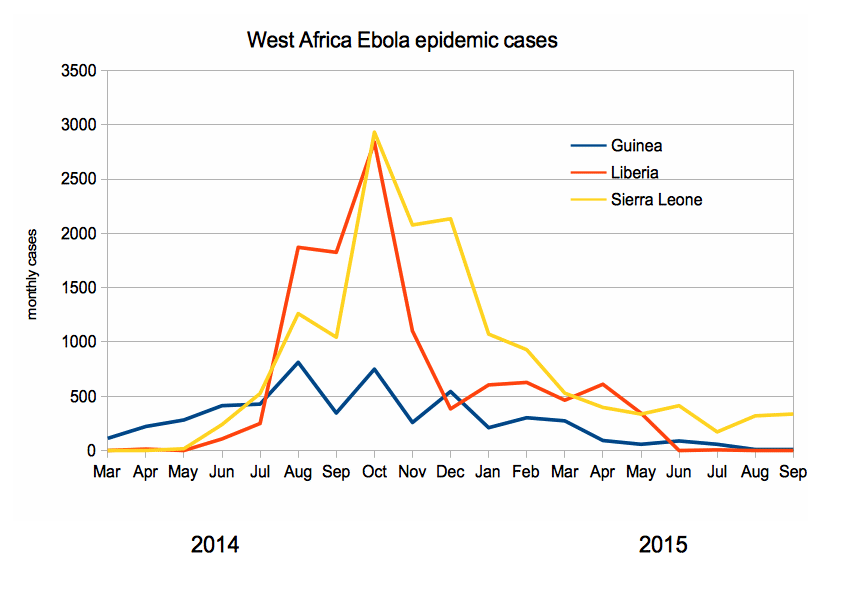
  • Time: Information about the epidemic came most quickly in English and French - official languages and main languages of media, the aid community, and the medical community. There was a lag in getting information in other languages of the affected countries. Major efforts to address this took a while to get going - according to TWB's report (cited above) its translation efforts began in November 2014 (though it seemed to have started some work in August), which was around the peak of the epidemic (per graph of cases above). Ad-hoc interpretation of incoming information on local levels (local radio, community meetings) was probably ongoing from relatively early in the cycle, with more organized efforts later on, though documentation is limited.
  • Space: Three countries were most hard-hit by the epidemic, and within those some regions within them more so than others. Responses obviously tried to address those, but logistics and information (such as for ebola education) tend to move from center to periphery. Data, on the other hand, may move from periphery to center by one or another means. Neither is perfect, but they evidently took time, especially early in the epidemic, even where there was mobile technology. Since the spatial distances were accompanied by language differences (different languages, different varieties of a language, or even different competencies in a same language variety), there was added time and evidently more potential for misunderstanding. All of this is in theory - I have seen no discussions of spatial dimensions of the response (looking in particular for the impact on information flows).
    • Linguistic demography: One dimension of linguistic demography is of course who speaks what where. Another is that on the country level, speakers of some languages are more numerous than others overall. Translations in languages more widely spoken on the national level were apparently done before less spoken ones. This makes sense on a broad scale but where less widely spoken languages dominate in a local areas, these likely were used orally (the backstory to the murder of health workers in Womey, Guinea included mention of local languages; a story from neighboring Côte d'Ivoire offered a peak at interpretation on the village level), but otherwise may not have received much attention. The only project I heard of that focused on translations in "smaller" languages was one organized by SIL in the neighboring Casamance region of Senegal (mentioned here).
    • Levels/layers: International aid and NGOs, national administration and services, and local communities and their local and extra-local networks seemed to operate on different and often only selectively interacting levels, especially early in the cycle. This dynamic meant that what happened or was being said on one level may or may not have had (immediate) effect on, or even in the extreme not been known by the others. And where information and diverse languages are involved, gaps and even contradictions (the latter in the form for example of misinformation about what ebola is or its treatment) seemed to emerge fairly quickly especially in critical early stages of an emergency.
    • Modes: Translation efforts focused on standard texts or posters, especially on the level of international aid and NGOs, but also some national level print media, and governmental and non-governmental entities. Interpretation and creation of information in African languages were more national and local in character - meetings, individual contacts, blogs. In the case of media (print, radio, TV) content about ebola, it is not clear the mode in which it was rendered in African languages (translation, interpretation, or creation*). For example, two international organizations working with media - International Committee of the Red Cross (ICRC) and Catholic Relief Services (CRS) - had projects with community radio stations to broadcast messages in local languages, but in neither case was it clear how that was done (which languages, whether oral translation from Europhone scripts or scripts pre-translated in target languages, what training, etc.). An example of community contacts in local languages to spread information about ebola in Liberia was given by International Rescue Committee (IRC) - the person in the example was a physician assistant and evidently fluent in the target language, so able to put information in his own words ("creation" in this model) to fit the needs and questions/challenges as he encountered them.
    • Media: Ebola messaging in African languages was conveyed on diverse media (print, poster, TV, radio, blogs, video, and mobile apps) as well as via community meetings and individual contacts. I am not aware of any studies of media activity during the ebola epidemic that might include discussion of languages used. An exception is information about mobile media used during the epidemic - "mobile-based interactive voice response technology," and apps like the SAWBO animations with African language voice-overs and the abovementioned "Polly." Also, an observation mentioned in an earlier posting that the dominant languages used in each means of communication tended to differ, such that in Nigeria supposedly the higher tech media used more English and the in person and community communication tended to be in first languages.
    • Organizations and languages: The observation by Nadia Berger and Grace Tang based on TWB's work translating ebola messages that "translation is not always considered a priority by governments and aid agencies" echoes experience more generally in international development. This is a major structural hurdle to more effective use of African languages in response to crises like the ebola epidemic, in health education, and indeed in all aspects of development. Do organizations and agencies have policies with regard to languages in the multilingual societies struck by the epidemic, or was the linguistic dimension of their work handled as an incidental consideration really given less priority in the face of a very physical crisis, despite its relevance to successful public education and control of disease transmission?
    With the latter point in mind, it is worth taking a quick look at whether and how language as a factor did or did not figure in reports of organizations involved in response to the ebola epidemic.

    Language in reports on ebola responses?


    Reports on ebola response efforts by Medecins Sans Frontiers, World Health Organization, and IRC did not mention languages or translation, nor did an analysis of the international ebola response by the UK Overseas Development Institute's Humanitarian Policy Group.

    The U.S. Centers for Disease Control (CDC), to its credit, did in its report mention language as a factor: "The Road to Zero: CDC's Response to the Ebola Epidemic." (Recall that CDC's ebola information resources included a few in Malinké - a variety of Manding). The two specific mentions merit a closer look:
    • A CDC worker with "intermediate" French worked with people Guinea's forest region, of which perhaps only one per village might speak French, to "translate important  health messages into the local language" and train local workers. An impressive effort, but the kind of situation where available language support - people with better French and acknowledged erudition in the local language(s) - could help assure accuracy of translations and messages in the local language. Also, since that part of Guinea has several local languages, it is not clear which was the focus of efforts
    • A training of midwives and cleaners was held in the Malinké language "since they do  not speak French, the official language of Guinea." Looked at another way, a big reason to use an important first language and lingua franca like Malinké would be that this is understood better, and that an advantage of training using such languages is that it could arguably better prepare trainees for work with patients who may also speak them better than the Europhone official language, French. (Another possibility might be a bilingual format with relevant African and Europhone languages, arguably better preparing trainees for contexts they will encounter.) 
    Reports or website content of all but a few of the 67 organizations on USAID-CIDI's list of NGOs involved in ebola response also did not discuss languages or translation (to be fair, a few of those which didn't were only involved in logistics of shipping supplies). CIDI's list is extensive, but notable among the omissions is TWB, certainly the most prominent international NGO facilitating translation of ebola materials. The exceptions which did mention language include:
    Another organization on the CIDI list, Mali Health Organizing Project, used Bambara in its ebola response, as one would expect (for example in a factsheet), but did not mention this linguistic dimension in its report or website.

    In all of these instances it would be helpful to have any materials developed/used for review (were they saved?) and incorporate them in archives for potential reuse (per 2Ds & 4Rs).

    Perspectives of health workers & patients?


    Another level at which language is important in such an epidemic is that of the interaction between health workers and the patients. For a glimpse of this issue, see two personal accounts by Western nurses about the language gap between them and patients (in Nurse.com and PIH.org). It would not of course have been possible to train foreign health workers in any of the local languages they would encounter, given the time factor, but one wonders if a couple of words or phrases might have made the difficult experience a bit more bearable for caregiver and patient (especially the younger ones).


    * Note on these 3 terms. On the first two, there seems to be a gap in the terminology: "translation," strictly speaking, refers to text, as distinct from "interpretation" being defined as oral and in person (physically or virtually). This leaves out what we might call oral translation, or interpretation of a source either received as text (announcer on radio reading in one language but giving the meaning in another) or heard in one language (in a meeting or on media) but transmitted orally in another language at a later time. These kinds of cross-language sharing are common in multilingual societies with rich oral traditions, and I suggest in this context they be considered as forms of interpretation (keep in mind the range of meaning of "interpretation" as an art). "Creation" is intended to cover instances where the writer (for example of a blog) or speaker (many possible scenarios) is conveying their understanding of a subject in their own words - which happen to be in a language different than that of the main international media, medical research, etc. Of course the lines among these three are not rigid, but I think it is useful to retain them as more or less archetypes of different ways information about ebola was communicated in African languages. (The neologism "transcreation" has specific applications, but might constructively be adapted for use somewhere within this space.)

    Monday, September 08, 2014

    Multilingual Literacy Day, 2014

    It's actually International Literacy Day today (8 September), but given how often in the case of multilingual societies statistics on literacy are not clear on what they are measuring and assuming, I'm taking liberty with the title of this brief post.

    Recalling how often one encounters or hears of people schooled in Africa - and literate or even highly educated - who say they cannot read their first language, it is worth asking why literacy for polyglots is not more often multilingual literacy. The technical term for this is pluriliteracy (multiliteracy seems to be more often used for ability to read and use diverse media).

    Additional thoughts (the morning after)

    First, the theme of the 2014 observation of International Literacy Day - "Literacy and Sustainable Development" - highlights an important link. Literacy isn't just nice to have, but fundamental, and this bears reiterating.

    Second, my initial comments above come from a long interest in the subject of multilingual literacy or pluriliteracy, especially in Africa. I found it striking that people could go through extensive schooling without ever seeing their maternal languages in print, or learning established (even if historically recent) rules of orthography for them - and then to read discussions of literacy in societies in which these people grew up described as a single thing (as if we were talking about literacy in a monolingual region of the US or China). A regional news summary on the UNESCO site entitled "Celebrating International Literacy Day 2014 in the Sahel countries," for instance, lists many activities, but only in Burkina Faso is there any mention of which languages were involved: "articles related to literacy in French and local languages."

    My active interest in this topic goes back to the beginning of the UN Literacy Decade in 2003 when I set up a discussion group on literacy theory, practice, and policy in multilingual contexts worldwide, called "Multilingual Literacy" (Literacy in Multilingual Societies). It sought to promote consideration of questions such as:
    • What approaches to adult literacy and basic education for children work best on the countrywide, community and individual levels in multilingual societies?
    • Should measures of "literacy" (% literate) be more complex in countries or communities where multiple languages and maybe even scripts are used?
    • What other issues arise with various approaches to literacy in countries where many languages are spoken (e.g., language survival, national unity, prioritizing limited education resources, production of materials for post-literacy, role of ICT, meaning of literacy to the people...), and how can they be addressed?
    • What about terminology and related concepts? (e.g., multiliteracy, pluriliteracy, multi/bilingualism)
    Here's hoping that the next International Literacy Day pays more attention to pluriliteracy in multilingual societies...

    Kamusi at 20: Keeping the vision alive and working

    The Kamusi Project, which seeks to provide an open dictionary of all languages, for use in reference and in language technology development, is facing a challenge not unfamiliar to other language-related initiatives: Funding. This effort - sometimes perceived as too ambitious or esoteric but always visionary in its goals and use of technology - is currently campaigning for support through the Global Giving Open Challenge.

    Kamusi was originally developed in 1994 as a proposal by Dr. Martin Benjamin and Dr. Ann Biersteker, then both at Yale University's Council on African Studies. Billed as the "Internet Living Swahili Dictionary," its objective was to respond to the need for new reference material on Swahili, and to do so by using the potential user contributions over the internet (this was more than 6 years before Wikipedia was launched). It is worth noting that a reason cited for exploring the internet medium for dictionary development was unfavorable "economics of Swahili publishing." Kamusi is still today an excellent Swahili resource (both monolingual and English <-> Swahili), even as its goals have evolved.

    Kamusi was run at Yale, with benefit of US Department of Education funding, until 2006, and during this time was recognized as a finalist in the Stockholm Challenge 2001. At the end of this period, Dr. Benjamin - Martin to those who know him - summarized Kamusi in the context of African languages on the web at Wikimania 2006. He continued to run Kamusi as it transitioned in 2007 from Yale to a server hosted by the World Language Documentation Centre.

    Under Martin's direction, Kamusi has since then been incorporated as a non-profit in the US and Switzerland (where he lives with his family), and has expanded its mission beyond Swahili to a pan-African and eventually global scope.

    Funding from Canada's International Development Research Centre (IDRC) for Kamusi, as part of the multi-member African Network for Localisation (ANLoc) project, enabled Kamusi to lead development of locales for 100 African languages (locale data facilitates computer software handling a language) and terminology for 12 African languages. Later funding from the US National Endowment for the Humanities (NEH) enabled work on a pilot for Kamusi's multilingual model (basically, there's a lot more to a multilingual dictionary than words in parallel, since concepts don't line up neatly across languages).

    Since the conclusion of major funding in 2012, Kamusi has continued work on the multilingual model, including how to annotate degrees of separation (when a concept is translated through another language), homophones, multi-word expressions (something I personally wish machine translation had been better at years ago), and data input from any language. In 2013 Kamusi's work gained it recognition as a launch partner in the White House Big Data Initiative.

    Although Kamusi has an affiliation with l'École polytechnique fédérale de Lausanne (EPFL) since last September, this has not filled the funding gap to enable completion of the programming work necessary to bring all of this to fruition and take the Global Online Living Dictionary (GOLD) from a proven pilot project to a full-scale reality.
     
    Looking at Kamusi's history - which is long in internet terms - one is impressed by the thought and effort that has gone into it, by Martin and by a range of other contributors, from its beginning at Yale to recent collaborations and donors, with many individual contributions all along. It would be a shame if current funding difficulties would cause this important work to end.

    For something like Kamusi, it helps, I think, to look as far ahead as we can look back. Twenty yeas from now, the advantages of building language resources for the many languages that don't have the economic or political/policy weight to get commercial and investor attention - even if they have demographic importance (keep in mind how quickly Africa's population is growing, for instance), but especially if those numbers aren't there either - will be a lot more apparent than they seem today. For countries where many of these languages are spoken, like most of those in Africa, there is a long-term need for projects like Kamusi that connect high level language technology with less-resourced and often low-status languages - and in Kamusi's case, also link those with the more widely spoken international languages.

    At this point, Kamusi's effort to gain enough support to qualify for ongoing listing on Global Giving is an attempt to keep the organization going at a critical period in its history. Please consider helping.

    Wednesday, September 03, 2014

    The problem with calling some languages "local"

    Only in Africa, it seems, can a language spoken by millions be called a "local language." The term is used widely, not just in Africa, and although I've also used it, I'm increasingly finding it problematic as employed in African contexts for two main main reasons:
    1. It is inexact, often serving as a catch-all term for languages other than the main Europhone official languages, from those like Akposso that are truly localized in use, to languages like Hausa spoken across many borders by many people of many backgrounds as a first or second language. 
    2. It is misleading. As a term, "local language" implies a low rank of importance relative to "official language" or "language of wider communication," when for some languages and/or in some contexts such a hierarchy of importance would be inappropriate. In Senegal and Mali, for instance, Wolof and Bambara, respectively, are spoken more widely than French, but are sometimes referred to as "local languages." Such indiscriminate use of the term arguably pigeonholes languages and disincentivizes thinking about their use in communication, education, extension, etc.
    At this point, I'd like to suggest that more thought be given to using the term "local language" when speaking and writing about African languages. It probably should be used much more sparingly than it is now. Sometimes a language really is local, but other times, what we may call "local language" in Africa is actually more widely spoken than some European languages that we probably never would call "local."

    It may be that a key piece in more deliberate use/non-use of "local language" in Africa is informing development, health, diplomatic, and other specialists about the sociolinguistics, culture, and policies regarding African languages in areas they work. Should a basic course about African languages and multilingualism in development and contemporary society (this is different than studying a language or intro to African cultures) be part of the education of non-Africans planning to work in Africa?

    Tuesday, November 26, 2013

    What does "bilingualism" mean in multilingual Africa?

    A couple of questions seen in a recent tweet raise a number of issues about perceptions of languages, bilingualism, and multilingualism in Africa:
    The answer to the last question would seem straightforward wouldn't it? Bilingual of course! Yet it does seem that the description of "bilingual" in Africa is often applied to the ability to speak two "Europhone" languages without consideration of African languages, despite the fact that there are many of the latter, spoken by many polyglot people in the many multilingual societies of the continent.

    There is no shortage of examples, but one that comes to mind is a statement in 2003 by then Senegalese President Abdoulaye Wade during a state visit to the Nigerian capital Abuja. Speaking of regional cooperation, he chose to broach the issue of language, remarking that it is too bad the peoples of their two countries are not bilingual* (the implied languages being English and French). Although I do not have a complete reference at hand, it is mentioned in a later discussion of  remarks by a Ghanaian scholar on the occasion of release of a book on the history of the Ewe people of Togo and Benin,** to the effect that more bilingual education was needed - again in terms of English and French. There was specific reference in this case to linking "Ewe-speaking" scholars who work academically in English or French, but with no mention of the language that this group has in common across all borders.

    "Official" bilingualism?

    Part of the issue certainly is focus on the official languages, which for so many African countries are only those languages inherited from the colonial period and put to use since independence for administration, education, and wider communication. This appears to be the case for example in a Q&A between a reporter from the Senegalese daily Le Soleil and the French ambassador in Dakar in 2012. The question had to do with the "temptation" of some Francophone states in Africa to "bilingualism,"*** again bypassing the multilingual context of Africa and attending to official languages and language policies. This particular question was likely a reference to Rwanda's addition of English as an official language, and Burundi and Gabon considering similar moves (although Rwanda's move made it officially trilingual as Kinyarwanda, the first language of the population, and French, inherited from the colonial period, were retained as official languages).

    In any event, the French ambassador's response reframed the question slightly to distinguish between the policies of countries and the decisions of individuals, including reference to maternal languages under the latter. I won't venture any interpretations other than to speculate that in some cases, it almost seems that "bilingual" is used as a code word for "adding English at the same official level as French" (I hope in the future to treat the area of policies of donor nations - former colonial powers among them - with regard to language and languages in Africa).

    Bilingual and multilingual education

    The term "bilingual" is also used in the context of so-called mother tongue/bilingual education, which typically involves an African language and a Europhone official language. This is a topic that has received significant attention from organizations and scholars involved in aid to and study of education in Africa (including Maurice Tadadjeu of Cameroon and Neville Alexander of South Africa, whose work has been mentioned previously on this blog). And it is a major focus in other world regions as well (a major Asian conference on mother tongue based/multilingual education - MTB/MLE - was just held in Bangkok earlier this month).

    However, one notes that in some contexts references to bilingual education in Africa actually mean instruction/learning only in Europhone languages.

    African multilingualism has been implicitly or explicitly recognized in various policy and applied contexts including a number of expert or ministerial-level conferences. In recent years, the African Academy of Languages, which functions under the auspices of the African Union, has sponsored a number of activities including the Bamako International Forum on Multilingualism (19-21 January 2009) whose recommendations included adoption of MTB/MLE. .

    The case of Cameroon

    The country of Cameroon is an interesting case to consider here, as it has two Europhone official languages - English and French - while also having some of the greatest linguistic diversity on the continent. It is common to hear the country described as bilingual, when in fact it is multilingual, with 280 living languages (by Ethnologue's count) . It is this juxtaposition that Prince Kum'a Ndumbe III was addressing when, on the occasion of a book fair his organization AfricAvenir sponsored in 2007, he stated: "The Cameroonian is not bilingual, he is multilingual."

    Some of the complexities of the situation in Cameroon are explored in a short paper entitled "Bilingualism" by Usmang Salle Leinyui, which includes a discussion of different kinds of bilingualism in the country, and in an overview entitled "Multilingual Cameroon: Policy, Practice, Problems and Solutions" by Tove Rosendal (2008; University of Gothenberg Africana Informal Series, No. 7).

    Cameroon has had an interesting history of efforts to promote literacy in its national languages (that term in much of Africa used for African first languages, and is a usage I would like to return to later). Much of Tadadjeu's work related to that, as did the AfricAvenir event mentioned above. However, "bilingual education" officially involves only English and French, as do various references to "bilingualism" in official documents (see Jacques Leclerc's L'aménagement linguistique dans le monde for more on this and related language policy issues). And although there have been efforts to promote use of and literacy in Cameroon's national languages (including proposal of a trilingual education model), and the constitution and high level documents mention them, Leclerc describes official "indifference" towards national languages, and Rosendal notes lack of implementation of policies to favor them.

    Summary and closing question

    So part of the issue of "bilingualism" in multilingual Africa often referring to Europhone languages and not African languages has to do with what have been designated "official languages." Another part may have to do with the status of languages - with it often seeming the case that knowledge of European languages is accorded more prestige than knowledge of African languages. Those two parts are certainly interrelated.

    How then would a person be called who speaks one African language, one Europhone language, and, say, one Asian language?


    * "Helas! nos peuples ne sont pas bilingues."
    ** Lawrance, Benjamin N., ed. 2005. The Ewe of Togo and Benin. Woeli Publishing Services (Ghana).
    *** "Des pays africains francophones sont de plus en plus tentés par le bilinguisme. Que pensez-vous de cette évolution ?"

    Sunday, February 08, 2009

    Bamako triptych, and resuming again

    Since my last posting, which was after returning from a trip to Bamako, I haven't had the time to do much with this blog. Circumstances have changed somewhat, though the focus of my work and essence of the ideas that I am developing are much the same.

    The title of this entry remembers that trip to Bamako and alludes to a recent conference on languages and an ongoing one on African development, both in the same city. More on those below.

    This blog in the mix of things

    This blog, to review, is focused on African languages, ICT and development, with attention to some related matters. I've given particular attention to language-development links.

    In addition to the postings, I have arrayed in the left sidebar feeds from a number of lists relating to these subjects, especially the language-ICT links. Part of the concept is that even when I am not posting actively, there is changing & updating material (or links to same). I intend to do more with the main part of this blog but it really is a question of time.

    Two things not in the left sidebar that I have been working on in some of my online time over the last few months are two projects on my personal/professional site, donosborn.org: another blog, "Multidisciplinary Perspectives," which concerns a wider rage of topics (and facilitates exploring some ideas); and a collection of information on the International Year of Languages (which is about to end).

    Bamako last year and now


    My trip to Bamako in May 2008 was mainly an opportunity for Dwayne Bailey, project lead of the African Network for Localisation (ANLoc) and me to meet with Adama Samassekou and his colleagues at the African Academy of Languages (ACALAN). ACALAN, which is now part of the African Union, has been collaborating with UNESCO and to a lesser degree IDRC on issues of linguistic diversity and ICT. It is hoped to work more with them on issues relating to localization of ICT in African languages.

    In January (2009/1/19-21), ACALAN hosted a conference involving UNESCO and the MAAYA linguistic diversity network called the Bamako International Forum on Multilingualism. Billed as "A first step towards a World Summit on Multilingualism," this event treated aspects of multilingualism with anaccent on Africa.

    Interesting to note that this month - 2009/2/19-21 - the ninth Forum de Bamako is being held. Exactly one month later and in the same hotel as the conference on multilingualism, one wonders if this conference on development (with the theme this year of governance) will boach the topic of languages in development and governance in multilingual societies.

    I have not been able to attend either of these two meetings, but I look forward to seeing the Action Plan from the former and the proceedings of the latter. Hopefully I can then follow up with some comments.

    In the meantime, I'm trying to catch up on various work, notably for ANLoc on policy relating to localization (language and ICT).

    Wednesday, January 21, 2004

    Student demonstrations this morning in Niamey. Happens just often enough that one loses track of exactly what the issue is - generally something with the bourses, that is the student living stipends, but sometimes politics.

    On the national scene the local elections have been postponed from March to June. Not sure if there is a connection. (The curious can check out some of the links at J. Mayer's page - click on the link to that in the left column under "Niger" - for sources of news.)

    I wrote an e-mail with a quick take on my interests (a networking/jobhunting thing important even as the clock ticks down...) which I'll revise part of a bit for this venue:

    In effect I have one foot in language & multilingual ICT and the other in agriculture, environment and rural development. What links the two are

    • a conviction about the nature and importance of agriculture in human society (goes beyond the obvious; the relentless focus on production is leading to some very questionable results), and an interest in enhancing opportunities for smallholder farming families in poorer countries

    • an approach to land & resource management that emphasizes "putting the mind on the land" beginning with local knowledge (not stopping there, of course) and using various low & high tech tools of spatial imaging

    • a view of "development" that goes back to its core meaning of "unfolding, revealing potentialities" (if you start from there rather than the usual usages of the term, you get a much broader set of goals)

    • seeing education or "learning" as the dynamic thread linking these interests (with a Freirian accent - though this is pretty mainstream now)

    • understanding of the importance of one's first language in learning, "owning," and generating knowledge (but for various reasons most of education & development approaches in Africa minimize this)

    • the strong impression from experience that multilingual societies function differently from monolingual ones in ways that people used to monolingual living (or even alternating from one to another more or less monolingual setting using different languages) don't easily appreciate

    • recognition of the importance of language skills in life success and social skills, and that current education systems and economic factors are producing in Africa many people with what one might call "impaired bilingualism" (no schooling in the first language(s) and more or less limited acquisition of the language of instruction - the worst of both worlds when in fact the best of both is possible)

    The latter is an interesting line of reasoning I have only recently begun to really think about - the suggestion being that inadequate skills in self-expression lead to social and psychological problems esp. in men (?), and that lack of words, of language skills, effectively equals inadequacy. A quote I ran across by Australian author John Marsden a couple of months ago got me thinking along these lines: "Language impoverishment can lead to frustration, impotence and/or rage."

    Is lack of language education, within the broadly recognized "lack of education" (which tends to get reduced to the also important but different domain of vocational education - as if young people don't need to think as long as they learn to do), an underappreciated factor in problems in disadvantaged communities? And lack of good bilingual language education a factor in polyglot societies? A lot of the youth caught up in the violent armed groups in Liberia, Sierra Leone, and Côte d'Ivoire, for instance, are probably really fluent in no language - whether there is any link or not I think is is a valid question to look at. Obviously all the violence plays out in a context of social, political and economic issues - but
    how it is playing out may have something to do with a rootless/hopeless generation that speaks neither maternal language nor external language well. George Packer's descriptions of the youth in CI are worth rereading in this context.

    Monday, January 19, 2004

    Niamey, c'est une ville polyglotte. Comme tout le pays et toute l'Afrique d'ailleurs. Ici la langue offiielle est le français, pour les raisons de l'histoire de la sous-région et aussi de besoin de langue franque. Mais promener en ville c'est d'écouter "Fofo" et "Sannu," par exemple, plus souvent que "Bonjour." C'est normale, vu le fait que le Zarma et/ou le Haoussa sont les langues maternelles de la grande majorité de la population.

    C'est aussi normale ici et dans le plupart de l'Afrique d'écouter et parler plusieurs langues au cours d'une journée. J'ai l'impression qu'on ne peut pas parler une seule langue dans la journée sans se borner socialement et intellectuellement.

    Handicap ou avantage, vivre avec ce multilinguisme? J'ai l'impression que ce n'est pas un désavantage a priori, et il y a des aspects positives. La communication passe bien par les voies (et voix) plurales si on est habitué. Le problème arrive si on ne maitrise aucune de ces langues - et les possibilités d'expression sont ainsi limités. Mais si on a une connaissance un peu approfondie dans au moins une langue, on peut, je crois, aller plus loin avec des autres langues.

    En fin, ce sont quelques réflexions. J'ai l'impression sans avoir vraiement recherché la question que les dynamiques des sociétés multilingues de l'Afrique - et les implications pour l'éducation, la culture, le développement, etc. - ne sont pas très bien compris jusqu'au présent.