Showing posts with label education. Show all posts

Monday, February 21, 2022

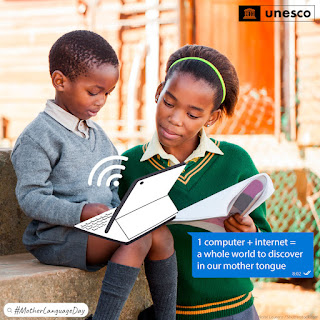
IMLD 2022: Using technology for multilingual learning

Source: IMLD2022 social media pack. (Yes, the laptop graphic is
superposed on the photo)

The theme of the 2022 edition of International Mother Language Day (21 February) is "Using technology for multilingual learning: Challenges and opportunities." According to UNESCO's homepage for IMLD 2022, the focus of this year's observation is "the potential role of technology to advance multilingual education and support the development of quality teaching and learning for all."

Having a long-time interest in languages, technology, and development (with learning fundamental in that nexus), I'm personally happy to see the highlighting of  multilingualism and technology in education.

At the same time, one is well aware that multilingualism is often not a relationship of equals. Some languages are "well-resourced" in terms of materials, support for use in information and communication technologies, policy agendae, and monetary budgets. Other languages, including the mother languages of Africa, tend not to have these benefits in the same measure or at all.

So while it is a positive step to have all languages be included in multilingual approaches - as opposed to being marginalized or excluded from education and public discourse - I see an implicit call in the theme of this year's IMLD for attention to strengthening the position of the "less-resourced" languages among them. It would be helpful to make that point explicit.

Friday, February 21, 2020

IMLD 2020: "Languages without borders"

The theme of this year's International Mother Language Day (IMLD2020; 21 February 2020) - "Languages without borders" - seems especially appropriate for Africa. So many (almost all?) African languages - or more accurately, populations having a common mother tongue - are divided by borders established during the colonial period (and prudently maintained in the interests of peace). And people on opposite sides of these borders continue to use their languages, which former Malian president Alpha Oumar Konaré once referred to as "sutures" linking neighboring African countries.

The African Academy of Languages (ACALAN), has had structures in place for some years to work on African "cross-border vehicular languages," which are larger in numbers of speakers and geographic extend of use. In her message on the occasion of IMLD2020, UNESCO Director-General Audrey Azoulay calls attention to all cross-border languages - all mother tongues that cross borders:
For IMLD 2020, UNESCO has chosen the theme of languages without borders to draw attention to the way in which all languages, including mother tongues, contribute to intercultural dialogue and peace. Indeed, throughout the world, numerous cross-border languages bring their speakers closer to one another, turning borders into bridges instead of barriers.

40% of people not educated in mother languages


In  her IMLD2020 message, Mme Azoulay also calls out another fact that is particularly relevant to Africa:
Moreover, mother tongues are valuable allies in our efforts to achieve quality education for all. In fact, as UNESCO studies have shown, studying in a language which is not one’s own interferes with learning and increases inequalities. Yet according to the most recent estimates, 40% of the world’s citizens find themselves in this situation. Bilingual or multilingual education based on students’ mother tongue not only encourages learning, but also contributes to understanding and dialogue among peoples.

As with all IMLDs, we hold out the hope that this observance may inspire more progress in use and development of the diverse languages that are productive and charished parts of our common human heritage.


Wednesday, October 11, 2017

One's campaign for girls' education, & mother tongue-based teaching

Photo from One's girls' education petition webpage
Today is the International Day of the Girl Child, and the NGO One is using the occasion to highlight the fact that 130 million girls are not in school and promote a petition campaign to urge funding by world leaders.

This is an important issue and a laudable effort. It is also an issue that exists alongside the lack of instruction in first languages - and arguably efforts to increase the number of girls in school could work well in tandem with efforts to expand mother tongue based (and multilingual) education. One's campaign seems to miss this dimension.

Medium of instruction important for girls' education


In many countries in Africa school instruction is only in a Europhone official language (from day 1, or from early in primary school). This poses difficulties for all students, and also introduces a linguistic divide between daughters and mothers, who more often than fathers tend not to have facility in the school language.

A pair of UNESCO documents in 2005 for example spotlighted connections between girls education and first language instruction: "the learner's mother tongue holds the key to making schooling more inclusive for all disadvantaged groups, especially for girls and women." These are:

The toughest places


One also has produced a report "The Toughest Places for a Girl to Get an Education" which found that 9 of the 10 most difficult countries were in Africa (starting with the most difficult): South Sudan; Central African Republic; Niger; Afghanistan; Chad; Mali; Guinea; Burkina Faso; Liberia; and Ethiopia. This report, however, also does not mention language of instruction.

Education is one of the sectors in multilingual Africa in which the linguistic dimension of policy and action has been relatively well discussed - even if the quality of debate and policy results may vary. The question of language(s) of instruction is certainly also related to the issue of getting and keeping more girls in school, and it deserves explicit attention from outside organizations seeking to increase that number.

Thursday, February 09, 2017

Health info in African languages, on 2 non-African sites

Here are quick reviews of two websites - one Australian the other American - that have health information in numerous world languages, including a number from Africa. Both are primarily intended to serve immigrant communities. This post will then return briefly to the theme of the benefits of systematically sharing and improving of health related information composed in or translated into African languages.

Health Translations


Health Translations is a website maintained by the government of the state of Victoria in Australia.  It has information (mainly documents such as fact sheets and flyers, from what I can tell, some with illustrations) on over 80 topics in a total of almost 100 languages or language varieties (although not all information is in every language, and some languages have few items).

The African languages for which there are materials include: Afrikaans; Akan; Amharic; Arabic; Bemba; Dinka; Juba Arabic; Kirundi; Krio; Lingala; Nuer; Oromo; Shona; Somali; Sudanese Arabic (also listed as Sudanese); Swahili (Congolese); Swahili (Kenyan); and Tigrinya.

This is an impressive collection of materials from various sources, apparently all Australian, and in different formats. They appear to all be translations - a given material may be available in a few or quite a number of language versions. Navigating from the a click on the desired language on the list of languages (which helpfully includes both English & native names/scripts) to a particular topical resource requires interacting with screens in English - not surprising, but when one gets to the list of topics and resources in a particular language, the titles are only in English, and then on the list of languages in which a material is translated (this is a typical navigation sequence), the language names are in English (no native scripts used). So the resource appears intended to be used by or with help of professionals or others who can read English.

Source: Bushfire smoke & your health [am]
I'm not able to evaluate the quality of the translations, but noted French in Lingala (which may simply be typically used loanwords) and by chance an anomalous English word in an Amharic text (image).

All the several documents I viewed were PDFs, mainly text but some image (meaning the text cannot be searched or copied out for editing into other materials). Spot checking some non-Latin text, specifically Ethiopic/Ge'ez used for Amharic and Tigrinya, and complex Latin, specifically for Dinka, there were some issues with the text that would interfere with searches or copying out passages (such problems are not uncommon with PDF rendering, even when visually the PDF presents everything correctly and in its intended place).

Some Amharic text when copied out and pasted showed capital A for አ and E for እ in initial position (for example, here). The corresponding characters are appropriate, interestingly, but this makes search or reuse of such text problematic.

From original (l.); copy-pasted out (r.)
Source: Bushfire smoke ... [din]

The Dinka text sampled showed some typical problems with complex Latin in PDFs. Dinka is written with what I call in ALDA a "category 4" Latin orthography in that it includes extended Latin characters (aka modified letters) plus combining diacritics, sometimes together as in the open-o with diaeresis in the word "daiɣɔ̈kthai" (dioxide) featured on the left side of the image. Copying that word from the PDF and pasting it in a word processor or advanced text editor yielded the results on the right, missing one extended character and the combining diacritic on the other. This complicates any potential re-use of this text, but also means that document, folder, or web searches will not pick up words with such character combinations.

Will return to these issues, why they're important, and what to do about them in the last section of this post.


HealthReach


HealthReach: Health Information in Many Languages is a program of the US Library of Medicine of the National Institutes of Health. It includes translations in 46 languages maintained on the MedinePlus site. A total of almost 350 topics are listed (although here too, not all information is in every language, and some languages have fewer items than others).

The African languages for which there are materials include: Amharic; Arabic; Oromo; Somali; Swahili; and Tigrinya, The native names of languages are featured on the list of languages, except oddly for Amharic and Tigrinya, which are transliterated into Latin ("amarunya" instead of አማርኛ, and "tigrinya" instead of ትግርኛ).

This also is an impressive collection from diverse sources, in this case American, but it is longer on topics and shorter on languages covered. The list of topics for each language also includes the titles in the language and its script - except again for Amharic and Tigrinya (not even transliterations) - as well as in English.

All materials checked were PDFs. There are no materials for African languages with complex Latin scripts.

As for non-Latin scripts, text in Arabic seems to behave as intended, from small samples. On the other hand, some Amharic text when copied out and pasted showed the same capital A for አ and E for እ observed above, plus O for ኦ (see here).  A Tigrinya document had a similar issue. So this issue may have to do with a problem in PDFs for handling a particular set of characters - አኡኢኣኤእኦኧ (representing glottal stop plus the range of vowels) - or a subset of them, which might be helpful to know when troubleshooting.

Health education materials and the "2Ds & 4Rs"


In highlighting aspects of public health messaging during the ebola epidemic in West Africa (2014-15), this blog suggested a systematic approach to sharing and improving materials that were developed and used in that context (with primary attention to text and images). A mnemonic - 2Ds & 4Rs - was put forth in October 2014, initially to explain the rationale for reposting and discussing various ebola education materials, but also as a way to capture the ideal cycle of utility of such production. Too often, materials are developed, used for a particular purpose, and then forgotten, when they could add to a growing living corpus of resources to tap for future work. This is important in any field and language, but arguably especially important in health, and for languages that have fewer resources and emerging terminologies / technical lexicons, such as many in Africa.

In that context I propose to use the 2Ds & 4Rs to consider the efforts represented by the two sites discussed above. Of the 6 elements of this model, the first three have to do more with the sharing and use of materials, and the last three with their longer term development and potential re-use. These are listed with brief explanations and what I see as relevance to the two sites:
  • Dissemination (making materials available, including via multiple sources)
    • Both sites bring together and post materials from diverse sources, increasing their exposure and access to them.
  • Demonstration (showing how materials in African languages can be presented, including in cases where complex scripts are involved)
    • Both sites show that African language materials can be presented on the same footing as other world languages.
    • However, the HealthReach presentation does not use available technology to present the native names of Amharic and Tigrinya, or titles of materials in those languages.
  • Reading (creating or translating text materials with attention to how they may be read aloud in groups or over local radio, which may be more likely scenarios for their use than the typical Western expectation of silent reading by individuals)
    •  It appears that all or most of the materials from diverse sources compiled on the two sites are translations from English of technical descriptions and advice. It is not clear how well how well adapted they are for the range of uses and audiences they might serve.
  • Review (written material - text - is well suited for review, comparison, and analysis; such material, especially in less resourced languages and on issues of public importance like health, should undergo such treatment)
    • No information on how any of the materials may be or have been reviewed, either in the diverse organizations where they originated, or in the projects hosting the two websites. 
    • Image PDFs, where these occur, do not lend themselves to processes of review.
    • Text PDFs with problems in their encoding of non-Latin or complex Latin scripts, present problems for review.
  • Revision (after review of materials, and in response to other information and feedback relevant to them, materials should undergo appropriate revisions in content, form of language, copyediting, and presentation)
    • No information on any revisions of any of the materials.
    • Issues cited under "Review" with image PDFs and with text PDFs that have encoding problems also hinder revision work.
  • Re-use or re-purposing (text materials can be re-used or sections re-purposed)
    • No information on re-use or re-purposing of any of the materials.

The two sites profiled above and the various health and medical education materials presented on them represent an important resource for fifteen African languages (and some varieties of two of those).

One additional question is whether such materials, intended primarily to serve needs of immigrants in Australia and the US, might be useful as is or with modifications, for speakers of the same languages in relevant African countries. Or in the reverse sense, whether any health extension materials from Africa might inform revision of these materials and development of new ones. A next step could be a for a site to begin to collect health materials in African languages from all sources.

There are many directions in which this could be taken, with the goals of improving availability, quality and utility of health education information in a range of African languages. One, for example, is linking with the longstanding WikiProject Med's Translation Task Force for development of articles in those African languages that have Wikipedias (such as Afrikaans, Akan, Amharic, Arabic, Kirundi, Lingala, Oromo, Shona, Somali, Swahili, and Tigrinya). Another might be connecting with efforts to advance development of standard terminologies. Still another might be to bring in human language technology, such as text to speech, so that materials designed and disseminated in text form could be accessible in audio via mobile devices.

Thanks to Charles Riley of Yale University for calling our attention to these two websites.
Saturday, April 23, 2016

Sinanci & 豪萨语 (Chinese & Hausa) materials

Contemporary Chinese
A couple of quick observations about links between Hausa language and Chinese (Mandarin), with attention to China:
  1. More is being done with these two languages (without using another tongue as intermediary) than many realize; and
  2. There appears to be a gap in knowledge of Unicode support for the extended-Latin "hooked" characters in Hausa by people producing materials with Hausa text .
I plan to go a little more in-depth on African languages and Chinese in a future post - and should note in that context that Swahili is the African language (other than Arabic) with the most connections with Chinese - but for now would note that there is a number of materials for Hausa speakers to learn Chinese, and for Chinese speakers to learn Hausa. Although I have not yet found a bibliography of such materials, responses to a question on the Chinese in Africa/Africans in China (CA/AC) list, and an internet search focused on Hausa and Chinese have yielded information on some items (the latter beginning with images, which is unusual from my web-searching experience).

Chinese for Hausa-speakers


The image on the top right, for Sinanci na Zamani - 当代中文, is for one of a set of materials (see here for another) for learning Chinese from Hausa - the title translates as Modern or Contemporary Chinese.

I received divergent assessments of availability of Chinese learning materials for Africa in African languages, with one reporting for instance that Confucius Institutes create local language materials on their own, and another suggesting that materials and teacher skills mainly in English might be limitations of the Institutes. In follow up research, however, I found PDFs of a book chapter introducing the Chinese pinyin system in Hausa, and a chapter on basic conversation (the latter includes the title "Kuaile Hanyu" in the page footers), both on the Confucius Institute's website, Hanban.org (it is not clear that either of these is part of the Sinanci na Zamani series mentioned above).

That doesn't necessarily mean that these materials are used in Confucius Institutes - they could be used in schools. (I would mention here that I heard from another source that a private Chinese language school in Niamey, Niger taught from French, and used neither Hausa or Zarma.)

One technical note on the production of both of these Hausa-Chinese chapters found on Hanban.org pertains to hacks used for extended Latin characters used in both Hausa (the "hooked letters" ɓ, ɗ, and k) and Chinese pinyin (vowels with tone marks). The image of "Gabatarwa" (introduction) above "reveals" the coding behind the hooked characters in the PDF: } = ƙ] = ɗ; ~ = ɓ. This is similar to the pre-Unicode 8-bit font hacks like we had to do for the Fulfulde lexicon a quarter century ago, or have been done with fonts like Bambara Arial also in the 1990s. In fact, it appears to be the "ANSI" encoded (8-bit) font "AbdallaUbaAdamu-regular" that is the source of these substitutions (one source indicates this font was created in 1996).

What is more surprising is the many such substitutions done for tone-marked vowels in pinyin, all of which have had Unicode codepoints for years now. (For a quick look, see the Google cached versions of one and the other of the two chapters mentioned above, which show the actual characters that have been hacked for hooked consonants or toned vowels). Either the documents are rather old or their creators were not "Unicode savvy" in an expression that itself is dated.
Hausa Language

Hausa for Chinese-speakers


Although there must certainly be a significant number of materials for Chinese speakers learning Hausa, given that Hausa has been taught for many years at Beijing Foreign Studies University, my quick searches have not come up with a lot. One book that did come up in several searches is Harshen Hausa - 豪萨语 (Hausa Language; see image of cover on right).

Dictionaries


Classified Dictionary
I was told about one dictionary for young Hausa speakers learning Chinese characters - 汉语图解小词典(豪萨语版)/ Ƙaramin Ƙamus Na Sinanci Da Hausa Cikin Hotuna - and in the course of researching found some others. Notable among them is one listed on the Hanban.org site: 汉语豪萨语分类词典 Ƙamus na Sinanci zuwa Hausa (A Classified Chinese-Hausa Dictionary; image on left). Published in 2013, it is also available for Kindle and as iBook and App. I also found proofs for the first few pages of a dictionary (image PDF; not clear what publication it came from).

In addition, the Chinese multinational telecom, Hwawei, has a dictionary app for Android: Ƙamus na Hausa - Sinanci da Sinanci - Hausa / 豪萨语 - 中文 以及 中文 - 豪萨语 字典 Ver 1.0 APK.

Summary


I came to this subject with modest expectations, which were more or less confirmed by responses to the question I posed on the CA/AC list (thanks again to those who responded offline to my question). However as I looked into it further, it seemed that there is much more happening. In addition to materials, it bears mentioning that what I understood as plans for Hausa dubbing of Chinese films have already started (more on that in another post).

The 8-bit vs. Unicode font issue mentioned may already be resolved. Assuming it is, the lessons learned might be applicable to China Radio International's Hausa service web content.

This very quick survey is just a start and doubtless has missed much. I hope to come back to the topic as indicated above, in a broader Africa-wide look at connections between Chinese and African languages.

Sunday, February 21, 2016

IMLD 2016 & education in Africa

The theme of today's observance of International Mother Language Day (IMLD) - "Quality education, language(s) of instruction, and learning outcomes" - seems to speak specifically to multilingual societies such as most of those in Africa. Indeed UNESCO's poster for IMLD 2016 (here and at right) highlights examples from Burkina Faso, Ethiopia, and Mali.

This year's theme connects with Sustainable Development Goal 4 ("Ensure inclusive and equitable quality education and promote lifelong learning opportunities for all") of the 2030 Agenda for Sustainable Development, and with UNESCO's Education 2030 Framework for Action.

Language and understanding


The main issue is the importance of schooling in first languages especially in early grades, which research shows leads to better educational outcomes. The poster and other publicity quote a report that as many as 40% of school children receive instruction in languages they do not understand.

Forty percent is an astounding figure. Even something say half that would indicate serious shortcomings in long-term efforts to promote "education for all."

The natural response to call for education that children can understand, however, highlights other questions: why policies have not done better, how to deal with multilingual classrooms (where there are several mother languages), where to get resources for materials and teacher training etc.

But the first step is to recognition of the issues, which the IMLD theme will hopefully help to promote.

The case of Zambia


One of many possible cases is the country of Zambia.

A recent brief on girls' education, literacy and numeracy by the Adolescent Girls Empowerment Program (AGEP) found:
Overall levels of literacy are quite low, with less than a third of younger girls and about half of older girls being able to read.
  •  When looking at literacy levels by number of years of schooling attained, it appears that only in secondary school do girls starting developing meaningful literacy skills.
  •  Math skills are also low. Out of a maximum of 10 possible correct answers meant to be completed by those with four years of schooling, not even those with secondary school could complete more than 75% Results are similar for girls in both urban and rural areas.
Surprisingly, however, MOI (language) does not come up as being a possible contributing factor to such low results. (No comparison with boys' levels.)

Of course girls' education presents some challenges that go beyond curriculum - hence a project like AGEP. But even out of school, might the MOI be an issue to the extent that language could limit mothers' involvement in their daughters' education?

More broadly, shortcomings of English-only instruction in Zambia have been noted for all students. In 2005, for example, the Basic Education Teachers Union of Zambia called for science to be taught in local languages, but framed that mainly as a need in rural schools. A 2014 paper by Rebekah Gordon notes recognition of low reading levels in Zambia, as well as efforts at reform over the years (the paper also has some historical background).

Language - MOI - is clearly a factor in the quality of education and the learning outcomes in a multilingual country like Zambia, but finding the ways to make that right is not always as straightforward a matter as it might seem.

Wednesday, December 30, 2015

Unicode in African computer science curricula?

Unicode Consortium logo
A current thread on the Unicode email list asks about Unicode in the computer science curricula of universities or other schools - on the premise that most students in this area learn little to nothing about it. The thread also touches on the broader level of familiarity of computer technicians with internationalization ("i18n").

I'd like to relay this question in the direction of information and communications technology (ICT) experts in Africa: Are there examples of Unicode being taught as part of courses in any African universities? Or of computer science programs that do not include Unicode or internationalization in any courses?

For those not familiar with Unicode (and the ISO/IEC 10646 universal character set), it is the character encoding standard that permits use of any or all writing systems on computers and across the internet. (For more, see the Unicode Consortium's page, "What is Unicode?")

Relevance of Unicode in Africa


Given the use of extended Latin characters in written forms of many languages in Africa, and the use of non-Latin scripts for others, it would seem that Unicode would be a natural subject to introduce to students who plan to work in ICT in Africa. So perhaps there are some good examples to share?

For instance, last September there was news that computer science students at American University of Nigeria (AUN) developed phone apps in Hausa and Fulfulde for teaching literacy. This requires some knowledge of Unicode, implying that perhaps the students learned about it at AUN. (I'm seeking more info on this for an upcoming post in the "Really smart mobiles know African languages" series.)

On the other hand, the persistence of an 8-bit "special font" in Mali would seem to indicate that in that country at least, the word about Unicode hasn't spread to people who should know about it. Are there other examples of Unicode not being used where it would help most?

(See also: "Unicode and the architecture of ICT," 30 June 2015)

Thursday, December 10, 2015

Graphics arrangement for posters in Arabic & N'Ko

Localization primarily concerns language - translation from a source language to a target language - but also requires attention to cultural dimensions of communication and presentation of images. One aspect that apparently has been overlooked on more than one occasion is the arrangement of graphics when the target language is written - and read - right-to-left (RTL).

An often cited example is advertising translated into Arabic, where "before" (on the left) and "after" (on the right) pictures were not switched in the Arabic version, unintentionally implying the opposite of the visual message the advertisers hoped to convey (one site mentions this happening for a medicine and for laundry detergent).

RTL in ebola materials


International SOS to its credit has various ebola education materials in several languages, including Arabic and N'Ko, which are both written RTL. However these products - whatever the quality of their translations (which I'm not in a position to judge) - have run afoul of the same issue described above: The graphic layouts have not been inverted to correspond with the text direction.

First, ebola awareness posters in Arabic and N'Ko:

Ebola awareness posters in N'Ko (Manding) and Arabic, from International SOS

The graphics in these posters are arranged in exactly the same way as they are for left-to-right languages (like English), which means that the text reads one way, while the images are ordered in the opposite direction. Not ideal - readers can probably figure it out (assuming a certain level of literacy and familiarity with a visual clue like the arrow point, which we take for granted), but why make them work at it? Imagine following instructions or a comic in English with illustrations in panels organized from your right to your left.

But it's easy to fix. Here's the middle section of the N'Ko poster with graphics inverted:


This was quick and dirty, done with MS Paint on a laptop (can anyone who reads N'Ko evaluate it?). A professional effort would use a more sophisticated graphics program (Gimp or Adobe Photoshop) to get the spacings and alignments right and maybe flip some of the individual images. But the text and the illustrated story line here do at least go in the same direction.
Handwashing poster in Arabic from ISOS

And there's more. A handwashing poster in Arabic, again from International SOS (translation by Translators Without Borders), has the images of steps ordered in the direction contrary to how the language is read. It could be redone with the image sequence reversed to RTL and the digits changed to Arabic form (١٢٣٤٥٦٧٨٩٠).

Again, I'm not trying to be critical, but these are errors that stand out, and don't require any particular knowledge of the languages or scripts involved to set right.

A lot of good effort and resources went into producing such materials, and for good reasons, but all that gets unnecessarily discounted if such a basic mistake - one well known in advertising, localization, and development communication - is not corrected before dissemination.

But starting from where we are, with the urgency of the epidemic that prompted these efforts behind us, we have the opportunity to more carefully review and revise such materials to prepare them for re-use/re-purposing (per the 2Ds+4Rs). And in the case of layout, to think about establishing a best-practice of producing alternate graphics templates with inverted image order for RTL languages. How can this be done?

Sunday, November 15, 2015

Early Writing in Indigenous Languages

On the theme of the importance of stories, I thought I'd pass on a call for chapters for an academic publication on writing by children in their first languages. The scope is global, including Africa. It is announced by Dr. Arieh Sherris, who is currently a Fulbright Visiting Scholar at the University of Education, Winneba, in Ghana.

From the call:
The lion’s share of the world’s living languages face a bleak future. A growing consensus of linguists predicts that by the close of the 21st century 50-90% will disappear. Efforts to reverse this trend are underway worldwide. The purpose of this edited volume is to provide case studies of revitalization efforts at schooling early writing among children between approx. 3 and 12 years in lesser-known languages from Africa, Asia, Australia, Europe, North America, and South America.
For those interested, the full call is available on the Society for the Study of the Indigenous Languages of the Americas (SSILA) website.

Wednesday, July 22, 2015

Literacy in Senegal; languages unmentioned

I first got interested in African languages after my experience working in the field in Togo, where so much happened around me in languages that I never mastered beyond greetings and a few phrases. Later in Mali and Guinea, I made special efforts to learn their languages for working and living on community levels. This experience and subsequent research and observation have convinced me of the importance of African languages in development work (even for foreigners and outside-funded projects), and attuned me to how language is and is not mentioned in various discussions and descriptions of development work in Africa.

Source: EDC, "Youth Volunteers Can Contribute to Significant Reading
Gains: Evidence from the HYVALL project in Senegal
," March 2015
So it was with interest that I looked at some articles on the "Harnessing Youth Volunteers as Literacy Leaders" (HYVALL) project in Senegal, which is funded by USAID under its All Children Reading Grand Challenge program, and implemented by YMCA Senegal with the US non-governmental organization, Education Development Center, Inc. (EDC). I found it striking that one, and another, and then another article about this literacy effort made no mention at all of the language or languages used.

Only when listening to a YouTube video by two members of  YMCA Senegal could one learn that the students were discussing French lessons in "mother tongues" (French being the medium of instruction). But those languages for some reason were not named (presumably Wolof, the most spoken language in Senegal, is one of them).

This is an interesting approach, making more formal outside of school and via peer tutoring the informal practice sometimes seen in African classrooms of the teacher explaining aspects of a lesson formally given in the Europhone language of instruction in the students' first language. However it also raises the question whether HYVALL makes any effort to expand students' literacy skills in their first language, and towards achieving "pluriliteracy" - or "multilingual literacy" in all their spoken languages.

I've discussed pluriliteracy in African Languages in a Digital Age (pp. 40-41), as well as in a blog posting last year. Puriliteracy may not be the explicit goal of education or literacy efforts in Africa, although mother-tongue based/multilingual education may imply that outcome to a degree, and literacy in different languages or scripts is rarely if ever discussed in statistics. However it would seem to merit prioritization by programs such as All Children Reading.

As much as mention of languages, and African languages in particular, might be omitted from communication about foreign-funded literacy projects, African languages seem often to be absent from the design and content of the projects themselves.

Saturday, July 18, 2015

More on book donations to Africa

My previous post on "Linguistic imbalance in book donations to Africa" elicited a reply from Hans Zell, who informed me of work he and Raphaël Thierry have done on a two part study under the collective title "Book donation programmes for Africa: Time for a reappraisal? Two perspectives," which is to be published later this year in African Research & Documentation (No. 127, 2015). Pre-publication versions are available on Academia.edu:
I had not been aware of this work, which addresses a real gap in research on book donations to Africa and their impact. From a quick perusal it certainly seems that both parts go into considerable depth, including on aspects of the languages of books donated to Africa, and with reference to a large number of programs. If you are interested in the subject of book donations to Africa, add these to your reading list.

Addendum (20 July 20)


Here is the full citation for the study in Madagascar mentioned in the previous posting:
In responding to my blog posting, Laurence Hugues called my attention to a recent publication on e-books to Africa:
Both of the above mention the issue of the language(s) of publication of the books or e-books donated to Africa, and both were cited and discussed by Hans Zell and Raphaël Thierry in their respective articles.

One interesting subject touched on by all of the above is that of a new "charter" or set of agreed-upon standards and best practices for book donations (not just limited to Africa). A "Charte de Don des Livres" was created in 2005 by several organizations including UNESCO, but never translated (as far as I can find) into English. That document did not specifically mention languages at all, although it does recommend (Article 9) that book donations take into account the cultural identities of recipient communities.

In researching my original posting on the "linguistic imbalance" of book donations to Africa, I came across an article by the executive director of Books for Africa, which argues the case for donating English-language (not African language) materials:
There is clearly a range of opinions and experience regarding best practices, so it does seem that the time is ripe for a broader dialogue to reappraise book donations to multilingual Africa, taking into account languages (linguistic "bibliodiversity"), the roles of national publishing and local writers, diverse community interests, evolving digital technologies, and other factors. The outcome could be some agreed upon set of guidelines for future book donations and foreign support for development of reading materials.

Thursday, July 16, 2015

Linguistic imbalance in book donations to Africa

“When you give someone a book, you don’t give him just paper, ink, and glue. You give him the possibility of a whole new life.” - Christopher Morley (American author and publisher)

“Sadly there are still those people who believe that any book is better than no book, so irrelevant and unusable materials from the West are shipped over, at no small cost.” - Sara Harrity MBE (former director, Book Aid International)

Giving books and other reading materials to those who do not otherwise have access to them is seen as a good thing, and it generally is, apart donation practices that have been widely criticized as "book dumping." However, there is also an inherent asymmetry in the kind of reading material generally going from the West to Africa, in that most of it is in Europhone languages, with little or none in the first languages of the children and communities who receive them. And this linguistic imbalance, aside from sometimes being a factor in unusability of materials (when people can't read the language in which they are written), certainly carries with it unintended messages about the lower value of first languages and local cultures relative to those of the donated materials.

At least some book donation programs in Africa have taken steps to address this imbalance by including materials in African languages, and among these, projects providing e-books and other digital texts have the easier road.

Book donations to Africa: What's involved?


A 2014 article based on a study in Madagascar ("What 'new' book donation practices can meet the needs of young African readers in libraries?") has a useful description of book donations to Africa:
"Donations can be books collected from libraries, schools, individuals or associations abroad. They can be new books, recuperated book pulps or second-hand books, mainly religious books, textbooks, literature, and some academic and professional books. It [sic] can also be books bought or published by international organisations and freely redistributed as part of their education programme.
"Donations can also be acquisitions of local books through purchases in a bookshop or the allocation of a budget to an associative structure towards acquiring books published locally."
In this mix, clearly the weight of foreign books in Europhone languages (in which most reading and instructional materials are published) is literally and figuratively much greater. For instance, the US non-profit Books for Africa has shipped over 30 million books in hundreds of containers to Africa. But a search of their site yields no mention of books in languages other than in English or French. Another American NGO, African Library Project, also focuses on English language materials but also asks for donations to help purchase "native language" books.

The British non-profit Book Aid International also seems to focus on English language materials to Africa, but also has included some locally produced books in African languages. Another British NGO, Books2Africa International has a helpful online chat feature and an searchable database of titles they ship to Africa, but I learned that the books they send are mostly English along with French, Spanish, German, and some Arabic (though they have future plans for African language titles, and support African authors).

South African children reading story books in African languages
(photo from Joburg.org.za via article in Afrcomum.com)

Acquisition of locally published materials, which would in most cases be the main way to include materials in African languages, is limited by the amount and type of publications produced in the recipient countries. This is another key dimension to consider in the larger picture of reading and instruction materials in Africa, which in turn is a function of the nexus of limitations in resources for publishing in Africa, first-language literacy, incentives for authors writing in African languages, etc.

Even when locally published materials are included among those distributed, another potential issue is comparisons of quality of foreign books from the West in Europhone languages with locally produced books in African languages. In many African countries, at least as far as I am aware, materials in African languages are often printed on cheaper paper with a rougher presentation. What sort of message does disparity in quality of local and international books give to recipients of book donations?

That said, there are quality books published in Africa, as well as by some specialized publishers outside of the continent (this is a topic I hope to return to).

Can digital books redress the linguistic imbalance?


Some initiatives to provide e-books and other digital reading materials to students in Africa have at least announced their intention to include books in the African languages of the recipients.

For example, the Library for All project, which recently announced an initiative in Rwanda with Bloomberg Philanthropies and the Imbuto Foundation, has indicated it will include books in  Kinyarwanda, the first language of virtually all Rwandans. A post about the initiative elaborates on plans (apparently pending funding):
"We will add titles in English, French, Creole, Spanish and Lingala to our Haitian and Congolese Libraries, while also building our Rwandan collection of Kinyarwanda titles. Specifically, we will license an additional 200 books for the Library and translate 30 new books into local languages."
The Worldreader program boasts over 27,000 e-books in 43 languages, including the following African languages (links are to Wikipedia pages about the languages): "Adamawa" (meaning a variety of the Fula language spoken in an area centered on northern Cameroon), Afrikaans, Akan (they list the three old literary standards separately as Akuapem-Twi, Fante, and "Twi-Akan"); Amharic; Chichewa/Nyanja (they list the two names for this language separately); Dholuo; Ekegusii; Ewe; Gikuyu; Giriama (a Mijikenda language; also listed as Kigiriama in their list); Hausa; Igbo; Kamba; Kiembu; Kinyarwanda; Luganda; Luhyia; Lulogooli; Ndebele (not clear whether this is northern or southern Ndebele); Sesotho; Setswana; Shona; Swahili; Tetela; Xhosa; Yoruba; and Zulu. This is an impressive list, but I found no figures on how many titles for each language.

In addition to formal ebook projects, there are also some websites offering some reading material in African languages (other than news sites - another topic), such as that of the Ghanaian NGO, Kasahorow.

Altogether, these are significant beginnings at leveraging the potential of electronic digital technology to add African language titles among the books and other reading materials that African students and adults have access to.

Digital technology has always had this potential for languages that have a relatively short written tradition. The costs of bringing out e-books or other text content on the internet is a lot less, of course, than those incurred in printing, binding, storing and shipping physical books. Combined with the ability to access such reading material on mobile devices (which are widely used in Africa) and dedicated devices (provided by some programs), this offers the possibility to at least partially offset the linguistic imbalance discussed above. However, resources to create (or translate) e-books, favorable governmental and donor policies, and support for authors and translators are still needed.

See also the follow-on post, More on book donations to Africa.

Thursday, December 18, 2014

Ebola materials in Temne (Temen, Themine, Themne, Timene, Timini, Timne, Timmannee)

Temne translation by TWB.
Source: International SOS.

A posting on this blog in September featured an ebola message in several languages of Sierra Leone, but not Temne, which is widely used mainly in the north of the country (over a million speakers). Here I'll highlight some ebola materials in Temne (with notes about the name of the language at the end).

First is a translation of the the widely translated and circulated ebola poster by International SOS (on right). This was dated October 7, and done by Translators Without Borders (TWB, which also was involved in producing Mende and Krio versions of the poster).

TWB also helped Humanitarian Response with production of Temne versions of "Social Mobilisation Key Messages" and "Messages for children and caregivers on Ebola - Child Protection and Education."

Other material I'm aware of is audio, beginning with Temne versions of the CDC's radio spots. These recordings - which now are in 17 African languages or varieties of those languages (aside from English and French versions) - have been mentioned several times previously on this blog. It is worth recalling that these audio spots are not accompanied by text version in these languages, and there is no information about the approach(es) taken to producing the translations.

Scientific Animations Without Borders (SAWBO) has produced an animation on ebola, and one of the voice-overs is in Temne. SAWBO's products are available in formats for viewing on cell phones and computer (though there do not appear to be text versions / scripts available).

I am not aware of any material on ebola developed directly in Temne (written or recorded), although on the levels of national or community radio there may have been some significant use of the language in messaging.

What's in a spelling?


A quick comment on nomenclature. The name for the language is rendered in quite a few variant spellings (perhaps including some misspellings), several of which I've listed in the title. These have been observed on the web and/or taken from Ethnologue. Such variation in spelling can't help in managing information in the language. This is not problem unique to Temne (I discussed it in another posting), but seems to be a bit extreme in this case.

The most widely used spellings in English seem to be "Temne" and "Themne," although I remember hearing the language called "Timini" by a native speaker some time ago (the name in the language itself is apparently "Themnɛ"). Would it be possible to settle on one or two spellings that all organizations working in/with this language would use to refer to it?

Wednesday, November 26, 2014

Keeping African languages out of African schools?

Humiliation of Ugandan students who speak their mother tongue in school, and Malawi's recent decision to move to an English-only instruction policy, reflect the continued low status of African languages in African education. In much of Africa, the first languages of students are formally excluded from African schools by national policies, and/or accorded low or even negative value in school culture. In the extreme, this situation can be seen in terms of denial of human rights (per work by Tove Skutnabb-Kangas), but in any event seems to run contrary to ample research on the benefits of  learning in the mother tongue and of bilingual education.

"Why are schools punishing children for speaking African languages?"


Punishment for speaking Luganda at school.
Image from Facebook via ThisisAfrica.me.
A recent article by writer and lawyer Bwesigye bwa Mwesigire called attention to ongoing practices in some Ugandan schools of humiliating students who speak African languages. A particular example is requiring students caught speaking a language other than English to wear a sack, until they catch one of their peers transgressing the English-only rule, who will then have to wear the sack.

This is not a new linguistic human rights issue, nor a practice limited to one country. It extends back to colonial rule, though enforcement of "no vernacular" has evidently moved from corporal punishment by teachers to humiliation and enforcement by students. I previously mentioned this in a 2008 blog posting entitled "Burning textbooks, beating schoolchildren."

New "English-only" policy in Malawi


In a decision made last March by then Malawian Minister of Education, Lucious Kanyumba, changed Malawi's longstanding bilingual education policy to one where students will be taught in English only from day one of their schooling. The stated object of the change, which is now implemented, was to improve English language levels of students.

Previous language of instruction policy (per a 2000 paper by Henri G. Chilora) had all students learning in the national language Chichewa for the first four grades, and then shifting to English. However this policy, adopted in 1968, had the effect of eliminating other Malawian languages from schools (see Chilora's paper, and one by Misheck Dickson Issa and Shoko Yamada on perceptions of language of instruction policy).

The decision to move to English-only has been controversial, with arguments against it citing advantages of MTB/MLE, lack of teachers prepared to instruct in English, and questions about equating good English with good education. It elicited an early protest from students of Chancellor College. A good summary of the debate - which begins by acknowledging the students' action - is provided by Steve Sharra (a later version of this article was highlighted by Ndesanjo Macha in his blog).

A study by Helen Abadzi, Radhika Iyengar, Alia Karim and Florie Chagwira of Columbia University's Center on Globalization and Sustainable Development found that even if the goal of education was good English, it would make sense to begin teaching reading in children's first languages (which happen to be written with orthographies where letters have more consistent values than in English).

Language of instruction policy in Malawi has moved away from use of its children's first languages in stages - first using only Chichewa (national language, first language of a majority, and also a second language for some number) in the name of national unity, and now to only English (official language, first language of almost no one, and a second language for some number) in the name of better job opportunities.

Language of Instruction (LoI) in Uganda and Malawi


In the process of researching this blog post, I came across an article (actually a book chapter) that examines and compares language in education policies in the two countries mentioned above: Ismail S. Gyagenda and Wardah M. Rajab-gyagenda, "Examining Ugandan and Malawian Language of Instruction Policies From a Linguistic Human Rights Perspective," in Zehlia Babaci-Wilhite, ed., Giving Space to African Voices: Rights in Local Languages and Local Curriculum (SensePublishers, Rotterdam, 2014). For now I'll just pass on the reference, but one passage from the content available online leaves us with a relevant perspective and question:
"In the human rights approach [to language policy], language is a manifestation of one's identity and cannot be willy-nilly suppressed without deep educational consequences for the students as well as society in general. How do the LoI policies of Uganda and Malawi over the years fare within this human rights perspective?"