Showing posts with label ebola. Show all posts

Thursday, May 12, 2016

Multilingual extension in Africa: The response to Ebola


Various earlier posts on this blog have discussed the importance of African languages in extension and development from general and tactical points of view (with particular reference to agriculture). Also during the course of the ebola epidemic in West Africa (which peaked in 2014-5), a number of posts looked at specific efforts to undertake health education and ebola awareness in various languages, and proposed systematically sharing, vetting, improving, and providing for re-use of translated and original materials in African languages.

This post looks from several different angles at multilingual messaging, including translation, over the course of the ebola epidemic. It will be followed by another post considering what strategies one might identify for future responses to emergencies - as well as less urgent public education needs - in multilingual contexts.

First, however, a quick note concerning summaries or evaluations of the linguistic dimension of the ebola response. As far as I am aware, there is no comprehensive overview or analysis. Reports from major organizations involved in the ebola response barely mention language (at the end of this post is a quick review). Perhaps the only report specifically on language and translation in the response was done by the international NGO Translators Without Borders, which was prominent in arranging translations of ebola materials into many languages (not just in West Africa): "Words of Relief  – Ebola Crisis Learning Review" (29 May 2015).  For a little bit broader view, but without pretense to completeness, I posted a summary largely reflecting content on this blog: "Ebola messaging in African languages - taking stock and looking ahead" (12 Dec. 2015, on LinkedIn). Both of the above proposed some lessons for the future.

Even lists of resources and websites, mainly done for reference or reporting during the period of the epidemic, are not comprehensive (for example, here). As I'll discuss below, one reason has to do with the scale or "layer" at which these operate, meaning that local activities either tend to be missed by international activities (which do the reports we see), or just aren't seen as falling in their scope. But it may also just be that information didn't travel or networks weren't connected. When researching ebola projects recently, for instance, I discovered an analysis of an interesting multilingual cellphone messaging project in Guinea called "Polly" from a group at Carnegie Melon University - something I personally had not seen mentioned elsewhere. Are there others?
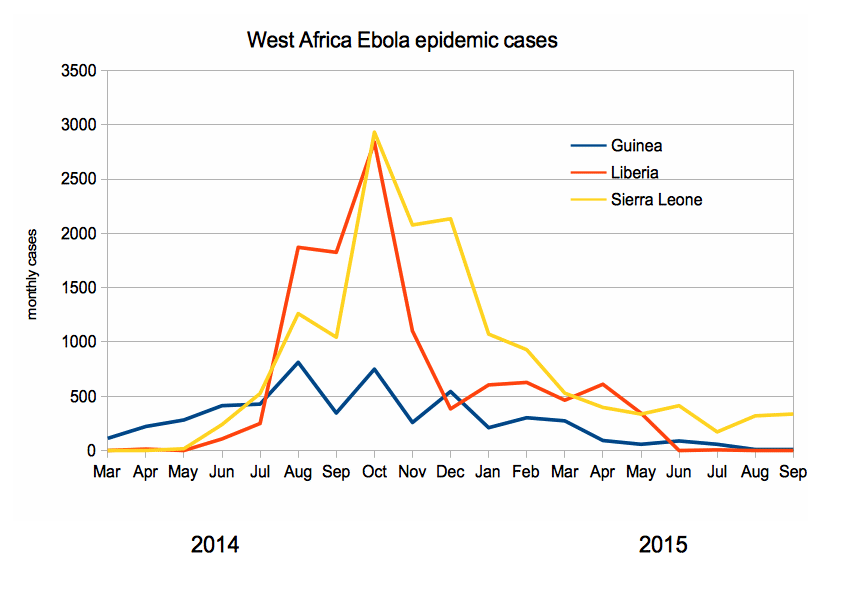

Image by Chris55, Wikimedia Commons, CC BY-SA 4.0

Ebola messaging in African languages


It is useful to disaggregate as much as possible several interrelated aspects of the process of responding to a crisis like ebola in a multilingual context: time; space; demographics of languages; the levels or layers of activity (international, national, provincial, local); modes of developing information in diverse languages (translation, interpretation, and creation*); media (print, media, mobile, in person); and organizational policies.

  • Time: Information about the epidemic came most quickly in English and French - official languages and main languages of media, the aid community, and the medical community. There was a lag in getting information in other languages of the affected countries. Major efforts to address this took a while to get going - according to TWB's report (cited above) its translation efforts began in November 2014 (though it seemed to have started some work in August), which was around the peak of the epidemic (per graph of cases above). Ad-hoc interpretation of incoming information on local levels (local radio, community meetings) was probably ongoing from relatively early in the cycle, with more organized efforts later on, though documentation is limited.
  • Space: Three countries were most hard-hit by the epidemic, and within those some regions within them more so than others. Responses obviously tried to address those, but logistics and information (such as for ebola education) tend to move from center to periphery. Data, on the other hand, may move from periphery to center by one or another means. Neither is perfect, but they evidently took time, especially early in the epidemic, even where there was mobile technology. Since the spatial distances were accompanied by language differences (different languages, different varieties of a language, or even different competencies in a same language variety), there was added time and evidently more potential for misunderstanding. All of this is in theory - I have seen no discussions of spatial dimensions of the response (looking in particular for the impact on information flows).
    • Linguistic demography: One dimension of linguistic demography is of course who speaks what where. Another is that on the country level, speakers of some languages are more numerous than others overall. Translations in languages more widely spoken on the national level were apparently done before less spoken ones. This makes sense on a broad scale but where less widely spoken languages dominate in a local areas, these likely were used orally (the backstory to the murder of health workers in Womey, Guinea included mention of local languages; a story from neighboring Côte d'Ivoire offered a peak at interpretation on the village level), but otherwise may not have received much attention. The only project I heard of that focused on translations in "smaller" languages was one organized by SIL in the neighboring Casamance region of Senegal (mentioned here).
    • Levels/layers: International aid and NGOs, national administration and services, and local communities and their local and extra-local networks seemed to operate on different and often only selectively interacting levels, especially early in the cycle. This dynamic meant that what happened or was being said on one level may or may not have had (immediate) effect on, or even in the extreme not been known by the others. And where information and diverse languages are involved, gaps and even contradictions (the latter in the form for example of misinformation about what ebola is or its treatment) seemed to emerge fairly quickly especially in critical early stages of an emergency.
    • Modes: Translation efforts focused on standard texts or posters, especially on the level of international aid and NGOs, but also some national level print media, and governmental and non-governmental entities. Interpretation and creation of information in African languages were more national and local in character - meetings, individual contacts, blogs. In the case of media (print, radio, TV) content about ebola, it is not clear the mode in which it was rendered in African languages (translation, interpretation, or creation*). For example, two international organizations working with media - International Committee of the Red Cross (ICRC) and Catholic Relief Services (CRS) - had projects with community radio stations to broadcast messages in local languages, but in neither case was it clear how that was done (which languages, whether oral translation from Europhone scripts or scripts pre-translated in target languages, what training, etc.). An example of community contacts in local languages to spread information about ebola in Liberia was given by International Rescue Committee (IRC) - the person in the example was a physician assistant and evidently fluent in the target language, so able to put information in his own words ("creation" in this model) to fit the needs and questions/challenges as he encountered them.
    • Media: Ebola messaging in African languages was conveyed on diverse media (print, poster, TV, radio, blogs, video, and mobile apps) as well as via community meetings and individual contacts. I am not aware of any studies of media activity during the ebola epidemic that might include discussion of languages used. An exception is information about mobile media used during the epidemic - "mobile-based interactive voice response technology," and apps like the SAWBO animations with African language voice-overs and the abovementioned "Polly." Also, an observation mentioned in an earlier posting that the dominant languages used in each means of communication tended to differ, such that in Nigeria supposedly the higher tech media used more English and the in person and community communication tended to be in first languages.
    • Organizations and languages: The observation by Nadia Berger and Grace Tang based on TWB's work translating ebola messages that "translation is not always considered a priority by governments and aid agencies" echoes experience more generally in international development. This is a major structural hurdle to more effective use of African languages in response to crises like the ebola epidemic, in health education, and indeed in all aspects of development. Do organizations and agencies have policies with regard to languages in the multilingual societies struck by the epidemic, or was the linguistic dimension of their work handled as an incidental consideration really given less priority in the face of a very physical crisis, despite its relevance to successful public education and control of disease transmission?
    With the latter point in mind, it is worth taking a quick look at whether and how language as a factor did or did not figure in reports of organizations involved in response to the ebola epidemic.

    Language in reports on ebola responses?


    Reports on ebola response efforts by Medecins Sans Frontiers, World Health Organization, and IRC did not mention languages or translation, nor did an analysis of the international ebola response by the UK Overseas Development Institute's Humanitarian Policy Group.

    The U.S. Centers for Disease Control (CDC), to its credit, did in its report mention language as a factor: "The Road to Zero: CDC's Response to the Ebola Epidemic." (Recall that CDC's ebola information resources included a few in Malinké - a variety of Manding). The two specific mentions merit a closer look:
    • A CDC worker with "intermediate" French worked with people Guinea's forest region, of which perhaps only one per village might speak French, to "translate important  health messages into the local language" and train local workers. An impressive effort, but the kind of situation where available language support - people with better French and acknowledged erudition in the local language(s) - could help assure accuracy of translations and messages in the local language. Also, since that part of Guinea has several local languages, it is not clear which was the focus of efforts
    • A training of midwives and cleaners was held in the Malinké language "since they do  not speak French, the official language of Guinea." Looked at another way, a big reason to use an important first language and lingua franca like Malinké would be that this is understood better, and that an advantage of training using such languages is that it could arguably better prepare trainees for work with patients who may also speak them better than the Europhone official language, French. (Another possibility might be a bilingual format with relevant African and Europhone languages, arguably better preparing trainees for contexts they will encounter.) 
    Reports or website content of all but a few of the 67 organizations on USAID-CIDI's list of NGOs involved in ebola response also did not discuss languages or translation (to be fair, a few of those which didn't were only involved in logistics of shipping supplies). CIDI's list is extensive, but notable among the omissions is TWB, certainly the most prominent international NGO facilitating translation of ebola materials. The exceptions which did mention language include:
    Another organization on the CIDI list, Mali Health Organizing Project, used Bambara in its ebola response, as one would expect (for example in a factsheet), but did not mention this linguistic dimension in its report or website.

    In all of these instances it would be helpful to have any materials developed/used for review (were they saved?) and incorporate them in archives for potential reuse (per 2Ds & 4Rs).

    Perspectives of health workers & patients?


    Another level at which language is important in such an epidemic is that of the interaction between health workers and the patients. For a glimpse of this issue, see two personal accounts by Western nurses about the language gap between them and patients (in Nurse.com and PIH.org). It would not of course have been possible to train foreign health workers in any of the local languages they would encounter, given the time factor, but one wonders if a couple of words or phrases might have made the difficult experience a bit more bearable for caregiver and patient (especially the younger ones).


    * Note on these 3 terms. On the first two, there seems to be a gap in the terminology: "translation," strictly speaking, refers to text, as distinct from "interpretation" being defined as oral and in person (physically or virtually). This leaves out what we might call oral translation, or interpretation of a source either received as text (announcer on radio reading in one language but giving the meaning in another) or heard in one language (in a meeting or on media) but transmitted orally in another language at a later time. These kinds of cross-language sharing are common in multilingual societies with rich oral traditions, and I suggest in this context they be considered as forms of interpretation (keep in mind the range of meaning of "interpretation" as an art). "Creation" is intended to cover instances where the writer (for example of a blog) or speaker (many possible scenarios) is conveying their understanding of a subject in their own words - which happen to be in a language different than that of the main international media, medical research, etc. Of course the lines among these three are not rigid, but I think it is useful to retain them as more or less archetypes of different ways information about ebola was communicated in African languages. (The neologism "transcreation" has specific applications, but might constructively be adapted for use somewhere within this space.)

    Thursday, December 10, 2015

    Graphics arrangement for posters in Arabic & N'Ko

    Localization primarily concerns language - translation from a source language to a target language - but also requires attention to cultural dimensions of communication and presentation of images. One aspect that apparently has been overlooked on more than one occasion is the arrangement of graphics when the target language is written - and read - right-to-left (RTL).

    An often cited example is advertising translated into Arabic, where "before" (on the left) and "after" (on the right) pictures were not switched in the Arabic version, unintentionally implying the opposite of the visual message the advertisers hoped to convey (one site mentions this happening for a medicine and for laundry detergent).

    RTL in ebola materials


    International SOS to its credit has various ebola education materials in several languages, including Arabic and N'Ko, which are both written RTL. However these products - whatever the quality of their translations (which I'm not in a position to judge) - have run afoul of the same issue described above: The graphic layouts have not been inverted to correspond with the text direction.

    First, ebola awareness posters in Arabic and N'Ko:

    Ebola awareness posters in N'Ko (Manding) and Arabic, from International SOS

    The graphics in these posters are arranged in exactly the same way as they are for left-to-right languages (like English), which means that the text reads one way, while the images are ordered in the opposite direction. Not ideal - readers can probably figure it out (assuming a certain level of literacy and familiarity with a visual clue like the arrow point, which we take for granted), but why make them work at it? Imagine following instructions or a comic in English with illustrations in panels organized from your right to your left.

    But it's easy to fix. Here's the middle section of the N'Ko poster with graphics inverted:


    This was quick and dirty, done with MS Paint on a laptop (can anyone who reads N'Ko evaluate it?). A professional effort would use a more sophisticated graphics program (Gimp or Adobe Photoshop) to get the spacings and alignments right and maybe flip some of the individual images. But the text and the illustrated story line here do at least go in the same direction.
    Handwashing poster in Arabic from ISOS

    And there's more. A handwashing poster in Arabic, again from International SOS (translation by Translators Without Borders), has the images of steps ordered in the direction contrary to how the language is read. It could be redone with the image sequence reversed to RTL and the digits changed to Arabic form (١٢٣٤٥٦٧٨٩٠).

    Again, I'm not trying to be critical, but these are errors that stand out, and don't require any particular knowledge of the languages or scripts involved to set right.

    A lot of good effort and resources went into producing such materials, and for good reasons, but all that gets unnecessarily discounted if such a basic mistake - one well known in advertising, localization, and development communication - is not corrected before dissemination.

    But starting from where we are, with the urgency of the epidemic that prompted these efforts behind us, we have the opportunity to more carefully review and revise such materials to prepare them for re-use/re-purposing (per the 2Ds+4Rs). And in the case of layout, to think about establishing a best-practice of producing alternate graphics templates with inverted image order for RTL languages. How can this be done?

    Thursday, November 19, 2015

    Two ebola posters in Krio, and revenge of Bambara Arial

    On the theme of reviewing health education materials on ebola (and generally) per 2Ds&4Rs, here are some examples of why it is important.

    First, two different posters in Krio, and quick analysis following. The first one comes from the International SOS collection (.pdf originals were converted to .png to display here):
    Krio ebola poster from International SOS
    The other Krio poster comes from the US Centers for Disease Control and Prevention (CDC) collection.

    Krio ebola poster from CDC
    Although I do not speak Krio, the language in the first poster looks to be closer to that used in a Krio announcement by the US Embassy in Freetown last year (see previous post on this blog). Can anyone familiar with the written form of the language tell if the second one is Krio or English with some Krio words? (Of course, Krio is an English-based creole, but it isn't English.)

    Second, is a Bambara translation of instructions on hand-washing, again from the International SOS site.
    Bambara poster on hand-washing from International SOS


    It seems to have been a good translation, but produced with an old 8-bit font (apparently Bambara Arial), which when printed or converted to .pdf on a computer without that font, produced the odd and unreadable results you see. In the age of Unicode, this shouldn't happen.

    At some stage such efforts in African languages need to be reviewed, just as materials in English or French would be. Not to find fault, but to correct and also to identify the types of problems to watch out for in future such work. This can be done in the context of an archive of African language health education materials, but another issue is how to build in review of such materials before they get disseminated.

    Wednesday, November 18, 2015

    Ebola education materials in African languages need an archive

    We are approaching the second anniversary of the genesis of the ebola epidemic in West Africa in Meliandou, a village in the "Forest region" of southeastern Guinea, and hopefully also its end in that country. The the epidemic of course also ravaged neighboring Liberia and Sierra Leone, which have recently been declared ebola-free, and threatened to expand across the region before concerted local and international efforts turned the tide.

    During the worst of the crisis I tried to highlight some of the ebola education efforts in African languages, with attention to some aspects that might affect their effectiveness to communicate messages. In that process I suggested that it is helpful to make health education materials in these languages widely available not only for their intended purpose, but also to facilitate improving them for future use, as summarized in "2Ds+4Rs: Why repost ebola info in African languages?"

    At this time, with the peak of the epidemic thankfully behind us, it is important to find a way to archive ebola education materials in African languages. Other materials and lessons learned in English and French are certainly also important, but certainly won't lack for attention. It seems that there are three challenges for materials in African languages:
    • The languages are many, but materials in each relatively few
    • Materials are dispersed in different virtual and probably physical locations
    • Although some materials are accessible on internet, other materials on local or national levels are not, and in fact may in time be lost
    So for instance the Ebola Communication Network and International SOS sites each have some posters in African languages (along with other languages) and a few in the same languages. That's fine, but why not also bring all the African language materials from those and other sites, to a site only on African languages, and group the materials by language? Such a site could be maintained by one or more of language organizations like the African Academy of Languages (ACALAN), health organizations like the WHO Regional Office for Africa, or academic organizations such as the African Language Materials Archive (ALMA).

    In addition to the digital materials shared on websites - text as well as audio and video - I imagine there must be more materials in diverse languages on national levels. How to gather those is another question.

    Thursday, March 26, 2015

    Ebola information in Vai

    Recent news of a new case of ebola in Liberia, and discussions such as that initiated by Bill Gates on preparedness for future possible epidemics, make the issue of developing health education resources in the first languages of potentially affected populations an ongoing and future priority.

    Following up on previous postings of ebola information in various African languages, here is a translation in the Vai language of a FAQ on the virus from the World Health Organization, as transcribed in the Vai syllabary and in the exended Latin orthography. The translation and transcriptions were done by Tombekai V. Sherman and facilitated by Athinkra LLC. These are available in PDF format on Athinkra's Google site. Thanks to Charles Riley of Yale University for sharing the Word .doc versions, which are much simpler to copy into the blog.

    Vai is spoken by over 100,000 people mainly in Liberia, but also in Sierra Leone.

    The Vai syllabary is encoded in Unicode. To view the text, you may need to download a font. Free Vai fonts are available on Michael Everson's website. (See also the SIL Vai fonts page.)


    ꖦꖕꕰ ꕺꖃ ꗏ ꔳꘂ ꖴꗷ ꗏꗒꗡ ꕉꔱꔸꕪ ꕗꕴꔀ ꕞ ꖏꕎ

    Dúúnyá kpolo lɔ tíyɛ́ kulɛ lɔndɔɛ áfíríka gbawoe lá kówa

    ꖤꕢ ꖷꔧ ꘃ ꕎꕌꔳ ꖴꖨꘋ ꕒ ꕉ ꕞ ꗓꔒ ꗪ Iꕷꕞ ꕙꗐꔻ ꕃꕩꕌ ꕞ

    Túsá múĩ́ kɛ́ wáhátí kúluŋmɓa a lá sɔ́lé ɓɛ ibhóla varɔ́si kiyaha la


    ꔤꕷꕞ ꕙꖄꔻ ꕃꕩꕌ ꔳꕩ ꔈ ꕎ ꖏ?

    ꔤꕷꕞ ꔳꕩ ꕃꕩ ꗬꗷꕩꕌꔒ ꕎ ꖏ ꕉ ꘃꖷ ꕞ ꘊꘊ ꗪ ꗉꖺꗚ ꕉꖷ ꕎꕌꔳ ꖴꖨꘋ ꕒ ꕉ ꕧꕴ ꗞ ꘃꗺ ꖸ ꕮ ꔧ ꘃꗺ ꔌꘋ ꖷ ꖸ ꕔꕌ ꗞ ꘃꗺ ꖸ ꕞ ꕉꖸꕊ ꗪ ꕃꔤꘂ ꗱ (ꗚ ꗅꘋ, ꖑꔓꕞ, ꔧ ꕴꖃ) ꕉꖷ ꕃꕩ ꔫꔤ ꕯ ꔤꕷꕞ ꕙꖄꔻꘂ ꕎ ꗱ. ꕉꕌ ꘊꘊ ꗪ ꘃ ꗉꖺꗚ ꕉꖷ ꕉ ꖴꘋ ꗞ ꕘꕌ ꕎꕌꔳ ꖴꖫ ꖝ ꗏ, ꘃ, ꗞ ꖴꘋ ꕸꖃ ꔉꕖꕌ ꕉ ꕧꕌ.

    ꕉꔤ ꘊꘊ ꕪꕮ?

    ꕪꘋ ꖷ ꗏꔤ ꕙꖄꔻ ꘈꗢꖸ ꖸ ꔮꔷꘋꔕ ꗪ ꖦꖕꕰ, ꗞ ꕮ ꕉ ꗓ, ꕉꖷ ꕉ ꗏ ꕪꔒ ꕮꕊ ꗷꔤ ꖷ ꔖꔜ ꕙꖄꔻꘂ ꖃꘋꕡ ꗞ ꘃꗺ ꖸ ꗏ. ꕎꕌꔳ ꖴꖨꘋ ꕒ, ꗞꗢ ꔖꔜꕯꕊ ꕩꕌ ꔬꕩ ꕎꕌꔳ ꖷ ꕉ ꖤꖕꔒꔀ ꘃꗺ ꔌꘋ ꕞ ꕉ ꘃ ꖷ ꕙꖄꔻꘂ ꘈꗢ ꗪ ꕉ ꗏ.

    ꕃꕞꔤ ꔳ ꕎ ꘃ ꘃꖷ ꔤꕷꕞ ꕙꖄꔻꘂꔤ ꗞ ꔬꕩ ꕒꕡ ꖷ ꗏꖺ ꕩ ꖤꖕꔒꔀ ꕀ ꔌꘋ ꖸ ꕞ ꖝꖕꕯꕊ ꗏ, ꗞ ꗷꔤ ꖷ ꕃꕩꕌ ꗪ ꗳ ꕉ ꕺꖃ ꗏ, ꔌꘋ ꖸ ꗚ ꕴꔤ, ꗷꔤ, ꕸ, ꗻꔤ, ꕔꔺ, ꔧ ꕉꖸ ꗃ ꗠꖻ ꖸ, ꔧ ꗏ ꕃꔷ ꔌꘋ ꖷꔧ ꗃ ꕃꕩ ꗞꗢ ꕮꔧ.

     ꕉ ꖴꘋ ꘊꘊꕰ ꔌꘋ ꖸ ꗱ ꗚ ꘈꗻꔤ, ꕉ ꘃ ꖷ ꕞ ꕒꘋ ꖤꖕꕎ ꕀ ꔌꘋ ꖸ ꕞ ꗞ ꖝꖕꕯꕊ ꗏ, ꕉ ꘃꖷ ꔻꔭꔤꔒ ꕞ ꔳ ꗳ ꔤꕷꕞ ꕙꖄꔻꘂ ꕞ.

    ꕉ ꖴꘋ ꕎꕌꔳ ꔬꕩ ꔎꔒ ꗱꕞ ꗪ ꔎꔒ ꗞ ꕒꘋꔕ ꕉ ꗛꖺ ꗏꗒ ꗳ ꕮꕊ ꗏ ꘃꖷ ꕉꔤ ꗬꗷꕩꕌ

    ꔤꕷꕞ ꕙꖄꔻ ꕃꕩꕌ ꕧꔤ ꕀꕩ ꕪꕮ ꔧ ꖏ ꖷ ꖸ ꕃꕩꕌ ꕩꕌ ꕮ ꗞ ꕺꖃ ꗏ?
    • ꕃꕮ 
    • ꗉꗟ ꘃ 
    • ꖝ ꗏ ꗃ 
    • ꕪꘋꗜꖺ ꖨꘋ 
    • ꖨꘋ ꗓꕯꕊ ꖸ ꗪ ꖬꘂ ꖬꘂꗡ ꗏ 
    • ꖝ ꗏ ꖨꘋ 
    • ꖴꘋ ꖨꘋ 
    • ꕪꔷ ꘈꗻ ꗚ ꗠꖻꗠꖻ ꕎꔤ ꕯ ꗞ ꔬꕩ 
    • ꕪꔷ, ꕧ ꗅ ꗏ ꕧꕌꔒ, ꔻꖎ ꔻꖎ, ꕉꖷ ꕃꕩ ꗞꗢ ꗃꖺ ꖸ ꗏ, ꕴꔤ ꔳ ꗃꕯ ꕪꘋ ꖷ ꔰ ꖇꕱ ꗪ ꗞ ꖝꖕꕯꕊ ꕮ. 
    ꗞ ꖴꘋ ꕸꖃ ꔉꕖꕌ ꕉ ꕧꕌ ꕪꕮ?
    • ꔤ ꖬꕮ ꘃꖷ ꔤ ꕮ ꖤꖕ ꕀ ꔌꘋ ꔰ ꕞ ꕉ ꘃꖷꔧ ꗃ ꔤꕷꕞ ꗞꖻ ꖝꖕꕯꕊ ꗏ ꖺ ꗞ ꖷ ꔤꕷꕞ ꕃꕩꕌ ꗪ ꕉ ꕞ. ꗞ ꖷꔧ ꕔꕌ ꗞ ꗷꔤ ꘈꗢ ꕞ, ꕕ ꖷ ꗐꕒ ꕸꕔꔤ ꔳ ꕉ ꕸꖃ, ꕉꖷ ꕧ ꗅ ꖴꕮ ꗱꗡ ꘈꗢꘈꗢꔧ ꔳ ꕉ ꕧ ꗅꗡ ꖸ ꖴꕮ, ꕉꖷ ꕉ ꖬꘋ ꕮ ꖝꘋꔕꔤ ꔳ. 
    • ꗞ ꖷ ꔰ ꕧ ꕀꕩ ꔒꘋ ꗨꗡ ꗪ ꘃ ꔤꕷꕞ ꕃꕩꕌ ꖴꘋ ꔳꕩ ꕉ ꕞ, ꕉꖸꔧ ꕚꕌ ꕉ ꕞ ꕧꕮ ꘀꕇ ꕪꘋ ꘃꖷ ꕉꖸ ꖴꘋ ꕉ ꘀꗫꕩ ꕉꖷ ꕉꖸꔧ ꗓ ꔎꘋ ꕃꕩ ꘈꗢ ꕞ. ꕕ ꖷ ꗏ ꕉꖸꔧ ꗞ ꖸ ꘀꗫ ꕉ ꘃ ꖷ ꖸ ꕔꕌꔒ ꔳꕩ ꔤꕷꕞ ꕃꕩ ꗞꖻ ꕞ 
    • ꗞ ꖷ ꖸꔧ ꕘꕌ ꔤꕷꕞ ꗱ, ꕕ ꖷ ꕉꖸꔧ ꗞꗢ ꘃ ꗏꖺꕎ ꔌꘋ ꗅꖤ ꗅꖤ ꗏ ꕉꖷ ꕉꖸ ꕩꕌ ꕚꕴ ꕧꕮ; 
    • ꕕ ꖷ ꗞ ꖸꔧ ꖴꘋꗒ ꕪ ꔇꔀ ꕧꕮ ꘀꕇ ꕪꘋ ꔧ ꕉꕡꕌ ꗱꗡ ꘃ ꔤꕷꕞꕌ ꖴꘋ ꔳꕩ ꗞ ꕞ. 
    • ꗞ ꖷ ꔰ ꕔ ꗱ ꗓꖺ ꗪ ꕮꕯ ꕉꕌ ꖏ ꕮ ꕉ ꕞ ꗓꔒ ꗪ ꔤꕷꕞ ꕃꕩꕌ ꕞ, ꕕ ꖷ ꕉꖸ ꕩꕌ ꕮ ꕧꘋꕨꕌ ꕎ ꘃ ꕃꕩ ꗞꖻ ꕮꔕꔀ ꖸ ꕞ, ꕉꖷ ꕉꖸꔧ ꗓ ꕃꕩ ꔫꔤ ꕞ ꔬꕩ ꕃꔤꘂ ꖸ ꗱ ꗯꗷꘋ. 
    • ꗞ ꖷ ꖸ ꔰ ꗪ ꗓ ꘃꕯ ꖽꔻꔪꕿꔀ, ꕕ ꖷ ꕉꖸꔧ ꖴꘋꗒ ꕪ ꕚꘋꔕ ꗱꗡ ꕉ ꕞ ꗓꔒ ꗪ ꕃꕩ ꘈꗢ ꕞ ꖏꕎ ꔧ ꕃꕞ ꖷ ꖸ ꗱ ꕉ ꖴꘋ ꘊꘊꕰ. ꕕ ꖷ ꕉꖸꔧ ꕞ ꔷꔤ ꖏ ꖸ ꕮ ꗚ ꕃꕞ ꖷ ꖸ ꗱ ꗞ ꖸꔧ ꕀ ꖺ ꕴꔤ ꔬ ꕉꖸ ꕙꕰꕊ ꖸ ꗏ ꔧ ꗓ ꘃ ꖷ ꔰ ꕞ ꗓꔒ ꗪ ꕴꔤ ꖏ ꕞ, ꖺ ꕀ ꔌꘋ ꖷ ꖸ ꔰ ꗪ ꖝꖕꕯꕊ ꗏ, ꔧ ꗐꕒ ꘃ ꗞ ꖝꖕꕯꕊ ꗏ ꕀ ꗃ ꖏꕎ, ꔧ ꕀ ꖺ ꕴꔤ ꕢꕌ ꖴꖫ ꖷ ꔰ ꕉꖸꕩꕌ ꘃꕩ ꕔꔤ ꗏ, ꕉꖸꕊ ꔬꕩ ꕃꔤꘂ ꔳ ꗷꔤ ꖷ ꗏꖺ ꕉ ꕢꔒ ꗪ ꘀꘉ ꔞꘋ ꖏꔀ ꖸ ꕮ ꕉ ꕞ ꗓꔒ ꗪ ꕃꕩ ꘈꗢ ꕞ. ꖽꔻꔪꕿ ꗞꗢ ꖸ ꗏꗒ ꔰ ꕉꖸꕊ ꕃꔤ ꔌꘋ ꗏꔤ ꖸꔧ ꔳ ꕉ ꘃ ꖷ ꗪꘋꕡ ꕃꕩ ꘈꗢ ꕞ ꔬꕩ ꕃꔤꘂ ꕮ, ꗚ ꕸꖃꕒꕌꕇ ꕮꔧ ꕈꕰꔒ, ꗏꖺꕎ ꕸꖃ ꕸꕔ, ꖬꘋ ꕮ ꖝꘋ ꔌꘋ, ꔧ ꕧ ꗅ ꕮ ꖝꘋ ꔌꘋ. ꗓ ꘃ ꗱ ꔌꘋ ꖷ ꖸ ꕕ ꕮꕊ ꗞꔧ ꕿ ꕉꖸ ꔱꔷ, ꕕ ꖷ ꕉꖸ ꗽꘉꔒꔤ ꔳ ꕞꕌꕃꔤ ꕪ ꗨꗡꘉꗢ ꗞꔧ ꕿ ꕉꖸ ꘃ ꗏ ꕔꔤ ꗏ. 
    • ꕃꕩ ꘈꗢ ꖴꘋ ꗏ ꘊꘊꕰ ꕃꕩ ꗞꗢ ꕞ ꖏꕞ ꗟꖺꔒꔀ ꖸ ꗱ ꖺ ꔉꔊ ꕧ ꖏꕞ ꖷ ꕃꕩ ꗞꗢ ꕢꕌ ꕉ ꕮ. ꕕ ꖷ ꔌꘋ ꗷꔤ ꘈꗢꖸ ꖸ ꗽꘉꗷꔤ ꔳ ꕞꕌꕃꔤꕪ ꗨꗡꘉꗢ ꗞꔧ ꕿ ꖤꖕ ꕉꖸ ꕞ. 
    • ꔒꔟꕩ ꖷ ꔰ ꕮ ꔤꕷꕞ ꕞ ꗃꕎꘋ, ꖸ ꗞꗢ ꖸ ꕮꔧ ꕕ ꖷ ꕉꖸꔧ ꔵ ꘃ ꕉ ꗏ ꘃꖷ ꗞꗢ ꖸ ꗬꗡꔤ ꖴꘋꗒ ꕪ ꕚꘋꔕ ꗱꗡ ꕉ ꕞ ꗓꔒ ꗪ ꕃꕩꕌ ꗪꗡ ꕞ, ꔧ ꗷꔤ ꖷ ꗞ ꖴꘋ ꕸꖃ ꔉꕖꕌ ꕉꕌ ꘊꘊꗢ ꕧꕌ, ꕉ ꕒꕢꔒ ꗪ ꗷꔤ ꖷ ꗞꔧ ꕘꕌ ꖏꔀ ꖸ ꖴꘋ ꔻꔤ. ꗞ ꖷ ꖸꔧ ꕘꕌ ꔤꕷꕞ ꕼꕱ ꗱ, ꕕ ꖷ ꕉꖸ ꕩꕌꖸ ꕚꕴ ꕧꕮ ꔧ ꗷꔤ ꖷ ꕃꕩꕌ ꔇꔀ ꖴꘋ ꗞ ꕮꔕ ꖸ ꔬꕩꕌ. 
    ꗞ ꖷ ꖸ ꕔꕌꔒ ꔳꕩ

    ꕃꔤ ꖷ ꕃꕞ ꔋꘋꔋꘋ ꖷ ꗱ ꗞ ꖸ ꖴꘋ ꕃꕩ ꘈꗢ ꔬꕩꕌ ꕉ ꗃ ꗱ ꕉ ꔳꕩ ꕴꔤ ꗱ ꕎ, ꔧ ꕀ ꔌꘋ ꖷ ꖸ ꔰ ꖝꖕꕯꕊ ꕩꕌꖸ ꕈꕰ ꖺ ꕀ ꔌꘋ ꖷ ꖸ ꔰꔤ ꗃ ꖝꖕꕯꕊ ꗏ, ꗞ ꖷ ꖸ ꕔꕌꔒ ꔳꕩ ꔤꕷꕞ ꕃꕩ ꗞꖻ ꕞ, ꕕ ꖷ ꕉꖸꔧ ꔳ ꕧ ꘀꗫ ꕚꘋꔕ ꗛꖺ. ꕕ ꖷ ꕉꖸꕩꕌꖸ ꕺꖃꔀ ꕞ ꕔꔺꘂ ꘀꗫ ꔻꔤꕯꕊ ꗱꕞ ꔎꔒ ꔰ ꖝ ꗏ, ꕉꖷ ꕕ ꖷ ꕉꖸꕩꕌꖸ ꕮ ꕧꘋꕨꕌ ꗞ ꕮꔕ ꖸ ꕞ ꕎꕌꔳ ꖷ ꗏꖺ ꕉꕡꕌ ꗱꗡꔒꔀ ꘃ ꕉ ꕺꖃꔀ ꗪ ꕔꔺꕯꕊ ꖺ ꕃꕮ ꗪ ꗻꗡꕯꕊ ꕉ ꕞ.
    Ibhóla várɔ́si kiyaha tiya mɓe wá ko?

    Ibhóla tiya kiya kpɛlɛyáhalé wá ko a kɛ mú lá nyɛnyɛ ɓɛ fɔɔyɔ amu wáhátí kúluŋ ɓa a jáwo mɔ kɛ́ndɛ́ nú ma hĩ kɛ́ndɛ́ feŋ mú nú kpãha mɔ kɛ́ndɛ́ nú la anúã ɓɛ́ kiiyɛ fɛ (yɔ́ kpɔŋ, goréla, hĩ woló) amu kiya ɓhií na ibhóla varɔ́si wá fɛ. Aha nyɛ́nyɛ́ ɓɛ kɛ fɔɔyɔ amu a kuŋ mɔ faha wáhátí kúndú ɓú lɔ, kɛ́ mɔ kuŋ ɓóló kpemgbáha a jáha.

    Ai nyɛnyɛ káma?

    Kaŋ mú lɔ́í várɔ́si mɛɛ̃nú nu kpíliŋndé ɓɛ dúúnyá, mɔ má a sɔ tíŋ tiŋ, amu a lɔ kálé máã lɛ́i mú sénjé várɔ́siyɛ loŋnda mɔ kɛ́ndɛ́ nú lɔ. wáhátí kúluŋ ɓa, mɔɛ̃ sénjénaã yaha ɓiya wáhátí mú a tuulée kɛ́ndɛ́ feŋ la a kɛ mú várɔ́si mɛɛ̃ ɓɛ a lɔ.

    Kílai ti wá kɛ kɛmú ibhóla varɔ́siyɛi mɔ ɓiya ɓanda mú lɔ́ɔ ya tuulée jí feŋ nú la mɔ ɓúunaã lɔ, mɔ lɛ́i mú kiyáha ɓɛ tɛ́ a kpoló lɔ, féŋ nú yɔ́ woí, lɛ́i, ɓo, sɛ́í, kpãndí, hĩ anú ɓɔ́ nyɔ́ɔ́ nú, hĩ lɔ́ kili feŋ múĩ́ ɓɔ mɔɛ̃ máí.

    A kuŋ nyɛ́nyɛ́nya féŋ nú fɛ yɔ́ mɛ́sɛí, a kɛ mú la ɓaŋ tuúwa jí feŋ nú la mɔ ɓúunaã lɔ, a kɛ mú símɓiilé la ti tɛ́ ibhóla varɔ́siyɛ la.

    A kuŋ wáhátí ɓíya télé fɛlá ɓɛ́ télé mɔ ɓáŋndé a kɔ́ɔ lɔndɔ́ tɛ maã lɔ kɛmú ai kpɛlɛyaha

    Ibhóla varɔ́isi kiyaha jái jiya káma hĩ kó mú nú kiyaha yaha ma mɔ kpoló lɔ?
    • kímá 
    • fɔ́nɔ́ kɛ́ 
    • gbú lɔ ɓɔ́ 
    • káŋngɔ́ɔ lúŋ 
    • lúŋ sɔnáã nu ɓɛ́ suyɛ súyɛɛ lɔ 
    • ɓú lɔ lúŋ 
    • kuŋ lúŋ 
    • kali mɛ́sɛ́ yɔ́ nyɔ́ɔ́nyɔ́ɔ wái ná mɔ ɓiya 
    • kalí, já kpɔ́ lɔ jahalé, síyo síyo, amu kiya mɔɛ̃ ɓɔ́ɔ nú lɔ, woí ti ɓɔ́na kaŋ mú gbi sóó ɓɛ mɔ ɓúunaã ma.
    Mɔ kuŋ ɓóló kpemgbáha a jáha káma?
    • I suma kɛmú í má tuu jí feŋ gbi la a kɛmúĩ́ ɓɔ ibhóla mɔɔ̃́ ɓúunaã lɔ ɔ mɔ mú ibhóla kiyaha ɓɛ a la. Mɔ múĩ́ kpãha mɔ lɛ́i mɛɛ̃ la, kpã mu rɔ́ɓa ɓokpai ti a ɓóló, ja kpɔ́ kuma fɛ̃ɛ́ mɛɛ̃mɛɛ̃ĩ́ ti a já kpɔɛ nú kuma, amu a súŋ ma ɓúŋndéi ti. 
    • Mɔ mú gbi já jíyá leŋ pɛ́ɛ́ ɓɛ kɛ ibhólá kiyaha kuŋ tiya a la, anúĩ taha a la jama jɛnɛ kaŋ kɛmú anú kuŋ a jɛ́mɓɛya amu anúĩ sɔ téŋ kiya mɛɛ̃ la. kpã mu lɔ́ anúĩ mɔ nú jɛmɓɛ a ku mú nú kpãhalé tiya ibhóla kiya mɔɔ̃́ la. 
    • Mɔ mú núĩ faha ibhóla fɛ, kpã mu anúĩ mɔɛ̃ kɛ rɔ́ɓa feŋ kpɔ́tú kpɔ́tú lɔ amu anúyaha tawo jáma; 
    • Kpa mu mɔ núĩ kuŋndɔ ká ɓee jáma jɛni kaŋ hĩ andaha fɛɛ kɛ ibhóla kuŋ tiya mɔ la. 
    • Mɔ mú gbi kpã fɛ sɔ́ɔ ɓɛ mána aha kó ma a lá sɔ́lé ɓɛ ibhóla kiyaha la, kpã mú anú yaha ma jaŋnjaha wá kɛ kiya mɔɔ̃́ mandée nú la, amu anúĩ sɔ kiya ɓhií la ɓiya kííyɛ nu fɛ gbɛ́lɛ́ŋ. 
    • Mɔ mú nú gbi ɓɛ sɔ kɛ́na hɔsipítoe, kpã mu anúĩ kuŋndɔ ká táŋndé fɛɛ a lá sɔ́lé ɓɛ kiya mɛɛ̃ lá kówa hĩ kíla mú nú fɛ a kuŋ nyɛ́nyɛ́nya. kpã mu anúĩ lá lii kó nú ma yɔ́ kíla mú nú fɛ mɔ núĩ jí ɔ woí ɓi anú vanyáa nú lɔ ɔ sɔ kɛ́ mú gbi lá sɔ́lé ɓɛ woi ko la, ɔ jí feŋ mú nú gbi ɓɛ ɓúunáã lɔ, hĩ …... anúa ɓiya kííyɛi ti lɛ́i mú lɔ́ɔ a salé ɓɛ jɛni keŋ koe nú ma a lá sɔ́lé ɓɛ kiya mɛɛ̃ la. hosipíto mɔɛ̃ nú lɔndɔ́ gbi anúa kili feŋ núĩ ti a kɛ mú ɓɛŋnda kiya mɛɛ̃ la ɓiya kííyɛ ma, yɔ́ ɓólóɓáhání máí nyínyalé, rɔ́ɓa ɓóló ɓokpa, súŋ ma ɓúŋ feŋ, hĩ já kpɔ́ kuma fɛ́ɛ́ mɛɛ̃mɛɛ̃. Sɔ kɛ́ feŋ mú nú kpã máã mɔĩ to anú fili, kpã mu anú zɛnɛléi ti lahakiika pɛ́ɛ́nɛ́ɛ̃ mɔĩ to anú kɛ kpái lɔ. 
    • Lengéya mú gbi ma ibhóla la ɓɔwaŋ, nú mɔɛ̃ nú máí kpã mu anúĩ dí kɛ a lɔ kɛmú mɔɛ̃ nú kpɛ́ɛ́i kuŋndɔ ká táŋndé fɛɛ a lá sɔ́lé ɓɛ kiyaha ɓɛ́ɛ la, hĩ lɛ́i mú mɔ kuŋ ɓóló kpemgbáha aha nyɛ́nyɛɛ̃ jáha, a ɓasalé ɓɛ lɛ́i mú mɔĩ faha kóe nú kuŋ sii. Mɔ mú núĩ faha ibhóla fɛ, kpã mu anúyahanú tawo jáma hĩ lɛ́i mú kiyáha ɓée kuŋ mɔ mandé nú ɓiyaha. 
    Mɔ mú nú kpãhalé tiya

    Kii mú kila gbeŋgbeŋ mú fɛ mɔ kuŋ kiya mɛɛ̃ ɓiyáha a ɓɔ fɛ a tiya woí fɛ wa, hĩ ji feŋ mú nú gbi ɓúu náã yahanú nyinya ɔ féŋ mú nú gbii ɓɔ ɓúu náã lɔ, mɔ mú nú kpãhalé tiya ibhóla mɔɔ̃́ la, kpã mu anúĩ ti já jɛ́mɓɛ́ táŋndé kɔ́ɔ. kpã mu anúyahanú kpolóe lá kpãndiyɛ jɛmɓɛ si náã fɛlá télé gbi ɓu lɔ, amu kpã mu anúyahanú ma jaŋnjaha mɔ mandée nú la wáhátíĩ́ mú lɔ́ɔ andaha fɛ́ɛ́lée kɛ a kpolóe ɓɛ kpãndi náã ɔ kimá ɓɛ sɛɛ náã la.


                                       Communication, Advocacy and Media Unit
                                       Telephone: + 472 413 9420, + 242 06 614 2401
                                       E-mail: afrgodrdcam@who.int
                                       Source: World Health Organization Regional Office for Africa

    Addendum (27 March 2015)

    As far as I'm aware, there are 3 Unicode fonts that include the Vai script:
    • Dukor (Evertype)
    • Ebrima (African font provided with Windows 7)
    • Wakor (Evertype; this is based on the old SIL Vai font, which is not Unicode)

    Wednesday, December 31, 2014

    Does spelling matter in Malinke ebola materials?

    An earlier post looked at problems with non-standard Bambara in an ebola poster. Here I'll look at similar issues with a poster in Malinke (Maninka), a closely related Manding language spoken mainly in upper Guinea, and also southwestern Mali.

    The Malinke poster at right is a translation of a CDC poster on ebola symptoms, one of various different materials translated into a number of languages by Translators Without Borders. It appears to be written in the old, pre-1985 Guinean orthography with some French spellings.

    After independence, Guinea adopted a common alphabet to transcribe all its languages, using the keys available on the typewriters of the day. Many people learned to read and write with these spelling rules (I personally encountered people and Pular materials using this system, and used it myself, in the mid-1980s), and to some degree their use persists.

    When the government transitioned after the death of longtime president Sékou Touré in the mid-1980s, Guinea adopted an orthography harmonized with that of the other countries of the region. For Malinké that meant for example the following changes: dy → j ; è → ɛ ; nh → ŋ ; ny → ɲ ; ö → ɔ ; and ty → c (the latter sound is represented by "ch" in English and variously by "tch" or "thi" in French).

    The French writing influences in the poster are dj instead of dy or j, and ou instead of u. The accent aigu on é in the poster is probably gratuitous (the letter e in the old and new Malinke orthographies indicates the same sound) - unless a tone was intended by the writer (Manding languages are tonal, but usually tones are not marked in writing them in Latin-based script).

    To see what the current orthography would look like, a simple set of substitutions would be straightforward, however I'm not sure on some word divisions (what knowledge I have of Bambara is an imperfect guide for that task).

    The product as is, is presumably readable - and read-aloud-able - by many in Guinea since it is based on the older transcription. I don't have information on how widespread use of the new orthography is, but that is a question that should be considered.

    And to the extent it is used consistently, conversion to the new system would be easy - which would facilitate use with Malinké populations outside of Guinea, or comparison with materials in other Manding languages (for terminology development etc.). Malike is also written in the N'Ko script (which has been the subject of some previous posts) - transcription between that and the Latin-based systems for communication or for comparison  is not as simple.

    So in answer to whether spelling matters - yes, especially if the material is to be re-used or reviewed in comparison to other materials in Malinke or in other Manding languages. The fact that there has been a change in orthographies adds a complication, but one easily dealt with if each system is used consistently. And as indicated above, the matter of relative knowledge and use of the old and new orthographies for Malinke - and other languages of Guinea - is a question.

    Addendum (2 January 2015)


    I am told that the ebola poster above has numerous mistakes. This again points to the need to review materials in African languages (per "2Ds & 4Rs"), preferably before publication.

    See also follow up posting: "More on written Malinke."

    Friday, December 26, 2014

    When do Liberian languages bear mentioning in ebola reporting?

    A recent Oxfam piece about door-to-door ebola education volunteers in the West Point township of Liberia's capital, Monrovia, is an interesting story about local level efforts to combat the epidemic...
    However it tells us nothing about the important linguistic aspects of this communication and research effort in multilingual Liberia. What languages does a volunteer like the profiled Agnes Nyantie use in speaking with various people in West Point? What kind of training did she and colleagues receive in those languages? When she "meticulously" fills out visit forms, is she doing so verbatim, or translating from one spoken language to another written one (presumably English)?

    It may be that all is done seamlessly in English (the official language), but given that Liberia is a country where 31 languages are spoken (per Ethnologue), that no first language is spoken by more than 20% of the population (per Aménagement linguistique dans le monde), and standard English is spoken by only about 20% of the population (per Fact Monster), that seems unlikely.

    Liberian (Pidgin) English is spoken as a second language by around half the population, playing a role analogous to Krio in Sierra Leone, though not as widespread, and apparently not as standardized. So it may be that a lot of the conversations that would be part of work like that being done in West Point take place in the pidgin. However, would a non-standardized pidgin be used to fill out visit forms?

    What about the first languages of Liberia in ebola work? They are used on radio stations, for instance. A story last October in Jeune Afrique highlighted local radio in first languages of Liberia, such as Bassa. A WHO/Africa story discusses traditional chiefs of the National Traditional Council of Liberia recording "several radio messages in different languages telling their people to take steps to avoid Ebola" - these recordings were also used on radio.

    It would seem likely that these languages are used commonly in local level person-to-person interactions about ebola - whether of the sort described in West Point or in treatment facilities, etc.

    However, given the lack of standardized writing for some languages (different situation from some other countries of the region) and use of indigenous scripts which are not yet fully supported on computers/mobile devices for writing some of them, there may not be much ebola messaging in text format - though that is a question to answer.

    So back to the Oxfam article... Recognizing the importance of that organization's contributions to the fight against ebola, and the courageous work of local volunteers working with it to inform and research in ebola striken areas, it would be informative to have more details on the linguistic dimensions of their communication and survey efforts.

    Thursday, December 18, 2014

    Ebola materials in Temne (Temen, Themine, Themne, Timene, Timini, Timne, Timmannee)

    Temne translation by TWB.
    Source: International SOS.

    A posting on this blog in September featured an ebola message in several languages of Sierra Leone, but not Temne, which is widely used mainly in the north of the country (over a million speakers). Here I'll highlight some ebola materials in Temne (with notes about the name of the language at the end).

    First is a translation of the the widely translated and circulated ebola poster by International SOS (on right). This was dated October 7, and done by Translators Without Borders (TWB, which also was involved in producing Mende and Krio versions of the poster).

    TWB also helped Humanitarian Response with production of Temne versions of "Social Mobilisation Key Messages" and "Messages for children and caregivers on Ebola - Child Protection and Education."

    Other material I'm aware of is audio, beginning with Temne versions of the CDC's radio spots. These recordings - which now are in 17 African languages or varieties of those languages (aside from English and French versions) - have been mentioned several times previously on this blog. It is worth recalling that these audio spots are not accompanied by text version in these languages, and there is no information about the approach(es) taken to producing the translations.

    Scientific Animations Without Borders (SAWBO) has produced an animation on ebola, and one of the voice-overs is in Temne. SAWBO's products are available in formats for viewing on cell phones and computer (though there do not appear to be text versions / scripts available).

    I am not aware of any material on ebola developed directly in Temne (written or recorded), although on the levels of national or community radio there may have been some significant use of the language in messaging.

    What's in a spelling?


    A quick comment on nomenclature. The name for the language is rendered in quite a few variant spellings (perhaps including some misspellings), several of which I've listed in the title. These have been observed on the web and/or taken from Ethnologue. Such variation in spelling can't help in managing information in the language. This is not problem unique to Temne (I discussed it in another posting), but seems to be a bit extreme in this case.

    The most widely used spellings in English seem to be "Temne" and "Themne," although I remember hearing the language called "Timini" by a native speaker some time ago (the name in the language itself is apparently "Themnɛ"). Would it be possible to settle on one or two spellings that all organizations working in/with this language would use to refer to it?

    Tuesday, December 16, 2014

    Two more ebola posters in Bambara

    Here are two other Bambara translations of the widely translated and circulated ebola poster by International SOS.

    In a previous posting, I called attention to another version of the same poster in non-standard Bambara. Both of the ones discussed here use the current standard orthography, but also appear to be a better and more complete translations. However there are differences, which provide an opportunity to review them in comparison and ask questions about methods and outcomes.

    The one on the left below was posted on Facebook on October 2 (original provenance not clear); the one to its right was translated by NGO Miriyawa and came from the International SOS site, dated December 1.

    To facilitate parallel review of differences between the two translations, the headings (only) are presented in the table below - along the lines of what I did for the previous Bambara translation (which can be opened in a separate screen for comparison):

    EBOLA VIRISI (BANAKISԐ) EBOLA
    EBOLA YE MUN YE, A BԐ YԐLԐMA COGODI? EBOLA YE MUYE A BԐ MϽGϽ SϽRϽ COGODI?
    MUN YE EBOLA TAAMASHԐNW YE?
    Tamashԑnw bԑ daminԑ tile 2 magalen kᴐ Ebolatᴐ walima a fure la
    EBOLA TAMASԐNW YE MUN YE?
    Tamasԑnw bese ka daminԑn tile 2-21 i magalen kᴐfԑ banabagatᴐ la walima a su la
    Tamashԑn Kunfᴐlᴐw - Tamashԑn Labanw > Tamasԑn Fᴐlᴐ - Tamasԑn Wԑrԑw >
    EBOLA KUNBԐNI ANI WALI KԐTA N'I BANARA? EBOLA KUNBԐ COGO ANI ANW KAN KA MUNKԐ

    The differences show how different people or teams can come up with alternative ways of rendering the same text - presumably comparable in meaning, but not necessarily equal in accuracy or comprehensibility. Or, if the two were actually translated from different versions (for example, one from French and the other from English), this shows how that can result in different outcomes in the target language (Bambara in this case). It is useful in any event, I think, to first compare the two versions in terms of the language in which they are written: Leaving aside copy-editing issues (spelling; typography), how accurate and understandable are the alternative headings - and the rest of the text?

    Going back a step, one question is whether there was any back-translation in either case to verify the accuracy of the translations. Also, what kind of proofing (copy-editing) was done on each version? There are some errors and inconsistencies, although probably not enough to affect meaning.

    Another question is whether either of these versions were "field tested" to get an idea of how an average reader - or a listener to the text being read aloud - would understand and react to the text. And visually, how people react to the illustrations. If that was not done, it would be informative to field test the two versions together (perhaps adding the previously discussed one as well).

    When doing translations for public education about a health emergency, there is obviously a concern with getting materials out there promptly. However, translation shouldn't be a "once and done" thing. I've previously outlined a case for review of materials (in the context of 2Ds & 4Rs), but review - including quality control - needn't delay initial roll-out of material. Some level of review can be built into the initial process, and then follow-up review can follow. In the case of Bambara there are several materials on ebola available now (remember also the MHOP/Dokotoro factsheet and the Bambara Wikipedia article), which could provide the basis for a more in-depth analysis of use of Bambara for communicating about this virus and other diseases.

    Finally, a quick word about "banakisɛ," which appears in one of the above posters. Composed of "bana" (sickness) and "kisɛ" (seed), the literal sense seems very evocative, and in any case more tangible than the abstract loan "virisi." Definitely would wash my hands thoroughly to get rid of those banakisɛw.

    Thursday, December 11, 2014

    Languages & communication in Senegal's ebola success

    Ebola prevention poster in Wolof.
    Y'en a marre and An@fa. 
    Source: TWB via Alexandria blog

    Senegal was declared ebola-free in mid-October, just before a similar declaration for Nigeria. Having previously looked at languages and communication in Nigeria's success, this post will do the same (belatedly) for Senegal. Language is a key consideration in ebola messaging in the multilingual states of West Africa, even if that fact is sometimes overlooked (such as by a National Geographic article on four lessons from Nigeria and Senegal, or a US Embassy Dakar sponsored conference for journalists on responsible ebola reporting).

    By way of background, French is the official language of Senegal, and Wolof the most widely spoken. Of the country's 38 languages (by Ethnologue's count). Wolof and five other languages - Jola (Diola in French spelling), Malinke, Pulaar (as Fula is known there), Serer, and Soninke - are the main national languages. I'll return below to more detailed discussion of categorizating indigenous languages in Senegal, as it could be relevant to planning messaging strategies in similar multilingual countries like Mali, which is the latest country in the region to have an ebola crisis.

    Enter, ebola


    Prior to the sole ebola case in the Senegal - an infected man who came from Guinea to Dakar before the closing of the Guinea-Senegal border on August 21 (he ultimately recovered) - the country had been "well-prepared with an Ebola response plan as early as March." From what information I've been able to gather, information and public education aspects of this plan used a number of languages, but mainly Wolof and French. (An earlier posting included some links to videos and other web-based info in Wolof and Fula/Pulaar.)

    A Senegalese source I consulted (Dr. Ibra Sene) indicated that Wolof and French were used in various media as part of the "massive campaign" to educate people about ebola. However, a report in International Business Times (25 September), characterized radio and television broadcasts of ebola prevention messages as "all day long, in all languages" (without specifying which). If the latter is accurate, it is likely that local community radio stations extended the campaign in additional languages (more on community radio below).

    Still, an SIL-led initiative for translation in southern Senegal was a response to the perception of insufficient attention to communicating about ebola in less-widely spoken languages. It focused on developing ebola materials in the Bandial Gusilay, Jola (Jola-Fonyi), and Manjaku languages of Casamance. Two expat literacy workers in Senegal who facilitated the workshop, Clare Orr and Elisabeth Gerger,  framed it this way
    "These days, a lot of awareness-raising about Ebola is going on across Senegal on the radio and TV. However, many people in the villages don't speak enough French, Senegal's official language, or Wolof, the most widely-used national language, to understand the message well. This is why we are trying to reach them through documents and information in their own languages. Those who are able to read in their language can always read the information aloud for those who can't."

     Community radio


    Community radio is a key component of development communication in much of Africa (see here and here, for example), including Senegal. A grant by OSIWA in September to the Senegalese Union des Radios Associatives et Communautaires (URAC) for an ebola education program on 73 radio stations reflects the importance of this medium.

    A couple of articles have highlighted community radio broadcasts about ebola in first languages of other countries - Guinea, and Liberia and West Africa in general - so one may assume that something similar has been happening in on community radio stations in Senegal. Questions relating to African language broadcasts about ebola on community radio include: which languages?; how was the material developed/translated?; and is any of it available in recordings or transcriptions?

    An interesting dimension of communication via local radio in West Africa is that of associated radio listeners' clubs. The UN FAO noted use of these (and a training for club leaders) to address ebola in communities in Senegal.

    Social media


    On social media, an interesting initiative launched at the end of August as a Facebook group called SenStopEbola, with an associated Twitter account @senstopebola, translated notices and advice on ebola into seven Senegalese languages (see also here; the languages were not specified, but presumably included French and the 6 main national languages). .

    Senegal made use of SMS to send text messages about ebola, but reports I've seen have not indicated what languages were used or the content of messages. Also, it's not clear whether the multilingual GooglePlay app - "About Ebola" (which was created last April, and mentioned in a previous posting on this blog) - is counted as part of this effort. Another GooglePlay app, SenStopEbola, which is evidently related to the initiative on Facebook, was mentioned as having Wolof content, but again, no information on how it has figured in wider efforts.

    The national languages of Senegal


    Of the 38 languages of Senegal, the six most widely spoken - Wolof, Pulaar, Seser, Soninke, Malinke, and Jola - were denoted "national languages" first by presidential decree in 1971, and are specifically named as such in the Senegalese constitution of 2001. The constitution allows for other national languages once "codified" (which includes establishing an "official" standardized orthography).

    From 2001, the policy has been to expand the number of national languages, and to that end, several others were codified by 2002: Hassaniya Arabic; Balanta; Bassari (a.k.a. Oniyan); Manjaku; Mankanya; Noon; and Saafi (a.k.a. Safen). Codification of others has apparently proceeded since then.

    The result is three "groups" of Senegalese languages that reflect history and number of speakers (without implying a hierarchy of value):
    • Those recognized early as national languages, which tend to have the largest numbers of speakers, and for which there is some notable amount of written material.
    • Those codified more recently, but which still need further research 
    • Those still needing further study towards codification.

    Such a grouping of languages in a multilingual state might be a useful parameter to consider when planning out messaging on health topics such as ebola, or other development communication. The first group is readily used, with standard orthography, perhaps also having resources available to consult on the subject area involved - and it reaches the largest number of people. It may be possible even to work on materials outside of the country. The second group may require more effort, including consultation with experts in country. The third may require work mainly on the local level, and where there is not time to develop a standard orthography, use of phonetic transcriptions.

    The experience in Senegal may have followed the above to a degree, but further information is needed. In any event, the first group is divided between Wolof, which was widely used, and the other 5 established national languages, which presumably had varying use (ebola info in Pulaar was on the web, for instance, and the others were  probably used on community radio).


    Spelling again


    As a small contribution to review of ebola materials, the ebola poster in Wolof above has one apparent misspelling - "Fagaroul" - with the French "ou" taking the place of the Wolof "u." It is interesting to note, however, that the same title and spelling is used on the French version of the poster (i.e., a Wolof title, with French influenced spelling, on a French language ebola poster).

    Monday, November 24, 2014

    Does spelling matter in Bambara ebola materials?

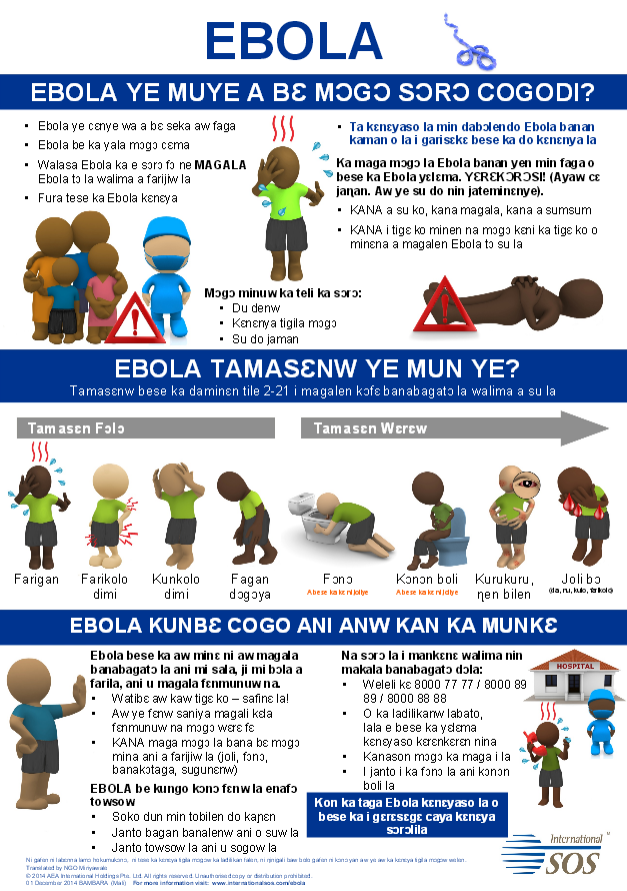
    International SOS ebola poster in Bambara
    A Bambara version of an ebola information poster - one of a number of translations of an original done by International SOS - shows why review of technical health materials translated into or composed in African languages is necessary (per "2Ds & 4Rs"). While giving due credit for the translation, it is also important for the common ultimate goal of communicating about ebola in the most widely spoken language in Mali to offer constructive criticism towards improving this product and guiding similar efforts.

    In the case of this poster, it is immediately apparent that the standard Bambara orthography is not used. This is important since the standard orthography is used in adult literacy, some primary education, and various publications including on ebola and other health related topics. In a previous posting on this blog - "More on standard orthographies of African languages"- I discussed in more detail the reasons to respect and make use of the alphabets and rules of spelling adopted in many African countries for writing their languages. In the case of critically important health information on a deadly virus, adherence to standard ways of writing, as well as to as much standard terminology as there may be, would seem obligatory.

    The resolution of the poster available at this time (from an image accompanying a tweet embedded below, which also includes a French version) is not sufficient to review the content in detail, but is is possible to provide some tentative revisions to the headings (see below the embedded tweet).

    Proposed revisions


    Here are the original headings from the poster followed by tentative revisions. In this I have relied on my rusty knowledge of Bambara with reference to the online dictionary at Bambara.org. Any corrections or better renditions are invited:
    • EBOLA BAANA
    • EBOLA BANA
    (NB- Doubled vowels are pronounced differently than single ones. "Baana" by itself may mean "rich person," although the context here would tell one that what is meant is "bana"=disease.)
    • EBOLA YE MOUBANAYE, ABE DJENSE TIOGODI?
    • EBOLA YE MUN BANA YE, A BƐ JƐNSƐN COGO DI?
    (NB- Clear influence of French orthography - further comment below)
    • ABANA BE DON TIOGODI?
    • A BANA BƐ DƆN COGO DI?
    (NB- Bambara has a 7 vowel system; "ɛ" and "ɔ" are different from "e" and "o")
    • KA EBOLA KOUNBEN ANI I BEN MUKE NI IBANA NA?
    • KA EBOLA KUNBƐN ANI I BƐ MUN KƐ NI I BANANA? [or ... N'I BANANA?]
    (NB- Some issues with nasalized terminal vowels, which are indicated with an "n" following:  "bɛ" is generally not written with a terminal "n", but it may be that the writer hears the open-e ("ɛ") as nasalized; on the other hand, "mun" [what] is written with a terminal "n", though in common speech, the nasalization may not be heard. Also, "ni i" [if you] is often contracted as "n'i".)

    Bambara in French orthography?


    It is possible to write Bambara (or any language for that matter) in French orthography. The New York Times, for instance, used the French spelling of the Bambara and Manding term "jatigiya" (basically meaning hospitality)  - "diatiguiya" - in two recent stories on ebola in Mali (on Nov. 10 and Nov. 12). And it is true that Bambara speakers schooled only in French (which for long has been the general rule in Mali) may resort to orthographic rules of the latter when transcribing their first language - although it should be pointed out that this often results in different spellings based on the user's hearing and rendering of sounds. This juxtaposition of a language (Bambara) with a historically recent standardized written form, and a large number of the literate population taught only in a second language (French), raises legitimate questions about how best to render Bambara in print for ebola messaging.

    However the fact that Mali has chosen a particular orthography (much like that used for similar Manding languages in neighboring countries in the region), and that people taught to read the language have been taught in this orthography, would support using this system rather than one based on French phonetics. Keep in mind that people taught to read Bambara in adult literacy classes or in mother tongue based bilingual schools would likely be in villages where they could read the material - aloud i necessary for any community members who cannot read it.

    As an example of use of the Bambara orthography, note the translation of an ebola factsheet done by the Dokotoro Project and the Mali Health Organizing Project, which was highlighted in an earlier posting on this blog.

    International SOS ebola poster in Yoruba
    I also should note here that Bambara can also be written in the N'Ko alphabet, and that there are people literate in that instead or as well. Altogether this is a complicated situation similar to that in the rest of the multilingual West African region, but not one so complex as to make use of first languages and local lingua francas like Bambara in their written forms problematic for implementation.

    Better localization also means pants


    Translation also needs to be accompanied by attention to cultural appropriateness of the material and also, where images are involved, the visual literacy of the audience. Together, these considerations are part of full "localization" of material. It is worth noting in this context that when Translators Without Borders produced localizations of the same International SOS ebola posters in Nigerian languages, they added pants to the figures (which although abstract, appear in the original to be dressed only in t-shirts). A revised Bambara version should probably follow suit.

    (For a discussion of technical aspects of producing text documents in Bambara, see the next posting: "Writing Bambara right." For two other translations of the same poster, which use standard Bambara, see:  "Two more ebola posters in Bambara." For a similar issue with a poster translated into the related Malinke language, see: "Does spelling matter in Malinke ebola materials?")

    Thursday, November 06, 2014

    Uganda ebola posters, in which languages?

    Here are three ebola posters from Uganda - produced by the Health Promotion and Education Division of the Ministry of Health - for which I'm requesting help to identify the languages. Have had no luck with other channels so will post here and hope for input from a wider audience.

    The three were part of a 3-page PDF document, which I converted into separate image files (these were also posted on Twitter):

    1. Yega ebindi ebikwataine na EBOLA


    2. Omanya ebikwete aha EBOLA


     3. Minya binene'bihambengene okwa EBOLA


    There was a suggestion on Twitter by @IndigenousTweet that the language of the third one is Olukonzo.

    Please feel free to add a comment if you can identify the languages of any of the three. 

    Addendum (13 Nov. 2014)


    A tweet from @IndigenousTweet offers tentative identification of the languages:

    • Rutooro is one of four closely related languages of southwestern Uganda, for which a common standardized version - Runyakitara - has been developed. It's worth checking whether the poster is actually in Runyakitara.
    • Lusoga is spoken in southern Uganda, to the east of the area where Luganda (to which it is closely related) dominates.
    • Olukonzo is also spoken in southwest Uganda and apparently also across the border in DRC.
    A follow on question is whether these three posters are actually a subset of a larger number of translations with other Ugandan languages. (Am seeking more info, which I'll post when available.)