Showing posts with label communication. Show all posts

Tuesday, May 31, 2016

Multilingual extension in Africa: Framing the contexts


This post continues the discussion about multilingual extension and public education responses to emergencies where there are many languages from the previous post about the response to the West African ebola epidemic, with a look at general lessons and strategies.

Multilingual marketing & multilingual extension


There is a lot of information available about multilingual marketing aimed mainly at commercial users, and often with a focus on web content, for example on blogs and news sites (Business 2 Community, Business News Daily, ClickZ, Mention, Search Engine Journal), and corporate sites (ADAM, Ecoconsultancy, Lionbridge, MarketingProfs). Part of the pitch in these pieces is that most people base decisions like purchasing on information in their principal language, and most people do not speak English. Hence the need to localize messages, involving primarily translation but also attention to cultural norms and sensibilities. Multilingual marketing strategies allow a message to reach a linguistically diverse population - no mystery there. Most of the focus of such discussion, however, is on parts of the world with lucrative markets and good connectivity - much of the global North plus dynamic urban centers globally.

Although one can certainly tap such advice for information relevant to a range of situations, there is not any comparable font of advice that I'm aware of focused on strategies for extension, development communication, public health education, or messaging relating to crises in the multilingual global South, including Africa. These regions tend to have less disposable income and less connectivity than in the global North. And large numbers of their populations, if not majorities, speak languages that may be at once "less-resourced" in technical and literary senses, absent from school curricula or taught only in the first couple of grades, and given lower in status than that accorded the main European, Asian, and Middle Eastern languages.

The relative lack of prioritization of African language messaging by international entities involved in the ebola response can be seen in this context.

Understanding African linguistic realities


Planning for use of diverse languages in extension and public education, or even just accepting that it is worthwhile, requires understanding the "linguistic terrain," which may be defined as including information about the languages spoken (what they are and how they are related), the linguistic demography (who speaks what in what areas), and relevant sociolinguistic factors (how various languages are used, status of languages, etc.). Understanding the linguistic terrain, in turn, requires attention to specifics, and may be facilitated by models or "frameworks" which put such specifics into perspectives useful for action.

For instance, figures on the number of languages spoken in a country are readily accessed, and not infrequently these elicit in foreigners the impression of a kind of Babel, too complicated to deal with beyond maybe assuring there is local staff able to interpret as needed (else just relying on ad hoc interpretation in the field). Beyond the numbers, the names may be unfamiliar, issues of who speaks what where and when not understood, the close relationship of some sets of languages with different names unknown, and there's always someone ready to offer a rationale for not bothering with African languages.

In approaching the multiplicity of languages in multilingual African countries, the first task is getting past the numbers, to put some identity to the names, and then to frame some understanding of how they are (and could be) used, by whom, where, and when.

Hierarchies, relationships, and priorities


The simplest and easiest framework in which to approach linguistic diversity in Africa - which arguably the default understanding for many - is a hierarchy in which the "Europhone" international languages are higher, and "local languages" are lower. That could be on the basis of several factors - elite status, career and education opportunities, existence of written and digital resources, number of speakers globally - but not others - mother tongue status, cultural content, number of speakers locally/regionally.
Classes of development of a linguistic variety proposed by Kloss (1978),
as quoted in Mioni (1988). Source: Guerini (2006:33)

The diagram at the right, adapted from work by Heinz Kloss, illustrates what such a hierarchy might look like (though I'm interpreting it here for purposes different than it was proposed). In many African countries, a Europhone official languages is #1 in such a ranking (Afrikaans, Amharic, Arabic, Swahili might also be considered here), and most other languages are down the scale (per the diagram, they all would be nos. 4-6).

Such a simple hierarchy may have utility for description, but also has limitations - perhaps notably in confirming biases. It is probably not a good guide for communication strategies.

Hierarchy of  languages in de Swaan's (2001) theory. Source:
Wikimedia Commons, By Jqho1 - Own work, CC BY-SA 4.0
A hierarchical approach proposing a system of relations was Abram de Swaan's global language system theory (developed across several publications culminating in a 2001 book). He considered languages as forming a network of "constellations," each having more central and more peripheral languages. De Swaan's system adopts the core-periphery paradigm of world system theory, and includes arguments from history and a mathematical model for the communicative value of a language (Q-value). A more complete discussion of his work is beyond the scope of this post, but for our purposes, the model has been widely influential.

Source: Calvet (2006:76)
Among those referencing De Swaan, Louis-Jean Calvet (1999, 2006) explored how this approach works and may change in several regions. In one African case - Mali - it is clear that some languages do not fit simply into a hierarchical system of constellations (in a different discussion, we'd be calling many of these "cross-border languages," although the limits of constellations do not follow country boundaries).

In general the constellation approach seems most useful when analyzing the global or broad regional systems, and may not be helpful in communication strategies that require dissemination of messages in what are framed as peripheral languages.

Rough long-tail distro of 1st+2nd languages in Mali
A different approach that I have discussed previously (in general and in the case of Mali) uses the observation that numbers of speakers of languages as a rule follow a long-tail distribution. This is true at any scale, but the languages at the head of the distribution at more local levels may be different than those at a regional or country levels. This is not necessarily better than the constellation approach, but it does offer a different understanding of data that suggests different priorities. Arguably when a crisis such as ebola is most critical in certain localities, awareness of the language distributions on those local levels might be important for effective messaging there.

Types of African language repertoires in Mioni (1988).
Source: Guerini (2006:30-32) (combined 3 figures)
Since linguistic demographics and language policies differ by country it is also important to look at the organization of languages at that level. Alberto Mioni (1988) proposed three language profiles common in African countries: 1) a typical one with a "high language" (HL), usually an "exolanguage," what I have been calling Europhone languages, a national lingua franca, and local languages; 2) having two HLs, a developed national standard and an exolanguage, along with local languages; and 3) with local standard unavailable/undeveloped, and just the HL and local languages. These are simplifications, and like the hierarchical models above, they broadly minimize smaller languages that may be important locally, but they may provide a context for application of another analysis like the long-tail.

The reason for reviewing the above is that taken together, they might be used as alternative "framing" of a given sociolinguistic situation to arrive at a better understanding for planning purposes. That is, while studying the specifics of what languages are spoken in a country is essential (especially for foreigners working there), having diverse conceptual tools to understand the communication environment may be key to appropriate and successful messaging.

Leveraging the global networks of local languages


Due to emigration, there are communities of speakers of many African languages in diverse parts of the world. In other contexts (such as African language Wikipedias) it has been pointed out that these communities may be resources for development of materials.

In the case of epidemics that take on global dimensions, it may be possible to link multilingual messaging approaches between countries where a language is spoken natively, and communities of speakers in other countries (emigrants, diaspora). When fear of a wider ebola epidemic was at its height, the issue of translation was brought up in the US, for example, but apparently without making this link.


Taking multilingual extension to another level


The above is hardly comprehensive, but seeks to outline conceptual approaches to use in strategies for messaging in multilingual Africa, in emergencies like the ebola epidemic, but also general development communication. The previous post on lessons from the response to ebola, reviewed some specific issues. Taken together they are intended to promote discussion leading to more effective and appropriate use of African languages in a range of public education and development contexts.

References:
  • Louis-Jean Calvet, 2006, Towards and Ecology of World Languages, Polity Press. (Translated by Andrew Brown from 1999, Pour une écologie des langues du monde, Plon)
  • Federica Guerini, 2006, Language Alternation Strategies in Multilingual Settings: A Case Study: Ghanaian Immigrants in Northern Italy, Peter Lang.
  • Heinz Kloss, 1978, Problems of Language Policy in South Africa, Braumüller.
  • Alberto Mioni, 1988, "Standardization Processes and Linguistic Repertoires in Africa and Europe: Some Comparative Remarks," in Peter Auer and Aldo di Luzio, eds., Variation and Convergence: Studies in Social Dialectology, Walter de Gruyter.
  • Abram de Swaan, 2001, Words of the World: The Global Language System, 1st ed., Polity Press.

Friday, December 26, 2014

When do Liberian languages bear mentioning in ebola reporting?

A recent Oxfam piece about door-to-door ebola education volunteers in the West Point township of Liberia's capital, Monrovia, is an interesting story about local level efforts to combat the epidemic...
However it tells us nothing about the important linguistic aspects of this communication and research effort in multilingual Liberia. What languages does a volunteer like the profiled Agnes Nyantie use in speaking with various people in West Point? What kind of training did she and colleagues receive in those languages? When she "meticulously" fills out visit forms, is she doing so verbatim, or translating from one spoken language to another written one (presumably English)?

It may be that all is done seamlessly in English (the official language), but given that Liberia is a country where 31 languages are spoken (per Ethnologue), that no first language is spoken by more than 20% of the population (per Aménagement linguistique dans le monde), and standard English is spoken by only about 20% of the population (per Fact Monster), that seems unlikely.

Liberian (Pidgin) English is spoken as a second language by around half the population, playing a role analogous to Krio in Sierra Leone, though not as widespread, and apparently not as standardized. So it may be that a lot of the conversations that would be part of work like that being done in West Point take place in the pidgin. However, would a non-standardized pidgin be used to fill out visit forms?

What about the first languages of Liberia in ebola work? They are used on radio stations, for instance. A story last October in Jeune Afrique highlighted local radio in first languages of Liberia, such as Bassa. A WHO/Africa story discusses traditional chiefs of the National Traditional Council of Liberia recording "several radio messages in different languages telling their people to take steps to avoid Ebola" - these recordings were also used on radio.

It would seem likely that these languages are used commonly in local level person-to-person interactions about ebola - whether of the sort described in West Point or in treatment facilities, etc.

However, given the lack of standardized writing for some languages (different situation from some other countries of the region) and use of indigenous scripts which are not yet fully supported on computers/mobile devices for writing some of them, there may not be much ebola messaging in text format - though that is a question to answer.

So back to the Oxfam article... Recognizing the importance of that organization's contributions to the fight against ebola, and the courageous work of local volunteers working with it to inform and research in ebola striken areas, it would be informative to have more details on the linguistic dimensions of their communication and survey efforts.

Tuesday, December 16, 2014

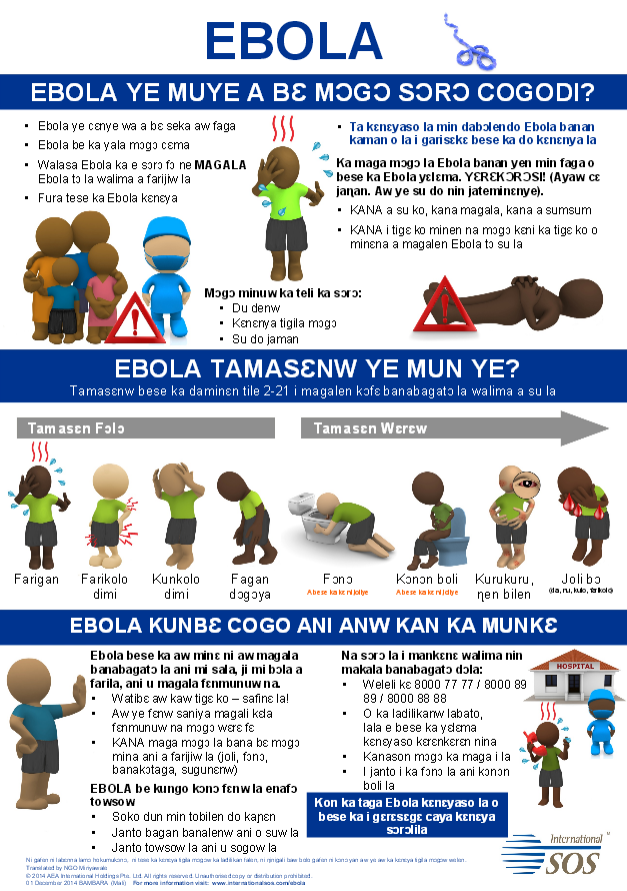
Two more ebola posters in Bambara

Here are two other Bambara translations of the widely translated and circulated ebola poster by International SOS.

In a previous posting, I called attention to another version of the same poster in non-standard Bambara. Both of the ones discussed here use the current standard orthography, but also appear to be a better and more complete translations. However there are differences, which provide an opportunity to review them in comparison and ask questions about methods and outcomes.

The one on the left below was posted on Facebook on October 2 (original provenance not clear); the one to its right was translated by NGO Miriyawa and came from the International SOS site, dated December 1.

To facilitate parallel review of differences between the two translations, the headings (only) are presented in the table below - along the lines of what I did for the previous Bambara translation (which can be opened in a separate screen for comparison):

EBOLA VIRISI (BANAKISԐ) EBOLA
EBOLA YE MUN YE, A BԐ YԐLԐMA COGODI? EBOLA YE MUYE A BԐ MϽGϽ SϽRϽ COGODI?
MUN YE EBOLA TAAMASHԐNW YE?
Tamashԑnw bԑ daminԑ tile 2 magalen kᴐ Ebolatᴐ walima a fure la
EBOLA TAMASԐNW YE MUN YE?
Tamasԑnw bese ka daminԑn tile 2-21 i magalen kᴐfԑ banabagatᴐ la walima a su la
Tamashԑn Kunfᴐlᴐw - Tamashԑn Labanw > Tamasԑn Fᴐlᴐ - Tamasԑn Wԑrԑw >
EBOLA KUNBԐNI ANI WALI KԐTA N'I BANARA? EBOLA KUNBԐ COGO ANI ANW KAN KA MUNKԐ

The differences show how different people or teams can come up with alternative ways of rendering the same text - presumably comparable in meaning, but not necessarily equal in accuracy or comprehensibility. Or, if the two were actually translated from different versions (for example, one from French and the other from English), this shows how that can result in different outcomes in the target language (Bambara in this case). It is useful in any event, I think, to first compare the two versions in terms of the language in which they are written: Leaving aside copy-editing issues (spelling; typography), how accurate and understandable are the alternative headings - and the rest of the text?

Going back a step, one question is whether there was any back-translation in either case to verify the accuracy of the translations. Also, what kind of proofing (copy-editing) was done on each version? There are some errors and inconsistencies, although probably not enough to affect meaning.

Another question is whether either of these versions were "field tested" to get an idea of how an average reader - or a listener to the text being read aloud - would understand and react to the text. And visually, how people react to the illustrations. If that was not done, it would be informative to field test the two versions together (perhaps adding the previously discussed one as well).

When doing translations for public education about a health emergency, there is obviously a concern with getting materials out there promptly. However, translation shouldn't be a "once and done" thing. I've previously outlined a case for review of materials (in the context of 2Ds & 4Rs), but review - including quality control - needn't delay initial roll-out of material. Some level of review can be built into the initial process, and then follow-up review can follow. In the case of Bambara there are several materials on ebola available now (remember also the MHOP/Dokotoro factsheet and the Bambara Wikipedia article), which could provide the basis for a more in-depth analysis of use of Bambara for communicating about this virus and other diseases.

Finally, a quick word about "banakisɛ," which appears in one of the above posters. Composed of "bana" (sickness) and "kisɛ" (seed), the literal sense seems very evocative, and in any case more tangible than the abstract loan "virisi." Definitely would wash my hands thoroughly to get rid of those banakisɛw.

Thursday, December 11, 2014

Languages & communication in Senegal's ebola success

Ebola prevention poster in Wolof.
Y'en a marre and An@fa. 
Source: TWB via Alexandria blog

Senegal was declared ebola-free in mid-October, just before a similar declaration for Nigeria. Having previously looked at languages and communication in Nigeria's success, this post will do the same (belatedly) for Senegal. Language is a key consideration in ebola messaging in the multilingual states of West Africa, even if that fact is sometimes overlooked (such as by a National Geographic article on four lessons from Nigeria and Senegal, or a US Embassy Dakar sponsored conference for journalists on responsible ebola reporting).

By way of background, French is the official language of Senegal, and Wolof the most widely spoken. Of the country's 38 languages (by Ethnologue's count). Wolof and five other languages - Jola (Diola in French spelling), Malinke, Pulaar (as Fula is known there), Serer, and Soninke - are the main national languages. I'll return below to more detailed discussion of categorizating indigenous languages in Senegal, as it could be relevant to planning messaging strategies in similar multilingual countries like Mali, which is the latest country in the region to have an ebola crisis.

Enter, ebola


Prior to the sole ebola case in the Senegal - an infected man who came from Guinea to Dakar before the closing of the Guinea-Senegal border on August 21 (he ultimately recovered) - the country had been "well-prepared with an Ebola response plan as early as March." From what information I've been able to gather, information and public education aspects of this plan used a number of languages, but mainly Wolof and French. (An earlier posting included some links to videos and other web-based info in Wolof and Fula/Pulaar.)

A Senegalese source I consulted (Dr. Ibra Sene) indicated that Wolof and French were used in various media as part of the "massive campaign" to educate people about ebola. However, a report in International Business Times (25 September), characterized radio and television broadcasts of ebola prevention messages as "all day long, in all languages" (without specifying which). If the latter is accurate, it is likely that local community radio stations extended the campaign in additional languages (more on community radio below).

Still, an SIL-led initiative for translation in southern Senegal was a response to the perception of insufficient attention to communicating about ebola in less-widely spoken languages. It focused on developing ebola materials in the Bandial Gusilay, Jola (Jola-Fonyi), and Manjaku languages of Casamance. Two expat literacy workers in Senegal who facilitated the workshop, Clare Orr and Elisabeth Gerger,  framed it this way
"These days, a lot of awareness-raising about Ebola is going on across Senegal on the radio and TV. However, many people in the villages don't speak enough French, Senegal's official language, or Wolof, the most widely-used national language, to understand the message well. This is why we are trying to reach them through documents and information in their own languages. Those who are able to read in their language can always read the information aloud for those who can't."

 Community radio


Community radio is a key component of development communication in much of Africa (see here and here, for example), including Senegal. A grant by OSIWA in September to the Senegalese Union des Radios Associatives et Communautaires (URAC) for an ebola education program on 73 radio stations reflects the importance of this medium.

A couple of articles have highlighted community radio broadcasts about ebola in first languages of other countries - Guinea, and Liberia and West Africa in general - so one may assume that something similar has been happening in on community radio stations in Senegal. Questions relating to African language broadcasts about ebola on community radio include: which languages?; how was the material developed/translated?; and is any of it available in recordings or transcriptions?

An interesting dimension of communication via local radio in West Africa is that of associated radio listeners' clubs. The UN FAO noted use of these (and a training for club leaders) to address ebola in communities in Senegal.

Social media


On social media, an interesting initiative launched at the end of August as a Facebook group called SenStopEbola, with an associated Twitter account @senstopebola, translated notices and advice on ebola into seven Senegalese languages (see also here; the languages were not specified, but presumably included French and the 6 main national languages). .

Senegal made use of SMS to send text messages about ebola, but reports I've seen have not indicated what languages were used or the content of messages. Also, it's not clear whether the multilingual GooglePlay app - "About Ebola" (which was created last April, and mentioned in a previous posting on this blog) - is counted as part of this effort. Another GooglePlay app, SenStopEbola, which is evidently related to the initiative on Facebook, was mentioned as having Wolof content, but again, no information on how it has figured in wider efforts.

The national languages of Senegal


Of the 38 languages of Senegal, the six most widely spoken - Wolof, Pulaar, Seser, Soninke, Malinke, and Jola - were denoted "national languages" first by presidential decree in 1971, and are specifically named as such in the Senegalese constitution of 2001. The constitution allows for other national languages once "codified" (which includes establishing an "official" standardized orthography).

From 2001, the policy has been to expand the number of national languages, and to that end, several others were codified by 2002: Hassaniya Arabic; Balanta; Bassari (a.k.a. Oniyan); Manjaku; Mankanya; Noon; and Saafi (a.k.a. Safen). Codification of others has apparently proceeded since then.

The result is three "groups" of Senegalese languages that reflect history and number of speakers (without implying a hierarchy of value):
  • Those recognized early as national languages, which tend to have the largest numbers of speakers, and for which there is some notable amount of written material.
  • Those codified more recently, but which still need further research 
  • Those still needing further study towards codification.

Such a grouping of languages in a multilingual state might be a useful parameter to consider when planning out messaging on health topics such as ebola, or other development communication. The first group is readily used, with standard orthography, perhaps also having resources available to consult on the subject area involved - and it reaches the largest number of people. It may be possible even to work on materials outside of the country. The second group may require more effort, including consultation with experts in country. The third may require work mainly on the local level, and where there is not time to develop a standard orthography, use of phonetic transcriptions.

The experience in Senegal may have followed the above to a degree, but further information is needed. In any event, the first group is divided between Wolof, which was widely used, and the other 5 established national languages, which presumably had varying use (ebola info in Pulaar was on the web, for instance, and the others were  probably used on community radio).


Spelling again


As a small contribution to review of ebola materials, the ebola poster in Wolof above has one apparent misspelling - "Fagaroul" - with the French "ou" taking the place of the Wolof "u." It is interesting to note, however, that the same title and spelling is used on the French version of the poster (i.e., a Wolof title, with French influenced spelling, on a French language ebola poster).

Wednesday, October 22, 2014

Languages & communication in Nigeria's ebola success

In a comment to my posting on possible roles of language and miscommunication in the tragic murder of 8 ebola campaign workers in Womey, Guinea, Charles Chukwuemeka Okolie commented on the Nigerian experience, noting that the "Ebola message was given in more than 100 languages including the tiny minority tongue[s] both in the print and electronic media." Now that Nigeria has been declared ebola-free, some more details are being reported about ebola messaging in Nigerian languages.

For example, an article entitled "Ebola-free: How did Nigeria and Senegal do it?" the Los Angeles Times today mentioned public awareness campaigns on ebola in Nigeria in which "Information was communicated in multiple languages via radio, television, social media, text messages and a large electronic billboard in the center of Lagos."

Another current article, "How Nigeria prevented an Ebola epidemic" in Medical News Today (MNT) mentioned language use in the context of the Nigerian authorities' quick response to the ebola threat: "House-to-house and local radio campaigns - using local dialects - explained the risks, how to take personal preventive measures and what was being done to control virus spread."

A recent article in the Globe and Mail, "Ebola: How Nigeria and Senegal stopped the disease ‘dead in its tracks’," explains further:
"In Nigeria, social mobilization teams went house-to-house to visit 26,000 families who lived within two kilometres of the Ebola patients. They explained Ebola’s warning signs and how to prevent the virus from spreading. Leaflets and billboards, in multiple languages, along with social-media messages, were used to educate the broader Nigerian population."
And an IRIN article last week, "Ebola and the media – Nigeria’s good news story," provides a different perspective, implying primarily English use on internet and mobile devices, with Nigerian languages prioritized on other media:
"Nigerians who do not have access to the Internet and mobile phones have not been left out of the Ebola campaign. Traditional mediums like radio, flyers, posters, village meetings and announcements by town criers are all being used. Priority is given to local languages.

"Comparing the traditional methods of campaigning to social media and SMS campaigns, Nwokedi Moses, better known as Big MO, a vernacular language broadcaster with Wazobia FM, said the two approaches worked well together. 'The social media Ebola campaign was massive, but it complemented the traditional media. This is due to social media’s limited reach within rural areas.'"

Not overnight


Nigeria's success in multilingual ebola messaging evidently benefited from existing capabilities, including those developed in anti-polio campaigns (according to the MNT article cited above). Also, according to Johns Hopkins Center for Communication Programs director Susan Krenn (as paraphrased by CNN in an article yesterday, "Using music to fight Ebola in Liberia"), there have been in the past various family planning and anti-malaria programs on the state and city levels in Nigeria, in its "four main languages" (these are not specified, but probably include English, Hausa, Yoruba, and Igbo).

Nigeria also has prepared specifically for messaging on ebola. For example, last April, Nigerian health minister Onyebuchi Chukwu was quoted in a Xinhua article, "Nigeria not safe from Ebola virus: health minister" as saying:
"So Nigeria is in danger but we have recently said fine that in addition to the leaflets that we are producing for lassa and other hemorrhagic fever, we will now emphasize Ebola fever. As I speak to you, we have already approved for jingles to be produced in various languages produced for Nigerian Center for Disease Control to be aired on Radio, Television and newspaper adverts,"

What now?


There are several questions:
  • Which languages were used in ebola messaging? 
  • How were health workers who went house-to-house trained for messaging in the languages they would encounter?
  • What kind of materials have been developed in these languages and how are they being stored and made available for other ebola efforts? These would include not only items published for distribution, but also scripts for broadcasting and materials for instruction.
  • Most of the above information apparently concerns official (different levels of government in Nigeria) response. To what extent did international partners also contribute to ebola messaging in Nigerian languages? (The collaboration between Translators Without Borders and the Nigerian Institute of Translators and Interpreters was mentioned in a previous post on this blog.)
  • Are there lessons from this experience for other countries in West Africa?
This brief article focuses on Nigeria's success, which is not to overlook that of Senegal. I hope to be able to post soon on how Senegal handled ebola messaging in its languages.

NB- Some additional edits were made to this article after posting, on the same day.

Sunday, September 28, 2014

Speaking English in rural Africa

A recent tweet by @WorldVisionUN offered this opinion about development communication in Africa:
This is a good attention getter, as I think it is a common assumption that in what are known as "English-speaking" African countries, people speak ... English. In fact, however, the linguistic situations in countries where English is the de facto or de jure official language, are more complicated than either the common assumption or @WorldVisionUN's tweet would imply.

My experience in rural Africa - which includes a number of years in "Francophone" countries - has been that when you speak French or English you may actually be speaking to someone who has enough language skills to interpret. And therein lies other problems, including first of all, the quality of such ad hoc translation.

The bottom line, though, is that sole reliance on Europhone languages for communication, education, and extension in rural Africa will always have sub-optimal results. I believe this is in line with the point @WorldVisionUN is trying to make.

In some earlier posts, I've explored some aspects of this in the context of agricultural development. For instance:


Friday, September 19, 2014

Fear, loathing, and murder in Womey, Guinea

Reports of the brutal murder of most of an ebola outreach team by villagers in Womey, Guinea already has spawned reactions on social media referring to "ignorance" and "low education levels." Nothing excuses such killing, but before concluding that the causes are a local population that is simply unenlightened and/or given to violence, more facts should be sought.

What is known of the incident from current reports (see 18 Sept. reports in GuineeNews, ReliefWeb, Washington Post) is that a team consisting mainly of local government officials and local media went to Womey on Tuesday 16 Sept. as part of an ebola education campaign. They were attacked by a mob with stones and clubs, and 8 of them killed as they fled into the bush (9 people were listed as missing in this report, and apparently all but the son of the Sous-préfet of Womey [head of the "sub-prefecture" administrative area] were confirmed dead; the regional governor, Lancèi Condé, and a female journalist also escaped alive).

Womey is in the region where ebola in West Africa first occurred about nine months ago. This virus had never before been seen in the area, and apparently many people suspected it had been brought by outsiders. An incident in N'Zerekore city (not far from Womey) in late August certainly fed the anxiety level when workers were sent into a market to spray disinfectant without prior announcement - some people reportedly feared the spray was intended to spread the virus. Riots ensued.

It is worth recalling that when reading a report that people in Womey feared the ebola campaign team had come to kill them.

It is also worth considering this evaluation from Cheikh Ibrahima Niang, a Senegalese anthropologist who has worked in some ebola-affected areas of the region:
"Quand les populations disent qu’Ebola n’existe pas, elles se rebellent contre quelque chose. Elles sont dans des situations où on ne les a pas consultées et ont l’impression qu’on les traite avec beaucoup de paternalisme." [When people say that ebola doesn't exist, they are rebelling against something. They are in situations where they haven't been consulted and have the impression they are being treated with lots of paternalism.]
So it seems that some of the issues involved in the events in Womey are: fear; anger; sharply different perceptions of authorities on the one hand and local residents on the other; and communication or lack of it.

With my interest in language in development communication - and in public education on ebola - I've also wondered what the linguistic dimensions may have been. The region of Guinea in which this took place is very multilingual (much more than the other three traditional regions of the country, in each of which one African language dominates). In addition to 5 languages (of Guinea's 8 national languages) - Guerzé/Kpelle, Kissi, Toma, Kono, and Lola - there is also the official language of French. And some of the higher level government and health officials come from other regions and not speak any of the local languages. That adds to complexity of communication: Were communications in locally dominant languages lacking in quality or frequency? Did they counter the narrative about ebola being introduced and how? How strong were the local language skills of the outreach team? (On the latter question, the presence of local radio journalists on the team presumably means there were people fluent in the local language(s).)

An article giving Gov. Condé's account of the incident in Womey hints at language as a factor, but in an unexpected way. Apparently the delegation had visited other localities without incident, and the meeting in Womey began in a relaxed atmosphere. The governor's opening talk (presumably in French; there was no mention of that or interpretation) went well. According to the account, however, when another team member stepped up to talk in the local language (which was not specified), people started throwing rocks, and chaos ensued. This could be interpreted in various ways, of course. It would be horrible to think that a misstatement by the second speaker was so off or misinterpreted that it triggered the reaction. On the other hand, it is no more comforting to see this as premeditated. So it will be informative to have any further information as it becomes available.

In any event, one must come back to the nexus of issues around fear, anger, perceptions, and communication. Of these, communication is a key to mitigating other issues, and language (choice of languages, quality of translations, etc.) is inseparable from the communication process.