Showing posts with label Sierra Leone. Show all posts

Thursday, May 12, 2016

Multilingual extension in Africa: The response to Ebola


Various earlier posts on this blog have discussed the importance of African languages in extension and development from general and tactical points of view (with particular reference to agriculture). Also during the course of the ebola epidemic in West Africa (which peaked in 2014-5), a number of posts looked at specific efforts to undertake health education and ebola awareness in various languages, and proposed systematically sharing, vetting, improving, and providing for re-use of translated and original materials in African languages.

This post looks from several different angles at multilingual messaging, including translation, over the course of the ebola epidemic. It will be followed by another post considering what strategies one might identify for future responses to emergencies - as well as less urgent public education needs - in multilingual contexts.

First, however, a quick note concerning summaries or evaluations of the linguistic dimension of the ebola response. As far as I am aware, there is no comprehensive overview or analysis. Reports from major organizations involved in the ebola response barely mention language (at the end of this post is a quick review). Perhaps the only report specifically on language and translation in the response was done by the international NGO Translators Without Borders, which was prominent in arranging translations of ebola materials into many languages (not just in West Africa): "Words of Relief  – Ebola Crisis Learning Review" (29 May 2015).  For a little bit broader view, but without pretense to completeness, I posted a summary largely reflecting content on this blog: "Ebola messaging in African languages - taking stock and looking ahead" (12 Dec. 2015, on LinkedIn). Both of the above proposed some lessons for the future.

Even lists of resources and websites, mainly done for reference or reporting during the period of the epidemic, are not comprehensive (for example, here). As I'll discuss below, one reason has to do with the scale or "layer" at which these operate, meaning that local activities either tend to be missed by international activities (which do the reports we see), or just aren't seen as falling in their scope. But it may also just be that information didn't travel or networks weren't connected. When researching ebola projects recently, for instance, I discovered an analysis of an interesting multilingual cellphone messaging project in Guinea called "Polly" from a group at Carnegie Melon University - something I personally had not seen mentioned elsewhere. Are there others?
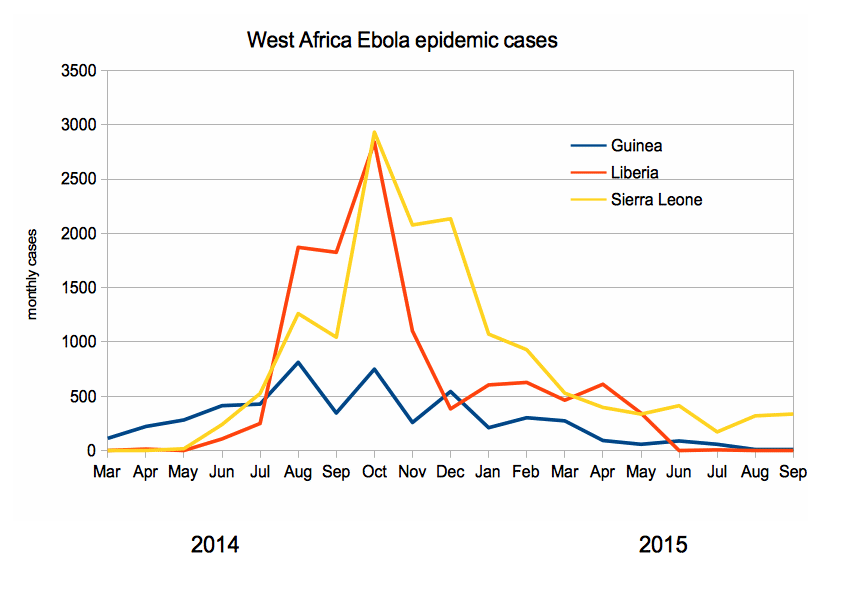

Image by Chris55, Wikimedia Commons, CC BY-SA 4.0

Ebola messaging in African languages


It is useful to disaggregate as much as possible several interrelated aspects of the process of responding to a crisis like ebola in a multilingual context: time; space; demographics of languages; the levels or layers of activity (international, national, provincial, local); modes of developing information in diverse languages (translation, interpretation, and creation*); media (print, media, mobile, in person); and organizational policies.

  • Time: Information about the epidemic came most quickly in English and French - official languages and main languages of media, the aid community, and the medical community. There was a lag in getting information in other languages of the affected countries. Major efforts to address this took a while to get going - according to TWB's report (cited above) its translation efforts began in November 2014 (though it seemed to have started some work in August), which was around the peak of the epidemic (per graph of cases above). Ad-hoc interpretation of incoming information on local levels (local radio, community meetings) was probably ongoing from relatively early in the cycle, with more organized efforts later on, though documentation is limited.
  • Space: Three countries were most hard-hit by the epidemic, and within those some regions within them more so than others. Responses obviously tried to address those, but logistics and information (such as for ebola education) tend to move from center to periphery. Data, on the other hand, may move from periphery to center by one or another means. Neither is perfect, but they evidently took time, especially early in the epidemic, even where there was mobile technology. Since the spatial distances were accompanied by language differences (different languages, different varieties of a language, or even different competencies in a same language variety), there was added time and evidently more potential for misunderstanding. All of this is in theory - I have seen no discussions of spatial dimensions of the response (looking in particular for the impact on information flows).
    • Linguistic demography: One dimension of linguistic demography is of course who speaks what where. Another is that on the country level, speakers of some languages are more numerous than others overall. Translations in languages more widely spoken on the national level were apparently done before less spoken ones. This makes sense on a broad scale but where less widely spoken languages dominate in a local areas, these likely were used orally (the backstory to the murder of health workers in Womey, Guinea included mention of local languages; a story from neighboring Côte d'Ivoire offered a peak at interpretation on the village level), but otherwise may not have received much attention. The only project I heard of that focused on translations in "smaller" languages was one organized by SIL in the neighboring Casamance region of Senegal (mentioned here).
    • Levels/layers: International aid and NGOs, national administration and services, and local communities and their local and extra-local networks seemed to operate on different and often only selectively interacting levels, especially early in the cycle. This dynamic meant that what happened or was being said on one level may or may not have had (immediate) effect on, or even in the extreme not been known by the others. And where information and diverse languages are involved, gaps and even contradictions (the latter in the form for example of misinformation about what ebola is or its treatment) seemed to emerge fairly quickly especially in critical early stages of an emergency.
    • Modes: Translation efforts focused on standard texts or posters, especially on the level of international aid and NGOs, but also some national level print media, and governmental and non-governmental entities. Interpretation and creation of information in African languages were more national and local in character - meetings, individual contacts, blogs. In the case of media (print, radio, TV) content about ebola, it is not clear the mode in which it was rendered in African languages (translation, interpretation, or creation*). For example, two international organizations working with media - International Committee of the Red Cross (ICRC) and Catholic Relief Services (CRS) - had projects with community radio stations to broadcast messages in local languages, but in neither case was it clear how that was done (which languages, whether oral translation from Europhone scripts or scripts pre-translated in target languages, what training, etc.). An example of community contacts in local languages to spread information about ebola in Liberia was given by International Rescue Committee (IRC) - the person in the example was a physician assistant and evidently fluent in the target language, so able to put information in his own words ("creation" in this model) to fit the needs and questions/challenges as he encountered them.
    • Media: Ebola messaging in African languages was conveyed on diverse media (print, poster, TV, radio, blogs, video, and mobile apps) as well as via community meetings and individual contacts. I am not aware of any studies of media activity during the ebola epidemic that might include discussion of languages used. An exception is information about mobile media used during the epidemic - "mobile-based interactive voice response technology," and apps like the SAWBO animations with African language voice-overs and the abovementioned "Polly." Also, an observation mentioned in an earlier posting that the dominant languages used in each means of communication tended to differ, such that in Nigeria supposedly the higher tech media used more English and the in person and community communication tended to be in first languages.
    • Organizations and languages: The observation by Nadia Berger and Grace Tang based on TWB's work translating ebola messages that "translation is not always considered a priority by governments and aid agencies" echoes experience more generally in international development. This is a major structural hurdle to more effective use of African languages in response to crises like the ebola epidemic, in health education, and indeed in all aspects of development. Do organizations and agencies have policies with regard to languages in the multilingual societies struck by the epidemic, or was the linguistic dimension of their work handled as an incidental consideration really given less priority in the face of a very physical crisis, despite its relevance to successful public education and control of disease transmission?
    With the latter point in mind, it is worth taking a quick look at whether and how language as a factor did or did not figure in reports of organizations involved in response to the ebola epidemic.

    Language in reports on ebola responses?


    Reports on ebola response efforts by Medecins Sans Frontiers, World Health Organization, and IRC did not mention languages or translation, nor did an analysis of the international ebola response by the UK Overseas Development Institute's Humanitarian Policy Group.

    The U.S. Centers for Disease Control (CDC), to its credit, did in its report mention language as a factor: "The Road to Zero: CDC's Response to the Ebola Epidemic." (Recall that CDC's ebola information resources included a few in Malinké - a variety of Manding). The two specific mentions merit a closer look:
    • A CDC worker with "intermediate" French worked with people Guinea's forest region, of which perhaps only one per village might speak French, to "translate important  health messages into the local language" and train local workers. An impressive effort, but the kind of situation where available language support - people with better French and acknowledged erudition in the local language(s) - could help assure accuracy of translations and messages in the local language. Also, since that part of Guinea has several local languages, it is not clear which was the focus of efforts
    • A training of midwives and cleaners was held in the Malinké language "since they do  not speak French, the official language of Guinea." Looked at another way, a big reason to use an important first language and lingua franca like Malinké would be that this is understood better, and that an advantage of training using such languages is that it could arguably better prepare trainees for work with patients who may also speak them better than the Europhone official language, French. (Another possibility might be a bilingual format with relevant African and Europhone languages, arguably better preparing trainees for contexts they will encounter.) 
    Reports or website content of all but a few of the 67 organizations on USAID-CIDI's list of NGOs involved in ebola response also did not discuss languages or translation (to be fair, a few of those which didn't were only involved in logistics of shipping supplies). CIDI's list is extensive, but notable among the omissions is TWB, certainly the most prominent international NGO facilitating translation of ebola materials. The exceptions which did mention language include:
    Another organization on the CIDI list, Mali Health Organizing Project, used Bambara in its ebola response, as one would expect (for example in a factsheet), but did not mention this linguistic dimension in its report or website.

    In all of these instances it would be helpful to have any materials developed/used for review (were they saved?) and incorporate them in archives for potential reuse (per 2Ds & 4Rs).

    Perspectives of health workers & patients?


    Another level at which language is important in such an epidemic is that of the interaction between health workers and the patients. For a glimpse of this issue, see two personal accounts by Western nurses about the language gap between them and patients (in Nurse.com and PIH.org). It would not of course have been possible to train foreign health workers in any of the local languages they would encounter, given the time factor, but one wonders if a couple of words or phrases might have made the difficult experience a bit more bearable for caregiver and patient (especially the younger ones).


    * Note on these 3 terms. On the first two, there seems to be a gap in the terminology: "translation," strictly speaking, refers to text, as distinct from "interpretation" being defined as oral and in person (physically or virtually). This leaves out what we might call oral translation, or interpretation of a source either received as text (announcer on radio reading in one language but giving the meaning in another) or heard in one language (in a meeting or on media) but transmitted orally in another language at a later time. These kinds of cross-language sharing are common in multilingual societies with rich oral traditions, and I suggest in this context they be considered as forms of interpretation (keep in mind the range of meaning of "interpretation" as an art). "Creation" is intended to cover instances where the writer (for example of a blog) or speaker (many possible scenarios) is conveying their understanding of a subject in their own words - which happen to be in a language different than that of the main international media, medical research, etc. Of course the lines among these three are not rigid, but I think it is useful to retain them as more or less archetypes of different ways information about ebola was communicated in African languages. (The neologism "transcreation" has specific applications, but might constructively be adapted for use somewhere within this space.)

    Thursday, March 26, 2015

    Ebola information in Vai

    Recent news of a new case of ebola in Liberia, and discussions such as that initiated by Bill Gates on preparedness for future possible epidemics, make the issue of developing health education resources in the first languages of potentially affected populations an ongoing and future priority.

    Following up on previous postings of ebola information in various African languages, here is a translation in the Vai language of a FAQ on the virus from the World Health Organization, as transcribed in the Vai syllabary and in the exended Latin orthography. The translation and transcriptions were done by Tombekai V. Sherman and facilitated by Athinkra LLC. These are available in PDF format on Athinkra's Google site. Thanks to Charles Riley of Yale University for sharing the Word .doc versions, which are much simpler to copy into the blog.

    Vai is spoken by over 100,000 people mainly in Liberia, but also in Sierra Leone.

    The Vai syllabary is encoded in Unicode. To view the text, you may need to download a font. Free Vai fonts are available on Michael Everson's website. (See also the SIL Vai fonts page.)


    ꖦꖕꕰ ꕺꖃ ꗏ ꔳꘂ ꖴꗷ ꗏꗒꗡ ꕉꔱꔸꕪ ꕗꕴꔀ ꕞ ꖏꕎ

    Dúúnyá kpolo lɔ tíyɛ́ kulɛ lɔndɔɛ áfíríka gbawoe lá kówa

    ꖤꕢ ꖷꔧ ꘃ ꕎꕌꔳ ꖴꖨꘋ ꕒ ꕉ ꕞ ꗓꔒ ꗪ Iꕷꕞ ꕙꗐꔻ ꕃꕩꕌ ꕞ

    Túsá múĩ́ kɛ́ wáhátí kúluŋmɓa a lá sɔ́lé ɓɛ ibhóla varɔ́si kiyaha la


    ꔤꕷꕞ ꕙꖄꔻ ꕃꕩꕌ ꔳꕩ ꔈ ꕎ ꖏ?

    ꔤꕷꕞ ꔳꕩ ꕃꕩ ꗬꗷꕩꕌꔒ ꕎ ꖏ ꕉ ꘃꖷ ꕞ ꘊꘊ ꗪ ꗉꖺꗚ ꕉꖷ ꕎꕌꔳ ꖴꖨꘋ ꕒ ꕉ ꕧꕴ ꗞ ꘃꗺ ꖸ ꕮ ꔧ ꘃꗺ ꔌꘋ ꖷ ꖸ ꕔꕌ ꗞ ꘃꗺ ꖸ ꕞ ꕉꖸꕊ ꗪ ꕃꔤꘂ ꗱ (ꗚ ꗅꘋ, ꖑꔓꕞ, ꔧ ꕴꖃ) ꕉꖷ ꕃꕩ ꔫꔤ ꕯ ꔤꕷꕞ ꕙꖄꔻꘂ ꕎ ꗱ. ꕉꕌ ꘊꘊ ꗪ ꘃ ꗉꖺꗚ ꕉꖷ ꕉ ꖴꘋ ꗞ ꕘꕌ ꕎꕌꔳ ꖴꖫ ꖝ ꗏ, ꘃ, ꗞ ꖴꘋ ꕸꖃ ꔉꕖꕌ ꕉ ꕧꕌ.

    ꕉꔤ ꘊꘊ ꕪꕮ?

    ꕪꘋ ꖷ ꗏꔤ ꕙꖄꔻ ꘈꗢꖸ ꖸ ꔮꔷꘋꔕ ꗪ ꖦꖕꕰ, ꗞ ꕮ ꕉ ꗓ, ꕉꖷ ꕉ ꗏ ꕪꔒ ꕮꕊ ꗷꔤ ꖷ ꔖꔜ ꕙꖄꔻꘂ ꖃꘋꕡ ꗞ ꘃꗺ ꖸ ꗏ. ꕎꕌꔳ ꖴꖨꘋ ꕒ, ꗞꗢ ꔖꔜꕯꕊ ꕩꕌ ꔬꕩ ꕎꕌꔳ ꖷ ꕉ ꖤꖕꔒꔀ ꘃꗺ ꔌꘋ ꕞ ꕉ ꘃ ꖷ ꕙꖄꔻꘂ ꘈꗢ ꗪ ꕉ ꗏ.

    ꕃꕞꔤ ꔳ ꕎ ꘃ ꘃꖷ ꔤꕷꕞ ꕙꖄꔻꘂꔤ ꗞ ꔬꕩ ꕒꕡ ꖷ ꗏꖺ ꕩ ꖤꖕꔒꔀ ꕀ ꔌꘋ ꖸ ꕞ ꖝꖕꕯꕊ ꗏ, ꗞ ꗷꔤ ꖷ ꕃꕩꕌ ꗪ ꗳ ꕉ ꕺꖃ ꗏ, ꔌꘋ ꖸ ꗚ ꕴꔤ, ꗷꔤ, ꕸ, ꗻꔤ, ꕔꔺ, ꔧ ꕉꖸ ꗃ ꗠꖻ ꖸ, ꔧ ꗏ ꕃꔷ ꔌꘋ ꖷꔧ ꗃ ꕃꕩ ꗞꗢ ꕮꔧ.

     ꕉ ꖴꘋ ꘊꘊꕰ ꔌꘋ ꖸ ꗱ ꗚ ꘈꗻꔤ, ꕉ ꘃ ꖷ ꕞ ꕒꘋ ꖤꖕꕎ ꕀ ꔌꘋ ꖸ ꕞ ꗞ ꖝꖕꕯꕊ ꗏ, ꕉ ꘃꖷ ꔻꔭꔤꔒ ꕞ ꔳ ꗳ ꔤꕷꕞ ꕙꖄꔻꘂ ꕞ.

    ꕉ ꖴꘋ ꕎꕌꔳ ꔬꕩ ꔎꔒ ꗱꕞ ꗪ ꔎꔒ ꗞ ꕒꘋꔕ ꕉ ꗛꖺ ꗏꗒ ꗳ ꕮꕊ ꗏ ꘃꖷ ꕉꔤ ꗬꗷꕩꕌ

    ꔤꕷꕞ ꕙꖄꔻ ꕃꕩꕌ ꕧꔤ ꕀꕩ ꕪꕮ ꔧ ꖏ ꖷ ꖸ ꕃꕩꕌ ꕩꕌ ꕮ ꗞ ꕺꖃ ꗏ?
    • ꕃꕮ 
    • ꗉꗟ ꘃ 
    • ꖝ ꗏ ꗃ 
    • ꕪꘋꗜꖺ ꖨꘋ 
    • ꖨꘋ ꗓꕯꕊ ꖸ ꗪ ꖬꘂ ꖬꘂꗡ ꗏ 
    • ꖝ ꗏ ꖨꘋ 
    • ꖴꘋ ꖨꘋ 
    • ꕪꔷ ꘈꗻ ꗚ ꗠꖻꗠꖻ ꕎꔤ ꕯ ꗞ ꔬꕩ 
    • ꕪꔷ, ꕧ ꗅ ꗏ ꕧꕌꔒ, ꔻꖎ ꔻꖎ, ꕉꖷ ꕃꕩ ꗞꗢ ꗃꖺ ꖸ ꗏ, ꕴꔤ ꔳ ꗃꕯ ꕪꘋ ꖷ ꔰ ꖇꕱ ꗪ ꗞ ꖝꖕꕯꕊ ꕮ. 
    ꗞ ꖴꘋ ꕸꖃ ꔉꕖꕌ ꕉ ꕧꕌ ꕪꕮ?
    • ꔤ ꖬꕮ ꘃꖷ ꔤ ꕮ ꖤꖕ ꕀ ꔌꘋ ꔰ ꕞ ꕉ ꘃꖷꔧ ꗃ ꔤꕷꕞ ꗞꖻ ꖝꖕꕯꕊ ꗏ ꖺ ꗞ ꖷ ꔤꕷꕞ ꕃꕩꕌ ꗪ ꕉ ꕞ. ꗞ ꖷꔧ ꕔꕌ ꗞ ꗷꔤ ꘈꗢ ꕞ, ꕕ ꖷ ꗐꕒ ꕸꕔꔤ ꔳ ꕉ ꕸꖃ, ꕉꖷ ꕧ ꗅ ꖴꕮ ꗱꗡ ꘈꗢꘈꗢꔧ ꔳ ꕉ ꕧ ꗅꗡ ꖸ ꖴꕮ, ꕉꖷ ꕉ ꖬꘋ ꕮ ꖝꘋꔕꔤ ꔳ. 
    • ꗞ ꖷ ꔰ ꕧ ꕀꕩ ꔒꘋ ꗨꗡ ꗪ ꘃ ꔤꕷꕞ ꕃꕩꕌ ꖴꘋ ꔳꕩ ꕉ ꕞ, ꕉꖸꔧ ꕚꕌ ꕉ ꕞ ꕧꕮ ꘀꕇ ꕪꘋ ꘃꖷ ꕉꖸ ꖴꘋ ꕉ ꘀꗫꕩ ꕉꖷ ꕉꖸꔧ ꗓ ꔎꘋ ꕃꕩ ꘈꗢ ꕞ. ꕕ ꖷ ꗏ ꕉꖸꔧ ꗞ ꖸ ꘀꗫ ꕉ ꘃ ꖷ ꖸ ꕔꕌꔒ ꔳꕩ ꔤꕷꕞ ꕃꕩ ꗞꖻ ꕞ 
    • ꗞ ꖷ ꖸꔧ ꕘꕌ ꔤꕷꕞ ꗱ, ꕕ ꖷ ꕉꖸꔧ ꗞꗢ ꘃ ꗏꖺꕎ ꔌꘋ ꗅꖤ ꗅꖤ ꗏ ꕉꖷ ꕉꖸ ꕩꕌ ꕚꕴ ꕧꕮ; 
    • ꕕ ꖷ ꗞ ꖸꔧ ꖴꘋꗒ ꕪ ꔇꔀ ꕧꕮ ꘀꕇ ꕪꘋ ꔧ ꕉꕡꕌ ꗱꗡ ꘃ ꔤꕷꕞꕌ ꖴꘋ ꔳꕩ ꗞ ꕞ. 
    • ꗞ ꖷ ꔰ ꕔ ꗱ ꗓꖺ ꗪ ꕮꕯ ꕉꕌ ꖏ ꕮ ꕉ ꕞ ꗓꔒ ꗪ ꔤꕷꕞ ꕃꕩꕌ ꕞ, ꕕ ꖷ ꕉꖸ ꕩꕌ ꕮ ꕧꘋꕨꕌ ꕎ ꘃ ꕃꕩ ꗞꖻ ꕮꔕꔀ ꖸ ꕞ, ꕉꖷ ꕉꖸꔧ ꗓ ꕃꕩ ꔫꔤ ꕞ ꔬꕩ ꕃꔤꘂ ꖸ ꗱ ꗯꗷꘋ. 
    • ꗞ ꖷ ꖸ ꔰ ꗪ ꗓ ꘃꕯ ꖽꔻꔪꕿꔀ, ꕕ ꖷ ꕉꖸꔧ ꖴꘋꗒ ꕪ ꕚꘋꔕ ꗱꗡ ꕉ ꕞ ꗓꔒ ꗪ ꕃꕩ ꘈꗢ ꕞ ꖏꕎ ꔧ ꕃꕞ ꖷ ꖸ ꗱ ꕉ ꖴꘋ ꘊꘊꕰ. ꕕ ꖷ ꕉꖸꔧ ꕞ ꔷꔤ ꖏ ꖸ ꕮ ꗚ ꕃꕞ ꖷ ꖸ ꗱ ꗞ ꖸꔧ ꕀ ꖺ ꕴꔤ ꔬ ꕉꖸ ꕙꕰꕊ ꖸ ꗏ ꔧ ꗓ ꘃ ꖷ ꔰ ꕞ ꗓꔒ ꗪ ꕴꔤ ꖏ ꕞ, ꖺ ꕀ ꔌꘋ ꖷ ꖸ ꔰ ꗪ ꖝꖕꕯꕊ ꗏ, ꔧ ꗐꕒ ꘃ ꗞ ꖝꖕꕯꕊ ꗏ ꕀ ꗃ ꖏꕎ, ꔧ ꕀ ꖺ ꕴꔤ ꕢꕌ ꖴꖫ ꖷ ꔰ ꕉꖸꕩꕌ ꘃꕩ ꕔꔤ ꗏ, ꕉꖸꕊ ꔬꕩ ꕃꔤꘂ ꔳ ꗷꔤ ꖷ ꗏꖺ ꕉ ꕢꔒ ꗪ ꘀꘉ ꔞꘋ ꖏꔀ ꖸ ꕮ ꕉ ꕞ ꗓꔒ ꗪ ꕃꕩ ꘈꗢ ꕞ. ꖽꔻꔪꕿ ꗞꗢ ꖸ ꗏꗒ ꔰ ꕉꖸꕊ ꕃꔤ ꔌꘋ ꗏꔤ ꖸꔧ ꔳ ꕉ ꘃ ꖷ ꗪꘋꕡ ꕃꕩ ꘈꗢ ꕞ ꔬꕩ ꕃꔤꘂ ꕮ, ꗚ ꕸꖃꕒꕌꕇ ꕮꔧ ꕈꕰꔒ, ꗏꖺꕎ ꕸꖃ ꕸꕔ, ꖬꘋ ꕮ ꖝꘋ ꔌꘋ, ꔧ ꕧ ꗅ ꕮ ꖝꘋ ꔌꘋ. ꗓ ꘃ ꗱ ꔌꘋ ꖷ ꖸ ꕕ ꕮꕊ ꗞꔧ ꕿ ꕉꖸ ꔱꔷ, ꕕ ꖷ ꕉꖸ ꗽꘉꔒꔤ ꔳ ꕞꕌꕃꔤ ꕪ ꗨꗡꘉꗢ ꗞꔧ ꕿ ꕉꖸ ꘃ ꗏ ꕔꔤ ꗏ. 
    • ꕃꕩ ꘈꗢ ꖴꘋ ꗏ ꘊꘊꕰ ꕃꕩ ꗞꗢ ꕞ ꖏꕞ ꗟꖺꔒꔀ ꖸ ꗱ ꖺ ꔉꔊ ꕧ ꖏꕞ ꖷ ꕃꕩ ꗞꗢ ꕢꕌ ꕉ ꕮ. ꕕ ꖷ ꔌꘋ ꗷꔤ ꘈꗢꖸ ꖸ ꗽꘉꗷꔤ ꔳ ꕞꕌꕃꔤꕪ ꗨꗡꘉꗢ ꗞꔧ ꕿ ꖤꖕ ꕉꖸ ꕞ. 
    • ꔒꔟꕩ ꖷ ꔰ ꕮ ꔤꕷꕞ ꕞ ꗃꕎꘋ, ꖸ ꗞꗢ ꖸ ꕮꔧ ꕕ ꖷ ꕉꖸꔧ ꔵ ꘃ ꕉ ꗏ ꘃꖷ ꗞꗢ ꖸ ꗬꗡꔤ ꖴꘋꗒ ꕪ ꕚꘋꔕ ꗱꗡ ꕉ ꕞ ꗓꔒ ꗪ ꕃꕩꕌ ꗪꗡ ꕞ, ꔧ ꗷꔤ ꖷ ꗞ ꖴꘋ ꕸꖃ ꔉꕖꕌ ꕉꕌ ꘊꘊꗢ ꕧꕌ, ꕉ ꕒꕢꔒ ꗪ ꗷꔤ ꖷ ꗞꔧ ꕘꕌ ꖏꔀ ꖸ ꖴꘋ ꔻꔤ. ꗞ ꖷ ꖸꔧ ꕘꕌ ꔤꕷꕞ ꕼꕱ ꗱ, ꕕ ꖷ ꕉꖸ ꕩꕌꖸ ꕚꕴ ꕧꕮ ꔧ ꗷꔤ ꖷ ꕃꕩꕌ ꔇꔀ ꖴꘋ ꗞ ꕮꔕ ꖸ ꔬꕩꕌ. 
    ꗞ ꖷ ꖸ ꕔꕌꔒ ꔳꕩ

    ꕃꔤ ꖷ ꕃꕞ ꔋꘋꔋꘋ ꖷ ꗱ ꗞ ꖸ ꖴꘋ ꕃꕩ ꘈꗢ ꔬꕩꕌ ꕉ ꗃ ꗱ ꕉ ꔳꕩ ꕴꔤ ꗱ ꕎ, ꔧ ꕀ ꔌꘋ ꖷ ꖸ ꔰ ꖝꖕꕯꕊ ꕩꕌꖸ ꕈꕰ ꖺ ꕀ ꔌꘋ ꖷ ꖸ ꔰꔤ ꗃ ꖝꖕꕯꕊ ꗏ, ꗞ ꖷ ꖸ ꕔꕌꔒ ꔳꕩ ꔤꕷꕞ ꕃꕩ ꗞꖻ ꕞ, ꕕ ꖷ ꕉꖸꔧ ꔳ ꕧ ꘀꗫ ꕚꘋꔕ ꗛꖺ. ꕕ ꖷ ꕉꖸꕩꕌꖸ ꕺꖃꔀ ꕞ ꕔꔺꘂ ꘀꗫ ꔻꔤꕯꕊ ꗱꕞ ꔎꔒ ꔰ ꖝ ꗏ, ꕉꖷ ꕕ ꖷ ꕉꖸꕩꕌꖸ ꕮ ꕧꘋꕨꕌ ꗞ ꕮꔕ ꖸ ꕞ ꕎꕌꔳ ꖷ ꗏꖺ ꕉꕡꕌ ꗱꗡꔒꔀ ꘃ ꕉ ꕺꖃꔀ ꗪ ꕔꔺꕯꕊ ꖺ ꕃꕮ ꗪ ꗻꗡꕯꕊ ꕉ ꕞ.
    Ibhóla várɔ́si kiyaha tiya mɓe wá ko?

    Ibhóla tiya kiya kpɛlɛyáhalé wá ko a kɛ mú lá nyɛnyɛ ɓɛ fɔɔyɔ amu wáhátí kúluŋ ɓa a jáwo mɔ kɛ́ndɛ́ nú ma hĩ kɛ́ndɛ́ feŋ mú nú kpãha mɔ kɛ́ndɛ́ nú la anúã ɓɛ́ kiiyɛ fɛ (yɔ́ kpɔŋ, goréla, hĩ woló) amu kiya ɓhií na ibhóla varɔ́si wá fɛ. Aha nyɛ́nyɛ́ ɓɛ kɛ fɔɔyɔ amu a kuŋ mɔ faha wáhátí kúndú ɓú lɔ, kɛ́ mɔ kuŋ ɓóló kpemgbáha a jáha.

    Ai nyɛnyɛ káma?

    Kaŋ mú lɔ́í várɔ́si mɛɛ̃nú nu kpíliŋndé ɓɛ dúúnyá, mɔ má a sɔ tíŋ tiŋ, amu a lɔ kálé máã lɛ́i mú sénjé várɔ́siyɛ loŋnda mɔ kɛ́ndɛ́ nú lɔ. wáhátí kúluŋ ɓa, mɔɛ̃ sénjénaã yaha ɓiya wáhátí mú a tuulée kɛ́ndɛ́ feŋ la a kɛ mú várɔ́si mɛɛ̃ ɓɛ a lɔ.

    Kílai ti wá kɛ kɛmú ibhóla varɔ́siyɛi mɔ ɓiya ɓanda mú lɔ́ɔ ya tuulée jí feŋ nú la mɔ ɓúunaã lɔ, mɔ lɛ́i mú kiyáha ɓɛ tɛ́ a kpoló lɔ, féŋ nú yɔ́ woí, lɛ́i, ɓo, sɛ́í, kpãndí, hĩ anú ɓɔ́ nyɔ́ɔ́ nú, hĩ lɔ́ kili feŋ múĩ́ ɓɔ mɔɛ̃ máí.

    A kuŋ nyɛ́nyɛ́nya féŋ nú fɛ yɔ́ mɛ́sɛí, a kɛ mú la ɓaŋ tuúwa jí feŋ nú la mɔ ɓúunaã lɔ, a kɛ mú símɓiilé la ti tɛ́ ibhóla varɔ́siyɛ la.

    A kuŋ wáhátí ɓíya télé fɛlá ɓɛ́ télé mɔ ɓáŋndé a kɔ́ɔ lɔndɔ́ tɛ maã lɔ kɛmú ai kpɛlɛyaha

    Ibhóla varɔ́isi kiyaha jái jiya káma hĩ kó mú nú kiyaha yaha ma mɔ kpoló lɔ?
    • kímá 
    • fɔ́nɔ́ kɛ́ 
    • gbú lɔ ɓɔ́ 
    • káŋngɔ́ɔ lúŋ 
    • lúŋ sɔnáã nu ɓɛ́ suyɛ súyɛɛ lɔ 
    • ɓú lɔ lúŋ 
    • kuŋ lúŋ 
    • kali mɛ́sɛ́ yɔ́ nyɔ́ɔ́nyɔ́ɔ wái ná mɔ ɓiya 
    • kalí, já kpɔ́ lɔ jahalé, síyo síyo, amu kiya mɔɛ̃ ɓɔ́ɔ nú lɔ, woí ti ɓɔ́na kaŋ mú gbi sóó ɓɛ mɔ ɓúunaã ma.
    Mɔ kuŋ ɓóló kpemgbáha a jáha káma?
    • I suma kɛmú í má tuu jí feŋ gbi la a kɛmúĩ́ ɓɔ ibhóla mɔɔ̃́ ɓúunaã lɔ ɔ mɔ mú ibhóla kiyaha ɓɛ a la. Mɔ múĩ́ kpãha mɔ lɛ́i mɛɛ̃ la, kpã mu rɔ́ɓa ɓokpai ti a ɓóló, ja kpɔ́ kuma fɛ̃ɛ́ mɛɛ̃mɛɛ̃ĩ́ ti a já kpɔɛ nú kuma, amu a súŋ ma ɓúŋndéi ti. 
    • Mɔ mú gbi já jíyá leŋ pɛ́ɛ́ ɓɛ kɛ ibhólá kiyaha kuŋ tiya a la, anúĩ taha a la jama jɛnɛ kaŋ kɛmú anú kuŋ a jɛ́mɓɛya amu anúĩ sɔ téŋ kiya mɛɛ̃ la. kpã mu lɔ́ anúĩ mɔ nú jɛmɓɛ a ku mú nú kpãhalé tiya ibhóla kiya mɔɔ̃́ la. 
    • Mɔ mú núĩ faha ibhóla fɛ, kpã mu anúĩ mɔɛ̃ kɛ rɔ́ɓa feŋ kpɔ́tú kpɔ́tú lɔ amu anúyaha tawo jáma; 
    • Kpa mu mɔ núĩ kuŋndɔ ká ɓee jáma jɛni kaŋ hĩ andaha fɛɛ kɛ ibhóla kuŋ tiya mɔ la. 
    • Mɔ mú gbi kpã fɛ sɔ́ɔ ɓɛ mána aha kó ma a lá sɔ́lé ɓɛ ibhóla kiyaha la, kpã mú anú yaha ma jaŋnjaha wá kɛ kiya mɔɔ̃́ mandée nú la, amu anúĩ sɔ kiya ɓhií la ɓiya kííyɛ nu fɛ gbɛ́lɛ́ŋ. 
    • Mɔ mú nú gbi ɓɛ sɔ kɛ́na hɔsipítoe, kpã mu anúĩ kuŋndɔ ká táŋndé fɛɛ a lá sɔ́lé ɓɛ kiya mɛɛ̃ lá kówa hĩ kíla mú nú fɛ a kuŋ nyɛ́nyɛ́nya. kpã mu anúĩ lá lii kó nú ma yɔ́ kíla mú nú fɛ mɔ núĩ jí ɔ woí ɓi anú vanyáa nú lɔ ɔ sɔ kɛ́ mú gbi lá sɔ́lé ɓɛ woi ko la, ɔ jí feŋ mú nú gbi ɓɛ ɓúunáã lɔ, hĩ …... anúa ɓiya kííyɛi ti lɛ́i mú lɔ́ɔ a salé ɓɛ jɛni keŋ koe nú ma a lá sɔ́lé ɓɛ kiya mɛɛ̃ la. hosipíto mɔɛ̃ nú lɔndɔ́ gbi anúa kili feŋ núĩ ti a kɛ mú ɓɛŋnda kiya mɛɛ̃ la ɓiya kííyɛ ma, yɔ́ ɓólóɓáhání máí nyínyalé, rɔ́ɓa ɓóló ɓokpa, súŋ ma ɓúŋ feŋ, hĩ já kpɔ́ kuma fɛ́ɛ́ mɛɛ̃mɛɛ̃. Sɔ kɛ́ feŋ mú nú kpã máã mɔĩ to anú fili, kpã mu anú zɛnɛléi ti lahakiika pɛ́ɛ́nɛ́ɛ̃ mɔĩ to anú kɛ kpái lɔ. 
    • Lengéya mú gbi ma ibhóla la ɓɔwaŋ, nú mɔɛ̃ nú máí kpã mu anúĩ dí kɛ a lɔ kɛmú mɔɛ̃ nú kpɛ́ɛ́i kuŋndɔ ká táŋndé fɛɛ a lá sɔ́lé ɓɛ kiyaha ɓɛ́ɛ la, hĩ lɛ́i mú mɔ kuŋ ɓóló kpemgbáha aha nyɛ́nyɛɛ̃ jáha, a ɓasalé ɓɛ lɛ́i mú mɔĩ faha kóe nú kuŋ sii. Mɔ mú núĩ faha ibhóla fɛ, kpã mu anúyahanú tawo jáma hĩ lɛ́i mú kiyáha ɓée kuŋ mɔ mandé nú ɓiyaha. 
    Mɔ mú nú kpãhalé tiya

    Kii mú kila gbeŋgbeŋ mú fɛ mɔ kuŋ kiya mɛɛ̃ ɓiyáha a ɓɔ fɛ a tiya woí fɛ wa, hĩ ji feŋ mú nú gbi ɓúu náã yahanú nyinya ɔ féŋ mú nú gbii ɓɔ ɓúu náã lɔ, mɔ mú nú kpãhalé tiya ibhóla mɔɔ̃́ la, kpã mu anúĩ ti já jɛ́mɓɛ́ táŋndé kɔ́ɔ. kpã mu anúyahanú kpolóe lá kpãndiyɛ jɛmɓɛ si náã fɛlá télé gbi ɓu lɔ, amu kpã mu anúyahanú ma jaŋnjaha mɔ mandée nú la wáhátíĩ́ mú lɔ́ɔ andaha fɛ́ɛ́lée kɛ a kpolóe ɓɛ kpãndi náã ɔ kimá ɓɛ sɛɛ náã la.


                                       Communication, Advocacy and Media Unit
                                       Telephone: + 472 413 9420, + 242 06 614 2401
                                       E-mail: afrgodrdcam@who.int
                                       Source: World Health Organization Regional Office for Africa

    Addendum (27 March 2015)

    As far as I'm aware, there are 3 Unicode fonts that include the Vai script:
    • Dukor (Evertype)
    • Ebrima (African font provided with Windows 7)
    • Wakor (Evertype; this is based on the old SIL Vai font, which is not Unicode)

    Thursday, December 18, 2014

    Ebola materials in Temne (Temen, Themine, Themne, Timene, Timini, Timne, Timmannee)

    Temne translation by TWB.
    Source: International SOS.

    A posting on this blog in September featured an ebola message in several languages of Sierra Leone, but not Temne, which is widely used mainly in the north of the country (over a million speakers). Here I'll highlight some ebola materials in Temne (with notes about the name of the language at the end).

    First is a translation of the the widely translated and circulated ebola poster by International SOS (on right). This was dated October 7, and done by Translators Without Borders (TWB, which also was involved in producing Mende and Krio versions of the poster).

    TWB also helped Humanitarian Response with production of Temne versions of "Social Mobilisation Key Messages" and "Messages for children and caregivers on Ebola - Child Protection and Education."

    Other material I'm aware of is audio, beginning with Temne versions of the CDC's radio spots. These recordings - which now are in 17 African languages or varieties of those languages (aside from English and French versions) - have been mentioned several times previously on this blog. It is worth recalling that these audio spots are not accompanied by text version in these languages, and there is no information about the approach(es) taken to producing the translations.

    Scientific Animations Without Borders (SAWBO) has produced an animation on ebola, and one of the voice-overs is in Temne. SAWBO's products are available in formats for viewing on cell phones and computer (though there do not appear to be text versions / scripts available).

    I am not aware of any material on ebola developed directly in Temne (written or recorded), although on the levels of national or community radio there may have been some significant use of the language in messaging.

    What's in a spelling?


    A quick comment on nomenclature. The name for the language is rendered in quite a few variant spellings (perhaps including some misspellings), several of which I've listed in the title. These have been observed on the web and/or taken from Ethnologue. Such variation in spelling can't help in managing information in the language. This is not problem unique to Temne (I discussed it in another posting), but seems to be a bit extreme in this case.

    The most widely used spellings in English seem to be "Temne" and "Themne," although I remember hearing the language called "Timini" by a native speaker some time ago (the name in the language itself is apparently "Themnɛ"). Would it be possible to settle on one or two spellings that all organizations working in/with this language would use to refer to it?

    Tuesday, November 04, 2014

    Time for a Krio Wikipedia?

    According to a recent tweet, one of the speakers at the recently concluded Localization World Conference in Vancouver (29-31 Oct. 2014), pointed out a specific need in the area of African language Wikipedia editions:


    The speaker was probably referring to Krio, a creole language that is the most widely spoken lingua franca in Sierra Leone. In my limited understanding, the pidgin forms of Liberian English spoken in Liberia, however, are not the same, even as they share some characteristics. None of the above are spoken significantly in Guinea, the third country in West Africa most impacted by the ebola epidemic.

    Nevertheless, this raises an important issue, since Krio is a language with a written form that is said to be spoken by 90% of Sierra Leoneans. It is evidently already used in at least some kinds of ebola communication, and would be a logical immediate focus for developing and disseminating further information on ebola and other health topics.

    A response to the above tweet informs us that there is already the foundation of a Wikipedia edition in Krio:


    So the next question is how to encourage development of this nascent Krio Wikipedia? Perhaps starting with ebola and other health-related info via the WikiProject Medicine's Translation Task Force and the Ebola translation task force?

    Tuesday, October 14, 2014

    Ethnologue: "National" and "Principal" languages in Africa

    Since raising the issue of Ethnologue's use of the term national language last December, that resource has undergone some revisions. Among the changes is replacing the problematic heading of "National Languages" (problematic because it is used in various distinct ways) with "Principal Languages" on the "Country" tab of the country information pages.

    This is a positive step as far as it goes (I'll come back to that below), but the new heading raises new issues. I believe these are important to review since Ethnologue is a major reference on the world's languages, and as such its presentation of data will influence how people (especially those from outside the region concerned) understand or misunderstand linguistic situations, with the potential to influence approaches taken to extension, public education, training, etc. for emergencies like the ebola outbreak in West Africa.

    What counts as a "Principal language"?


    A  reader looking up information on the languages of Niger would first come to the "Country" tab of the Niger page (a screenshot is pictured). On it, they would see under "Principal Languages," one language, French. A logical assumption the reader might make is that this language is unambiguously the "most important, consequential, or influential" (per Merriam-Webster.com's definition) in the country. But what of Hausa, spoken by perhaps half the population as a first language, which Ethnologue itself notes is also "the main trade language of Niger"? Or Zarma, spoken by 18-25% of the population,* which although concentrated in the west of the country, represents a number greater than the number of French speakers (5-15% of the population)? The Peace Corps program in Niger for many years (before its closure) prioritized Hausa and Zarma language training for rural development volunteers since French, however important on the governmental level, was not as useful where they worked.

    So where to draw the line in what is considered "principal" is a new problem. It turns out, however, that Ethnologue has a narrower definition of "Principal Languages":
    "Languages that have been identified as having a function at the nation-wide level are listed here. This includes all the languages that function at the national level as a working language or a language of identity or both, whether this is by statute or is the de facto situation. For a fuller discussion, see Official recognition."
    But even stated this way, couldn't Hausa, as the main trade language and one of Niger's statutory "national languages," still be considered a "principal language" in its own right? Also, from personal observation, Hausa as well as Zarma have been used de facto in local government work (as spoke languages), even though everyone knows French is the de jure language of governance. So there are several criteria on which one might add Hausa and perhaps Zarma as "Principal Languages."
     
    In this regard, the treatment of  Senegal (another example used in the previous posting) seems even more problematic. Here too, only French is listed in the category "Principal Languages," although Wolof is the most widely spoken language in the country, as well as being statutorily a national language. 

    Similarly, in Mali, Bambara is most widely spoken, and by a number of people larger than those speaking French. It is also statutorily a national language.But only the official language French is listed among "Principal Languages."

    Part of the reason for citing these examples is that by a common understanding of this new category "principal language," and arguably by a broader reading of Ethnologue's definition of the term, major languages other than the official one in some countries would seem to qualify. Certainly what one counts as "principal language" in many multilingual countries may depend on the criteria used, and a that in turn would depend on the intended application.

    Levels of official recognition


    One criterion in Ethnologue's treatment of "Principal Languages" in these countries is evidently the kind of official recognition involved. So in the case of South Africa, which has eleven official languages, all eleven are listed as "Principal Languages." Same for Chad's two designated official languages - French and Arabic.

    However, for the Republic of the Congo, three languages are listed as "Principal Languages": French, which is official; and Kituba and Lingala, which are statutorily national and vehicular languages (which seems similar to Hausa in Niger, Wolof in Senegal, and Bambara in Mali).

    What of countries where no language is designated in the constitution or legislation as official? (This is the case for quite a number of countries, including the US.) For Kenya and Tanzania, which each have English and Swahili as de facto official languages, both are "Principal Languages" for each.

    On the other hand, the page for Sierra Leone lists only English (de facto official) under "Principal Languages" even though Krio is used more widely (by at least 90% of the population). Though not formalized, Krio in practical terms could be regarded as a "principal language" of the country, since it is so widely used and arguably serves in part as a language of identity (another criterion in Ethnologue's definition). English, on the other hand, is reportedly understood well by only 13% of Sierra Leonean women - how principal is it from their perspective?


    An exhaustive review is beyond the purpose of this posting, but from the various examples, it seems that a narrow application of Ethnologue's definition for "Principal languages" on that important first page of country language information gives an incomplete picture of the linguistic reality in a number of African countries.

    Suggestions regarding "Principal Languages"


    Changing the heading "National Languages" to "Principal Languages" on the "Country" tab of Ethnologue's country information pages was a positive step for presenting first-glance information on the linguistic situations of multilingual African countries. A next step would be to review the criteria for giving languages that categorization. It might be useful to think of this as a way to give the readers a quick sense of the linguistic reality, which in multilingual states may be complicated, involving more than one language playing important roles in different ways.

    Part of the problem is using a commonly understood term like "principal" in a very limited way, requiring the reader to find the specific definition and adjust their understanding accordingly. I suspect that many readers will, like I did when first looking at the page, assume the common definition of "principal."

    Maybe a key would be to make the definition of "principal language" less dependent on the EGIDS framework. That would lead to another problem, mentioned above in the case of Hausa and Zarma in Niger - where to draw the line in a more flexible application of the term. One way to address this would be short annotation highlighting the criteria used. For example (not advocating this but giving as example), one could list for Niger: French (official); Hausa (main trade language). Or for Senegal: French (official); Wolof (most widely spoken). Sierra Leone: English (official); Krio (most widely spoken; identity). And so on.

    "National language," cont'd


    When one gets past the "Country" tab of the country information pages to the "Languages" and "Status" tabs, Ethnologue still uses "national language" in the way it previously did. This is again a question of nomenclature, important I would argue in the case of African countries that use the term in different ways (see the previous posting on this topic for a more complete discussion). Ethnologue has evidently reduced its use of the term "official language," so maybe "national language" could also be replaced by a term not already used in divergent senses or (like "principal language") carrying a generic meaning beyond that intended.

    Concluding note


    As in my previous posts about Ethnologue's content, I would like to stress that the purpose here is to offer constructive criticism and contribute to improving this important resource.


    * There do not appear to be any published percentage estimates of speakers of Zarma (including closely related and mutually intelligible varieties of Songhai) in Niger. When I worked there in 2000-04, the common understanding was that 25% of the country's population spoke it (as a first language). Ethnologue's 2006 estimate of 2.35 million speakers would be about 18% of the 2006 total estimated population of 13.248 million.

    Thursday, October 09, 2014

    Putting the "ɛ" (back) in Mende

    Mende-speaking area (UCLA LMP)
    How might Mende - a Mande language spoken by about 1.5 million (which many non-Sierra Leoneans may have encountered for the first time watching Amistad or Blood Diamond) - be used in written form as part of public education and health worker training for combating ebola?

    The Mende language (Mɛnde yia) is a major first language and lingua franca of southern Sierra Leone, an area particularly impacted by the current ebola epidemic in southwestern West Africa. In public education efforts on ebola, I understand that Mende, as well as other languages of Sierra Leone, have been used on broadcast media, and that in some cases, songs have been used to get messages across. However in this post the focus will be the written form of the language, with some thoughts on why that's important, and ways it might be used.

    "Kikakui"
    Mende is written in two ways::
    • the century-old "Kikakui" script, a right-to-left syllabary, which is apparently little used today (Ethnologue's entry on Mende states "limited usage except for correspondence and record keeping, especially accounting"); and 
    • a modified version of the Latin alphabet, which is more widely known, but apparently not used consistently since most of its speakers do not study it in school. 
    I'll focus on use of the Latin script for Mende, beginning with what I've learned about Mende's Latin-based orthography. The Mende alphabet (per AboutWorldLanguages.com's page on Mende) is as follows:
    a
    b
    d
    e
    ɛ
    f
    g
    gb
    h
    i
    j
    k
    kp
    l
    m
    n
    ny
    o
    ɔ
    p
    s
    t
    u
    v
    w
    y

    This includes three digraphs, which represent meaningfully significant sounds and count as letters, and two modified letters or "extended characters" to represent the additional vowels in Mende's 7-vowel system. Like a number of languages in West Africa (such as Bambara), Mende has, in addition to a, e, i, o, and u, the open-e, represented by ɛ, and open-o, represented by ɔ. (Mende is also a tonal language, but apparently tones are not marked.)

    For an example of Mende text, we may turn to the translation of the Universal Declaration of Human Rights - "Dunya Lahi Nuvuu Lɔnyisia Va" - from which I reproduce part of the preamble below (NB - the linked translation for some reason has the ɛ's and ɔ's in upper case, which I've corrected below):
    Magona Yɛpei

    A jifa kiliyei na kɛ numu vuu kpɛlɛɛ ti maa hɛwulei lɔ towa kpaupau le laha va, tɔnya kɛɛ ndilɛli dunyihu.

    A jifa ngawulɛɛhu kɛɛ baagbuala nuvugaa ti lɔnyisia ma ti wanga a pie hindangaa na hii i wotɛa a nɛmahugili waa nuvuu ma, dunya ninahu mia mahoingɔ muvuu i gu i yɛpɛ kia ngi longɔla, kɛɛ ngi lanayei kɛɛ ngi lima hinda.

    Perhaps the longest Mende text in Latin alphabet is a translation of the Bible, which dates to 1959.

    Ebola messaging and written Mende

    Focusing here on the written language does not in any way minimize the important, indeed central, role of the spoken language in communicating about ebola in West Africa. I've chosen for the above subheading "ebola messaging AND written Mende" rather than "ebola messaging IN written Mende" because as I see it, the former phrase encompasses the latter as well as uses of text designed to:
    1. take most advantage of spoken messages (for example, transcribing what is said, which lets one do more with it than simply recording would); and 
    2. enhance the effectiveness, accuracy, and consistency of oral communication (for example through use of scripts and talking points). 
    Oral and written communication are of course different (a topic I hope to come back to another time), but also complementary. Moreover, transcription of speech/audio, along with printed material destined for reading or reference - the language "reduced" (in)to writing, if you will - can be reviewed, revised, and re-used for public education and training programs. Understanding the complementarity of the written and spoken language seems to be important to expanding public education and health training efforts.

    Technology and standard written forms

    Language technology may have an important role to play in linking text and audio. For example, with text-to-speech (TTS) applications. Already a decade ago, for example, a working model for Swahili TTS was developed. There is also current research on Yoruba TTS. In principle, one could have TTS to make text messages "speak" to users in any language. Could be developed for Mende and other languages of countries most affected by the ebola epidemic?

    One could also combine text with video productions by using "same language subtitling" (SLS) to enhance the impact of such videos (and incidentally help increase literacy in those languages).

    Such applications, as well as searching text, combining text from different documents of different origins or ages, and assuring that readers get the intended meaning, require consistent use of an orthography - in the case of Mende, the one briefly discussed above. This poses a challenge where speakers of a language like Mende may never have learned to write it (apparently Mende is an elective subject in the Sierra Leone education system, so not all first-language speakers learn in or study it in school). The good news is that a spelling correction utility could be designed to convert irregularly transcribed text into a standard format (some years ago, for instance, a utility was developed in Kenya to add tilde marks in Gikuyu text where they were missing).

    Take for instance the Mende translation of an ebola message from the US Embassy/Freetown website, which I reposted on this blog three weeks ago. While it is a laudable effort and hopefully useful product, it clearly does not use the same alphabet as the examples cited above. A utility designed to "correct" such Mende text to the standard orthography would allow people not schooled in the language but literate in English to transcribe spoken/audio Mende text as best they can, and then render it in a form that can be more readily reviewed and re-used by others for expanded education and training efforts.

    For further discussion on the utility of standardized orthographies, see on this blog: "More on standard orthographies of African languages."

    Monday, October 06, 2014

    On the Atlantic Council's "Combating the Ebola Outbreak"

    Last Thursday, 2 October 2014, the Atlantic Council's Africa Center hosted an expert panel discussion on "Combating the Ebola Outbreak" in Washington, DC. Chaired by the Center's director, Dr. J. Peter Pham, the panel dealt with current efforts to address the crisis and longer-term considerations. (The full presentation, including presentations and Q&A, can be heard via a video link.)

    From a review of the audio of the discussion, I'd like to highlight three areas where the issue of language was implicitly or, in one case, explicitly mentioned. Keep in mind that West Africa, including the three countries currently experiencing the epidemic - Liberia, Sierra Leone, and Guinea - is a multilingual region, so this is a very practical issue.

    The first area was that of public education, which necessarily involves choice of language(s) for communication and development of materials. Panelist Donald Shriber, Deputy Director for Policy and Communication of the CDC's Center for Global Health referred in his comments to "health promotion and health communication, which means getting culturally appropriate messages out to people through trusted messengers." Language might be included under "culturally appropriate messages," and accuracy of messaging whatever the language would be implied - and both are arguably as important as cultural appropriateness (language and culture are dual considerations in localization, for instance) and trusted messengers (who one would hope would be able to convey clear, accurate, and consistent information in all languages used). As mentioned on a previous posting on this blog, the CDC has produced radio spots about ebola in 11 African languages of the region.

    The issue of public education came up again in the Q&A period in comments by former ambassador Robert Gribbin, who also served a short term recently as chargé d'affaires in the US Embassy in Sierra Leone. Amb. Gribbin mentioned that "There's been a massive education effort on the part of the [Sierra Leone] government, with its international partners to teach people about ebola, about what to do. ... And people are really quite aware I think of the immediacy of this ..." A natural question would be how the various languages of the country were used - as presumably they must have been in a "massive" public education push. It is worth remembering in this context that the US Embassy/Freetown has five Sierra Leonean language translations of an English language notice about ebola available on its website.

    Second, there were references to training of health workers, notably by Anne Witkowsky, US Department of Defense's (DoD) Deputy Assistant Secretary of Defense for Stability and Humanitarian Affairs.Ms. Witkowsky mentioned the DoD's plan to train up to 500 health workers per week. Here too, language becomes a big issue, both for training health workers, who may not have high levels in English or French, and who in any event, will have to communicate complex messages to patients and communities in their first languages. Will there be any training in or about messaging in various key languages where the health workers will ultimately work, or will it be assumed that the workers fully understand and can accurately interpret/translate on their own? (The latter is often the case in agricultural extension and development work in Africa - see the discussion and links here.)

    And third, the issue of communication about complex topics came up in remarks by Col. Nelson Michael (M.D., Ph.D.), Director of the US Military HIV Research Program at the Walter Reed Army Institute of Research. Referencing a UN publication on guidelines for good participatory practice,* he discussed the importance of community engagement in eventual vaccine trials, meaning that "the community is involved during the entire lifecycle of the project, from sitting on study teams to actually thinking about the designs of these studies to make sure that when volunteers are given informed consent that they have tests of understanding that their own native language is used so there's a contact and transparency between research indivduals and between those volunteers." Language here is explicit in the case of informed consent, but would also be important in the other participatory aspects.


    * I believe the publication is: "Guidelines on Citizens’ Engagement for Development Management and Public Governance," Development Management Branch, Division for Public Administration and Development Management, United Nations Department of Economic and Social Affairs, March 2011

    NB- Various minor additions and corrections after posting. Ambassador Gribbin's name corrected, with apologies for the error and thanks to Dr. Pham  (7 Oct 2014).

    Tuesday, September 16, 2014

    Some ebola message translations from Freetown

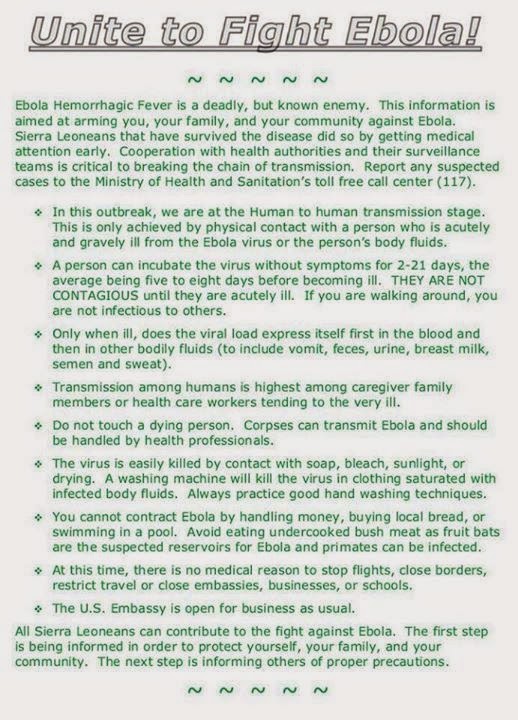
    Ebola message in EnglishThe US Embassy, Freetown, Sierra Leone website has 6 language versions of an ebola message (including English "Unite to Fight Ebola!"). I'm posting available image files of those documents from a Facebook posting by Zee Tunkara Clarkson (31 July 2014) with full text and links to the original PDFs of the documents. The object here is to promote dissemination of this material as well as to facilitate review by experts in the 5 languages of translation:  Krio, Mende, Kono, Susu, and Limba. (Three of these are cross-border languages, Mende also being spoken in Liberia, and Susu and Limba in Guinea.) Such material may possibly be useful in crafting other educational material in these languages.

    The text below was copied as-is from the documents pictured and linked. I do not speak any of these languages, so cannot comment on the translations, however there appear to be some inconsistencies in spellings (e.g., ibola and ebola in Krio). Feedback invited.


    Krio: "Le Wi Jɔyn An Fɔ Fɛt Ibola!"

    Ibola na sik we de kil kwik kwik wan ɛn na motalman ɛnimi; as i kin mek pɔsin in bɔdi de wam pas mak ɛn pul blɔd ɔlsay we gɛt ol na i bɔdi, so te i day.

    Dis mɛsej de fɔ ɛp yu, yu fambul dɛm ɛn yu neba dɛm fɔ fɛt ibola tranga wan.
    Salon pipul dɛm we bin gɛt ibola bɔt nɔr day bin liv bikɔs dɛn ebul go ɔ spitul kwik wan. Fɔ tap dis sik, na fɔ wok tranga wan wit di wɛlbɔdi pipul dɛm ɛn kɔl 117 ɛnitɛm yu si pɔsin we yu fil se gɛt dis sik. Yu nɔ go pe ɛnitin.
    • Fɔ naw, na pɔsin nɔ mɔ kin sheb dis sik. U kin gɛt dis sik we u jam bɔdi wit pɔsin we gɛt di sik bad bad wan ɔ sɛf kin gɛt am pan ɛni wata we de kɔmɔt na di pɔsin in bɔdi.
    • Pɔsin kin gɛt dis sik fɔ 2-21 de ɛn i nɔ go sho pan am, fɔ bɔku pipul, i go tek 5-8 de bifo i go sik. Durin dis tɛm, i nɔ go gi u pas di sik dɔn bad ɔf. If u de waka, u nɔ go kech di sik frɔm pɔsin we gɛt am.
    • Na we di posin don sik tranga wan na da tem de di sik go sho insef fos na di blod den na di wɛt, vɔmit, tɔylɛt, bɔbi wata spam ɛn swɛt.
    • Dis sik kin sheb kwi k wan frɔm pɔsin to pɔsin, mɔ to fambul we de mɛn di sik man or di wɛlbɔd i pipul dɛm we de tek care of dɛn sik man ya.
    • Duya, nɔ tɔch pɔsin we de day. Dedebɔdi kin gi u ebola so duya lɛf di dedebodi to di wɛlbɔdi pipul dɛm we dɛn dɔn tren fɔ andul dis sik ya.
    • Dis virus we wi kin kɔl tumbu, de day kwik wan if yu yuz sop, blich en san wi klos dɛm. Sɛf, yu we gɛt da machine for was klos kin yuz am for kil dis tumbu. Lɛ wi lan fɔ was wi an wit sop ɔl tɛm.
    • Yu nɔ go gɛt ebola if yu de ple wit mɔni, bay bred ɔ swim na wata. Nɔ it bush bif we nɔ kuk dɔn as dɛn bat we lɛk it fruit na dɛm wi biliv se de sheb dis ebola ɛn mɔnki, babu ɛn dɛn bush animal dɛn sɛf kin gɛt am.
    • As wi de tɔk so naw, wi nɔ gɛt no wɛlbɔdi risin fɔ tap plen nɔ fɔ flay, pipul fɔ travul, fɔ lɔk bɔda ɔ lɔk ɛmbasi, skul ɔ biznɛs dɛm.
    • Di american ɛmbasi opin fɔ biznɛs lɛk ɔltɛm.
    All salon man kin ɛp fɛt ibola. Di fɔs tin na fɔ no bɔt di sik so yu go protɛkt yusɛf, yu fambul dɛm ɛn u neba dɛm. Di nɛks tin na fɔ tɛl ɔda pipul dɛm aw dɛn sɛf kin ɛp tap ibola.


    Higbeh nyamu yila mia wa mu luehun ta toli ar Ebola, Taa nungaa waama wa, egbiya na ma, numgaa sia tia loo baoma. Mu yenge a goyila a hale bla sia ko mu higbe gi gbia ndohun. Nu gbi lee higbei gi ma ngoongo nu e pae hileblasia ti ma ngo flo.
    • Ba hingbei gi majoolo ar nu mui na hingbei gii gi gu gahun saniko nu mu hingbe ngur gi vondei.
    • Higbei gi ar yea nu gahun gi fele or gi nu fele gboyongo mahu yila.
    • Kelee ebola higbei eyeh numa tamia ar geh nu ngamii hun, golii, balii, fundei, ndolay yei, nyini yei.
    • Higbei gi ar lae lo nu gama ar bi bondasia or bi ma blasia ta bi mahun gbe.
    • Ba jaa ar numui na ebola higbei gi ma or numui na ebola higbei gi wa ga keley hiebla sia.
    • Ma hingbei gi waa flo, e na Mua mu yea ya wama fo ar bawei, klawa kemikasia, fulii ke klawa ngoli bee.
    • Ba ya ndogbo huen me, Huen na e yii panda ba mE, mehen na ndevei mia ba meh clo beh va.
    • Bee Ebola hingbei gi maango gi ba lolii ar kopoi, gi ba ye haka yea ya ma sabonda braedii yae ya mi ke gibon ba ye moi ma njei la.
    • Temi na e ya foi lei ko scuisia, embassisia, baluisia, businessisia ti gbo.
    • America Embassy wubla bla sia ti officii lao ngo temi gbi lee, ti lin hinda gbi.
    Mu kpelei ndoe gi hu mo a muye ma gu lo mu lapii a hin gbei wai gi ta toli Ebola ke hinda, halei ma pae ta mia a hingbei wai gi ma ngo lei, na mia a pae hingbei gi e mu hue ke mu bondaasia bee. Hinda yekei ma pa e a ndelaa nungaa yekei sa bee ma.


    Kono: "Mor Buteneh Che Kweyedondoryor Ebola ban Kwaya!"

    Ebola mu mor far gbadi ana Eh wan gbeh mor teh. Sakana kweh chea ehbatina mor ma benkwana, butuneh che kwaya gbandicha Mor bamoi min bow wnda gbadi ch, an fuawa ta bwe cheneh da. Ni moah wyiche bwetina, gbadicha eh fua wan banda moah chenechor. Mor gbadi chewakwa oryean bwetina timaor tima a wakwa or sonda mor bema Moi bwetin chawan gbabye chea ma 117.
    • Sanjeh chor gbandi che ka modonbwe artina ata modominday tina. Asin moi ya mason gbandi moi chedehchedel ama, Gbadi chiar arbebe tar or chiah or choir chiar.
    • Gbandiche emawan moi ma eyoson aca tay fea ma ata tay bifea kuma dondoiior. Che Moi kuso far gbandi chea sonda tay du the ar ta tay saiy ar the.
    • Gbandichea ebain gbadimoi dor. Inima weh gbaindachea ai bay mor dominda ma kadache Gbandiche ta gbaineh ma gbeh formoi ana hata or tar. Siache, susuei bor kaka, tarr. Asin, gbandi samoinfan bay amason kaka.
    • Iy ma tu suah, ambeh Gbandiche bay wan. Ni ya moi fah, ar to bweti mbowah ar ton kwaya Fineh mimbi gbandiche bay matuni somboiah, tay or kena gbandineh So mormor bo ark o tima or tima Yi tuah kapwe ah iea.
    • Gbandi eba moima Bbede orh or iea dah or kwa.
    • Yi ma feah or swi mima tama ni chendeh down,cheminah, feahor swim be knongbwoi down fan  Tosa na min to kenechior.
    • A beebeh kwa niooh nu Chebeor, momo ma foni mbeh fia dendeh ma na or ta. Momo ma bodar na ton ni Momo ma foni moie ma ta tache or.
    • Pu chenneh na wichetiya na kain famu Suku mbeh na kain famu.
    • Abbebeh Amerlica na cheneh a kain far mu sajameh.
    Morgbeh mormor boo art un Butuneh che kwa ya gbandi char. Mbe gbandi ch makwaor. Yi pen son mbe ya for to yi moin ja.


    Susu: "Muhu Berein Halam Fekayrinma Ebola Gayrayfey!"

    Ebola furay far furay nara. Gi furay etan, nu eha me fiyea, nu edoh ho boray. Leonenay, na habara gi furay sortoh aye serri na tongo e fa-yalan. Alan oh nu menga sie ha woo kayrain sortoh. A fala mengeh sie beh furay ma naha mu wama serry tongo fay. Hellity (117)
    • Hallow ar to forloh he key, aryerima mehri nu mehri nama. Egi furay sortoh manneh e na di eboray-rah.
    • Gi foo-ray lo manneh merima keyfree nu/mahoyennu kayrain. He suelee he solowma saha afa foorah
    • Foryei foo-rah afa wuleema sortoh, nu kwolee, nu bouwin woesi
    • Mehkeyray nehray, furayma dandama etangi furay masatorma
    • Enagha deen furayma fore nehray arfay colon
    • Gi furay, safwin, sogay. Temberin e bela he marah
    • E mu Ebola sortorma kobiri, tami yeama safay. E nah ha don say don naha mu yengri afa yerah. Keycoin nafa mordonma
    • Gi moment e nu norma baloyin dan dae aye mu kerabalama ecole nu wholiday, mu balama
    • US Embassy neh tanabay tembelay
    Leonenay nor manneh Ebola keriday. As sengeh, he tan, nu ehan meri aye nu e dohboray, nu gbetaye e fala berinbeh.


    Limba: "Mi Bointada Ba Dakila E thuna Key Dorma Ebola!"

    Ebola, e Thuna na key kori limba-meti. Key kotheh mi bah u thunkoh. Kayla bamba ba she ba me, hunpo hoe kentu, nu bay kentu ba mi hu kothor ba dakila Ebola. Hu gbon hoe ka Salone bin dae punkay kuta tali ban a gbokolimbi yakoh. Ma boinadi e ba pilin bay, bay bindeh masaay tabay ba mi na massita ba dakila e thuna ki. Yonkina hu gbon hoe ka ba pillim bay ka e kalahin 117 bana e kuta wah way sim ay kayhin ba e thorna key ka Ebola.
    • E thornah key seh key, key thala dain ka limba metti. E koh kin kutu na e labay kay wah metti wo tukeh, ni mu boti mu ka wah wo belun e thorna ki.
    • E san wu kothoh ba doma na wah bilun e thorna kin-kin ba ma loko koyi-kala ni manthay. Ma loko ma nundi, kin koh tukinokoh ka ma loko masoyi e ma loko maso-matati. Kin thornaki, kin sa thalanda yokoh wah wo thorna ma ka-here. Ba nah ndo punku thariokoh,e sakin thalintianda ka wah wu fenah.
    • Ba pilin bay e bay kenah-meh bay nayan kuta e thornah kin-kin.
    • Ba labay kay wah way tukeh. Ba pilin bay na doru wu labay kay wah way ni Ebola, ni ba mankia wah wu koro e Ebola.
    • E thunaki, kin koh kora e sineh, mu maythna, e kan woo. Mi thania ba loka tha lunkoh tha kantu timu-timu.
    • E sa kutu e thuna kinkin kama thalintanda kopiri, ka bola mu theri, ni ba gban thiokoh ka mandi. Ba thor mu thor mu poniyorta ma lohun - nor na bara.
    • Ka ma loko mama, mi ka eh e bali ba yikina thalan-boti ba sir, ba lunka beluin ni nga ken ken ka thurea-mina, ba yikina ba thariokoh, ba gboni bay, karani ba, ni Embassinabay.
    • Hu gbon hoe ka U.S. Embassy hoe petheh tuma-tuma nanda thurn hun.
    Mi formah kin ba thiah ma massay ba daykila Ebola. Yi kin Lanka kothor ba pulunokoh, ba bia bay kenda, ni metti da. Wu mankeh wu, mi kin bah wu tapay bia bi fenah ken na bin kothoh ba e thonaki.

    Thursday, September 04, 2014

    Ebola and health information in African languages

    The alarming ebola epidemic in West Africa - primarily Liberia, Sierra Leone, and Guinea, with a few cases in Nigeria - is now into its sixth month and still expanding. There are fears that ebola may explode into urban areas of the region. Doctors Without Borders/Médecins Sans Frontières (MSF) president Dr. Joanne Liu was recently quoted as saying that "the world is losing the battle to contain it," and Centers for Disease Control and Prevention (CDC) director Dr. Thomas Frieden was quoted as saying the epidemic is "spiraling out of control."

    International and national responses to ebola in West Africa have naturally focused on measures to control its spread and treat patients (as much as can be done, given the high mortality rate and lack of available remedies). Public health education is recognized as an essential element in controlling the epidemic and helping the region's population to understand what the real risks and treatments are.

    Ebola education in a multilingual region

    West Africa is of course a multilingual region, and any effort to effectively communicate and educate in such an emergency must take account of its multilingual nature, with many languages, limited knowledge of the various countries' official languages (English, French, or Portuguese), and limited literacy in first languages and regional lingua francas. No one language can be relied on to get ebola information and advice to all the people who need it. This means finding ways to translate messages, assure quality in such translations, and provide them in appropriate mixes of text (for posters, scripts) and audio (for national and local radio). It also has longer term implications that I will come back to in a later post on this blog.

    This linguistic dimension to public education on ebola in West Africa is recognized on various levels. The CDC for instance had radio spots produced in several languages of the affected area: Pular, several languages of the affected area. (links on language names go to Wikipedia descriptions). A Wellesley College prof, Dr. Donna A. Patterson, suggested that public campaigns should be available in "local languages" in an article entitled "Better Public Education Programs Could Help Stop the Spread of Ebola." And a news item on Côte d'Ivoire (Ivory Coast) mentioned translation on on the village level in the west of that country (although without the names of target languages).

    The non-governmental organization (NGO), Translators Without Borders (TWB) has coordinated translation of material into Hausa (see image at right). Its collaboration with the Nigerian Institute of Translators and Interpreters might be a good model for international and national collaboration on ebola messaging in African languages.

    However, attention to the importance of African first languages and lingua francas for public health education is apparently not a given. In an interview with BBC's World Update, TWB president Lori Thicke pointed out that health NGOs working in rural areas aren't always aware of language issues. Without anyone minimizing their efforts, this is not surprising from what I know of development projects and extension organizations, which tend to deal with "local languages" on an ad hoc basis with interpretation by staff or local people when the need arises (see blog posts on this in context of agriculture in 2007 and 2008).

    But it's not just a problem of NGOs in the field. In an interview on the US public television service, PBS, MSF's Dr. Liu referred to the need for clear messaging on ebola issues, but did not mention the challenges of quality translation of such messaging. She likely is well aware of that, but the fact it did not arise in either her statements or the interviewer's (Jeffrey Brown) questions is telling. Voice of America, in an August 20 article about media in West Africa and public education on ebola did not mention anything about languages or translation.

    This is not to say that the issue of translation of information on ebola is necessarily easy, but that it is an issue needing attention, especially at higher levels. The kind of volunteer-based translation that TWB facilitates is impressive, as is the less visible daily work on local levels by officials such as discussed in the Côte d'Ivoire item cited above, but it certainly would help to have more resources to support translation and wider coordination of translation efforts (the latter in part because many languages cross borders, meaning potential duplication of effort and differences in wording).

    Building resources for short- and long-term

    Another important need for dealing with ebola in the immediate future and in years to come, as well as for improving individual and public health in general, is to collect, record, and compile medical and health education material in African languages. Aside from providing reference material for the future, it also should help avoid having to start translations from scratch each time a public health emergency arises.

    Fortunately there is a volunteer effort to achieve this sort of outcome: the Wikipedia-based Medical Translation Project, which collaborates with TWB. An example of their work is an article on ebola in Hausa entitled "Ƙwayoyin cuta na Ebola" on the Hausa-language edition of Wikipedia

    I plan to post more on this project later.