Showing posts with label health. Show all posts

Tuesday, August 29, 2017

Polio information in Hausa

Hausa version of pamphlet on childhood immunization,
produced for distribution during Immunization Plus Day
activities, obtained from COMPASS-Kaduna, Aug. 2006.
Although almost eradicated worldwide, polio is still endemic in northern Nigeria as well as in parts of Afghanistan and Pakistan.

Public health campaigns in northern Nigeria such as those on polio have naturally included use of the Hausa language, which is dominant as a first language and lingua franca in that region and across the border in a large part of Niger. This post offers a glimpse of some materials.

According to Elisha P. Renne, professor emerita of anthropology and Afroamerican and African Studies at the University of Michigan, polio education in Kaduna State, Nigeria included short films, calenders, pamphlets, radio spot, and billboard - all in Hausa. (The photos of two pamplets, figure descriptions of those two included as captions here, and one photo of a billboard featured in this blog post were kindly furnished by Prof. Renne). 

The text in the first two items (at right and immediately below) is in standard Hausa boko script.

The late Sultan of Sokoto, Alhaji Muhammadu Maccido, shown giving oral polio vaccine,
on the 2005 calendar, sponsored by UNICEF and the Nigerian Ministry of Health.
The text on the billboard pictured below, however, is ASCIIfied. Depending how the display was created, this might be due to technical limitations. I've produced the text as I think it was intended in boko script below the image (which was not necessary for one of the lines, omitted in my added text). The billboard concerns vaccinations for more than just polio, so in the list of 6 diseases, I've also added their English translations where available in parentheses.*
Billboard at a Zaria city roundabout, 2012 (image cropped from photo received from Elisha Renne)

Iyaye maza da mata dasu bada haɗin kai lokacin riga kafin cututtukan yara

Bada haɗin ƙai don kawar de waɗannan cututtuka
  • Tarin fuƙa (tuberculosis)
  • Shan inna (polio)
  • Mashaƙo (bronchitis)
  • Ciwon tarin ƙiƙa (pertussis, whooping cough)
  • Baƙon dauro (measles)
  • Da tsinkau-tsinkau (?)


 Videos


There are various YouTube videos about polio in Hausa, including "majigi" films such as the below on polio prevention (part 1 embedded, parts 2 & 3 linked below; links to these were supplied by Prof. Renne).


Part 2 of 3 "In Kunni Yaji, Jiki Ya Tsiria"
Part 3 of 3 "In Kunni Yaji, Jiki Ya Tsiria"

None of the videos as far as I've seen have been same-language subtitled, though that would be an interesting way to combine literacy with health education.

Summary 


This is a very limited look at what is probably a considerable amount of material in Hausa on polio prevention, as well as on other health issues. One question is how well such materials are reviewed for accuracy of information and consistency of terminology.

It is my hope in future posts to bring out more such public health materials in Hausa and other African languages in the spirit of 2Ds&4Rs - a framework extending from dissemination to review and re-use of health education materials proposed during the ebola epidemic
__________________
* The English names were determined with reference to the following sources:
Nicholas Awde, 1996, Hausa-English/English-Hausa Practical Dictionary, Hippocrene.
Baba Mai Bello, 2015, The Perception of HIV/AIDS among Students in Northeastern Nigeria, LIT Verlag Münster.
Elisha P. Renne, 2010, The Politics of Polio in Northern Nigeria, Indiana University Press.

NB- Prof. Renne forwarded the images and information with an email response to an inquiry I made about her book cited above. The email exchange took place in April 2015.

Thursday, February 09, 2017

Health info in African languages, on 2 non-African sites

Here are quick reviews of two websites - one Australian the other American - that have health information in numerous world languages, including a number from Africa. Both are primarily intended to serve immigrant communities. This post will then return briefly to the theme of the benefits of systematically sharing and improving of health related information composed in or translated into African languages.

Health Translations


Health Translations is a website maintained by the government of the state of Victoria in Australia.  It has information (mainly documents such as fact sheets and flyers, from what I can tell, some with illustrations) on over 80 topics in a total of almost 100 languages or language varieties (although not all information is in every language, and some languages have few items).

The African languages for which there are materials include: Afrikaans; Akan; Amharic; Arabic; Bemba; Dinka; Juba Arabic; Kirundi; Krio; Lingala; Nuer; Oromo; Shona; Somali; Sudanese Arabic (also listed as Sudanese); Swahili (Congolese); Swahili (Kenyan); and Tigrinya.

This is an impressive collection of materials from various sources, apparently all Australian, and in different formats. They appear to all be translations - a given material may be available in a few or quite a number of language versions. Navigating from the a click on the desired language on the list of languages (which helpfully includes both English & native names/scripts) to a particular topical resource requires interacting with screens in English - not surprising, but when one gets to the list of topics and resources in a particular language, the titles are only in English, and then on the list of languages in which a material is translated (this is a typical navigation sequence), the language names are in English (no native scripts used). So the resource appears intended to be used by or with help of professionals or others who can read English.

Source: Bushfire smoke & your health [am]
I'm not able to evaluate the quality of the translations, but noted French in Lingala (which may simply be typically used loanwords) and by chance an anomalous English word in an Amharic text (image).

All the several documents I viewed were PDFs, mainly text but some image (meaning the text cannot be searched or copied out for editing into other materials). Spot checking some non-Latin text, specifically Ethiopic/Ge'ez used for Amharic and Tigrinya, and complex Latin, specifically for Dinka, there were some issues with the text that would interfere with searches or copying out passages (such problems are not uncommon with PDF rendering, even when visually the PDF presents everything correctly and in its intended place).

Some Amharic text when copied out and pasted showed capital A for አ and E for እ in initial position (for example, here). The corresponding characters are appropriate, interestingly, but this makes search or reuse of such text problematic.

From original (l.); copy-pasted out (r.)
Source: Bushfire smoke ... [din]

The Dinka text sampled showed some typical problems with complex Latin in PDFs. Dinka is written with what I call in ALDA a "category 4" Latin orthography in that it includes extended Latin characters (aka modified letters) plus combining diacritics, sometimes together as in the open-o with diaeresis in the word "daiɣɔ̈kthai" (dioxide) featured on the left side of the image. Copying that word from the PDF and pasting it in a word processor or advanced text editor yielded the results on the right, missing one extended character and the combining diacritic on the other. This complicates any potential re-use of this text, but also means that document, folder, or web searches will not pick up words with such character combinations.

Will return to these issues, why they're important, and what to do about them in the last section of this post.


HealthReach


HealthReach: Health Information in Many Languages is a program of the US Library of Medicine of the National Institutes of Health. It includes translations in 46 languages maintained on the MedinePlus site. A total of almost 350 topics are listed (although here too, not all information is in every language, and some languages have fewer items than others).

The African languages for which there are materials include: Amharic; Arabic; Oromo; Somali; Swahili; and Tigrinya, The native names of languages are featured on the list of languages, except oddly for Amharic and Tigrinya, which are transliterated into Latin ("amarunya" instead of አማርኛ, and "tigrinya" instead of ትግርኛ).

This also is an impressive collection from diverse sources, in this case American, but it is longer on topics and shorter on languages covered. The list of topics for each language also includes the titles in the language and its script - except again for Amharic and Tigrinya (not even transliterations) - as well as in English.

All materials checked were PDFs. There are no materials for African languages with complex Latin scripts.

As for non-Latin scripts, text in Arabic seems to behave as intended, from small samples. On the other hand, some Amharic text when copied out and pasted showed the same capital A for አ and E for እ observed above, plus O for ኦ (see here).  A Tigrinya document had a similar issue. So this issue may have to do with a problem in PDFs for handling a particular set of characters - አኡኢኣኤእኦኧ (representing glottal stop plus the range of vowels) - or a subset of them, which might be helpful to know when troubleshooting.

Health education materials and the "2Ds & 4Rs"


In highlighting aspects of public health messaging during the ebola epidemic in West Africa (2014-15), this blog suggested a systematic approach to sharing and improving materials that were developed and used in that context (with primary attention to text and images). A mnemonic - 2Ds & 4Rs - was put forth in October 2014, initially to explain the rationale for reposting and discussing various ebola education materials, but also as a way to capture the ideal cycle of utility of such production. Too often, materials are developed, used for a particular purpose, and then forgotten, when they could add to a growing living corpus of resources to tap for future work. This is important in any field and language, but arguably especially important in health, and for languages that have fewer resources and emerging terminologies / technical lexicons, such as many in Africa.

In that context I propose to use the 2Ds & 4Rs to consider the efforts represented by the two sites discussed above. Of the 6 elements of this model, the first three have to do more with the sharing and use of materials, and the last three with their longer term development and potential re-use. These are listed with brief explanations and what I see as relevance to the two sites:
  • Dissemination (making materials available, including via multiple sources)
    • Both sites bring together and post materials from diverse sources, increasing their exposure and access to them.
  • Demonstration (showing how materials in African languages can be presented, including in cases where complex scripts are involved)
    • Both sites show that African language materials can be presented on the same footing as other world languages.
    • However, the HealthReach presentation does not use available technology to present the native names of Amharic and Tigrinya, or titles of materials in those languages.
  • Reading (creating or translating text materials with attention to how they may be read aloud in groups or over local radio, which may be more likely scenarios for their use than the typical Western expectation of silent reading by individuals)
    •  It appears that all or most of the materials from diverse sources compiled on the two sites are translations from English of technical descriptions and advice. It is not clear how well how well adapted they are for the range of uses and audiences they might serve.
  • Review (written material - text - is well suited for review, comparison, and analysis; such material, especially in less resourced languages and on issues of public importance like health, should undergo such treatment)
    • No information on how any of the materials may be or have been reviewed, either in the diverse organizations where they originated, or in the projects hosting the two websites. 
    • Image PDFs, where these occur, do not lend themselves to processes of review.
    • Text PDFs with problems in their encoding of non-Latin or complex Latin scripts, present problems for review.
  • Revision (after review of materials, and in response to other information and feedback relevant to them, materials should undergo appropriate revisions in content, form of language, copyediting, and presentation)
    • No information on any revisions of any of the materials.
    • Issues cited under "Review" with image PDFs and with text PDFs that have encoding problems also hinder revision work.
  • Re-use or re-purposing (text materials can be re-used or sections re-purposed)
    • No information on re-use or re-purposing of any of the materials.

The two sites profiled above and the various health and medical education materials presented on them represent an important resource for fifteen African languages (and some varieties of two of those).

One additional question is whether such materials, intended primarily to serve needs of immigrants in Australia and the US, might be useful as is or with modifications, for speakers of the same languages in relevant African countries. Or in the reverse sense, whether any health extension materials from Africa might inform revision of these materials and development of new ones. A next step could be a for a site to begin to collect health materials in African languages from all sources.

There are many directions in which this could be taken, with the goals of improving availability, quality and utility of health education information in a range of African languages. One, for example, is linking with the longstanding WikiProject Med's Translation Task Force for development of articles in those African languages that have Wikipedias (such as Afrikaans, Akan, Amharic, Arabic, Kirundi, Lingala, Oromo, Shona, Somali, Swahili, and Tigrinya). Another might be connecting with efforts to advance development of standard terminologies. Still another might be to bring in human language technology, such as text to speech, so that materials designed and disseminated in text form could be accessible in audio via mobile devices.

Thanks to Charles Riley of Yale University for calling our attention to these two websites.

Thursday, May 12, 2016

Multilingual extension in Africa: The response to Ebola


Various earlier posts on this blog have discussed the importance of African languages in extension and development from general and tactical points of view (with particular reference to agriculture). Also during the course of the ebola epidemic in West Africa (which peaked in 2014-5), a number of posts looked at specific efforts to undertake health education and ebola awareness in various languages, and proposed systematically sharing, vetting, improving, and providing for re-use of translated and original materials in African languages.

This post looks from several different angles at multilingual messaging, including translation, over the course of the ebola epidemic. It will be followed by another post considering what strategies one might identify for future responses to emergencies - as well as less urgent public education needs - in multilingual contexts.

First, however, a quick note concerning summaries or evaluations of the linguistic dimension of the ebola response. As far as I am aware, there is no comprehensive overview or analysis. Reports from major organizations involved in the ebola response barely mention language (at the end of this post is a quick review). Perhaps the only report specifically on language and translation in the response was done by the international NGO Translators Without Borders, which was prominent in arranging translations of ebola materials into many languages (not just in West Africa): "Words of Relief  – Ebola Crisis Learning Review" (29 May 2015).  For a little bit broader view, but without pretense to completeness, I posted a summary largely reflecting content on this blog: "Ebola messaging in African languages - taking stock and looking ahead" (12 Dec. 2015, on LinkedIn). Both of the above proposed some lessons for the future.

Even lists of resources and websites, mainly done for reference or reporting during the period of the epidemic, are not comprehensive (for example, here). As I'll discuss below, one reason has to do with the scale or "layer" at which these operate, meaning that local activities either tend to be missed by international activities (which do the reports we see), or just aren't seen as falling in their scope. But it may also just be that information didn't travel or networks weren't connected. When researching ebola projects recently, for instance, I discovered an analysis of an interesting multilingual cellphone messaging project in Guinea called "Polly" from a group at Carnegie Melon University - something I personally had not seen mentioned elsewhere. Are there others?


Image by Chris55, Wikimedia Commons, CC BY-SA 4.0

Ebola messaging in African languages


It is useful to disaggregate as much as possible several interrelated aspects of the process of responding to a crisis like ebola in a multilingual context: time; space; demographics of languages; the levels or layers of activity (international, national, provincial, local); modes of developing information in diverse languages (translation, interpretation, and creation*); media (print, media, mobile, in person); and organizational policies.

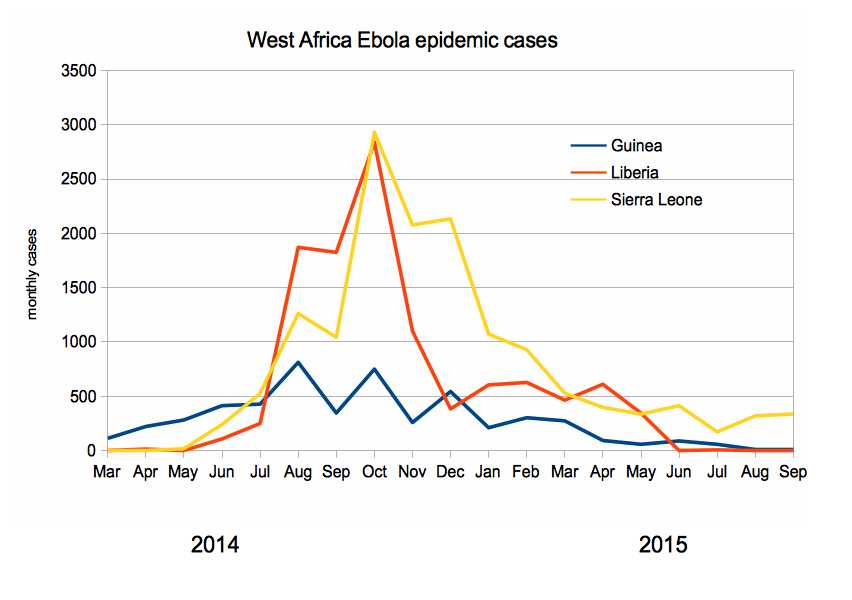
  • Time: Information about the epidemic came most quickly in English and French - official languages and main languages of media, the aid community, and the medical community. There was a lag in getting information in other languages of the affected countries. Major efforts to address this took a while to get going - according to TWB's report (cited above) its translation efforts began in November 2014 (though it seemed to have started some work in August), which was around the peak of the epidemic (per graph of cases above). Ad-hoc interpretation of incoming information on local levels (local radio, community meetings) was probably ongoing from relatively early in the cycle, with more organized efforts later on, though documentation is limited.
  • Space: Three countries were most hard-hit by the epidemic, and within those some regions within them more so than others. Responses obviously tried to address those, but logistics and information (such as for ebola education) tend to move from center to periphery. Data, on the other hand, may move from periphery to center by one or another means. Neither is perfect, but they evidently took time, especially early in the epidemic, even where there was mobile technology. Since the spatial distances were accompanied by language differences (different languages, different varieties of a language, or even different competencies in a same language variety), there was added time and evidently more potential for misunderstanding. All of this is in theory - I have seen no discussions of spatial dimensions of the response (looking in particular for the impact on information flows).
    • Linguistic demography: One dimension of linguistic demography is of course who speaks what where. Another is that on the country level, speakers of some languages are more numerous than others overall. Translations in languages more widely spoken on the national level were apparently done before less spoken ones. This makes sense on a broad scale but where less widely spoken languages dominate in a local areas, these likely were used orally (the backstory to the murder of health workers in Womey, Guinea included mention of local languages; a story from neighboring Côte d'Ivoire offered a peak at interpretation on the village level), but otherwise may not have received much attention. The only project I heard of that focused on translations in "smaller" languages was one organized by SIL in the neighboring Casamance region of Senegal (mentioned here).
    • Levels/layers: International aid and NGOs, national administration and services, and local communities and their local and extra-local networks seemed to operate on different and often only selectively interacting levels, especially early in the cycle. This dynamic meant that what happened or was being said on one level may or may not have had (immediate) effect on, or even in the extreme not been known by the others. And where information and diverse languages are involved, gaps and even contradictions (the latter in the form for example of misinformation about what ebola is or its treatment) seemed to emerge fairly quickly especially in critical early stages of an emergency.
    • Modes: Translation efforts focused on standard texts or posters, especially on the level of international aid and NGOs, but also some national level print media, and governmental and non-governmental entities. Interpretation and creation of information in African languages were more national and local in character - meetings, individual contacts, blogs. In the case of media (print, radio, TV) content about ebola, it is not clear the mode in which it was rendered in African languages (translation, interpretation, or creation*). For example, two international organizations working with media - International Committee of the Red Cross (ICRC) and Catholic Relief Services (CRS) - had projects with community radio stations to broadcast messages in local languages, but in neither case was it clear how that was done (which languages, whether oral translation from Europhone scripts or scripts pre-translated in target languages, what training, etc.). An example of community contacts in local languages to spread information about ebola in Liberia was given by International Rescue Committee (IRC) - the person in the example was a physician assistant and evidently fluent in the target language, so able to put information in his own words ("creation" in this model) to fit the needs and questions/challenges as he encountered them.
    • Media: Ebola messaging in African languages was conveyed on diverse media (print, poster, TV, radio, blogs, video, and mobile apps) as well as via community meetings and individual contacts. I am not aware of any studies of media activity during the ebola epidemic that might include discussion of languages used. An exception is information about mobile media used during the epidemic - "mobile-based interactive voice response technology," and apps like the SAWBO animations with African language voice-overs and the abovementioned "Polly." Also, an observation mentioned in an earlier posting that the dominant languages used in each means of communication tended to differ, such that in Nigeria supposedly the higher tech media used more English and the in person and community communication tended to be in first languages.
    • Organizations and languages: The observation by Nadia Berger and Grace Tang based on TWB's work translating ebola messages that "translation is not always considered a priority by governments and aid agencies" echoes experience more generally in international development. This is a major structural hurdle to more effective use of African languages in response to crises like the ebola epidemic, in health education, and indeed in all aspects of development. Do organizations and agencies have policies with regard to languages in the multilingual societies struck by the epidemic, or was the linguistic dimension of their work handled as an incidental consideration really given less priority in the face of a very physical crisis, despite its relevance to successful public education and control of disease transmission?
    With the latter point in mind, it is worth taking a quick look at whether and how language as a factor did or did not figure in reports of organizations involved in response to the ebola epidemic.

    Language in reports on ebola responses?


    Reports on ebola response efforts by Medecins Sans Frontiers, World Health Organization, and IRC did not mention languages or translation, nor did an analysis of the international ebola response by the UK Overseas Development Institute's Humanitarian Policy Group.

    The U.S. Centers for Disease Control (CDC), to its credit, did in its report mention language as a factor: "The Road to Zero: CDC's Response to the Ebola Epidemic." (Recall that CDC's ebola information resources included a few in Malinké - a variety of Manding). The two specific mentions merit a closer look:
    • A CDC worker with "intermediate" French worked with people Guinea's forest region, of which perhaps only one per village might speak French, to "translate important  health messages into the local language" and train local workers. An impressive effort, but the kind of situation where available language support - people with better French and acknowledged erudition in the local language(s) - could help assure accuracy of translations and messages in the local language. Also, since that part of Guinea has several local languages, it is not clear which was the focus of efforts
    • A training of midwives and cleaners was held in the Malinké language "since they do  not speak French, the official language of Guinea." Looked at another way, a big reason to use an important first language and lingua franca like Malinké would be that this is understood better, and that an advantage of training using such languages is that it could arguably better prepare trainees for work with patients who may also speak them better than the Europhone official language, French. (Another possibility might be a bilingual format with relevant African and Europhone languages, arguably better preparing trainees for contexts they will encounter.) 
    Reports or website content of all but a few of the 67 organizations on USAID-CIDI's list of NGOs involved in ebola response also did not discuss languages or translation (to be fair, a few of those which didn't were only involved in logistics of shipping supplies). CIDI's list is extensive, but notable among the omissions is TWB, certainly the most prominent international NGO facilitating translation of ebola materials. The exceptions which did mention language include:
    Another organization on the CIDI list, Mali Health Organizing Project, used Bambara in its ebola response, as one would expect (for example in a factsheet), but did not mention this linguistic dimension in its report or website.

    In all of these instances it would be helpful to have any materials developed/used for review (were they saved?) and incorporate them in archives for potential reuse (per 2Ds & 4Rs).

    Perspectives of health workers & patients?


    Another level at which language is important in such an epidemic is that of the interaction between health workers and the patients. For a glimpse of this issue, see two personal accounts by Western nurses about the language gap between them and patients (in Nurse.com and PIH.org). It would not of course have been possible to train foreign health workers in any of the local languages they would encounter, given the time factor, but one wonders if a couple of words or phrases might have made the difficult experience a bit more bearable for caregiver and patient (especially the younger ones).


    * Note on these 3 terms. On the first two, there seems to be a gap in the terminology: "translation," strictly speaking, refers to text, as distinct from "interpretation" being defined as oral and in person (physically or virtually). This leaves out what we might call oral translation, or interpretation of a source either received as text (announcer on radio reading in one language but giving the meaning in another) or heard in one language (in a meeting or on media) but transmitted orally in another language at a later time. These kinds of cross-language sharing are common in multilingual societies with rich oral traditions, and I suggest in this context they be considered as forms of interpretation (keep in mind the range of meaning of "interpretation" as an art). "Creation" is intended to cover instances where the writer (for example of a blog) or speaker (many possible scenarios) is conveying their understanding of a subject in their own words - which happen to be in a language different than that of the main international media, medical research, etc. Of course the lines among these three are not rigid, but I think it is useful to retain them as more or less archetypes of different ways information about ebola was communicated in African languages. (The neologism "transcreation" has specific applications, but might constructively be adapted for use somewhere within this space.)

    Friday, January 16, 2015

    Health information in African languages ... from the US

    A number of health agencies in the US have information available in various languages, as part of serving immigrant communities. These include some African languages. A sampling of sites includes:
    • National Institutes of Health
    • EthnoMed (includes short list by language, as well as list of other sites, some of which may have materials in diverse languages)
    • Echo Minnesota (page has several languages, both in a short list on left and in the sidebar at right)
    African languages with significant materials include: Amharic; Arabic; Oromo; Somali; Swahili; and Tigrinya. Such materials are freely available for use. They might also help in drafting articles for Wikipedia editions in those languages (per the work of Wiki Project Medicine's Translation Task Force).

    Thursday, December 18, 2014

    Ebola materials in Temne (Temen, Themine, Themne, Timene, Timini, Timne, Timmannee)

    Temne translation by TWB.
    Source: International SOS.

    A posting on this blog in September featured an ebola message in several languages of Sierra Leone, but not Temne, which is widely used mainly in the north of the country (over a million speakers). Here I'll highlight some ebola materials in Temne (with notes about the name of the language at the end).

    First is a translation of the the widely translated and circulated ebola poster by International SOS (on right). This was dated October 7, and done by Translators Without Borders (TWB, which also was involved in producing Mende and Krio versions of the poster).

    TWB also helped Humanitarian Response with production of Temne versions of "Social Mobilisation Key Messages" and "Messages for children and caregivers on Ebola - Child Protection and Education."

    Other material I'm aware of is audio, beginning with Temne versions of the CDC's radio spots. These recordings - which now are in 17 African languages or varieties of those languages (aside from English and French versions) - have been mentioned several times previously on this blog. It is worth recalling that these audio spots are not accompanied by text version in these languages, and there is no information about the approach(es) taken to producing the translations.

    Scientific Animations Without Borders (SAWBO) has produced an animation on ebola, and one of the voice-overs is in Temne. SAWBO's products are available in formats for viewing on cell phones and computer (though there do not appear to be text versions / scripts available).

    I am not aware of any material on ebola developed directly in Temne (written or recorded), although on the levels of national or community radio there may have been some significant use of the language in messaging.

    What's in a spelling?


    A quick comment on nomenclature. The name for the language is rendered in quite a few variant spellings (perhaps including some misspellings), several of which I've listed in the title. These have been observed on the web and/or taken from Ethnologue. Such variation in spelling can't help in managing information in the language. This is not problem unique to Temne (I discussed it in another posting), but seems to be a bit extreme in this case.

    The most widely used spellings in English seem to be "Temne" and "Themne," although I remember hearing the language called "Timini" by a native speaker some time ago (the name in the language itself is apparently "Themnɛ"). Would it be possible to settle on one or two spellings that all organizations working in/with this language would use to refer to it?

    Wednesday, October 29, 2014

    Two issues in use of African languages in ebola messaging

    A recent tweet highlights two issues about use of African languages in messaging about ebola in West Africa: nomenclature, the names and spellings of the languages; and re-use of material in one language variety (or dialect) in an area where another is spoken.
    (NB- "FLOTRG" = First Lady of the Republic of Guinea.)

    The reference is to two of the eleven language names for radio spots produced for the CDC (which have been mentioned previously on this blog). "Madingo" is actually a misspelling of "Mandingo," which may refer either to: (1) one of the Manding languages known to its speakers as Mandinka and spoken mainly in Senegambia; (2) the Mandingo "macrolanguage," a subgroup of Manding languages in the west of West Africa, including notably Mandinka, and Malinké (Maninkakan) of Guinea and neighboring countries; or (3) the entire range of Manding languages, per older usage (in English).

    Misspellings happen - I also noted a couple on the Ebola Communication Network site (since corrected) - but they also make it hard to locate information in searches. But, the apparent imprecision on the Manding variety in which the radio spot is recorded is another issue: these languages have a significant degree of mutual intelligibility, but material in one of them on technical or sensitive topics will not necessarily be understood as intended by speakers of other varieties.

    On the latter topic, Mary Crickmore, a high school classmate who later on took a different path to learning and working in Fula in Mali than I did, noted in correspondence how Fulfulde translations of sections of Where There is No Doctor ran into issues with some anatomy terms when tested in different parts of the country. I personally noted similar issues in shifting from Fulfulde in Mali to Pular in Guinea.

    This is not to say that material developed for one variety of a language (or one of a group of close and mutually intelligible languages) cannot be used in others, but that attention to differences of expression and vocabulary is essential to being understood as one intends, so it is helpful to be clear about the specific language variety(ies) involved. (The flip-side of this issue is how materials and terminology developed separately in different varieties of a language can be compared and harmonized, which requires awareness about the relationships of languages.)

    So possible re-use of the CDC radio spots in other countries where the languages are spoken (as suggested in the tweet above) would require review and likely a "localized" version to re-record. This in turn would benefit from access to scripts for such radio spots, or where these were not used or are not available, transcriptions, of the audio. (See 2Ds & 4Rs on this blog for further discussion.)

    As for "Fullar," it is not a term I have encountered, but it clearly refers to "Fula" (or "Fulah" with that random or gratuitous "h") and "Pular" (the main endonym for the language in Guinea, Sierra Leone, and Guinea-Bissau). Fullar in any event is not a standard term, and as such, would likely not be found in searches. (The case of names used for Fula is complicated enough already, without adding another term!)

    The CDC radio spot webpage also lists "Themne" for "Temne" - the former is a known alternative spelling, and seems to be another case of the "random/gratuitous h."

    Non-standard terms or spellings pose the same problem for searches that misspellings do. So, as more work is done on ebola messaging in African languages by diverse governmental, intergovernmental, nongovernmental, and academic organizations, there will be a need to catch instances where corrections are needed. Recourse might be made to the coding and names in ISO-639, as an available set of standards.

    Monday, October 27, 2014

    Wikipedia, ebola, and African languages

    MTP/TTF logo
    An article in the New York Times, "Wikipedia Is Emerging as Trusted Internet Source for Information on Ebola" (26 Oct. 2014), mentions translations of a main article on ebola "into other languages" - from English being understood. Those translations are coordinated through the Medical Translation Project / Translation Task Force (MTP/TTF) of the WikiProject Medicine, the WikiProjectMed Foundation, and Translators Without Borders.

    This post will briefly spotlight this translation effort, and what it has meant so far for African language editions of Wikipedia. First, however, I'd like to say that it is good to see the WikiProject Medicine and its head, Dr. James Heilman, receive this attention. Their current work on expanding available information about ebola is important and useful. I was also interested to learn from the article that the project was actually started a decade ago by Dr. Jacob de Wolff - making it a another lesson in the life cycle of ideas and their application.

    The MTP/TTF began in 2011; I first learned of it at the 2012 WikiMania conference. According to its webpage, it has facilitated translation of over 600 articles into 100 languages. This is impressive, especially since these translations are the result of volunteer efforts.

    However, progress on African languages* so far seems much less robust. The MTP/TTF monitors progress on translations under "full" articles and "short" (simplified) ones, and within each category (accessible via tabs on its homepage) there are several numbered groups (breaking the languages down into manageable numbers for display in table format).

    Under progress on the "full" articles, only 10 of the 30 current African language editions of Wikipedia are included (in group 7) - Chichewa, Hausa, Igbo, Kinyarwanda, Luganda, Shona, Swahili, Xhosa, Yoruba, and Zulu - and of these Swahili has by far more translations than any other language (29 of 33 articles). Seven languages have nothing at all. (The article on ebola is not included for any language in this category.)

    Under progress on the "short" (simplified) articles, African language editions feature in several groups (languages in italics are editions in "incubator," not full editions; there is some redundancy among the groups as accessed on 27 Oct. 2012):
    Progress for most of these languages has been limited, though it is clear that there is a concerted effort for translation of articles on ebola.

    However, it is also important to note that seven African language editions of Wikipedia - Afrikaans, Bambara, Ewe, Fula, Lingala, Sango, and Wolof ** - are not represented in any of the above lists. So it is good to note that Kasper Souren, who in 2005 played a pivotal role in getting the Bambara and Fula editions started, has just proposed an "Ebola translation task force" effort to promote translations in languages of West Africa, including facilitating an article on ebola in Bambara. Hopefully this initiative can, in addition to promoting translation of ebola-related information, also reinforce and expand the scope of the MTP/TTF to include all African language editions.


    Ebola articles in African languages

    Here's a list of African language editions of Wikipedia with ebola articles (26, by my count, as of 28 October): Afrikaans; Akan; Amharic; Bambara; Chichewa/Nyanja; Ewe; Fula; Hausa; Igbo; Kikuyu (Gikuyu); Kinyarwanda; Kirundi; Luganda; Oromo; Sesotho; Sesotho sa Leboa (N. Sotho); Setswana; Shona; Swahili; Swazi; Tigrinya; Tsonga; Venda; Xhosa; Yoruba; Zulu

    AfrophoneWikis

    Another resource of possible use in facilitating translation (and creation) of articles on ebola and related health and social issues for African language editions of Wikipedia is the "AfrophoneWikis" list. This was founded eight years ago, following the WikiMania 2006 conference, during which both Kasper and Martin Benjamin of Kamusi delivered presentations on support for Wikipedia development in African languages.


    * Although Arabic is an African language, spoken natively in North Africa for centuries, it has resources and enjoys a level of support typical of world languages. For purposes of this blog post, I am not including it in the discussion.
    ** There is also a Wikipedia edition in the Twi language, which is generally considered part of Akan.  
    NB- This article edited on 5 November to add the Lingala edition.

    Thursday, October 09, 2014

    Putting the "ɛ" (back) in Mende

    Mende-speaking area (UCLA LMP)
    How might Mende - a Mande language spoken by about 1.5 million (which many non-Sierra Leoneans may have encountered for the first time watching Amistad or Blood Diamond) - be used in written form as part of public education and health worker training for combating ebola?

    The Mende language (Mɛnde yia) is a major first language and lingua franca of southern Sierra Leone, an area particularly impacted by the current ebola epidemic in southwestern West Africa. In public education efforts on ebola, I understand that Mende, as well as other languages of Sierra Leone, have been used on broadcast media, and that in some cases, songs have been used to get messages across. However in this post the focus will be the written form of the language, with some thoughts on why that's important, and ways it might be used.

    "Kikakui"
    Mende is written in two ways::
    • the century-old "Kikakui" script, a right-to-left syllabary, which is apparently little used today (Ethnologue's entry on Mende states "limited usage except for correspondence and record keeping, especially accounting"); and 
    • a modified version of the Latin alphabet, which is more widely known, but apparently not used consistently since most of its speakers do not study it in school. 
    I'll focus on use of the Latin script for Mende, beginning with what I've learned about Mende's Latin-based orthography. The Mende alphabet (per AboutWorldLanguages.com's page on Mende) is as follows:
    a
    b
    d
    e
    ɛ
    f
    g
    gb
    h
    i
    j
    k
    kp
    l
    m
    n
    ny
    o
    ɔ
    p
    s
    t
    u
    v
    w
    y

    This includes three digraphs, which represent meaningfully significant sounds and count as letters, and two modified letters or "extended characters" to represent the additional vowels in Mende's 7-vowel system. Like a number of languages in West Africa (such as Bambara), Mende has, in addition to a, e, i, o, and u, the open-e, represented by ɛ, and open-o, represented by ɔ. (Mende is also a tonal language, but apparently tones are not marked.)

    For an example of Mende text, we may turn to the translation of the Universal Declaration of Human Rights - "Dunya Lahi Nuvuu Lɔnyisia Va" - from which I reproduce part of the preamble below (NB - the linked translation for some reason has the ɛ's and ɔ's in upper case, which I've corrected below):
    Magona Yɛpei

    A jifa kiliyei na kɛ numu vuu kpɛlɛɛ ti maa hɛwulei lɔ towa kpaupau le laha va, tɔnya kɛɛ ndilɛli dunyihu.

    A jifa ngawulɛɛhu kɛɛ baagbuala nuvugaa ti lɔnyisia ma ti wanga a pie hindangaa na hii i wotɛa a nɛmahugili waa nuvuu ma, dunya ninahu mia mahoingɔ muvuu i gu i yɛpɛ kia ngi longɔla, kɛɛ ngi lanayei kɛɛ ngi lima hinda.

    Perhaps the longest Mende text in Latin alphabet is a translation of the Bible, which dates to 1959.

    Ebola messaging and written Mende

    Focusing here on the written language does not in any way minimize the important, indeed central, role of the spoken language in communicating about ebola in West Africa. I've chosen for the above subheading "ebola messaging AND written Mende" rather than "ebola messaging IN written Mende" because as I see it, the former phrase encompasses the latter as well as uses of text designed to:
    1. take most advantage of spoken messages (for example, transcribing what is said, which lets one do more with it than simply recording would); and 
    2. enhance the effectiveness, accuracy, and consistency of oral communication (for example through use of scripts and talking points). 
    Oral and written communication are of course different (a topic I hope to come back to another time), but also complementary. Moreover, transcription of speech/audio, along with printed material destined for reading or reference - the language "reduced" (in)to writing, if you will - can be reviewed, revised, and re-used for public education and training programs. Understanding the complementarity of the written and spoken language seems to be important to expanding public education and health training efforts.

    Technology and standard written forms

    Language technology may have an important role to play in linking text and audio. For example, with text-to-speech (TTS) applications. Already a decade ago, for example, a working model for Swahili TTS was developed. There is also current research on Yoruba TTS. In principle, one could have TTS to make text messages "speak" to users in any language. Could be developed for Mende and other languages of countries most affected by the ebola epidemic?

    One could also combine text with video productions by using "same language subtitling" (SLS) to enhance the impact of such videos (and incidentally help increase literacy in those languages).

    Such applications, as well as searching text, combining text from different documents of different origins or ages, and assuring that readers get the intended meaning, require consistent use of an orthography - in the case of Mende, the one briefly discussed above. This poses a challenge where speakers of a language like Mende may never have learned to write it (apparently Mende is an elective subject in the Sierra Leone education system, so not all first-language speakers learn in or study it in school). The good news is that a spelling correction utility could be designed to convert irregularly transcribed text into a standard format (some years ago, for instance, a utility was developed in Kenya to add tilde marks in Gikuyu text where they were missing).

    Take for instance the Mende translation of an ebola message from the US Embassy/Freetown website, which I reposted on this blog three weeks ago. While it is a laudable effort and hopefully useful product, it clearly does not use the same alphabet as the examples cited above. A utility designed to "correct" such Mende text to the standard orthography would allow people not schooled in the language but literate in English to transcribe spoken/audio Mende text as best they can, and then render it in a form that can be more readily reviewed and re-used by others for expanded education and training efforts.

    For further discussion on the utility of standardized orthographies, see on this blog: "More on standard orthographies of African languages."

    Monday, October 06, 2014

    On the Atlantic Council's "Combating the Ebola Outbreak"

    Last Thursday, 2 October 2014, the Atlantic Council's Africa Center hosted an expert panel discussion on "Combating the Ebola Outbreak" in Washington, DC. Chaired by the Center's director, Dr. J. Peter Pham, the panel dealt with current efforts to address the crisis and longer-term considerations. (The full presentation, including presentations and Q&A, can be heard via a video link.)

    From a review of the audio of the discussion, I'd like to highlight three areas where the issue of language was implicitly or, in one case, explicitly mentioned. Keep in mind that West Africa, including the three countries currently experiencing the epidemic - Liberia, Sierra Leone, and Guinea - is a multilingual region, so this is a very practical issue.

    The first area was that of public education, which necessarily involves choice of language(s) for communication and development of materials. Panelist Donald Shriber, Deputy Director for Policy and Communication of the CDC's Center for Global Health referred in his comments to "health promotion and health communication, which means getting culturally appropriate messages out to people through trusted messengers." Language might be included under "culturally appropriate messages," and accuracy of messaging whatever the language would be implied - and both are arguably as important as cultural appropriateness (language and culture are dual considerations in localization, for instance) and trusted messengers (who one would hope would be able to convey clear, accurate, and consistent information in all languages used). As mentioned on a previous posting on this blog, the CDC has produced radio spots about ebola in 11 African languages of the region.

    The issue of public education came up again in the Q&A period in comments by former ambassador Robert Gribbin, who also served a short term recently as chargé d'affaires in the US Embassy in Sierra Leone. Amb. Gribbin mentioned that "There's been a massive education effort on the part of the [Sierra Leone] government, with its international partners to teach people about ebola, about what to do. ... And people are really quite aware I think of the immediacy of this ..." A natural question would be how the various languages of the country were used - as presumably they must have been in a "massive" public education push. It is worth remembering in this context that the US Embassy/Freetown has five Sierra Leonean language translations of an English language notice about ebola available on its website.

    Second, there were references to training of health workers, notably by Anne Witkowsky, US Department of Defense's (DoD) Deputy Assistant Secretary of Defense for Stability and Humanitarian Affairs.Ms. Witkowsky mentioned the DoD's plan to train up to 500 health workers per week. Here too, language becomes a big issue, both for training health workers, who may not have high levels in English or French, and who in any event, will have to communicate complex messages to patients and communities in their first languages. Will there be any training in or about messaging in various key languages where the health workers will ultimately work, or will it be assumed that the workers fully understand and can accurately interpret/translate on their own? (The latter is often the case in agricultural extension and development work in Africa - see the discussion and links here.)

    And third, the issue of communication about complex topics came up in remarks by Col. Nelson Michael (M.D., Ph.D.), Director of the US Military HIV Research Program at the Walter Reed Army Institute of Research. Referencing a UN publication on guidelines for good participatory practice,* he discussed the importance of community engagement in eventual vaccine trials, meaning that "the community is involved during the entire lifecycle of the project, from sitting on study teams to actually thinking about the designs of these studies to make sure that when volunteers are given informed consent that they have tests of understanding that their own native language is used so there's a contact and transparency between research indivduals and between those volunteers." Language here is explicit in the case of informed consent, but would also be important in the other participatory aspects.


    * I believe the publication is: "Guidelines on Citizens’ Engagement for Development Management and Public Governance," Development Management Branch, Division for Public Administration and Development Management, United Nations Department of Economic and Social Affairs, March 2011

    NB- Various minor additions and corrections after posting. Ambassador Gribbin's name corrected, with apologies for the error and thanks to Dr. Pham  (7 Oct 2014).

    Thursday, September 18, 2014

    On ebola, in Yoruba

    In a previous post, I included a link to a YouTube video on ebola in the Yoruba language. For reference, other videos on the subject in Yoruba and other Nigerian languages are accessible via @LensOnEbola on Twitter.  In this post, however, I'd like to highlight some information in written Standard Yoruba, since that can be read, revised, remixed, and reused in various ways.

    First, a quick intro to written Yoruba. The Latin-based script currently used for Yoruba in Nigeria - most of the Yorubaphone population lives in the southwestern part of that country - was developed beginning in the early 19th century (Samuel Ajayi Crowther, a remarkable figure in Nigerian history, was associated with that process). This orthography normally uses some characters with either small vertical lines or dots under (the latter sometimes referred to in English as "subdots") to represent the "open e" and "open o" vowel sounds and the "sh" sound (ẹ, ọ, ṣ). Since it is a tonal language, tone marks help disambiguate meaning, though are sometimes omitted. The Yoruba alphabet is considered a "complex Latin" script (Vietnamese is also in this category).

    Yoruba varieties in Benin are written with characters from the African reference alphabet. (Latin-based orthographies for African languages are generally fixed on the national level, and in many other cases have common characters and rules across borders).

    The following is a sampling of information mentioning ebola, in written Yoruba, sourced via quick online searches (NB- I do not speak the language so am trusting that the material so accessed is relevant and appropriate):
    This is just a sampling for one specific major language of West Africa. Any more complete and useful list of material on ebola in Yoruba would require a more systematic effort, as well as of course people literate in the language  Such collection of material in languages of the region could be used to develop information banks on ebola (and eventually other health issues) in those languages, which could be tapped for a range of public information, health worker training, and general education uses.