Showing posts with label translation. Show all posts

Friday, July 13, 2018

A movie on the life of Bishop Samuel Ajayi Crowther?

Bishop Crowther, 1888
Source: Wikipedia

Bishop Samuel Ajayi Crowther (c.1809-1891) was a remarkable figure in West African history, whose life bridged the end of the Atlantic slave trade era and the beginning of the period of European partition of the continent. Could his story be the basis of a major film production?

A compelling life story


Captured at age 12 or 13 in what is today Oyo State in southwest Nigeria, separated from his family, and sold into slavery, he was "recaptured" by a British anti-slaving force and eventually found his way back to his homeland and became prominent as a linguist and a member of the Anglican clergy (becoming in 1864 its first African bishop) in what was to become Nigeria. Towards the end of his life, however, this success collided with increasingly racist attitudes associated with the imposition of colonial rule.

This compelling story deserves more attention, and it is easy to imagine it being the subject of a major motion picture production. The idea is in no way new. From some contacts in Nigeria, notably Dr. Tunde Adegbola, and through him, filmmaker Tunde Kelani, I learned some years ago that there is interest in the production such a drama. There is at least one published dramatization of Crowther's life, a play focusing on his difficult later years, written by Prof. Femi Osofisan.¹

Certainly the most dramatic episode in Crowther's life was the unexpected reunion with his mother in 1846, which he himself recounted in these words (as presented in an 1892 biography):
"August 21. The text for this day in the Christian Almanac, is 'Thou art the Helper of the fatherless.' I have never felt the force of this text more than I did this day, as I have to relate that my mother, from whom I was torn away about five-and-twenty years ago, came with my brother in quest of me. When she saw me she trembled. She could not believe her own eyes. We grasped one another, looking at each other with silence and great astonishment, big tears rolling down her emaciated cheeks. A great number of people soon came together. She trembled as she held me by the hand and called me by the familiar names by which I well remember I used to be called by my grandmother, who has since died in slavery. We could not say much, but sat still, and cast now and then an affectionate look at each other--a look which violence and oppression had long checked--an affection which had nearly been extinguished by the long space of twenty-five years. My two sisters who were captured with us, are both with my mother, who takes care of them and her grandchildren in a small town not far from here, called Absika. Thus unsought for--after all search for me had failed--God has brought us together again, and turned our sorrow into joy."
Although a figure of the 19th century, Crowther's life story resonates beyond that period so critical in African history. The theme of separation and reunion is universal and powerful. His encounter with some of the worst aspects of racism, which unfortunately is still a very present problem (it was not until 2014 that the Church of England finally apologized for the treatment he received). Crowther's efforts in the area of Christian-Muslim dialogue reflect an important ongoing process. And his work with African languages, particularly but not limited to his native Yoruba, have an ongoing influence.

Ajayi Crowther, translation, and transcription


Early in his time in what is now Sierra Leone, where he was settled after reacue by the British, Crowther took an interest in languages and linguistics. Aside from his mother tongue and the English he learned in Freetown, he also learned Temne. In the course of his education leading to clerical vocation, he learned Latin and Greek, which later were essential in translating the Bible into Yoruba. He also learned Igbo (and contributed to work on translating the Bible into that language), Hausa, (in the context of a trip to the north), Nupe (for which he also published a grammar and vocabulary), and Igalla (which is closely related to Yoruba).

Character combos for open-e, open-o, & /sh/
in Yoruba. The small line is the "classic" look;
a dot under seems more often used these days.
Apparently much of the early work on writing Yoruba in the Latin alphabet (an older Ajami transcription already exised, likely used mainly by Muslim Yorubas) was begun by missionaries in Freetown working with Yoruba speakers who had been settled there, and Crowther collaborated with them. The system Crowther used to write Yoruba, including marks under e and o to denote open vowel forms of them (the language having a 7-vowel system), presumably built on those early efforts. With some modifications, such as tone markings, that orthography is still in use today, a significant contribution to the written forms of African languages.

When back in what was to become Nigeria, Crowther worked on A Vocabulary of the Yoruba Language, (1852), which was apparently the first linguistic work published by an African. His translation of the Anglican Book of Common Prayer and Bible into Yoruba came later.

Ajayi Crowther's place in African history


Although I had learned some basics about Bishop Crowther in my limited study of and reading on African history over the years (it is relevant to my work, but not my field), I first took an interest in his story due to his role in establishing the Yoruba orthography.² I hadn't realized until later that opinions of his role in Nigerian and West African history varied. In Prof. Osofisan's words (from prefatory notes to his play):
"Crowther has been much vilified by African scholars and historians, who accuse him of having been merely a lackey to the white colonials. His work as a pioneering missionaery who travelled widely and extensively along the River Niger, establishing missions and, above all, putting up a staunch fight against slavery, is hardly even appreciated. Even his works as translator and scholar, who established schools in many parts of the mission, and worked out the first written alphabets and primers for not only Yoruba, but also Igalla and Igbo, is always glossed over."
Maybe it's time - already a few years after the Church of England's apology for what was done to him late in his career - to "rehabilitate" Bishop Crowther's image in history more generally, and to provide the current generation with a new perspective on a complex and influential life and life's work?

A film on the life of Ajayi Crowther


Crowther achieved several firsts, as a clergy in his adopted religion, and as a prominent early linguist specializing in African languages. He engaged with African cultural, linguistic, and religious diversity. He was one of the first students at the famous Fourah Bay College. He personally experienced both slavery and the institutionalized racism of colonialism, but rose above them. He left a legacy that has perhaps been underappreciated.

So, could this story, to which the above sketch does not do full justice, be the basis for a major feature film production? One involving Nigerian and international producers and actors? Could it fully, accurately, and appropriately treat the linguistic aspects of the story?

The market is there for big Africa-themed productions - including ones in which African languages figure prominently. The action film Black Panther is a recent example. The 1997 historical drama Amistad did well. Language, transcription, and translation may seem like a harder sell, but the recent sci-fi film Arrival had linguistics as a central component of the plot.

Ethnic dimensions might need care to navigate. Crowther was obviously a Yoruba figure, but also spent formative years in the Creole community of Freetown, and later traveled and worked widely in what was to become Nigeria. The episode of his capture into slavery is said to have involved "Muslim Fulani" as well as eventually Portuguese slavers - so how to be historically accurate without feeding stereotypes should be a priority.³

The biggest challenges are that there is no script or even script treatment on the subject, and that research on the subject might yield more than one reasonable plot line to tell the story, with the potential for conflict between commercial imperatives (especially the bigger the production) and the importance of historical and linguistic accuracy, and sensitivity to the people groups treated.

So this post is intended to give a little more lift to an idea that merits consideration and, hopefully, action.

1. Femi Osofisan, Ajayi Crowther: The Triumphs and Travails of a Legend, Bookcraft, Ibadan, 2006. The play was first performed in Lagos in 2002.
2. This was about 10-15 years ago when I was focusing on support for African writing systems on computers and the internet.
3. There are currently reports of conflicts in Nigeria between herders, mainly Fulani (Fulɓe), and farmers of other ethnic groups, which have led to fatalities.

Thursday, September 28, 2017

A terminological issue in cross-language qualitative methods

What do you call it when someone hears something in one language, and then writes down the meaning in another language? It is technically not translation, interpretation, or transcription, in their purest senses, even though these terms are sometimes used to refer to the process or its products. Should we have a new term for this practice, especially to distinguish it from the alternative method of transcribing in the one language and then translating into the other?

This is an issue particularly relevant to qualitative research in Africa, where focus groups or interviews are often done in a language other than the one in which research analysis and reporting take place. It is also important in other multilingual countries and regions, and indeed some of my examples below come from experience in Afghanistan.

Two approaches


When I was managing research projects in Kabul in 2013, we handled qualitative data in the form of recordings of focus groups and in-depth interviews by having them transcribed in the source language (Dari or Pashto), then translated from the transcripts. This was standard in the company I worked with, and as a research practice, from all I had learned previously. I have in my possession, for example, a photocopy of a rather lengthy transcript of a recording in Fulfulde, prior to translation.1

It was of some surprise, therefore, to learn from another organization in Kabul that they paid people to translate or interpret into English directly from recordings, with no same-language transcripts. I later found that this kind of shortcut is actually not that uncommon. For example, I am working on a digitization project involving tapes in diverse African languages, plus written translations or transcripts in French or English.2 And see also the following excerpt from a recent position announcement, which does not even involve recordings (emphasis in original):
Notetakers will be responsible for capturing detailed and accurate documentation of focus group discussions and interviews in English, translating from Arabic to English in real time. The notetaker is thus the point person for all qualitative data obtained during the data collection phase.
Although skeptical about what seems like translating qualitative data "on the fly," since there is such potential for loss or distortion of information, and less facility in verifying the end product, I do recognize that there can be reasons - perhaps good ones - for such practice.3

The main issues here, however, are first to call attention to these different methods in qualitative research, which might be qualitatively different in their outcomes, and then to make the case for terminology to distinguish between them.

I'll begin with brief discussion of three terms already established in this space - transcription, interpretation, and translation - and then return to comparing these two approaches to cross-language qualitative data. I then consider possible blended terms to refer to the shorter approach.

Transcription


Transcription literally is conveying in writing - "reducing" the spoken language to its written form. By convention it refers to recording in the same language. Ideally a transcription should be verbatim, reflecting the actual words and expressions used.

The way one writes the language is a key consideration, though the general assumption in most cases I have encountered is to use the standard orthography. Transcription may also be phonetic, and this is common for example in linguistic research. There are gray areas between the two, as we found in Afghanistan, where speech in a language may vary in accent or regional variant forms, but which transcribers wrote in standard form - this we felt preserved the sense of what participants said in their languages, while facilitating later text analysis and translation.

The detail of transcription may vary, to the extent perhaps of indicating other sounds and vocalizations in addition to the meaningful speech.

Interpretation


Interpretation is conveying the meaning of a verbal utterances in one language into a verbal utterances in another. Interpretation may be in real time - either sequentially or consecutively, as is commonly done in formal or informal settings where someone interprets for two others who are speaking different languages, or simultaneously.
In any case, the usual assumption is that interpretation is done pretty close timewise to when the initial statement is made - at least when people are speaking directly. When a recording is involved, a spoken interpretation is usually not sought, but a written rendering of the meaning of the recorded speech might be - one of the situations of concern in this posting.

(The terms "interpretation" and "translation" are often used interchangeably, but here the strict definitions will be retained.)

Translation


Translation is the conveying of the meaning of text in one language into text in another. Translation may be more literal/word-for-word or more semantic/meaning focused. In the context of qualitative research, attention to the meaning and of the voice of participants is important.

The field of translation has seen a lot of change in recent years with specializations and the introduction and refinement of tools such as translation memory and machine translation.


From spoken source language to written target language


The context of cross-language qualitative data analysis is nicely summarized by Monique Hennink in her handbook on methods4:
In international focus group research, the group discussions are typically conducted in the language of the study participants, which may differ from that of the research investigators. Therefore, the tape-recording of the discussions will need to be translated and transcribed into the language of the research team for data analysis. The process may involve first transcribing the tape-recording in the language of the discussion and later translating the written document. This process will produce two transcripts: one in the original language of the discussion and a second translated transcript.
One advantage of having the two texts - one the transcript of the recorded discussions and the other the translation of that transcript - is in facilitating back checking of the translation. Another that the source language transcript can be used for text analysis.

Prof. Hennink continues4:
However, time and resource constraints lead many research projects to conduct the tasks of translation and transcription simultaneously, the outcome of which is a single transcript in the language of the investigators, with the tape-recording as the only record of the discussion in the original language.
Building on my previous discussion and illustrations above, here (below) is a quick schema illustrating these two approaches ("source language" here being the original language of the discussions, and the "target language" being that of the researchers, their analysis, and the final reporting or publication).
Two ways to get from spoken source language to written target language: In green, (1) transcription &
(2) translation; or in orange, (١) a direct rendering, for which there is/are not yet any specialized term/s.
What happens in the two-step process of transcription and translation (the green arrows, 1 & 2) is pretty straightforward. The transcription process may run into issues alluded to above in how to reconcile different pronunciations and usages with the standard language and its formal orthography, but these are problems common to transcription as a practice. Likewise, translation has its own set of issues such as whether to be more literal or more semantic.

On the other hand, what happens when the spoken source language data is not first reduced to writing in that language, but rather is rendered directly in the written target language (the orange arrow, with Arabic digit ١), is a process that needs more attention. It is clear, as already mentioned above, that the lack of a transcription in the source language makes verification of the product more difficult, and it also eliminates the possibility of text analysis in the source language.

But what about the process itself, what the person making the written target language product from the recording of the spoken source language? Should we think of that person as interpreting internally before writing, meaning perhaps an alternate two-step process? How does the quality of data processed this way compare with that of the formal two-step process above? Is this translation or interpretation, or should we call it something else? 

"Transterpretation," "interprescription," or ... ?


The process of rendering a recorded discussion in one language directly (one step) into a written record in another seems to be at the same time:
  • similar to that of same-language transcription in that the person doing it would likely listen and re-listen to the recording in order to get it right;
  • similar to interpretation in that they are working from what they hear, not something in writing; and
  • similar to translation in that the product is in written form and as such can be revised and edited. 
It yields a product used in the same way as that produced by transcription followed by translation, but as far as I am aware, there have not been any comparative evaluations of the two. 

Still, since the two processes - the two methods to convert spoken discussions in on language into text in another - are different, it would at least be useful to have different terms to refer to them. One possibility would be to simply call the two-step method "translation," understanding that a preceding step of transcription is involved, and to coin a term for the one-step method. For the latter, two possible ways of blending the terms "transcription" and "interpretation" that would convey the sense of writing down one's interpretation of spoken language, are "transterpretation" and "interprescription" (for the latter, the product would logically be an "interprescript" - an interpretation transcript). Of course there may be better ideas, which would be welcome.

Simultaneous interprescription or transterpretation?


As mentioned above, there is also the other scenario where discussions may be interpreted and transcribed (at least as summary notes) in one step in real time, i.e., without a recording. This is another approach to cross-language qualitative data from focus groups or interviews, which also ought to have an appropriate term to facilitate reference and clarity about methods.

1. These were transcriptions in handwritten Fulfulde photocopied by me around 1990, thanks to Prof. David W. Robinson. My intent was to use them for extracting lexical data for future revision of the Fulfulde lexicon.
2. These were produced by a project run by Nigel Cross and Rhiannon Barker that resulted in a book edited by them under the title At the Desert's Edge: Oral Histories from the Sahel (Panos, London, 1992).
3. As discussed below, limited resources and limited time are given as justifications for not transcribing in the source language. Another circumstance that might arise is where participants are not comfortable with being recorded, so a facilitator may make notes of their interpretation of the discussions (rather than attempt verbatim transcription or notes in the same language that need translating later).

4. Monique M. Hennink, International Focus Group Research: A Handbook for the Health and Social Sciences (Cambridge University Press, 2007, p. 214).

Sunday, June 19, 2016

TED talks in African languages?

Of all the TED and TEDx talks - a genre of knowledge sharing that began in the 1980s but went "viral" with the possibilities offered by YouTube - have any been given in any African language? The question is not so easy to answer as I'll get to below, but the process of trying to answer it gives rise to other questions such as: Could a TED talk or a TEDx event be given in one or several African languages?

Image source: javiermeias.com.

TED - "Ideas Worth Spreading"


TED, an acronym for Technology, Entertainment, Design, "is a global set of conferences run by the private nonprofit organization, Sapling Foundation." The idea of the conferences is sharing of ideas "usually in the form of short, powerful talks (18 minutes or less)."

The conferences have been held mainly in North America and Europe, with a handful in Asia and Latin America. One, in 2007, was held in Arusha, Tanzania with the theme, "Africa: The Next Chapter." Many, but not all, of the talks in these events become videos featured online.

The talks, which total some "2200+" according to the website, are apparently all given in English. (The program for the 2007 conference in Arusha is not available online to check.) Quite a number of talks are subtitled in other languages, as I'll discuss further on.

TEDx - "x = independently organized event"


Image adapted from: anthonygoddard.com.
TEDx events, of which there are several types, are licensed by TED but organized separately. The number of TEDx events around the world is not stated anywhere I looked, but one list includes 2967 events (number from the line count in my text editor), and a nice interactive map display includes some past events that are not on that list (I randomly checked some in Africa).

The total number of talks at these independent conferences must therefore be staggering. The drop-down list in the sidebar of the TEDx languages page lists 43 languages, of which the only African one is Arabic (to that extent, my first question in the opening paragraph above would be answered in the affirmative). However, given the large number of TEDxs that have been held in many diverse locations around the world, is it possible that there have been presentations in other languages not on that list?

From a rough count of TEDx events in Africa in 2015 on the map mentioned above, there were ~80 events, with well over half in diverse locations in sub-Saharan Africa. Were presentations in places like for example Kano, Nigeria, Dar es Salaam, Tanzania, and Addis Ababa, Ethiopia all English-only?


Subtitling of TED talks


According to the translation page on the TED site - there has been subtitling of talks in over 100 languages (the actual count on the page is 110, thanks again to copy-paste & line-count, but that number includes some varieties of the same languages, as well as English originals). The African languages among these, with their count of how many talks, include: Afrikaans (19); Amharic (13); Arabic (2091); Arabic, Algerian (9); Hausa (1); Igbo (1); Somali (20); and Swahili (33).

The one talk (in English) with Hausa subtitles - embedded below - was given in 2003 and with the subtitles evidently added in 2008. Worth noting that the Boko orthography is used, as you can see with the hooked consonants.


The one talk with Igbo subtitles does not appear to follow the standard orthography - the lack of subdot vowels is one giveaway, but also tone marks are absent. And there are untranslated English terms - the first instance I recall seeing of code-mixing in subtitles. The other language subtitles look polished, though I'm even less in the position to evaluate them.

TEDx talks, as noted above, come in various languages, and apparently some of them have same-language subtitling, although that term is not used (for example several dozen in French).

The translation/subtitling effort itself looks like a successful involvement of volunteer contributions for at least a number of languages.

TED or TEDx in African languages?


There are two ways to achieve more linguistic diversity relevant to Africa in TED talks. The first would be through expanding the translation program mentioned above.This might require some new approaches as the volunteer model may not work as well as in Northern countries. The benefit would be expanding access, particularly with some more widely spoken African languages.

The second would be to organize (more?) TEDx events that either allow presentations in African languages, or that explicitly invite presentations in one or more African language(s). This would seem to be an interesting way to bring in diverse presenters, and to develop recorded content that could be shared locally, nationally, or regionally (depending on the language demographics). Even for those without internet or mobile access to such TEDx recordings, it might be possible in some contexts to distribute video for TV and audio-only for national and community radio. And such content could of course be translated into other languages for wider dissemination.

Ideas for sharing, after all, can come in many languages.

Thursday, May 12, 2016

Multilingual extension in Africa: The response to Ebola


Various earlier posts on this blog have discussed the importance of African languages in extension and development from general and tactical points of view (with particular reference to agriculture). Also during the course of the ebola epidemic in West Africa (which peaked in 2014-5), a number of posts looked at specific efforts to undertake health education and ebola awareness in various languages, and proposed systematically sharing, vetting, improving, and providing for re-use of translated and original materials in African languages.

This post looks from several different angles at multilingual messaging, including translation, over the course of the ebola epidemic. It will be followed by another post considering what strategies one might identify for future responses to emergencies - as well as less urgent public education needs - in multilingual contexts.

First, however, a quick note concerning summaries or evaluations of the linguistic dimension of the ebola response. As far as I am aware, there is no comprehensive overview or analysis. Reports from major organizations involved in the ebola response barely mention language (at the end of this post is a quick review). Perhaps the only report specifically on language and translation in the response was done by the international NGO Translators Without Borders, which was prominent in arranging translations of ebola materials into many languages (not just in West Africa): "Words of Relief  – Ebola Crisis Learning Review" (29 May 2015).  For a little bit broader view, but without pretense to completeness, I posted a summary largely reflecting content on this blog: "Ebola messaging in African languages - taking stock and looking ahead" (12 Dec. 2015, on LinkedIn). Both of the above proposed some lessons for the future.

Even lists of resources and websites, mainly done for reference or reporting during the period of the epidemic, are not comprehensive (for example, here). As I'll discuss below, one reason has to do with the scale or "layer" at which these operate, meaning that local activities either tend to be missed by international activities (which do the reports we see), or just aren't seen as falling in their scope. But it may also just be that information didn't travel or networks weren't connected. When researching ebola projects recently, for instance, I discovered an analysis of an interesting multilingual cellphone messaging project in Guinea called "Polly" from a group at Carnegie Melon University - something I personally had not seen mentioned elsewhere. Are there others?


Image by Chris55, Wikimedia Commons, CC BY-SA 4.0

Ebola messaging in African languages


It is useful to disaggregate as much as possible several interrelated aspects of the process of responding to a crisis like ebola in a multilingual context: time; space; demographics of languages; the levels or layers of activity (international, national, provincial, local); modes of developing information in diverse languages (translation, interpretation, and creation*); media (print, media, mobile, in person); and organizational policies.

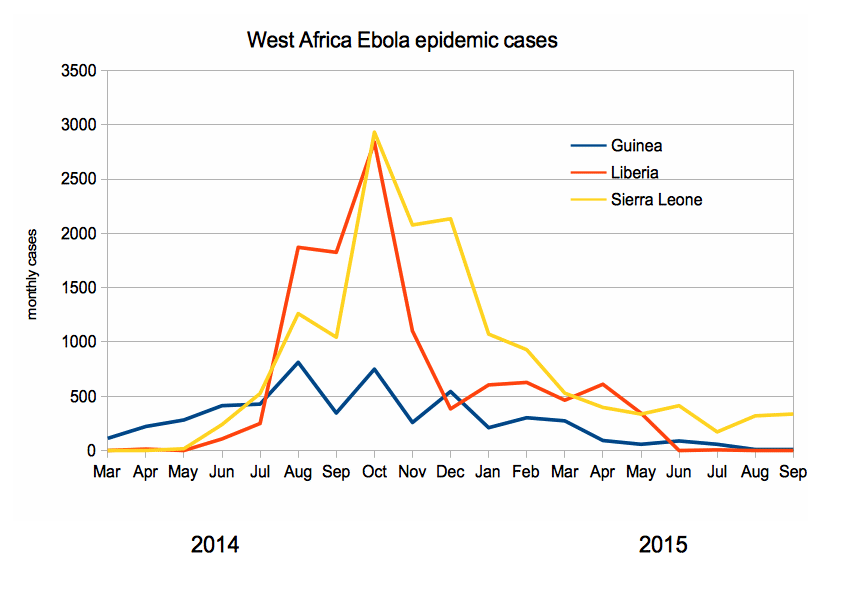
  • Time: Information about the epidemic came most quickly in English and French - official languages and main languages of media, the aid community, and the medical community. There was a lag in getting information in other languages of the affected countries. Major efforts to address this took a while to get going - according to TWB's report (cited above) its translation efforts began in November 2014 (though it seemed to have started some work in August), which was around the peak of the epidemic (per graph of cases above). Ad-hoc interpretation of incoming information on local levels (local radio, community meetings) was probably ongoing from relatively early in the cycle, with more organized efforts later on, though documentation is limited.
  • Space: Three countries were most hard-hit by the epidemic, and within those some regions within them more so than others. Responses obviously tried to address those, but logistics and information (such as for ebola education) tend to move from center to periphery. Data, on the other hand, may move from periphery to center by one or another means. Neither is perfect, but they evidently took time, especially early in the epidemic, even where there was mobile technology. Since the spatial distances were accompanied by language differences (different languages, different varieties of a language, or even different competencies in a same language variety), there was added time and evidently more potential for misunderstanding. All of this is in theory - I have seen no discussions of spatial dimensions of the response (looking in particular for the impact on information flows).
    • Linguistic demography: One dimension of linguistic demography is of course who speaks what where. Another is that on the country level, speakers of some languages are more numerous than others overall. Translations in languages more widely spoken on the national level were apparently done before less spoken ones. This makes sense on a broad scale but where less widely spoken languages dominate in a local areas, these likely were used orally (the backstory to the murder of health workers in Womey, Guinea included mention of local languages; a story from neighboring Côte d'Ivoire offered a peak at interpretation on the village level), but otherwise may not have received much attention. The only project I heard of that focused on translations in "smaller" languages was one organized by SIL in the neighboring Casamance region of Senegal (mentioned here).
    • Levels/layers: International aid and NGOs, national administration and services, and local communities and their local and extra-local networks seemed to operate on different and often only selectively interacting levels, especially early in the cycle. This dynamic meant that what happened or was being said on one level may or may not have had (immediate) effect on, or even in the extreme not been known by the others. And where information and diverse languages are involved, gaps and even contradictions (the latter in the form for example of misinformation about what ebola is or its treatment) seemed to emerge fairly quickly especially in critical early stages of an emergency.
    • Modes: Translation efforts focused on standard texts or posters, especially on the level of international aid and NGOs, but also some national level print media, and governmental and non-governmental entities. Interpretation and creation of information in African languages were more national and local in character - meetings, individual contacts, blogs. In the case of media (print, radio, TV) content about ebola, it is not clear the mode in which it was rendered in African languages (translation, interpretation, or creation*). For example, two international organizations working with media - International Committee of the Red Cross (ICRC) and Catholic Relief Services (CRS) - had projects with community radio stations to broadcast messages in local languages, but in neither case was it clear how that was done (which languages, whether oral translation from Europhone scripts or scripts pre-translated in target languages, what training, etc.). An example of community contacts in local languages to spread information about ebola in Liberia was given by International Rescue Committee (IRC) - the person in the example was a physician assistant and evidently fluent in the target language, so able to put information in his own words ("creation" in this model) to fit the needs and questions/challenges as he encountered them.
    • Media: Ebola messaging in African languages was conveyed on diverse media (print, poster, TV, radio, blogs, video, and mobile apps) as well as via community meetings and individual contacts. I am not aware of any studies of media activity during the ebola epidemic that might include discussion of languages used. An exception is information about mobile media used during the epidemic - "mobile-based interactive voice response technology," and apps like the SAWBO animations with African language voice-overs and the abovementioned "Polly." Also, an observation mentioned in an earlier posting that the dominant languages used in each means of communication tended to differ, such that in Nigeria supposedly the higher tech media used more English and the in person and community communication tended to be in first languages.
    • Organizations and languages: The observation by Nadia Berger and Grace Tang based on TWB's work translating ebola messages that "translation is not always considered a priority by governments and aid agencies" echoes experience more generally in international development. This is a major structural hurdle to more effective use of African languages in response to crises like the ebola epidemic, in health education, and indeed in all aspects of development. Do organizations and agencies have policies with regard to languages in the multilingual societies struck by the epidemic, or was the linguistic dimension of their work handled as an incidental consideration really given less priority in the face of a very physical crisis, despite its relevance to successful public education and control of disease transmission?
    With the latter point in mind, it is worth taking a quick look at whether and how language as a factor did or did not figure in reports of organizations involved in response to the ebola epidemic.

    Language in reports on ebola responses?


    Reports on ebola response efforts by Medecins Sans Frontiers, World Health Organization, and IRC did not mention languages or translation, nor did an analysis of the international ebola response by the UK Overseas Development Institute's Humanitarian Policy Group.

    The U.S. Centers for Disease Control (CDC), to its credit, did in its report mention language as a factor: "The Road to Zero: CDC's Response to the Ebola Epidemic." (Recall that CDC's ebola information resources included a few in Malinké - a variety of Manding). The two specific mentions merit a closer look:
    • A CDC worker with "intermediate" French worked with people Guinea's forest region, of which perhaps only one per village might speak French, to "translate important  health messages into the local language" and train local workers. An impressive effort, but the kind of situation where available language support - people with better French and acknowledged erudition in the local language(s) - could help assure accuracy of translations and messages in the local language. Also, since that part of Guinea has several local languages, it is not clear which was the focus of efforts
    • A training of midwives and cleaners was held in the Malinké language "since they do  not speak French, the official language of Guinea." Looked at another way, a big reason to use an important first language and lingua franca like Malinké would be that this is understood better, and that an advantage of training using such languages is that it could arguably better prepare trainees for work with patients who may also speak them better than the Europhone official language, French. (Another possibility might be a bilingual format with relevant African and Europhone languages, arguably better preparing trainees for contexts they will encounter.) 
    Reports or website content of all but a few of the 67 organizations on USAID-CIDI's list of NGOs involved in ebola response also did not discuss languages or translation (to be fair, a few of those which didn't were only involved in logistics of shipping supplies). CIDI's list is extensive, but notable among the omissions is TWB, certainly the most prominent international NGO facilitating translation of ebola materials. The exceptions which did mention language include:
    Another organization on the CIDI list, Mali Health Organizing Project, used Bambara in its ebola response, as one would expect (for example in a factsheet), but did not mention this linguistic dimension in its report or website.

    In all of these instances it would be helpful to have any materials developed/used for review (were they saved?) and incorporate them in archives for potential reuse (per 2Ds & 4Rs).

    Perspectives of health workers & patients?


    Another level at which language is important in such an epidemic is that of the interaction between health workers and the patients. For a glimpse of this issue, see two personal accounts by Western nurses about the language gap between them and patients (in Nurse.com and PIH.org). It would not of course have been possible to train foreign health workers in any of the local languages they would encounter, given the time factor, but one wonders if a couple of words or phrases might have made the difficult experience a bit more bearable for caregiver and patient (especially the younger ones).


    * Note on these 3 terms. On the first two, there seems to be a gap in the terminology: "translation," strictly speaking, refers to text, as distinct from "interpretation" being defined as oral and in person (physically or virtually). This leaves out what we might call oral translation, or interpretation of a source either received as text (announcer on radio reading in one language but giving the meaning in another) or heard in one language (in a meeting or on media) but transmitted orally in another language at a later time. These kinds of cross-language sharing are common in multilingual societies with rich oral traditions, and I suggest in this context they be considered as forms of interpretation (keep in mind the range of meaning of "interpretation" as an art). "Creation" is intended to cover instances where the writer (for example of a blog) or speaker (many possible scenarios) is conveying their understanding of a subject in their own words - which happen to be in a language different than that of the main international media, medical research, etc. Of course the lines among these three are not rigid, but I think it is useful to retain them as more or less archetypes of different ways information about ebola was communicated in African languages. (The neologism "transcreation" has specific applications, but might constructively be adapted for use somewhere within this space.)

    Tuesday, May 05, 2015

    Applied linguistics for development workers?

    In an article last January in The Guardian's Global Development Professionals Network, Maria May suggests "Six resolutions for aid workers" in 2015: 1. Be the best manager ever; 2. Read; 3. Write; 4. Spend more time in the field [i.e., don't let it slide down the list of priorities]; 5. Walk the walk [development "organizations need to exemplify the change that they are trying to make in society"]; and 6. Renew yourself.

    I'd like to suggest a 7th resolution for 2015 - never too late to improve practice - which is particularly important in multilingual contexts commonly encountered in development work in Africa: "Be a little bit of a linguist." What I mean by that is to pay attention to what languages are used and might be used, and how, in all levels of development work - especially on the level of beneficiaries and their communities.

    Language, of course, is key to communication, which is central to extension, learning, and collaborative planning and action. And when many languages are used in a community, communication in development becomes more complex, choice of languages becomes a factor, and several social and linguistic issues come into play:
    1. Participation: Who's talking? Who's not talking (or understanding)? These are issues even in monolingual communities, but where more than one language is spoken, try to observe what the use of or shift among languages means in terms of who does and doesn't participate fully - or at all. Typically use of an elite language or a language spoken by a majority in the community will favor people in leadership positions. Choice of language may reflect power as much as a desire to reach the most people. 
    2. Gender: Related to the previous point, what do women speak and not speak? Women tend not to have as many languages as men, due to lack of formal education of girls, as well as to the opportunities even unschooled men have to travel and interact with speakers of other languages in their region (and beyond). Try to get an idea of what languages women use in homes, community, and local markets, and what gaps there may be for their direct communication with government, extension agencies, development projects, school staff, etc.
    3. Interpretation: Where it is necessary to work across more than one language, what is the quality of rendition in the target language(s)? If you don't speak the target language you have to trust the interpreters who do, but don't do so blindly. You may have seen a spoof of movie subtitles where an actor speaks a long piece and the subtitle has one or two words - be alert to shortcut summaries and query the interpreter when s/he gives you one.* In 2010 I sat in on a training of community animal health workers in Moroto, Uganda, who requested a change of interpreter to one who had better command of relevant vocabulary in Karamojong language. If there had not been that alternative, what might have been lost in translation? Check to be sure of the interpreter's confidence in the technical topic(s) being discussed before putting them on the spot to translate for you.
    4. Translation: Can you bring talking points translated in the target language to the field? At its most basic level, interpretation is oral and translation written, but development work rarely involves the latter when "local languages" are involved. Yet "pre-translating" key concepts and terminology might be helpful as aids to ensure good interpretation and reduce "slippage" in conveying information. Translation is also a key to localizing ICT4D (see below).
    5. Local extension agents: What languages do they speak? I've remarked in the past that a US Peace Corps volunteer may get more language training in one week than the average local extension or development worker gets in an entire career. That may not seem to matter much if they speak the local languages, but even when they do, there is no support to assure the quality of technical expression in those tongues, and very likely such workers are not literate in them (if their formal education was uniquely in a Europhone official language). And often it is the case that local extension workers may be posted in a region of their country where a language(s) they are not so familiar with are spoken
    6. Local radio: What languages do they use? In my experience in West Africa, community radio stations split their programming among whatever languages are spoken by people living within their broadcast radius. With expertise across languages (including finding ways to express new concepts in them), the staff of a station in an area where you are working could be a valuable partner for both for understanding the sociolinguistic profile of the area and for messaging to reach all groups.
    7. ICT4D: Applications, software, and content that do not respond to the linguistic realities of the population will have a limited utility - or utility for a limited number of people. Localization (L10n) involves translation and adaptation to local culture and communication. Projects in information and communication technology for development (ICT4D) and efforts to develop L10n in the same countries would seem to be natural allies with complementary interests, but it may be up to the better funded ICT4D projects to reach out to make this connection.
    One by one, such issues may make perfect sense, but even when taken together, the reasons for attention to language as a factor in development have not led to a real understanding of the role of languages in development, or what we might do better in multilingual contexts - and with less-resourced languages - to improve practice and outcomes.

    The link between language and development is "largely ignored" according to Ekkehard Wolff. Robert Chaudenson has suggested that the subject of language is "taboo" in development work in Africa. And Birgit Brock Utne noted that foreign donors have a negative view of African multilingualism. This is a problem and we can do better.

    * An episode of interpretation recorded on video in southern Afghanistan, with translated subtitles, is an example of shortcuts or just bad interpretation. There are other dynamics going on in the video, but the segment about midway through with the local elder is worth viewing.

    On a similar topic: "Back again. Gates, Rockefeller & African languages" 14 Sep 2006.

    Tuesday, December 16, 2014

    Two more ebola posters in Bambara

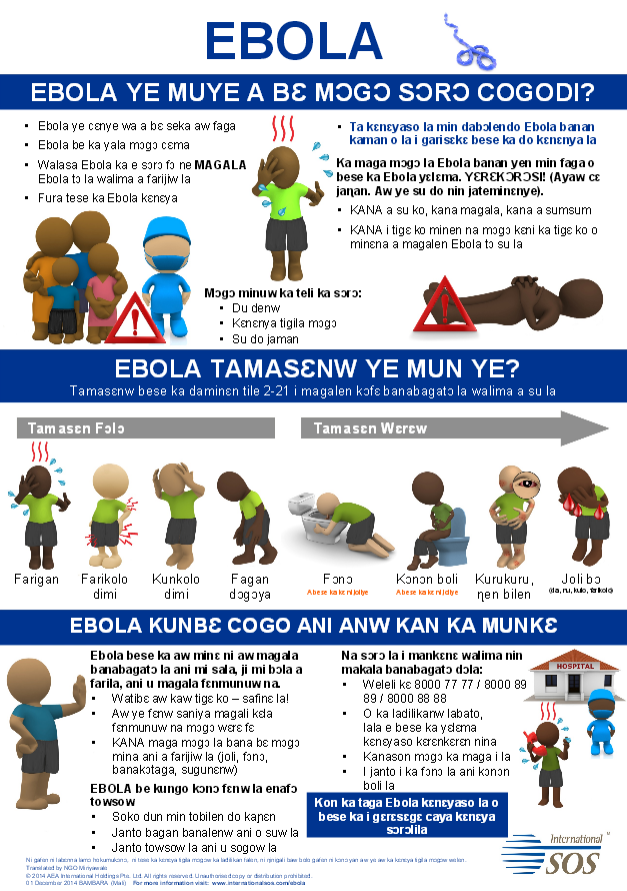
    Here are two other Bambara translations of the widely translated and circulated ebola poster by International SOS.

    In a previous posting, I called attention to another version of the same poster in non-standard Bambara. Both of the ones discussed here use the current standard orthography, but also appear to be a better and more complete translations. However there are differences, which provide an opportunity to review them in comparison and ask questions about methods and outcomes.

    The one on the left below was posted on Facebook on October 2 (original provenance not clear); the one to its right was translated by NGO Miriyawa and came from the International SOS site, dated December 1.

    To facilitate parallel review of differences between the two translations, the headings (only) are presented in the table below - along the lines of what I did for the previous Bambara translation (which can be opened in a separate screen for comparison):

    EBOLA VIRISI (BANAKISԐ) EBOLA
    EBOLA YE MUN YE, A BԐ YԐLԐMA COGODI? EBOLA YE MUYE A BԐ MϽGϽ SϽRϽ COGODI?
    MUN YE EBOLA TAAMASHԐNW YE?
    Tamashԑnw bԑ daminԑ tile 2 magalen kᴐ Ebolatᴐ walima a fure la
    EBOLA TAMASԐNW YE MUN YE?
    Tamasԑnw bese ka daminԑn tile 2-21 i magalen kᴐfԑ banabagatᴐ la walima a su la
    Tamashԑn Kunfᴐlᴐw - Tamashԑn Labanw > Tamasԑn Fᴐlᴐ - Tamasԑn Wԑrԑw >
    EBOLA KUNBԐNI ANI WALI KԐTA N'I BANARA? EBOLA KUNBԐ COGO ANI ANW KAN KA MUNKԐ

    The differences show how different people or teams can come up with alternative ways of rendering the same text - presumably comparable in meaning, but not necessarily equal in accuracy or comprehensibility. Or, if the two were actually translated from different versions (for example, one from French and the other from English), this shows how that can result in different outcomes in the target language (Bambara in this case). It is useful in any event, I think, to first compare the two versions in terms of the language in which they are written: Leaving aside copy-editing issues (spelling; typography), how accurate and understandable are the alternative headings - and the rest of the text?

    Going back a step, one question is whether there was any back-translation in either case to verify the accuracy of the translations. Also, what kind of proofing (copy-editing) was done on each version? There are some errors and inconsistencies, although probably not enough to affect meaning.

    Another question is whether either of these versions were "field tested" to get an idea of how an average reader - or a listener to the text being read aloud - would understand and react to the text. And visually, how people react to the illustrations. If that was not done, it would be informative to field test the two versions together (perhaps adding the previously discussed one as well).

    When doing translations for public education about a health emergency, there is obviously a concern with getting materials out there promptly. However, translation shouldn't be a "once and done" thing. I've previously outlined a case for review of materials (in the context of 2Ds & 4Rs), but review - including quality control - needn't delay initial roll-out of material. Some level of review can be built into the initial process, and then follow-up review can follow. In the case of Bambara there are several materials on ebola available now (remember also the MHOP/Dokotoro factsheet and the Bambara Wikipedia article), which could provide the basis for a more in-depth analysis of use of Bambara for communicating about this virus and other diseases.

    Finally, a quick word about "banakisɛ," which appears in one of the above posters. Composed of "bana" (sickness) and "kisɛ" (seed), the literal sense seems very evocative, and in any case more tangible than the abstract loan "virisi." Definitely would wash my hands thoroughly to get rid of those banakisɛw.

    Monday, November 24, 2014

    Does spelling matter in Bambara ebola materials?

    International SOS ebola poster in Bambara
    A Bambara version of an ebola information poster - one of a number of translations of an original done by International SOS - shows why review of technical health materials translated into or composed in African languages is necessary (per "2Ds & 4Rs"). While giving due credit for the translation, it is also important for the common ultimate goal of communicating about ebola in the most widely spoken language in Mali to offer constructive criticism towards improving this product and guiding similar efforts.

    In the case of this poster, it is immediately apparent that the standard Bambara orthography is not used. This is important since the standard orthography is used in adult literacy, some primary education, and various publications including on ebola and other health related topics. In a previous posting on this blog - "More on standard orthographies of African languages"- I discussed in more detail the reasons to respect and make use of the alphabets and rules of spelling adopted in many African countries for writing their languages. In the case of critically important health information on a deadly virus, adherence to standard ways of writing, as well as to as much standard terminology as there may be, would seem obligatory.

    The resolution of the poster available at this time (from an image accompanying a tweet embedded below, which also includes a French version) is not sufficient to review the content in detail, but is is possible to provide some tentative revisions to the headings (see below the embedded tweet).

    Proposed revisions


    Here are the original headings from the poster followed by tentative revisions. In this I have relied on my rusty knowledge of Bambara with reference to the online dictionary at Bambara.org. Any corrections or better renditions are invited:
    • EBOLA BAANA
    • EBOLA BANA
    (NB- Doubled vowels are pronounced differently than single ones. "Baana" by itself may mean "rich person," although the context here would tell one that what is meant is "bana"=disease.)
    • EBOLA YE MOUBANAYE, ABE DJENSE TIOGODI?
    • EBOLA YE MUN BANA YE, A BƐ JƐNSƐN COGO DI?
    (NB- Clear influence of French orthography - further comment below)
    • ABANA BE DON TIOGODI?
    • A BANA BƐ DƆN COGO DI?
    (NB- Bambara has a 7 vowel system; "ɛ" and "ɔ" are different from "e" and "o")
    • KA EBOLA KOUNBEN ANI I BEN MUKE NI IBANA NA?
    • KA EBOLA KUNBƐN ANI I BƐ MUN KƐ NI I BANANA? [or ... N'I BANANA?]
    (NB- Some issues with nasalized terminal vowels, which are indicated with an "n" following:  "bɛ" is generally not written with a terminal "n", but it may be that the writer hears the open-e ("ɛ") as nasalized; on the other hand, "mun" [what] is written with a terminal "n", though in common speech, the nasalization may not be heard. Also, "ni i" [if you] is often contracted as "n'i".)

    Bambara in French orthography?


    It is possible to write Bambara (or any language for that matter) in French orthography. The New York Times, for instance, used the French spelling of the Bambara and Manding term "jatigiya" (basically meaning hospitality)  - "diatiguiya" - in two recent stories on ebola in Mali (on Nov. 10 and Nov. 12). And it is true that Bambara speakers schooled only in French (which for long has been the general rule in Mali) may resort to orthographic rules of the latter when transcribing their first language - although it should be pointed out that this often results in different spellings based on the user's hearing and rendering of sounds. This juxtaposition of a language (Bambara) with a historically recent standardized written form, and a large number of the literate population taught only in a second language (French), raises legitimate questions about how best to render Bambara in print for ebola messaging.

    However the fact that Mali has chosen a particular orthography (much like that used for similar Manding languages in neighboring countries in the region), and that people taught to read the language have been taught in this orthography, would support using this system rather than one based on French phonetics. Keep in mind that people taught to read Bambara in adult literacy classes or in mother tongue based bilingual schools would likely be in villages where they could read the material - aloud i necessary for any community members who cannot read it.

    As an example of use of the Bambara orthography, note the translation of an ebola factsheet done by the Dokotoro Project and the Mali Health Organizing Project, which was highlighted in an earlier posting on this blog.

    International SOS ebola poster in Yoruba
    I also should note here that Bambara can also be written in the N'Ko alphabet, and that there are people literate in that instead or as well. Altogether this is a complicated situation similar to that in the rest of the multilingual West African region, but not one so complex as to make use of first languages and local lingua francas like Bambara in their written forms problematic for implementation.

    Better localization also means pants


    Translation also needs to be accompanied by attention to cultural appropriateness of the material and also, where images are involved, the visual literacy of the audience. Together, these considerations are part of full "localization" of material. It is worth noting in this context that when Translators Without Borders produced localizations of the same International SOS ebola posters in Nigerian languages, they added pants to the figures (which although abstract, appear in the original to be dressed only in t-shirts). A revised Bambara version should probably follow suit.

    (For a discussion of technical aspects of producing text documents in Bambara, see the next posting: "Writing Bambara right." For two other translations of the same poster, which use standard Bambara, see:  "Two more ebola posters in Bambara." For a similar issue with a poster translated into the related Malinke language, see: "Does spelling matter in Malinke ebola materials?")

    Wednesday, October 29, 2014

    Two issues in use of African languages in ebola messaging

    A recent tweet highlights two issues about use of African languages in messaging about ebola in West Africa: nomenclature, the names and spellings of the languages; and re-use of material in one language variety (or dialect) in an area where another is spoken.
    (NB- "FLOTRG" = First Lady of the Republic of Guinea.)

    The reference is to two of the eleven language names for radio spots produced for the CDC (which have been mentioned previously on this blog). "Madingo" is actually a misspelling of "Mandingo," which may refer either to: (1) one of the Manding languages known to its speakers as Mandinka and spoken mainly in Senegambia; (2) the Mandingo "macrolanguage," a subgroup of Manding languages in the west of West Africa, including notably Mandinka, and Malinké (Maninkakan) of Guinea and neighboring countries; or (3) the entire range of Manding languages, per older usage (in English).

    Misspellings happen - I also noted a couple on the Ebola Communication Network site (since corrected) - but they also make it hard to locate information in searches. But, the apparent imprecision on the Manding variety in which the radio spot is recorded is another issue: these languages have a significant degree of mutual intelligibility, but material in one of them on technical or sensitive topics will not necessarily be understood as intended by speakers of other varieties.

    On the latter topic, Mary Crickmore, a high school classmate who later on took a different path to learning and working in Fula in Mali than I did, noted in correspondence how Fulfulde translations of sections of Where There is No Doctor ran into issues with some anatomy terms when tested in different parts of the country. I personally noted similar issues in shifting from Fulfulde in Mali to Pular in Guinea.

    This is not to say that material developed for one variety of a language (or one of a group of close and mutually intelligible languages) cannot be used in others, but that attention to differences of expression and vocabulary is essential to being understood as one intends, so it is helpful to be clear about the specific language variety(ies) involved. (The flip-side of this issue is how materials and terminology developed separately in different varieties of a language can be compared and harmonized, which requires awareness about the relationships of languages.)

    So possible re-use of the CDC radio spots in other countries where the languages are spoken (as suggested in the tweet above) would require review and likely a "localized" version to re-record. This in turn would benefit from access to scripts for such radio spots, or where these were not used or are not available, transcriptions, of the audio. (See 2Ds & 4Rs on this blog for further discussion.)

    As for "Fullar," it is not a term I have encountered, but it clearly refers to "Fula" (or "Fulah" with that random or gratuitous "h") and "Pular" (the main endonym for the language in Guinea, Sierra Leone, and Guinea-Bissau). Fullar in any event is not a standard term, and as such, would likely not be found in searches. (The case of names used for Fula is complicated enough already, without adding another term!)

    The CDC radio spot webpage also lists "Themne" for "Temne" - the former is a known alternative spelling, and seems to be another case of the "random/gratuitous h."

    Non-standard terms or spellings pose the same problem for searches that misspellings do. So, as more work is done on ebola messaging in African languages by diverse governmental, intergovernmental, nongovernmental, and academic organizations, there will be a need to catch instances where corrections are needed. Recourse might be made to the coding and names in ISO-639, as an available set of standards.

    Monday, October 27, 2014

    Wikipedia, ebola, and African languages

    MTP/TTF logo
    An article in the New York Times, "Wikipedia Is Emerging as Trusted Internet Source for Information on Ebola" (26 Oct. 2014), mentions translations of a main article on ebola "into other languages" - from English being understood. Those translations are coordinated through the Medical Translation Project / Translation Task Force (MTP/TTF) of the WikiProject Medicine, the WikiProjectMed Foundation, and Translators Without Borders.

    This post will briefly spotlight this translation effort, and what it has meant so far for African language editions of Wikipedia. First, however, I'd like to say that it is good to see the WikiProject Medicine and its head, Dr. James Heilman, receive this attention. Their current work on expanding available information about ebola is important and useful. I was also interested to learn from the article that the project was actually started a decade ago by Dr. Jacob de Wolff - making it a another lesson in the life cycle of ideas and their application.

    The MTP/TTF began in 2011; I first learned of it at the 2012 WikiMania conference. According to its webpage, it has facilitated translation of over 600 articles into 100 languages. This is impressive, especially since these translations are the result of volunteer efforts.

    However, progress on African languages* so far seems much less robust. The MTP/TTF monitors progress on translations under "full" articles and "short" (simplified) ones, and within each category (accessible via tabs on its homepage) there are several numbered groups (breaking the languages down into manageable numbers for display in table format).

    Under progress on the "full" articles, only 10 of the 30 current African language editions of Wikipedia are included (in group 7) - Chichewa, Hausa, Igbo, Kinyarwanda, Luganda, Shona, Swahili, Xhosa, Yoruba, and Zulu - and of these Swahili has by far more translations than any other language (29 of 33 articles). Seven languages have nothing at all. (The article on ebola is not included for any language in this category.)

    Under progress on the "short" (simplified) articles, African language editions feature in several groups (languages in italics are editions in "incubator," not full editions; there is some redundancy among the groups as accessed on 27 Oct. 2012):
    Progress for most of these languages has been limited, though it is clear that there is a concerted effort for translation of articles on ebola.

    However, it is also important to note that seven African language editions of Wikipedia - Afrikaans, Bambara, Ewe, Fula, Lingala, Sango, and Wolof ** - are not represented in any of the above lists. So it is good to note that Kasper Souren, who in 2005 played a pivotal role in getting the Bambara and Fula editions started, has just proposed an "Ebola translation task force" effort to promote translations in languages of West Africa, including facilitating an article on ebola in Bambara. Hopefully this initiative can, in addition to promoting translation of ebola-related information, also reinforce and expand the scope of the MTP/TTF to include all African language editions.


    Ebola articles in African languages

    Here's a list of African language editions of Wikipedia with ebola articles (26, by my count, as of 28 October): Afrikaans; Akan; Amharic; Bambara; Chichewa/Nyanja; Ewe; Fula; Hausa; Igbo; Kikuyu (Gikuyu); Kinyarwanda; Kirundi; Luganda; Oromo; Sesotho; Sesotho sa Leboa (N. Sotho); Setswana; Shona; Swahili; Swazi; Tigrinya; Tsonga; Venda; Xhosa; Yoruba; Zulu

    AfrophoneWikis

    Another resource of possible use in facilitating translation (and creation) of articles on ebola and related health and social issues for African language editions of Wikipedia is the "AfrophoneWikis" list. This was founded eight years ago, following the WikiMania 2006 conference, during which both Kasper and Martin Benjamin of Kamusi delivered presentations on support for Wikipedia development in African languages.


    * Although Arabic is an African language, spoken natively in North Africa for centuries, it has resources and enjoys a level of support typical of world languages. For purposes of this blog post, I am not including it in the discussion.
    ** There is also a Wikipedia edition in the Twi language, which is generally considered part of Akan.  
    NB- This article edited on 5 November to add the Lingala edition.