Showing posts with label Mali. Show all posts

Friday, July 05, 2019

A life lesson in Fulfulde & the internal voices of a multilingual

After another hiatus in posting here, will begin again. More on all that below, but I wanted first to take the opportunity to share a couple of short items relating to my experience with some African languages.

"God knows his friends..."


I still remember a particular session of Fulfulde instruction in Moribabougou, Mali, back in 1983. As in all Peace Corps language classes - whatever the country, it seems - we were seated in a small hut, big enough for maybe 4-5 people plus a blackboard. On the particular day I'm remembering, someone passed behind the hut - nothing extraordinary in that given the layout of the training facilities beween the village and the school. Our instructor, Mady Kamanta, asked "Giɗo Alla?" Literally, "Friend of God?" which is actually a kind of "Who goes there?" The unseen person answered "Ko min, __" (and his name), basically, "It's me, ___." It was a village elder.

Short greetings followed and after the elder had gone, Mady said that the proper way to answer "Giɗo Alla?" was actually something like "Alla anndi giɗo mun. Min ko ___." Basically, God knows who's his friend. I'm ___." (I think it could also have been "Alla anndi yiɗɓe mun..." - "God knows his friends...")

A simple turn of phrase but a whole culture behind it. In pulaaku or pulaagu (basically Fula culture*), to the extent I can claim to understand it, there is a certain amount of humility and avoidance of presumption. (But as in any culture, I find there's also duality in which one sometimes encounters the apparent opposite.)

By the response you not only know the identity of the person, but also get a measure of them. In Moribabougou that day, the elder was a Bambara, and however wise he may gave been, or steeped in the context of Manding language and culture he was, could not be expected to have mastered all the nuances of a second or third language. So without knowing anything more about him, you'd learn something just from his response. From my later (and admittedly still limited) experience with varieties of Fula, I recall there were other small ways in which native speakers of the language (especially in central Mali) would test your knowledge in it.

As a turn of phrase, the "proper" form of response to "Giɗo Alla?" is is a great example of answering a question while deftly stepping aside from the premise of the question (whether implicit as in this case, or explicit, as perhaps in the case of some forms of argument). Something potentially useful in many contexts and cultures.

So for some reason I recalled this recently - which does not mean I had forgotten it in the meantime - and thought I'd share it here.

The words that come to mind (multilingual version)


A recent article on multilingualism and perception (published in June 2019 in On Biology then in slightly revised version in Psychology Today) had me thinking of the internal verbal generation in response to stimuli. That is, the words that come to mind in diverse situations, when one speaks more than one language. In my case those are sometimes words or phrases in Fula or Bambara (which are very different from each other).

Here I don't mean the kind of code-switching you do when speaking, and a word in a different language just says it better (or maybe you didn't know the term in the language of the conversation). I'm referring to the internal voice when you think of something or react to a situation. Occasionally the words I think of in certain situations are not in my first, or even second (French), language.

I'm assuming this must be common among multilinguals, but am not aware of any research on it. The closest I've seen as a non-specialist in linguistics relates to the perception of sounds, and how one interprets those as meaningful utterances, as mentioned for example in the article linked above.

Multilingualism is of course more common than monolingualism, but since linguistics and psychology arose in monolingual (sub)cultures, multilingual experience is described somewhat incompletely, and treated as if it were somehow unusual.

One would hope that as African research and scholarship in these areas becomes more prominent, multilingualism will be treated more as the norm, and monolingualism as the exception.

15 years of Beyond Niamey


Since I began this blog as an experiment in January 2004, there have been periods where I've written more often, and periods where I've posted nothing. A year ago - last summer here in the northern hemisphere - I anticipated a more substantial "reboot" than actually happened (the linked post - which opens in a new tab - is still a good statement of my current thinking on this blog, aside from the 2018-specific section, and blogging in general, which I've come to appreciate more with time).

One additional factor, which has always been in the background, but I've been thinking about more lately, is the question of what are the appropriate angles for a non-African to write about African languages and the "information society." This question is, frankly, the source of some doubt the deeper I get into it.

African languages are part of my life, for reasons perhaps apparent from the above, but which I'll discuss further in a subsequent post. However none of them are my language in the senses of mother tongue or cultural heritage. So as much as I may have my opinions, I also try to maintain a sense of propriety and humility. As I see it now, that allows focus on asking questions, making comparisons, and sharing information, ideas, and observations.

Readers are invited to follow critically as this blog evolves.

* Pulaaku is a somewhat complicated topic, often presented as the "Fula way" and comprised of several key attributes or behaviors. One summary posted on the web offers a list (although they had trouble with the hooked letters - "neaaaku," "aum," and "enaam" should be "neɗɗaaku," "ɗum," and "enɗam"). In an academic article entitled "L'image des Fulbe : Analyse critique de la constgruction du concept de pulaaku," Anneke Breedveld and Mirjam De Bruijn argue that the meanings of pulaaku vary by region, and perhaps our understanding of a single concept (and Fula people) is derived from foreign scholarship. In this, as much as in variation of the language, I tend to think that there are core concepts that are drawn from and interpreted variously, and that these interpretations don't represent divergence so much as dynamics. In the realms of ideas and identity, these dynamics could also mean convergence.

Sunday, January 06, 2019

Writing Bambara wrong & a petition to VOA

Why does the Voice of America (VOA) Bambara service's web content use a frenchized transcription of Bambara while Radio France International (RFI) uses the Bambara orthography?

Screenshot from page on VOA Bambara website. In Bambara orthography:
Jamana tigi: Ibrahima Bubakar Keyita ye Sankura foli kɛ ka ɲɛsin jamana
denw ma. (Presidential New Year's address to the people of the country)
This question comes to mind in light of a petition being circulated by the Cercle Linguistique Bamakois asking that VOA follow the Bambara orthography on its web presence. (An English version of the petition is included at the end of this post.)

According to Sam Samake, a language specialist in Bamako, VOA's rationale for its current approach is to reach a large number of listeners who do not read or write Bambara in the official orthography,1 but who have been schooled in the French language system. In the view of Dr. Coleman Donaldson, a researcher on Manding languages (which include Bambara), this is part of a pattern of disregard for the spelling and orthographic conventions adopted by the Malian government and used now in many in primary schools.2 (This system happens also to harmonize with orthographies of neighboring countries due to the process that included the Bamako 1966 and Niamey 1978 conferences.)

Use or non-use of African language orthographies - and implications of respect or disrespect that accompany that choice - is not at all a new discussion. Coleman has a more recent examination of the broader problem as it appears in Mali, in a book chapter:3
"In a context where there is no shortage of people trained in official Bamanan orthography, the fact that the multinational telecommunications firm Orange fails to respect the official conventions is not simply a case of shoddy work; it is in fact part of the message."
Screenshot from RFI Mandenkan homepage. (Days & times of broadcasts).
In fact, as Sam pointed out, Malian government personnel, including for example everyone in the national broadcasting service, ORTM, have been trained in this orthography.1 So it does not appear at all accidental that major international entities like VOA and Orange opt to write Bambara as they please.

In this context, it is interesting to note RFI's decision on "Mandenkan" web content. Mandenkan, or Manding, is a group of largely interintelligible languages including Bambara (or Bamanankan) in the Mande family. RFI uses what looks like Bambara in the proper Malian orthography. That said, the amount of text in the language is limited to a static page on its main site (from which the image above was drawn), and some text in older posts on its Facebook page.

L2 literacy & L1 illiteracy?


VOA's decision to use a frenchized (or Frenchified) transcription of Bambara - which it should be noted has no standard form, pretty much by definition - is apparently premised on the notion that many people in their audience don't read the standard Bambara orthography. There may be something to this, to the extent that in Mali, formal education is mainly or exclusively in French, and people who read French can sound out text with spellings reflecting French phonetics.

However this reasoning (or rationale) has at least two problems. First, it is not clear how much of the audience cannot read Bambara written in the official orthography. Have there been any surveys? And secondly, for a native speaker of the language, the official orthography would not seem that hard to work through.

On the latter point, a word about multilingual literacy, or its absence, in Africa. The fact that many people in Africa have been taught to read in a Europhone language (French, in the case of Mali), which for the vast majority is a second language ("L2"), but never formally taught in their first language ("L1") or local lingua franca (like Bambara in Mali), leads to situations where many people are not comfortable reading in their familiar African languages. I've been among those calling attention to the problem in using one measure of literacy in such multilingual contexts.4

However, that's not the same as saying an L2 (and non-L1) literate person should access their L1 only with the phonetcs of the L2. The bridge from L2-only literacy to L1 literacy is not as long as that from illiteracy to basic literacy of any kind. And the Latin-based orthography of Bambara (what we are talking about here) is not that difficult to master. After all, it doesn't seem to have put a crimp in RFI Mandenkan's effectiveness.

Tech issues: A problem? And a potential


One needs to ask if maybe a hidden issue with VOA and the Bambara orthography isn't the issue with keyboards and input. Is it possible that a simple input solution enabling the VOA Bambara service staff to type the special characters used in Bambara could change this discussion?

Also, could VOA use the perceived shortcomings in audience mastery of the Bambara orthography to engage their audience with some kind of online learning app? This would certainly generate a more favorable buzz than what the current situation is doing.

Petition to VOA


The only version of the petition I am aware of is the one in French on the Change.org site. A Bambara version would be logical - as a "medium is the message" statement if nothing else - but I have not seen any. Appended below for information of people who do not read French, but do read English, is a quick translation5 of the text of the petition into the latter:
Voice of America journalists must respect the Bambara orthography
Considering that Mali, since its accession to independence and through all the successive regimes, has emphasized the importance of the languages and cultures of the country;

Considering that the question of languages spoken in Mali is included in the country's constitution;

Considering that for decades there have been departments dedicated to the question of the languages of Mali;

Considering the remarkable work done by Malian and foreign linguists on the languages spoken in Mali from 1960 to the present day;

Considering the intellectual and financial effort made by Mali and its international partners (in particular the African Academy of Languages) in the codification and use of Mali's languages in schools and in the media;

Considering the learning and the respect of these standards in writing as an obligation in order to perpetuate the work of codification carried out;

Considering that the state of Mali through the dedicated departments guarantees these standards;

Considering that the journalists of the Mandenkan team of RFI (Radio France Internationale) have been trained and correctly use the spelling rules of Bambara;

Considering that the Bambara team of the Voice of America (VOA) does not respect any Bambara spelling rules;

We hereby call on the State of Mali (through the Ministry of National Education / Malian Academy of Languages) and the African Academy of Languages to remind the Voice of America of strict respect for the spelling rules of Bambara on the VOA Bambara page.

Recommend for this purpose:

The training of Bambaraphone journalists of VOA in the spelling rules of Bambara.

What about Hausa?


This discussion would not be complete without mention of the continued use of ASCIIfied Hausa by the international radio operations, including VOA and RFI. And how is it that RFI gets Mandenkan (Bambara) right, but not Hausa?
_______
1. He mentioned this in a discussion about the topic on the Facebook African Languages group page (2 Jan. 2019). Sam is a former Peace Corps/Mali language program instructor and administrator. We have known each other since the slightly famous Peace Corps pre-service training in Moribabougou, Mali in 1983.
2. See Coleman's blog post on this topic and the VOA petition, "Voice of America's Bambara Orthography and a Petition," on his interesting site about Manding languages (which include Bambara), An ka taa.
3. Coleman Donaldson. 2017. "Orthography, Standardization and Register: The Case of Manding." In P. Lane, J. Costa, & H. De Korne (Eds.), Standardizing Minority Languages: Competing Ideologies of Authority and Authenticity in the Global Periphery (pp. 175–199). New York, NY: Routledge.
4. See, for instance, "Multilingual Literacy Day, 2014" (8 Sep 2014).
5. Based on what Google Translate produced, which was much more useful than Systranet's output.

Tuesday, September 19, 2017

Boukary Konaté, Malian blogger

Boukary Konaté. Source: Deutsche Welle, 2012
Boukary Konaté, teacher, blogger, story teller, "defender of Malian culture," passed away on Sunday 17 September - too soon (age 40) - due to a critical health condition that deteriorated rapidly. He was laid to rest the next day, yesterday, in Bamako.

I did not know him well, having made his acquaintance via Twitter, where he went by the handle @Fasokan (which means "language of the homeland" in Bambara). Although we never met in person, I appreciated his work and contributions to communicating Malian culture and using the Bambara language on the web. Boukary's production - writing mainly but also photography - and work in the field touched many people.

Here are some tributes from friends and associates who knew him well, along with some news items (this list will be amended over the next few days):

On the matter of serious illness in poorer countries


Boukary Konaté died due to a liver condition that was not identified early enough for effective treatment (despite a late effort to collect funds to permit his evacuation to a country where appropriate surgery could be done). Such a situation can affect anyone anywhere, but the possibility that better equipped health service in Mali might have made for a happier outcome is cause for some reflection. We have benefited from Boukary's presence, but his early departure would probably not have been necessary in a more just world.

Ala ka hinε a la!

Friday, December 02, 2016

Quick comments on language in Mali today

In transit on the way back from a quick 3 weeks in Mali as part of a short-term consultancy with the Mali Justice Project. More on the project at another time, hopefully, but here are some quick (and unfortunately superficial) observations regarding language in Mali while they're still fresh in the memory.

This was my first time in Mali since 2008. Bamako has grown considerably, and from observations and descriptions, there is a much larger urban middle class. However, that has not seemed to have been accompanied by a shift to French in everyday language (as one might see in some other cities in Francophone states). Bambara seems to be spoken everywhere, with French and occasional other languages as well.

As an obvious foreigner, efforts to use Bambara are generally met positively or matter-of-factly (to the extent one's accent hasn't obscured the fact one is using the language). That was great, though I admit it almost got a bit disconcerting to have airport security shift out of role to banter with the toubab speaking broken Bambara.

Only one real opportunity to speak Fulfulde, and that with a colleague in the project office. I found though that the whoosh of Fulfulde I was able to call up (to my surprise) was hard to turn off at first. Part of that is shifting between too many languages for a former monolingual (even crossed wires between Bambara and Chinese once - an old occasional lapse I ascribe to the similar structures of the languages and how I think my brain handles them).

In traveling outcountry to Segou and Sikasso, also found Bambara easy to use in various settings. With Segou that is expected, since it is ethnically Bambara (and the center of a major precolonial Bambara kingdom), but even in Sikasso, the major city in the ethnically Senufo/Minianka region of Mali, there was no problem speaking Bambara with anyone small merchants to heads of services. In fact, a 2-day project meeting of people involved in commerce, transportation, and services de contrôle in Sikasso worked mainly in Bambara after starting in French.

Not so much signage in Bambara, though on the road to Segou did notice a couple of signs with N'Ko (wasn't able to get photos, sorry). Orange - the phone company - had a TV ad with "I ni tié" (i ni cɛ ≈ thank you). Frenchified renditions of Bambara text are frequent in the written forms I saw in such short usage, which generally accompanied French.

Also had the chance to visit the ACALAN offices - more about that in another post.

Friday, November 27, 2015

Breaking the "dialect barrier"*


You hear a lot about "language barrier" - a term that I for one would just as soon replace with "language divide" or "language gap" - but what about navigating the less daunting but sometimes trickier differences between dialects or varieties within a language or dialect continuum? Yet this must be common to the experience of many people around the world, including most of Africa.

Personally my biggest experience with this was transitioning in 1985 from Djenné, Mali, where as a Peace Corps volunteer I gained a certain competence in the Maasinankoore variety of Fulfulde, to Pita, Guinea, in the heart of the Pular-speaking Futa Jalon region. Actually it was unlike anything I've done before or since, even though I've encountered dialect differences more briefly elsewhere.

Making the transition was kind of fun - and occasionally funny. The biggest initial difference I found between Fula varieties has always been the greetings, but they are relatively simple to learn. Then there was keeping track of different verb endings, not making the initial consonant shifts in verbs, and a few other grammatical differences. Most of this was on the fly, but as I mentioned in an earlier posting, it did help me to have Sonja Fagerberg-Diallo's learning materials for both varieties of the language.

Then there were some differences in vocabulary - including some well-known (such as the first two below) and lesser known pitfalls:
  • caggal = "back (anatomy)" or "after" in Maasinankoore, but cagga = "prostitute" in Pular
  • ɓaawo = "back (anatomy)" or "after" in Pular, but ɓaawo = "female genitalia (very impolite)" in Maasinankoore
  • pati = "don't" in Maasinankoore, but pati = "grandmother" in Pular
  • kaani (pl. perfective of verb haanude) = "should" in Maasinankoore, but kaani = "ugly" in Pular
You can imagine that such differences could suddenly deflect a conversation into incomprehension or laughter.

Fortunately nothing I encountered in Futa Jalon was too extreme. As alluded to above, I spoke and listened, which is more or less how people from the region who move to a new area would bride a language or dialect gap. Except that I had a few advantages: One was that being a foreigner with any competence in the language was a bit of a novelty in Guinea at that time, so I think expectations were not high (and maybe some missteps were attributed to accent). I was also able to ask and get pointers from my Guinean co-workers in the community forestry project since they all also spoke French. And I was fortunate to have help of a local teacher, Amadou "Sernas" Bah, in going through an extensive Pular word list. (I had done something similar but more extensive in Djenné with Maasinankoore that led to the later Fulfulde Lexicon.)

The risk of meaning one thing but saying the opposite


I recall a Malian co-worker in Djenné, Boubey Touré, who came from Rharous in the Songhai area in the north of that country, but who never tried speaking his language (what Ethnologue classifies as Songhay, Koyraboro Senni) with speakers of the Djenné dialect of Songhai (a distinct variety of  Songhay, Koyra Chiini), for fear that some word he would say would would mean the opposite in local speech (as he put it). So he ended up mostly relying on Bambara in forestry extension work.

When I went to Futa Jalon, I actually encountered the kind of situation Boubey referred to, but in Fula. The accomplished (roughly past tense) negative ending for active voice verbs in Maasinankoore is pronounced -aayi (even though generally written -aali), wheras the future ending for active voice verbs in Pular is pronounced -ayi. Essentially the same sound. So coming from one background and not knowing, one could actually say a lot of things that mean almost the opposite in the other location.

The bigger lesson though is that an African extension worker like Boubey who is fluent in one language variety never had any training or materials to allow him to negotiate the dialect / language (variety) differences in his own country, while someone like me gets to go there as a Peace Corps volunteer, get all kinds of training for a second language, and then support and materials to transition to another variety of that language.

Greetings differ most markedly between dialects


I have much less experience with Manding varieties, but recall my first trip to the Bougouni area of Mali where people greeted me with "I ni se," a Bambara greeting I hadn't encountered before. It wasn't a different pronunciation of the widely used greeting, "I ni ce," and though it sounded disconcertingly close to the female response to greetings "Nse," it definitely wasn't that either. Then I realized this was the verb "se," to arrive. I ni se is a greeting on arrival. Welcome! Apparently this is common only in that region.

It is always the greetings that are the most different between varieties. One more example from Fula: In Maasinankoore one could say on parting, Alla hollu en ontuma (God show us another time), while in Pular I only ever heard a short form of that, En ontuma. Most other greetings are just different.

Thank you for your understanding


On a break from a PanAfrican Localisation workshop in Centurion (Tshwane), South Africa, Adel el Zaim, Dwayne Bailey and I took a walk over to a shopping area, and on the way out of one shop I looked back and read a sign "Dankie vir u ondersteuning." (What?) I asked Dwayne and he explained that it actually meant "Thank you for your support." English and Afrikaans are of course two separate though related languages, with some cognates, and evidently some faux amis as well. But this sort of example, even allowing for different spellings, of a concept ("under"+"standing") shifting meanings is something found between dialects as well.

Another example is from my move from Mali to Guinea: In Maasinankoore, the verb doomude (or doomugol) means simply to wait, but in Pular it has the sense of waiting around at mealtime to be invited to eat.

* Barrier or divide or gap?


Quick note on terminology. There is an advantage I think to using a "divide" or "gap" rather than "barrier" to describe the situation where lack of common language prevents or hampers communication. In effect what we're actually talking about is a "communication gap" in need of a common language "bridge" or learning some key differences between dialects to exchange ideas and information and do so accurately.

The gap/divide and bridge metaphor is I think quite powerful in portraying the problem and solution in the case of people with very different languages. In the case of dialects, the divide is not as wide or deep, and the problem is not as much inability to communicate, as running into mini-gaps such as differences in vocabulary or terms that are used differently. The knowledge need is more nuanced - figuring out what you know and don't know. So "dialect barrier" is no more apt here (I used it humorously in the title), but not sure of a better analogy.

Sunday, October 18, 2015

International Mother Language Day 2015 in Africa

Poster for IMLD 2015
Yes, the 16th annual International Mother Language Day was observed several months ago (21 February), but it's still worth highlighting a few of the IMLD 2015 events and articles in Africa. In the absence (as far as I've seen) of any comprehensive summary of IMLD activities on the continent, perhaps this can serve as a small way of facilitating exchange of information about the different kinds of activities that governments, NGOs, and universities have organized. (It's only 4 months until the next observance, by the way.)

The below list is only a selection, and not in any way comprehensive. A note about this posting is included at the end.

Angola:


"Culture Minister Calls Angolans for Natural Coexistence of Mother Tongues" (the Culture Minister, Rosa Cruz e Silva, called attention to the plurilingual nature of Angolan society. Theme of IMLD there was "United in the linguistic and cultural diversity in Angola, let's valorize our integrity")


Benin:


"16ème journée internationale de la langue maternelle : Pour une éducation inclusive à travers et par la langue" (summary of observance in Kétou commune, which featured several government officials including the minister of culture, as well as the Nigerian ambassador)


Cameroon:

"La Journée Internationale de la Langue Maternelle - Le 21 février 2015" (Ceremony at the Ministère de l’Éducation de Base in Yaoundé, including young students who were taking part in experimental bilingual classes of a project of ELAN-Afrique)


Congo (DRC):

"Le ministre de la Culture et des Arts Banza Mulakaly s’investit dans la promotion des langues maternelles" (the minister of Culture and Arts spoke at a ceremony organized by the Observatoire des langues)

From "International Mother Language Day 2015 Celebrations" compilation  (Shalom University of Bunia planned two half-day conferences with activities including presentations from eleven researchers involved with the region’s languages and speeches from academics and public officials about the value of the mother tongue.)

Ghana: 


"Ghana joins the world to celebrate International Mother Language Day" (observance at University of Education, Winneba, Ajumako Campus, featuring a talk by Dr. Avea Ephraim Nosh; alternate link here)

"EDUCATION: UEW students mark Int’l Mother Language Day" [website now offline] (another story on the above event, mentioning contributions to the discussion by Dr. Paul Opoku-Mensah, Prof. Samuel Asiedu Addo, and Mr. Samuel Donkoh)

"Radio broadcast in Akan, by Peter Essien" (calls for the same amount of attention to using Akan correctly on the air as is given to using English correctly)

"How Bible saved 8 Ghanaian languages" (highlights discussion by Rev. Erasmus Odonkor that translations of the Bible have played a key role in maintaining vitality of and literacy in several Ghanaian languages)

"Government urged to revive minority languages" (very brief item on observance in Accra in which experts called for language policy to promote mother tongue education for minority languages)

Kenya:

"International Mother Language Day: How well do you know your mother tongue?" (TV feature on IMLD including visit to classroom and interviews with people in the street)

"UoN Hosts International Mother Language Day" (a 2-day event hosted by University of Nairobi and co-organized by the Dept. of Linguistics and Languages, UNESCO, and an organization called Bible Translation and Literacy)

Madagascar:

"Tenin-dreny - La langue maternelle importe pour l'éducation" (highlights role of first lady Voahangy Rajaonarimampianina, the ministers of l'Artisanat, de la Culture et du Patrimoine [Brigitte Rasamoelina] and of Communication [Vonison Andrianjato] in the observance, which included, the awarding of the "Fantaro" prize; mention also of other events) 

Mali:


"Langues maternelles : UN LEVIER PRIVILEGIE POUR L’INTEGRATION SOCIALE" (Observance in Ouelessebougou, organized by l'Académie malienne des langues [AMALAN] and presided over by minister of education Kénékouo "Barthélemy" Togo)

Namibia:


"Chinamibia celebrates International Mother Language day" (Children of Namibia - ChiNamibia - and the Franco-Namibian Cultural Centre held an event including dance, drama, music, and poetry that was intended to highlight the importance of mother tongues)

Nigeria:


"NICO Supports International Mother Language Day Celebration 2015" (article on the National Institute for Cultural Orientation site about planning for a later observance of IMLD)

"Nwaozor - The Significance of Mother Tongue" (newspaper op-ed on IMLD in which the author discusses the importance of first languages and makes some policy recommendations)

Seychelles:


"International Mother Language Day – Discovering poetry in Seychelles" (Seychelles Writers’ Association, known locally as " Lardwaz" held a short ceremony on IMLD, in which they revealed their proposed calendar for 2015)


Somalia:


"International Mother Language Day marked in Mogadishu" (the president of Djibouti and government representatives from Ethiopia and Kenya joined the observance in Mogadishu; article also mentions laying the cornerstone of the Somali Language Academy, about which more here)

South Africa:

"Deputy Minister Rejoice Mabudafhasi observes International Mother Language Day, 21 Feb" (scheduled meeting with "future language practitioners" at University of Limpopo, Turf loop Campus, in Mankweng, Limpopo Province)

Tanzania:

"International Mother Language Day 2015" (blog posting by a Welsh person working in Tanzania, making connection between most children not speaking at home a language other than the Swahili used in school, and their lower scores in Standard 3 exams than native Swahili speakers)

Uganda:

From "International Mother Language Day 2015 Celebrations" compilation (Literacy and Adult Basic Education [LABE], a local NGO, planned language activities including reading and storytelling competitions in 6 post-conflict districts of northern Uganda)

Zimbabwe:

"Celebrate International Mother Language Day" (about preparations for celebrating IMLD by the San people in Tsholotsho)

Notes about this post & holding reserve posts


I actually started this post just after IMLD in February, but put it aside to focus on some other items. I added to it on a couple of occasions, and ultimately decided it was time to finish and publish.

As such this is a special case in an aspect of blogging I discovered over the years - having a number of drafts in the cooker, as it were. Some of those eventually I return to and complete more or less as planned, some change, and for others, the material in the draft might get repurposed. In this case, there was an obvious time limit on material related to an annual event (yours to decide if it already passed a more functional limit of utility). It turned out as intended, except that there was a second section to the original draft of this post that ultimately was not necessary, but that I may use later.

Monday, October 12, 2015

The secret life of Bambara Arial

Quite unexpectedly, I heard yesterday the names of two old 8-bit Malian computer fonts - Bambara Arial and Bambara Times - from two different people. Matt Heberger, who is coordinating work on the forthcoming Bambara translation of Where There is No Doctor mentioned that one of the translators provided him with copies of these fonts (as .ttf files), and Sam Samake, an old friend and former Peace Corps/Mali staff member, asked how I got "Bambara Arial" to work on the internet.

It wasn't supposed to be this way once Unicode rendered such special fonts unnecessary.

The history


In the 1990s, a joint project of the Malian Ministry of Education and the French Agence de Coopération Culturelle et Technique (ACCT; precursor to the Organisation Internationale de la Francophonie), produced two modified/hacked versions of the Arial and Times fonts, replacing characters not used in the orthographies of Malian national languages with characters not present in those original fonts or other commercially available fonts of that era. Thus for example, the "q" was replaced with "ɛ"* (type "q" get "ɛ" instead).

Table from Enguehard & Mbodj 2004.* Caractère affiché is what you get;
Caractère initial is original character & the key you tap to get the new one.
This approach for adapting fonts for writing systems not supported by the pre-Unicode standards was fairly common 1980s and 1990s, including in a number of African countries like Mali. Fonts like these achieved what they were primarily intended for - being able to compose and print documents with the extended alphabets. One could also share digital copies of documents, but those could be properly read only with the same fonts. Different modified fonts - and Mali had several - were mtually incompatible. That was the whole reason, of course, for Unicode, which also makes it possible to share documents in any alphabet across the internet on any browser, wordprocessor, etc.

But while Unicode became the international standard, evidently at least some people in Mali kept using Bambara Arial and perhaps other similar "special fonts." In 2005, USAID-funded "Community Learning and Information Centers" (CLICs) relied on these fonts for anything done in Malian national languages (apparently not that often). It may be that technicians in these telecenters did not have Unicode explained to them in their project training or prior study of computers.

The word about obsolescence of 8-bit fonts like Bambara Arial may not have gotten too far, or maybe the notion of a need for a "special font" to process text in languages like Bambara just was too ingrained. At this point I'm just wondering how after almost 2 decades, these old fonts are still in circulation and conversation. Just two years ago, there were these references to Bambara Arial online (thanks to a Google search):
  • N'oublie pas de les ecrire en vrai Bambara ''Bambara Arial''Dans Microsoft Word (Facebook, 2013-1-11)
  • I would like to arrange for volunteer translators for Bambara. How can I access fonts for the Bambara alphabet (Bambara Arial for example)? (Google code Khan Academy issue tracker, 2013-3-23)


More to it?

Adapted from an image by Denis Jacquerye.

There's a twist to the story though. It seems that in one respect, these old fonts follow Malian orthographies better than the Unicode fonts. The letter ɲ has two forms of upper case, one like the lower case letter but bigger ("n-form") and the other like the capital N with a tail on the left leg ("N-form") on the left and right sides respectively of the image on the right. The "n-form" is most used in Mali and apparently in the hacked 8-bit "special fonts" like Bambara Arial; most Unicode fonts use the "N-form" (thanks to Matt Heberger for his observations on that.). I doubt that this alone could account for the persistence of the old fonts, but it might be a factor.

Maybe a new life could be given to the old fonts that people are still using by reencoding them to Unicode and releasing them under recognizable names.


* Two articles in French mention modified 8-bit fonts used in Mali, showing which different characters were changed to extended Latin characters:  
Chantal Enguehard,et Chérif Mbodj. "Correcteurs orthographiques pour les langues africaines." Bulag 29, 2004, pp. 51-68.
Chantal Enguehard, et Soumana Kané. "Langues africaines et communication électronique : développement de correcteurs orthographiques." Agence universitaire de la Francophonie. Actes des Premières Journées scientifiques communes des réseaux de chercheurs concernant la langue, 31mai-1 juin 2004, Ouagadougou, Burkina Faso. pp.59-75.

Tuesday, December 16, 2014

Two more ebola posters in Bambara

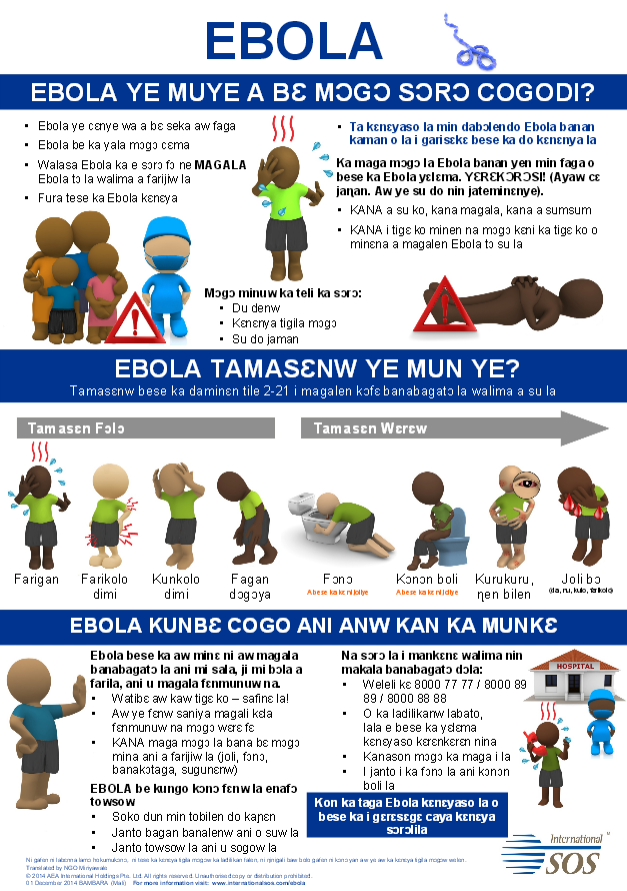
Here are two other Bambara translations of the widely translated and circulated ebola poster by International SOS.

In a previous posting, I called attention to another version of the same poster in non-standard Bambara. Both of the ones discussed here use the current standard orthography, but also appear to be a better and more complete translations. However there are differences, which provide an opportunity to review them in comparison and ask questions about methods and outcomes.

The one on the left below was posted on Facebook on October 2 (original provenance not clear); the one to its right was translated by NGO Miriyawa and came from the International SOS site, dated December 1.

To facilitate parallel review of differences between the two translations, the headings (only) are presented in the table below - along the lines of what I did for the previous Bambara translation (which can be opened in a separate screen for comparison):

EBOLA VIRISI (BANAKISԐ) EBOLA
EBOLA YE MUN YE, A BԐ YԐLԐMA COGODI? EBOLA YE MUYE A BԐ MϽGϽ SϽRϽ COGODI?
MUN YE EBOLA TAAMASHԐNW YE?
Tamashԑnw bԑ daminԑ tile 2 magalen kᴐ Ebolatᴐ walima a fure la
EBOLA TAMASԐNW YE MUN YE?
Tamasԑnw bese ka daminԑn tile 2-21 i magalen kᴐfԑ banabagatᴐ la walima a su la
Tamashԑn Kunfᴐlᴐw - Tamashԑn Labanw > Tamasԑn Fᴐlᴐ - Tamasԑn Wԑrԑw >
EBOLA KUNBԐNI ANI WALI KԐTA N'I BANARA? EBOLA KUNBԐ COGO ANI ANW KAN KA MUNKԐ

The differences show how different people or teams can come up with alternative ways of rendering the same text - presumably comparable in meaning, but not necessarily equal in accuracy or comprehensibility. Or, if the two were actually translated from different versions (for example, one from French and the other from English), this shows how that can result in different outcomes in the target language (Bambara in this case). It is useful in any event, I think, to first compare the two versions in terms of the language in which they are written: Leaving aside copy-editing issues (spelling; typography), how accurate and understandable are the alternative headings - and the rest of the text?

Going back a step, one question is whether there was any back-translation in either case to verify the accuracy of the translations. Also, what kind of proofing (copy-editing) was done on each version? There are some errors and inconsistencies, although probably not enough to affect meaning.

Another question is whether either of these versions were "field tested" to get an idea of how an average reader - or a listener to the text being read aloud - would understand and react to the text. And visually, how people react to the illustrations. If that was not done, it would be informative to field test the two versions together (perhaps adding the previously discussed one as well).

When doing translations for public education about a health emergency, there is obviously a concern with getting materials out there promptly. However, translation shouldn't be a "once and done" thing. I've previously outlined a case for review of materials (in the context of 2Ds & 4Rs), but review - including quality control - needn't delay initial roll-out of material. Some level of review can be built into the initial process, and then follow-up review can follow. In the case of Bambara there are several materials on ebola available now (remember also the MHOP/Dokotoro factsheet and the Bambara Wikipedia article), which could provide the basis for a more in-depth analysis of use of Bambara for communicating about this virus and other diseases.

Finally, a quick word about "banakisɛ," which appears in one of the above posters. Composed of "bana" (sickness) and "kisɛ" (seed), the literal sense seems very evocative, and in any case more tangible than the abstract loan "virisi." Definitely would wash my hands thoroughly to get rid of those banakisɛw.

Monday, November 24, 2014

Does spelling matter in Bambara ebola materials?

International SOS ebola poster in Bambara
A Bambara version of an ebola information poster - one of a number of translations of an original done by International SOS - shows why review of technical health materials translated into or composed in African languages is necessary (per "2Ds & 4Rs"). While giving due credit for the translation, it is also important for the common ultimate goal of communicating about ebola in the most widely spoken language in Mali to offer constructive criticism towards improving this product and guiding similar efforts.

In the case of this poster, it is immediately apparent that the standard Bambara orthography is not used. This is important since the standard orthography is used in adult literacy, some primary education, and various publications including on ebola and other health related topics. In a previous posting on this blog - "More on standard orthographies of African languages"- I discussed in more detail the reasons to respect and make use of the alphabets and rules of spelling adopted in many African countries for writing their languages. In the case of critically important health information on a deadly virus, adherence to standard ways of writing, as well as to as much standard terminology as there may be, would seem obligatory.

The resolution of the poster available at this time (from an image accompanying a tweet embedded below, which also includes a French version) is not sufficient to review the content in detail, but is is possible to provide some tentative revisions to the headings (see below the embedded tweet).

Proposed revisions


Here are the original headings from the poster followed by tentative revisions. In this I have relied on my rusty knowledge of Bambara with reference to the online dictionary at Bambara.org. Any corrections or better renditions are invited:
  • EBOLA BAANA
  • EBOLA BANA
(NB- Doubled vowels are pronounced differently than single ones. "Baana" by itself may mean "rich person," although the context here would tell one that what is meant is "bana"=disease.)
  • EBOLA YE MOUBANAYE, ABE DJENSE TIOGODI?
  • EBOLA YE MUN BANA YE, A BƐ JƐNSƐN COGO DI?
(NB- Clear influence of French orthography - further comment below)
  • ABANA BE DON TIOGODI?
  • A BANA BƐ DƆN COGO DI?
(NB- Bambara has a 7 vowel system; "ɛ" and "ɔ" are different from "e" and "o")
  • KA EBOLA KOUNBEN ANI I BEN MUKE NI IBANA NA?
  • KA EBOLA KUNBƐN ANI I BƐ MUN KƐ NI I BANANA? [or ... N'I BANANA?]
(NB- Some issues with nasalized terminal vowels, which are indicated with an "n" following:  "bɛ" is generally not written with a terminal "n", but it may be that the writer hears the open-e ("ɛ") as nasalized; on the other hand, "mun" [what] is written with a terminal "n", though in common speech, the nasalization may not be heard. Also, "ni i" [if you] is often contracted as "n'i".)

Bambara in French orthography?


It is possible to write Bambara (or any language for that matter) in French orthography. The New York Times, for instance, used the French spelling of the Bambara and Manding term "jatigiya" (basically meaning hospitality)  - "diatiguiya" - in two recent stories on ebola in Mali (on Nov. 10 and Nov. 12). And it is true that Bambara speakers schooled only in French (which for long has been the general rule in Mali) may resort to orthographic rules of the latter when transcribing their first language - although it should be pointed out that this often results in different spellings based on the user's hearing and rendering of sounds. This juxtaposition of a language (Bambara) with a historically recent standardized written form, and a large number of the literate population taught only in a second language (French), raises legitimate questions about how best to render Bambara in print for ebola messaging.

However the fact that Mali has chosen a particular orthography (much like that used for similar Manding languages in neighboring countries in the region), and that people taught to read the language have been taught in this orthography, would support using this system rather than one based on French phonetics. Keep in mind that people taught to read Bambara in adult literacy classes or in mother tongue based bilingual schools would likely be in villages where they could read the material - aloud i necessary for any community members who cannot read it.

As an example of use of the Bambara orthography, note the translation of an ebola factsheet done by the Dokotoro Project and the Mali Health Organizing Project, which was highlighted in an earlier posting on this blog.

International SOS ebola poster in Yoruba
I also should note here that Bambara can also be written in the N'Ko alphabet, and that there are people literate in that instead or as well. Altogether this is a complicated situation similar to that in the rest of the multilingual West African region, but not one so complex as to make use of first languages and local lingua francas like Bambara in their written forms problematic for implementation.

Better localization also means pants


Translation also needs to be accompanied by attention to cultural appropriateness of the material and also, where images are involved, the visual literacy of the audience. Together, these considerations are part of full "localization" of material. It is worth noting in this context that when Translators Without Borders produced localizations of the same International SOS ebola posters in Nigerian languages, they added pants to the figures (which although abstract, appear in the original to be dressed only in t-shirts). A revised Bambara version should probably follow suit.

(For a discussion of technical aspects of producing text documents in Bambara, see the next posting: "Writing Bambara right." For two other translations of the same poster, which use standard Bambara, see:  "Two more ebola posters in Bambara." For a similar issue with a poster translated into the related Malinke language, see: "Does spelling matter in Malinke ebola materials?")

Tuesday, October 21, 2014

Economics of language and the “long tail” effect (part 2)

This is the second of two postings on the "long tail" and languages. The previous one took a general look at the long tail distribution in the contexts of the economics of languages and multilingual societies. This one, also reposted from a 2008 post in "Multildisciplinary perspectives," reflects a parallel discussion in the Wikinomics blog, and looks at what the long tail distribution of languages would look like in one country: Mali. A major point here - which I think is relevant for something like strategies for public education on ebola in rural West Africa - is that the long tail distribution of languages holds regardless of the geographic scale, and the languages at the head of the distribution (on the left of the graph) on more local scales may be totally different from those on the larger scales.


On the Wikinomics blog, Dan Herman responded to my discussion of use of the long tail model for languages (the date of that article was 11 April 2008). He raised some interesting points that I’ll come to in a moment.

Part of the reason I posted on the long-tail concept is that I believe it will be useful in various ways to analyzing the situation of less widely-spoken languages (LWSLs; previously I’ve used "MINELs" which says less about the size of the speaking community). I deliberately framed it in the context of the economics of language because I see the long tail as a model useful in the broader context of that field. In any event, we’re just beginning to explore this and it would be of interest to know of other efforts.

A clarification also needs to be made between what I’m seeing as two dynamics in the long tail of languages. Dan writes (referring to a previous Wikinomics posting by his colleague Paul Artiuch that I had referenced):
"As Paul highlights in his post there are several tools and applications that, in theory, facilitate learning, or given Don’s take, not leaving, the long-tail."
It seems to me that these are really two different, although related, things. On the one hand, Paul looked more at how the potential “consumer” of language learning would perceive minority languages. On the other hand, I’m mostly interested in the view from the points of view closer to where the language is spoken, from individuals, households and communities who speak the language, to regional and national entities that serve them - govt., business, NGOs, education. The latter are all a different kind of “consumer” than potential language learners. (Parenthetically, I think this difference reflects one that I’ve noted in events related to the International Year of Languages [2008]: some people and organizations are focusing more on language learning and others more on a nexus of issues relating to language rights, endangered languages, etc.)

All of these viewpoints are valid, of course, but when considering language development and indeed survival it is useful to know whether ICT’s effect of lowering barriers for doing various things in/for less widely-spoken languages down the long tail ultimately balances or outweighs other factors that either encourage speakers of less-widely spoken languages to focus uniquely on more widely-spoken languages at the head of the distribution. Which is to say in effect, that the long-tail effect makes production and use of content and products in a language somewhere down the tail - say Soninke (language spoken by about a million people in Mali, Senegal & Mauritania, which has a historical link to the Ghana empire) - easier and cheaper for Soninke speakers than it was previously. But how will this affect use and development of the language?

In his Wikinomics blog article, Dan is skeptical, posing the question this way:
"… in a world where the language of economics is conducted in one, perhaps two, and in the future maybe three languages, can a combination of technology, ethno-nationalism and culture trump trade and economics?"
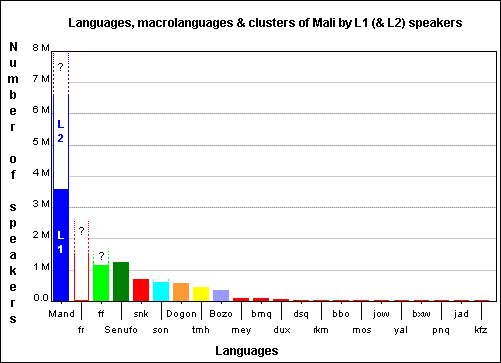
I’m not sure we can answer either question but it might help to look at the long tail in different ways to see what’s involved. In his book, The Long Tail, Chris Anderson shows that if you zero in on a section of the long tail, you find … another long tail distribution (see p. 21). One could for instance do the same with languages based on populations of speakers, or, to consider the viewpoint from a country and its citizens, look at just the languages in that country. For example, the following graph uses figures from Ethnologue [15th ed., accessed in 2008] of first language (L1) speakers of languages of Mali :


This is another classic long-tail distribution. I’ve used color codes for very closely related tongues that are interintelligible (at least to some degree - this is a question that could be discussed at length another time). For instance, dark blue is used for the Manding tongues like Bambara, Jula, Malinke and Khassonke. The red color is for languages not in one of those groups. Soninke (snk) is one of these, with 700,000 speakers and 1 million or so overall - pretty significant in a particular region and fourth among the language categories Ethnologue lists for Mali.

Of course, in a multilingual societies people generally learn other languages no matter where their mother tongue may be in the distribution. So it makes more sense in terms of usage to plot out first & second (or additional) language speakers. In the following graph I plot out the combined figures for the closely related groups - whether they be called “language,” “macrolanguage,” or language cluster - and add estimated second language (L2) speakers above those:


There is some uncertainty about L2 speakership - estimates about the percentage of Mali’s 10+ million population that speak Bambara run from 65-80%; and for the official language of French, one probably low estimate is 15%. Fulfulde has historically been a lingua franca in central Mali.

And there are other ways we could graph out long tails of language as well. For instance on more local levels. Or, since there is a lot of trade and movement among countries of the West Africa region of which Mali is a part, and many of the language communities are divided by borders, one could do regional or subregional graphs.

What is the point? First, the dominant “two or three” languages when you narrow the geographical scale are not necessarily - and in fact usually are not - the same as one sees on the international level. English, Mandarin Chinese and Spanish may be the most significant worldwide, but none of them are major in Mali for instance. And languages that are relatively far down the tail in the international distribution may be at the top on a country or regional scale. Some languages specific to a country or region have some significant advantages in this context. And indeed, locally dominant languages do displace weaker languages to some degree. This may be the case with Bambara in Mali, or at least in much of the country, for instance.

Second, a language like Soninke which is pretty far down the tail in the international scale, has a higher profile nationally or subregionally (remembering it is a cross-border language).

The global distribution hides these realities. While it is true I think that the long-tail effect of advances in ICT generally lower the barriers and increase the potential for various kinds of work with LWSLs way down the tail (to the point where the main problems encountered are when the languages have few resources) - including for language learners (among whom the particular category of “heritage language learners” deserves special note) - it may be that the long tail distributions on more local levels are more informative for discussions of linguistic situations and language policy.

In other words, the significance of ICT’s effect on the potential to do various work (like publishing) in LWSLs may best be seen in reference to long tail distributions on country and regional levels.

Dan suggests that
"As countries migrate through the demographic transition, and subsequently become increasingly urbanized, there’s an inherent move towards common languages in order to facilitate the trade of services and goods."
Whether this means more a “trimming” of the tail or more an evolution of the language portfolios of multilingual speakers and communities is open to discussion. None of us are suggesting that speakers of LWSLs should abandon their languages in favor of languages of wider communication (LWCs), but the question is whether a combination of application of ICTs and good language and education policies can facilitate people keeping and developing their languages, even if their numbers be few.

Tuesday, October 14, 2014

Ethnologue: "National" and "Principal" languages in Africa

Since raising the issue of Ethnologue's use of the term national language last December, that resource has undergone some revisions. Among the changes is replacing the problematic heading of "National Languages" (problematic because it is used in various distinct ways) with "Principal Languages" on the "Country" tab of the country information pages.

This is a positive step as far as it goes (I'll come back to that below), but the new heading raises new issues. I believe these are important to review since Ethnologue is a major reference on the world's languages, and as such its presentation of data will influence how people (especially those from outside the region concerned) understand or misunderstand linguistic situations, with the potential to influence approaches taken to extension, public education, training, etc. for emergencies like the ebola outbreak in West Africa.

What counts as a "Principal language"?


A  reader looking up information on the languages of Niger would first come to the "Country" tab of the Niger page (a screenshot is pictured). On it, they would see under "Principal Languages," one language, French. A logical assumption the reader might make is that this language is unambiguously the "most important, consequential, or influential" (per Merriam-Webster.com's definition) in the country. But what of Hausa, spoken by perhaps half the population as a first language, which Ethnologue itself notes is also "the main trade language of Niger"? Or Zarma, spoken by 18-25% of the population,* which although concentrated in the west of the country, represents a number greater than the number of French speakers (5-15% of the population)? The Peace Corps program in Niger for many years (before its closure) prioritized Hausa and Zarma language training for rural development volunteers since French, however important on the governmental level, was not as useful where they worked.

So where to draw the line in what is considered "principal" is a new problem. It turns out, however, that Ethnologue has a narrower definition of "Principal Languages":
"Languages that have been identified as having a function at the nation-wide level are listed here. This includes all the languages that function at the national level as a working language or a language of identity or both, whether this is by statute or is the de facto situation. For a fuller discussion, see Official recognition."
But even stated this way, couldn't Hausa, as the main trade language and one of Niger's statutory "national languages," still be considered a "principal language" in its own right? Also, from personal observation, Hausa as well as Zarma have been used de facto in local government work (as spoke languages), even though everyone knows French is the de jure language of governance. So there are several criteria on which one might add Hausa and perhaps Zarma as "Principal Languages."
 
In this regard, the treatment of  Senegal (another example used in the previous posting) seems even more problematic. Here too, only French is listed in the category "Principal Languages," although Wolof is the most widely spoken language in the country, as well as being statutorily a national language. 

Similarly, in Mali, Bambara is most widely spoken, and by a number of people larger than those speaking French. It is also statutorily a national language.But only the official language French is listed among "Principal Languages."

Part of the reason for citing these examples is that by a common understanding of this new category "principal language," and arguably by a broader reading of Ethnologue's definition of the term, major languages other than the official one in some countries would seem to qualify. Certainly what one counts as "principal language" in many multilingual countries may depend on the criteria used, and a that in turn would depend on the intended application.

Levels of official recognition


One criterion in Ethnologue's treatment of "Principal Languages" in these countries is evidently the kind of official recognition involved. So in the case of South Africa, which has eleven official languages, all eleven are listed as "Principal Languages." Same for Chad's two designated official languages - French and Arabic.

However, for the Republic of the Congo, three languages are listed as "Principal Languages": French, which is official; and Kituba and Lingala, which are statutorily national and vehicular languages (which seems similar to Hausa in Niger, Wolof in Senegal, and Bambara in Mali).

What of countries where no language is designated in the constitution or legislation as official? (This is the case for quite a number of countries, including the US.) For Kenya and Tanzania, which each have English and Swahili as de facto official languages, both are "Principal Languages" for each.

On the other hand, the page for Sierra Leone lists only English (de facto official) under "Principal Languages" even though Krio is used more widely (by at least 90% of the population). Though not formalized, Krio in practical terms could be regarded as a "principal language" of the country, since it is so widely used and arguably serves in part as a language of identity (another criterion in Ethnologue's definition). English, on the other hand, is reportedly understood well by only 13% of Sierra Leonean women - how principal is it from their perspective?


An exhaustive review is beyond the purpose of this posting, but from the various examples, it seems that a narrow application of Ethnologue's definition for "Principal languages" on that important first page of country language information gives an incomplete picture of the linguistic reality in a number of African countries.

Suggestions regarding "Principal Languages"


Changing the heading "National Languages" to "Principal Languages" on the "Country" tab of Ethnologue's country information pages was a positive step for presenting first-glance information on the linguistic situations of multilingual African countries. A next step would be to review the criteria for giving languages that categorization. It might be useful to think of this as a way to give the readers a quick sense of the linguistic reality, which in multilingual states may be complicated, involving more than one language playing important roles in different ways.

Part of the problem is using a commonly understood term like "principal" in a very limited way, requiring the reader to find the specific definition and adjust their understanding accordingly. I suspect that many readers will, like I did when first looking at the page, assume the common definition of "principal."

Maybe a key would be to make the definition of "principal language" less dependent on the EGIDS framework. That would lead to another problem, mentioned above in the case of Hausa and Zarma in Niger - where to draw the line in a more flexible application of the term. One way to address this would be short annotation highlighting the criteria used. For example (not advocating this but giving as example), one could list for Niger: French (official); Hausa (main trade language). Or for Senegal: French (official); Wolof (most widely spoken). Sierra Leone: English (official); Krio (most widely spoken; identity). And so on.

"National language," cont'd


When one gets past the "Country" tab of the country information pages to the "Languages" and "Status" tabs, Ethnologue still uses "national language" in the way it previously did. This is again a question of nomenclature, important I would argue in the case of African countries that use the term in different ways (see the previous posting on this topic for a more complete discussion). Ethnologue has evidently reduced its use of the term "official language," so maybe "national language" could also be replaced by a term not already used in divergent senses or (like "principal language") carrying a generic meaning beyond that intended.

Concluding note


As in my previous posts about Ethnologue's content, I would like to stress that the purpose here is to offer constructive criticism and contribute to improving this important resource.


* There do not appear to be any published percentage estimates of speakers of Zarma (including closely related and mutually intelligible varieties of Songhai) in Niger. When I worked there in 2000-04, the common understanding was that 25% of the country's population spoke it (as a first language). Ethnologue's 2006 estimate of 2.35 million speakers would be about 18% of the 2006 total estimated population of 13.248 million.