This is the second of two postings on the "long tail" and languages. The previous one took a general look at the long tail distribution in the contexts of the economics of languages and multilingual societies. This one, also reposted from a 2008 post in "Multildisciplinary perspectives," reflects a parallel discussion in the Wikinomics blog, and looks at what the long tail distribution of languages would look like in one country: Mali. A major point here - which I think is relevant for something like strategies for public education on ebola in rural West Africa - is that the long tail distribution of languages holds regardless of the geographic scale, and the languages at the head of the distribution (on the left of the graph) on more local scales may be totally different from those on the larger scales.
On the Wikinomics blog, Dan Herman responded to my discussion of use of the long tail model for languages (the date of that article was 11 April 2008). He raised some interesting points that I’ll come to in a moment.
Part of the reason I posted on the long-tail concept is that I believe it will be useful in various ways to analyzing the situation of less widely-spoken languages (LWSLs; previously I’ve used "MINELs" which says less about the size of the speaking community). I deliberately framed it in the context of the economics of language because I see the long tail as a model useful in the broader context of that field. In any event, we’re just beginning to explore this and it would be of interest to know of other efforts.
A clarification also needs to be made between what I’m seeing as two dynamics in the long tail of languages. Dan writes (referring to a previous Wikinomics posting by his colleague Paul Artiuch that I had referenced):
All of these viewpoints are valid, of course, but when considering language development and indeed survival it is useful to know whether ICT’s effect of lowering barriers for doing various things in/for less widely-spoken languages down the long tail ultimately balances or outweighs other factors that either encourage speakers of less-widely spoken languages to focus uniquely on more widely-spoken languages at the head of the distribution. Which is to say in effect, that the long-tail effect makes production and use of content and products in a language somewhere down the tail - say Soninke (language spoken by about a million people in Mali, Senegal & Mauritania, which has a historical link to the Ghana empire) - easier and cheaper for Soninke speakers than it was previously. But how will this affect use and development of the language?
In his Wikinomics blog article, Dan is skeptical, posing the question this way:

This is another classic long-tail distribution. I’ve used color codes for very closely related tongues that are interintelligible (at least to some degree - this is a question that could be discussed at length another time). For instance, dark blue is used for the Manding tongues like Bambara, Jula, Malinke and Khassonke. The red color is for languages not in one of those groups. Soninke (snk) is one of these, with 700,000 speakers and 1 million or so overall - pretty significant in a particular region and fourth among the language categories Ethnologue lists for Mali.
Of course, in a multilingual societies people generally learn other languages no matter where their mother tongue may be in the distribution. So it makes more sense in terms of usage to plot out first & second (or additional) language speakers. In the following graph I plot out the combined figures for the closely related groups - whether they be called “language,” “macrolanguage,” or language cluster - and add estimated second language (L2) speakers above those:
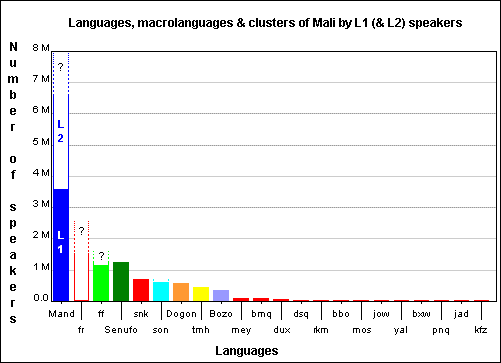
There is some uncertainty about L2 speakership - estimates about the percentage of Mali’s 10+ million population that speak Bambara run from 65-80%; and for the official language of French, one probably low estimate is 15%. Fulfulde has historically been a lingua franca in central Mali.
And there are other ways we could graph out long tails of language as well. For instance on more local levels. Or, since there is a lot of trade and movement among countries of the West Africa region of which Mali is a part, and many of the language communities are divided by borders, one could do regional or subregional graphs.
What is the point? First, the dominant “two or three” languages when you narrow the geographical scale are not necessarily - and in fact usually are not - the same as one sees on the international level. English, Mandarin Chinese and Spanish may be the most significant worldwide, but none of them are major in Mali for instance. And languages that are relatively far down the tail in the international distribution may be at the top on a country or regional scale. Some languages specific to a country or region have some significant advantages in this context. And indeed, locally dominant languages do displace weaker languages to some degree. This may be the case with Bambara in Mali, or at least in much of the country, for instance.
Second, a language like Soninke which is pretty far down the tail in the international scale, has a higher profile nationally or subregionally (remembering it is a cross-border language).
The global distribution hides these realities. While it is true I think that the long-tail effect of advances in ICT generally lower the barriers and increase the potential for various kinds of work with LWSLs way down the tail (to the point where the main problems encountered are when the languages have few resources) - including for language learners (among whom the particular category of “heritage language learners” deserves special note) - it may be that the long tail distributions on more local levels are more informative for discussions of linguistic situations and language policy.
In other words, the significance of ICT’s effect on the potential to do various work (like publishing) in LWSLs may best be seen in reference to long tail distributions on country and regional levels.
Dan suggests that
On the Wikinomics blog, Dan Herman responded to my discussion of use of the long tail model for languages (the date of that article was 11 April 2008). He raised some interesting points that I’ll come to in a moment.
Part of the reason I posted on the long-tail concept is that I believe it will be useful in various ways to analyzing the situation of less widely-spoken languages (LWSLs; previously I’ve used "MINELs" which says less about the size of the speaking community). I deliberately framed it in the context of the economics of language because I see the long tail as a model useful in the broader context of that field. In any event, we’re just beginning to explore this and it would be of interest to know of other efforts.
A clarification also needs to be made between what I’m seeing as two dynamics in the long tail of languages. Dan writes (referring to a previous Wikinomics posting by his colleague Paul Artiuch that I had referenced):
"As Paul highlights in his post there are several tools and applications that, in theory, facilitate learning, or given Don’s take, not leaving, the long-tail."It seems to me that these are really two different, although related, things. On the one hand, Paul looked more at how the potential “consumer” of language learning would perceive minority languages. On the other hand, I’m mostly interested in the view from the points of view closer to where the language is spoken, from individuals, households and communities who speak the language, to regional and national entities that serve them - govt., business, NGOs, education. The latter are all a different kind of “consumer” than potential language learners. (Parenthetically, I think this difference reflects one that I’ve noted in events related to the International Year of Languages [2008]: some people and organizations are focusing more on language learning and others more on a nexus of issues relating to language rights, endangered languages, etc.)
All of these viewpoints are valid, of course, but when considering language development and indeed survival it is useful to know whether ICT’s effect of lowering barriers for doing various things in/for less widely-spoken languages down the long tail ultimately balances or outweighs other factors that either encourage speakers of less-widely spoken languages to focus uniquely on more widely-spoken languages at the head of the distribution. Which is to say in effect, that the long-tail effect makes production and use of content and products in a language somewhere down the tail - say Soninke (language spoken by about a million people in Mali, Senegal & Mauritania, which has a historical link to the Ghana empire) - easier and cheaper for Soninke speakers than it was previously. But how will this affect use and development of the language?
In his Wikinomics blog article, Dan is skeptical, posing the question this way:
"… in a world where the language of economics is conducted in one, perhaps two, and in the future maybe three languages, can a combination of technology, ethno-nationalism and culture trump trade and economics?"I’m not sure we can answer either question but it might help to look at the long tail in different ways to see what’s involved. In his book, The Long Tail, Chris Anderson shows that if you zero in on a section of the long tail, you find … another long tail distribution (see p. 21). One could for instance do the same with languages based on populations of speakers, or, to consider the viewpoint from a country and its citizens, look at just the languages in that country. For example, the following graph uses figures from Ethnologue [15th ed., accessed in 2008] of first language (L1) speakers of languages of Mali :
This is another classic long-tail distribution. I’ve used color codes for very closely related tongues that are interintelligible (at least to some degree - this is a question that could be discussed at length another time). For instance, dark blue is used for the Manding tongues like Bambara, Jula, Malinke and Khassonke. The red color is for languages not in one of those groups. Soninke (snk) is one of these, with 700,000 speakers and 1 million or so overall - pretty significant in a particular region and fourth among the language categories Ethnologue lists for Mali.
Of course, in a multilingual societies people generally learn other languages no matter where their mother tongue may be in the distribution. So it makes more sense in terms of usage to plot out first & second (or additional) language speakers. In the following graph I plot out the combined figures for the closely related groups - whether they be called “language,” “macrolanguage,” or language cluster - and add estimated second language (L2) speakers above those:
There is some uncertainty about L2 speakership - estimates about the percentage of Mali’s 10+ million population that speak Bambara run from 65-80%; and for the official language of French, one probably low estimate is 15%. Fulfulde has historically been a lingua franca in central Mali.
And there are other ways we could graph out long tails of language as well. For instance on more local levels. Or, since there is a lot of trade and movement among countries of the West Africa region of which Mali is a part, and many of the language communities are divided by borders, one could do regional or subregional graphs.
What is the point? First, the dominant “two or three” languages when you narrow the geographical scale are not necessarily - and in fact usually are not - the same as one sees on the international level. English, Mandarin Chinese and Spanish may be the most significant worldwide, but none of them are major in Mali for instance. And languages that are relatively far down the tail in the international distribution may be at the top on a country or regional scale. Some languages specific to a country or region have some significant advantages in this context. And indeed, locally dominant languages do displace weaker languages to some degree. This may be the case with Bambara in Mali, or at least in much of the country, for instance.
Second, a language like Soninke which is pretty far down the tail in the international scale, has a higher profile nationally or subregionally (remembering it is a cross-border language).
The global distribution hides these realities. While it is true I think that the long-tail effect of advances in ICT generally lower the barriers and increase the potential for various kinds of work with LWSLs way down the tail (to the point where the main problems encountered are when the languages have few resources) - including for language learners (among whom the particular category of “heritage language learners” deserves special note) - it may be that the long tail distributions on more local levels are more informative for discussions of linguistic situations and language policy.
In other words, the significance of ICT’s effect on the potential to do various work (like publishing) in LWSLs may best be seen in reference to long tail distributions on country and regional levels.
Dan suggests that
"As countries migrate through the demographic transition, and subsequently become increasingly urbanized, there’s an inherent move towards common languages in order to facilitate the trade of services and goods."Whether this means more a “trimming” of the tail or more an evolution of the language portfolios of multilingual speakers and communities is open to discussion. None of us are suggesting that speakers of LWSLs should abandon their languages in favor of languages of wider communication (LWCs), but the question is whether a combination of application of ICTs and good language and education policies can facilitate people keeping and developing their languages, even if their numbers be few.


