Monday, September 22, 2014

"Pamɛbhamɛ" article on ebola

A monthly journal in the Dan language of Côte d'Ivoire named Pamɛbhamɛ features a short article on ebola, which I reproduce below. Thanks to Prof. Valentin Vydrine of LLACAN for sharing this and background on the journal.

Dan is a Mande language spoken by around a million people mainly in western Côte d'Ivoire, but also across the border in Liberia, with a few speakers also in Guinea. The language has two dialects - eastern (Dan-Gwɛɛtaa or Gwɛɛtaawu) and western (Dan-Blo or Blowo) - and Pamɛbhamɛ correspondingly has two editions. The journal has just recommenced publication after a hiatus of three years since the death of the editor of the Eastern Dan version, Kessé "Alphonse" Mongnan in 2011. That version has a new chief-editor, Emmanuel Zeh, and the Western Dan version is again being edited by Japhet Loh. According to Prof. Vydrine, Pamɛbhamɛ is the currently only African language periodical in Côte d'Ivoire.

The article below from Pamɛbhamɛ (No. 40) is in Eastern-Dan. The dashes ("-") and equal signs ("=") are used to indicate tones.


-Kwaa “Kɔdivua -sɛ ‘gü -wɔn
-Tiaandhö, kö -kë “klʋ̈ʋ̈klëë -sü -yö kë kwa –gɔ bha ‘aa –yö kë!

Kwa –bha “kɔdivua –dhɛ -todhʋ̈sü ‘gü, kwa –bha “dhiʋ̈sükwakamɛ -nu ‘wo kwa –gɔ “sɛ ya- ‘gü, -ang –lookotasü -wo wo ‘gü dɔ -ni ‘gü “gbɩɩ- “sɛgümɛ -nu =zo =kpaɔ -sü ‘gü, kë “dhʋ̈ kö Ebola –yua bha, ‘ya ‘dho –da kwa –gɔ “sɛ ya- ‘gü.

BHƲ̈Ʋ̈NË ‘WO- -DHƐ EBOLA BHA, -KAA –NU KË -KƆ –NU -GA

“Yua –zë -a -së ‘bhaa ‘dhö. Kwa
-mɛnu –wa pö ‘wɔn yaa –yö -dhö, ‘yö -a yaagüyaa ‘dhö ‘dhö. -A  –k̈ë “dhʋ̈ -sü bha- ‘gü, ‘yua yaa –yënngsü ‘ö =ya zun kwa –-bha “kɔdivua –sɛ ‘ka klöö- bha, wa –dhɛ EBOLA. “yua ‘ö “dhʋ̈ bha, mɛbhɩɩdhe “gblüdo ö -ta “saɔdhu “sima =në =ya- -nu zë. “yua ‘kö “dhʋ̈ bha ‘ö zun =dɛɛ -bha –a -bɛdhɛ ‘yaa ‘dho. Mɛbhɩdhe –duda -yua =dede –mü. Ebola –yua ‘kö “dhʋ̈ bha, =ya –ya ‘mɛ ‘ö- -bha “nɛnɛ “gbɩɩ- =në nu –a –mɛ -ta, ‘yö- -mɛ -yö -pe =dedewo, ‘yö- -mɛ -gɔ -ya –pʋ̈ʋ̈=dhɛ ‘gbanggɔ ‘dhö, ‘yö =yɔɔn bhɔ mɛ -bha, kö- -mɛ “glü ziö -ni ‘gü. ”Yua gbɛ -lokotasü -sü -mü“ɛ vlannggeedhö
-A EBOLA –yua kö bha  -wa-sü mü =dhɛ?
kwɩɩ” –mɛ -nu ‘ka =dɔ bha, ‘wɔn =ya da kö pë =ya siʋ̈” mɛ -bha.
-A –kë “dhʋ̈ -sü bha- ‘gü, EBOLA –yua bha -wa –sü “blü -wi –nu =në- -bha. “Fɛnng –nu oo, -Vë -nu oo, Gbɔng –nu, Zua –nu oo, “Sɔɔ -nu oo, “Tɩ -nu oo, “blü -bhɔɔ -nu.
‘Mɛ ‘ka yö ‘waa- pö “saa- =ya zun =Tɔ “puu –bha, =Gan “puu ‘yaa- “yʋʋ ‘sü. =Ya kë “dhʋ̈, -yö tɛɛwɔn ‘ka =dhɛ =Danwopö -mɛ -nu –zë wü =në- -dhɔ ‘dhö kwa –kë, “kɛɛ -kwa kwa bo “blüwü -nu =bhösü ‘ka. –Ka bhɔ wü =gee suu =gban –suu =gban =dhɛ taa.
MƐA- -KË MU =DHƐ
EBOLA –YUA –MƐ -GƆ ?

=ya kë dhɛ ‘ka- yö kö  “nɛnɛ “gbɩɩ- =ya nu –a –mɛ -ta, kö- -mɛ -yö -pe =dedewo, ‘yö- -mɛ -gɔ -ya –pʋ̈ʋ̈ =dhɛ ‘gbanggɔ ‘dhö, ‘yö =yɔɔn bhɔ mɛ -bha, kö- -mɛ “glü ziö -ni ‘gü. –ka –dhɔtrɔɔ -nu –dhɛ “vaandhö. ‘waa –zuö -a –mɛ -bha. –Dhɔtrɔɔ -nu –bha “nimlɔɔ ‘ö ‘waa- =saabho yö =nɛ, 143 ɛɛn” 401
-KWAA KË -SË KÖ -YÖ KË -SË.
‘Mɛ ‘wo “yua bha- dɔ -wa –pö =ya kë =dhɛ mɛ ‘bha =ya ga ebola -yua bha- -kɔ ‘ka, ‘ka ‘dho –zuö -a –mɛ =gee –bha. –ka bhɔ- ‘ka taa =glɛɛn. -kaa –a  –bhasɔ -nu, -a wɔta –pë -nu =gban =pia “pɛɛpɛdhö.
-Yö ‘to kwa “yaan =dhɛ, “yua ‘ö- -kë ‘gü -kɔ -kë =dhɛ -kɔ bha- ‘dhö bha, ‘pë ‘wo- -da aa’ mi ‘gü ‘yaa –wa.
–A –WƆN ‘GÜ KWA –DHO –TOSƐA KË ‘MÜ =DHƐ KWA ‘KO “PIƲ̈?
-dhɔtrɔɔ -nu –wa -pö =dhɛ Ebola –yua ‘kö “dhʋ̈ bha, ‘ö ‘mɛ ‘kö- -bha, kaa- -mɛ ‘ka =kɔ -da ka ‘ko =kwɛɛ- kö ‘bha- ‘sü, ɛɛn” ‘zü kaa- -mɛ ka =loo ka kwëë- kö ‘bha- ‘sü. –a -gɛn –mü =dhɛ -yö ‘fuëyi ‘ö mɛ -bha –a ‘gü.
-A -kë “dhʋ̈ -sü bha- ‘gü, dha ‘yaa mɛ -zo –da ‘yaa mɛ -ma. –ka –dhio dɔ kaa- ‘në -ta, kaa- ‘kɔɔ -mɛ -nu –ta, ka =kɔɔnmɛ -nu –ta, ‘ka- pö ka dɔ -mɛ -nu –dhɛ.
-ƐƐ, KÖ KWA –BHAA –YÖ KË ‘WƆNSË ‘KA BHA ‘AA –YÖ KË!

EBOLA –YUA
EBOLA –YUA ‘KÖ “DHƲ̈ -YÖ KWA –GƆ MƐTII -SƐ YA- ‘GÜ -EE?

Friday, September 19, 2014

Fear, loathing, and murder in Womey, Guinea

Reports of the brutal murder of most of an ebola outreach team by villagers in Womey, Guinea already has spawned reactions on social media referring to "ignorance" and "low education levels." Nothing excuses such killing, but before concluding that the causes are a local population that is simply unenlightened and/or given to violence, more facts should be sought.

What is known of the incident from current reports (see 18 Sept. reports in GuineeNews, ReliefWeb, Washington Post) is that a team consisting mainly of local government officials and local media went to Womey on Tuesday 16 Sept. as part of an ebola education campaign. They were attacked by a mob with stones and clubs, and 8 of them killed as they fled into the bush (9 people were listed as missing in this report, and apparently all but the son of the Sous-préfet of Womey [head of the "sub-prefecture" administrative area] were confirmed dead; the regional governor, Lancèi Condé, and a female journalist also escaped alive).

Womey is in the region where ebola in West Africa first occurred about nine months ago. This virus had never before been seen in the area, and apparently many people suspected it had been brought by outsiders. An incident in N'Zerekore city (not far from Womey) in late August certainly fed the anxiety level when workers were sent into a market to spray disinfectant without prior announcement - some people reportedly feared the spray was intended to spread the virus. Riots ensued.

It is worth recalling that when reading a report that people in Womey feared the ebola campaign team had come to kill them.

It is also worth considering this evaluation from Cheikh Ibrahima Niang, a Senegalese anthropologist who has worked in some ebola-affected areas of the region:
"Quand les populations disent qu’Ebola n’existe pas, elles se rebellent contre quelque chose. Elles sont dans des situations où on ne les a pas consultées et ont l’impression qu’on les traite avec beaucoup de paternalisme." [When people say that ebola doesn't exist, they are rebelling against something. They are in situations where they haven't been consulted and have the impression they are being treated with lots of paternalism.]
So it seems that some of the issues involved in the events in Womey are: fear; anger; sharply different perceptions of authorities on the one hand and local residents on the other; and communication or lack of it.

With my interest in language in development communication - and in public education on ebola - I've also wondered what the linguistic dimensions may have been. The region of Guinea in which this took place is very multilingual (much more than the other three traditional regions of the country, in each of which one African language dominates). In addition to 5 languages (of Guinea's 8 national languages) - Guerzé/Kpelle, Kissi, Toma, Kono, and Lola - there is also the official language of French. And some of the higher level government and health officials come from other regions and not speak any of the local languages. That adds to complexity of communication: Were communications in locally dominant languages lacking in quality or frequency? Did they counter the narrative about ebola being introduced and how? How strong were the local language skills of the outreach team? (On the latter question, the presence of local radio journalists on the team presumably means there were people fluent in the local language(s).)

An article giving Gov. Condé's account of the incident in Womey hints at language as a factor, but in an unexpected way. Apparently the delegation had visited other localities without incident, and the meeting in Womey began in a relaxed atmosphere. The governor's opening talk (presumably in French; there was no mention of that or interpretation) went well. According to the account, however, when another team member stepped up to talk in the local language (which was not specified), people started throwing rocks, and chaos ensued. This could be interpreted in various ways, of course. It would be horrible to think that a misstatement by the second speaker was so off or misinterpreted that it triggered the reaction. On the other hand, it is no more comforting to see this as premeditated. So it will be informative to have any further information as it becomes available.

In any event, one must come back to the nexus of issues around fear, anger, perceptions, and communication. Of these, communication is a key to mitigating other issues, and language (choice of languages, quality of translations, etc.) is inseparable from the communication process.

Thursday, September 18, 2014

On ebola, in Yoruba

In a previous post, I included a link to a YouTube video on ebola in the Yoruba language. For reference, other videos on the subject in Yoruba and other Nigerian languages are accessible via @LensOnEbola on Twitter.  In this post, however, I'd like to highlight some information in written Standard Yoruba, since that can be read, revised, remixed, and reused in various ways.

First, a quick intro to written Yoruba. The Latin-based script currently used for Yoruba in Nigeria - most of the Yorubaphone population lives in the southwestern part of that country - was developed beginning in the early 19th century (Samuel Ajayi Crowther, a remarkable figure in Nigerian history, was associated with that process). This orthography normally uses some characters with either small vertical lines or dots under (the latter sometimes referred to in English as "subdots") to represent the "open e" and "open o" vowel sounds and the "sh" sound (ẹ, ọ, ṣ). Since it is a tonal language, tone marks help disambiguate meaning, though are sometimes omitted. The Yoruba alphabet is considered a "complex Latin" script (Vietnamese is also in this category).

Yoruba varieties in Benin are written with characters from the African reference alphabet. (Latin-based orthographies for African languages are generally fixed on the national level, and in many other cases have common characters and rules across borders).

The following is a sampling of information mentioning ebola, in written Yoruba, sourced via quick online searches (NB- I do not speak the language so am trusting that the material so accessed is relevant and appropriate):
This is just a sampling for one specific major language of West Africa. Any more complete and useful list of material on ebola in Yoruba would require a more systematic effort, as well as of course people literate in the language  Such collection of material in languages of the region could be used to develop information banks on ebola (and eventually other health issues) in those languages, which could be tapped for a range of public information, health worker training, and general education uses.

Tuesday, September 16, 2014

Some ebola message translations from Freetown

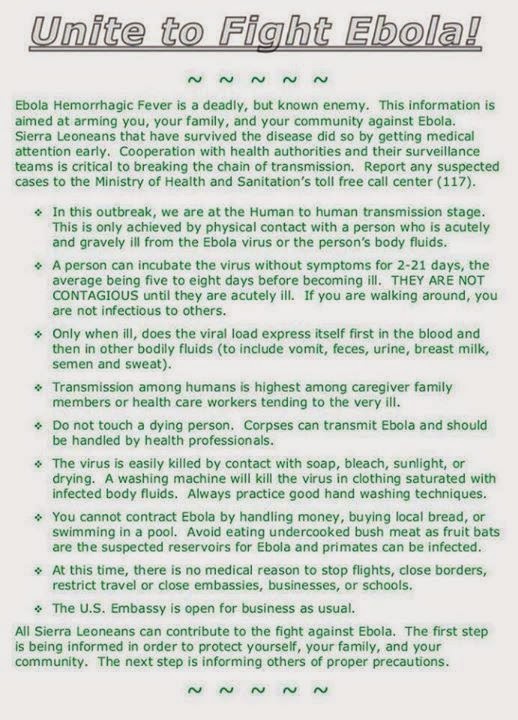
Ebola message in EnglishThe US Embassy, Freetown, Sierra Leone website has 6 language versions of an ebola message (including English "Unite to Fight Ebola!"). I'm posting available image files of those documents from a Facebook posting by Zee Tunkara Clarkson (31 July 2014) with full text and links to the original PDFs of the documents. The object here is to promote dissemination of this material as well as to facilitate review by experts in the 5 languages of translation:  Krio, Mende, Kono, Susu, and Limba. (Three of these are cross-border languages, Mende also being spoken in Liberia, and Susu and Limba in Guinea.) Such material may possibly be useful in crafting other educational material in these languages.

The text below was copied as-is from the documents pictured and linked. I do not speak any of these languages, so cannot comment on the translations, however there appear to be some inconsistencies in spellings (e.g., ibola and ebola in Krio). Feedback invited.


Krio: "Le Wi Jɔyn An Fɔ Fɛt Ibola!"

Ibola na sik we de kil kwik kwik wan ɛn na motalman ɛnimi; as i kin mek pɔsin in bɔdi de wam pas mak ɛn pul blɔd ɔlsay we gɛt ol na i bɔdi, so te i day.

Dis mɛsej de fɔ ɛp yu, yu fambul dɛm ɛn yu neba dɛm fɔ fɛt ibola tranga wan.
Salon pipul dɛm we bin gɛt ibola bɔt nɔr day bin liv bikɔs dɛn ebul go ɔ spitul kwik wan. Fɔ tap dis sik, na fɔ wok tranga wan wit di wɛlbɔdi pipul dɛm ɛn kɔl 117 ɛnitɛm yu si pɔsin we yu fil se gɛt dis sik. Yu nɔ go pe ɛnitin.
  • Fɔ naw, na pɔsin nɔ mɔ kin sheb dis sik. U kin gɛt dis sik we u jam bɔdi wit pɔsin we gɛt di sik bad bad wan ɔ sɛf kin gɛt am pan ɛni wata we de kɔmɔt na di pɔsin in bɔdi.
  • Pɔsin kin gɛt dis sik fɔ 2-21 de ɛn i nɔ go sho pan am, fɔ bɔku pipul, i go tek 5-8 de bifo i go sik. Durin dis tɛm, i nɔ go gi u pas di sik dɔn bad ɔf. If u de waka, u nɔ go kech di sik frɔm pɔsin we gɛt am.
  • Na we di posin don sik tranga wan na da tem de di sik go sho insef fos na di blod den na di wɛt, vɔmit, tɔylɛt, bɔbi wata spam ɛn swɛt.
  • Dis sik kin sheb kwi k wan frɔm pɔsin to pɔsin, mɔ to fambul we de mɛn di sik man or di wɛlbɔd i pipul dɛm we de tek care of dɛn sik man ya.
  • Duya, nɔ tɔch pɔsin we de day. Dedebɔdi kin gi u ebola so duya lɛf di dedebodi to di wɛlbɔdi pipul dɛm we dɛn dɔn tren fɔ andul dis sik ya.
  • Dis virus we wi kin kɔl tumbu, de day kwik wan if yu yuz sop, blich en san wi klos dɛm. Sɛf, yu we gɛt da machine for was klos kin yuz am for kil dis tumbu. Lɛ wi lan fɔ was wi an wit sop ɔl tɛm.
  • Yu nɔ go gɛt ebola if yu de ple wit mɔni, bay bred ɔ swim na wata. Nɔ it bush bif we nɔ kuk dɔn as dɛn bat we lɛk it fruit na dɛm wi biliv se de sheb dis ebola ɛn mɔnki, babu ɛn dɛn bush animal dɛn sɛf kin gɛt am.
  • As wi de tɔk so naw, wi nɔ gɛt no wɛlbɔdi risin fɔ tap plen nɔ fɔ flay, pipul fɔ travul, fɔ lɔk bɔda ɔ lɔk ɛmbasi, skul ɔ biznɛs dɛm.
  • Di american ɛmbasi opin fɔ biznɛs lɛk ɔltɛm.
All salon man kin ɛp fɛt ibola. Di fɔs tin na fɔ no bɔt di sik so yu go protɛkt yusɛf, yu fambul dɛm ɛn u neba dɛm. Di nɛks tin na fɔ tɛl ɔda pipul dɛm aw dɛn sɛf kin ɛp tap ibola.


Higbeh nyamu yila mia wa mu luehun ta toli ar Ebola, Taa nungaa waama wa, egbiya na ma, numgaa sia tia loo baoma. Mu yenge a goyila a hale bla sia ko mu higbe gi gbia ndohun. Nu gbi lee higbei gi ma ngoongo nu e pae hileblasia ti ma ngo flo.
  • Ba hingbei gi majoolo ar nu mui na hingbei gii gi gu gahun saniko nu mu hingbe ngur gi vondei.
  • Higbei gi ar yea nu gahun gi fele or gi nu fele gboyongo mahu yila.
  • Kelee ebola higbei eyeh numa tamia ar geh nu ngamii hun, golii, balii, fundei, ndolay yei, nyini yei.
  • Higbei gi ar lae lo nu gama ar bi bondasia or bi ma blasia ta bi mahun gbe.
  • Ba jaa ar numui na ebola higbei gi ma or numui na ebola higbei gi wa ga keley hiebla sia.
  • Ma hingbei gi waa flo, e na Mua mu yea ya wama fo ar bawei, klawa kemikasia, fulii ke klawa ngoli bee.
  • Ba ya ndogbo huen me, Huen na e yii panda ba mE, mehen na ndevei mia ba meh clo beh va.
  • Bee Ebola hingbei gi maango gi ba lolii ar kopoi, gi ba ye haka yea ya ma sabonda braedii yae ya mi ke gibon ba ye moi ma njei la.
  • Temi na e ya foi lei ko scuisia, embassisia, baluisia, businessisia ti gbo.
  • America Embassy wubla bla sia ti officii lao ngo temi gbi lee, ti lin hinda gbi.
Mu kpelei ndoe gi hu mo a muye ma gu lo mu lapii a hin gbei wai gi ta toli Ebola ke hinda, halei ma pae ta mia a hingbei wai gi ma ngo lei, na mia a pae hingbei gi e mu hue ke mu bondaasia bee. Hinda yekei ma pa e a ndelaa nungaa yekei sa bee ma.


Kono: "Mor Buteneh Che Kweyedondoryor Ebola ban Kwaya!"

Ebola mu mor far gbadi ana Eh wan gbeh mor teh. Sakana kweh chea ehbatina mor ma benkwana, butuneh che kwaya gbandicha Mor bamoi min bow wnda gbadi ch, an fuawa ta bwe cheneh da. Ni moah wyiche bwetina, gbadicha eh fua wan banda moah chenechor. Mor gbadi chewakwa oryean bwetina timaor tima a wakwa or sonda mor bema Moi bwetin chawan gbabye chea ma 117.
  • Sanjeh chor gbandi che ka modonbwe artina ata modominday tina. Asin moi ya mason gbandi moi chedehchedel ama, Gbadi chiar arbebe tar or chiah or choir chiar.
  • Gbandiche emawan moi ma eyoson aca tay fea ma ata tay bifea kuma dondoiior. Che Moi kuso far gbandi chea sonda tay du the ar ta tay saiy ar the.
  • Gbandichea ebain gbadimoi dor. Inima weh gbaindachea ai bay mor dominda ma kadache Gbandiche ta gbaineh ma gbeh formoi ana hata or tar. Siache, susuei bor kaka, tarr. Asin, gbandi samoinfan bay amason kaka.
  • Iy ma tu suah, ambeh Gbandiche bay wan. Ni ya moi fah, ar to bweti mbowah ar ton kwaya Fineh mimbi gbandiche bay matuni somboiah, tay or kena gbandineh So mormor bo ark o tima or tima Yi tuah kapwe ah iea.
  • Gbandi eba moima Bbede orh or iea dah or kwa.
  • Yi ma feah or swi mima tama ni chendeh down,cheminah, feahor swim be knongbwoi down fan  Tosa na min to kenechior.
  • A beebeh kwa niooh nu Chebeor, momo ma foni mbeh fia dendeh ma na or ta. Momo ma bodar na ton ni Momo ma foni moie ma ta tache or.
  • Pu chenneh na wichetiya na kain famu Suku mbeh na kain famu.
  • Abbebeh Amerlica na cheneh a kain far mu sajameh.
Morgbeh mormor boo art un Butuneh che kwa ya gbandi char. Mbe gbandi ch makwaor. Yi pen son mbe ya for to yi moin ja.


Susu: "Muhu Berein Halam Fekayrinma Ebola Gayrayfey!"

Ebola furay far furay nara. Gi furay etan, nu eha me fiyea, nu edoh ho boray. Leonenay, na habara gi furay sortoh aye serri na tongo e fa-yalan. Alan oh nu menga sie ha woo kayrain sortoh. A fala mengeh sie beh furay ma naha mu wama serry tongo fay. Hellity (117)
  • Hallow ar to forloh he key, aryerima mehri nu mehri nama. Egi furay sortoh manneh e na di eboray-rah.
  • Gi foo-ray lo manneh merima keyfree nu/mahoyennu kayrain. He suelee he solowma saha afa foorah
  • Foryei foo-rah afa wuleema sortoh, nu kwolee, nu bouwin woesi
  • Mehkeyray nehray, furayma dandama etangi furay masatorma
  • Enagha deen furayma fore nehray arfay colon
  • Gi furay, safwin, sogay. Temberin e bela he marah
  • E mu Ebola sortorma kobiri, tami yeama safay. E nah ha don say don naha mu yengri afa yerah. Keycoin nafa mordonma
  • Gi moment e nu norma baloyin dan dae aye mu kerabalama ecole nu wholiday, mu balama
  • US Embassy neh tanabay tembelay
Leonenay nor manneh Ebola keriday. As sengeh, he tan, nu ehan meri aye nu e dohboray, nu gbetaye e fala berinbeh.


Limba: "Mi Bointada Ba Dakila E thuna Key Dorma Ebola!"

Ebola, e Thuna na key kori limba-meti. Key kotheh mi bah u thunkoh. Kayla bamba ba she ba me, hunpo hoe kentu, nu bay kentu ba mi hu kothor ba dakila Ebola. Hu gbon hoe ka Salone bin dae punkay kuta tali ban a gbokolimbi yakoh. Ma boinadi e ba pilin bay, bay bindeh masaay tabay ba mi na massita ba dakila e thuna ki. Yonkina hu gbon hoe ka ba pillim bay ka e kalahin 117 bana e kuta wah way sim ay kayhin ba e thorna key ka Ebola.
  • E thornah key seh key, key thala dain ka limba metti. E koh kin kutu na e labay kay wah metti wo tukeh, ni mu boti mu ka wah wo belun e thorna ki.
  • E san wu kothoh ba doma na wah bilun e thorna kin-kin ba ma loko koyi-kala ni manthay. Ma loko ma nundi, kin koh tukinokoh ka ma loko masoyi e ma loko maso-matati. Kin thornaki, kin sa thalanda yokoh wah wo thorna ma ka-here. Ba nah ndo punku thariokoh,e sakin thalintianda ka wah wu fenah.
  • Ba pilin bay e bay kenah-meh bay nayan kuta e thornah kin-kin.
  • Ba labay kay wah way tukeh. Ba pilin bay na doru wu labay kay wah way ni Ebola, ni ba mankia wah wu koro e Ebola.
  • E thunaki, kin koh kora e sineh, mu maythna, e kan woo. Mi thania ba loka tha lunkoh tha kantu timu-timu.
  • E sa kutu e thuna kinkin kama thalintanda kopiri, ka bola mu theri, ni ba gban thiokoh ka mandi. Ba thor mu thor mu poniyorta ma lohun - nor na bara.
  • Ka ma loko mama, mi ka eh e bali ba yikina thalan-boti ba sir, ba lunka beluin ni nga ken ken ka thurea-mina, ba yikina ba thariokoh, ba gboni bay, karani ba, ni Embassinabay.
  • Hu gbon hoe ka U.S. Embassy hoe petheh tuma-tuma nanda thurn hun.
Mi formah kin ba thiah ma massay ba daykila Ebola. Yi kin Lanka kothor ba pulunokoh, ba bia bay kenda, ni metti da. Wu mankeh wu, mi kin bah wu tapay bia bi fenah ken na bin kothoh ba e thonaki.

Wednesday, September 10, 2014

More on ebola and health information in African languages

Quick follow-up on last week's post on Ebola and health information in African languages, to share some more information about initiatives on ebola education and reporting in African languages.

Following tweets on the previous post, there was additional information via Twitter on some videos in Nigerian languages:

The Nigerian language videos (YouTube) that I'm aware of so far are as follows (would appreciate more links from those who have them):
Also from Nigeria, there is an official poster in Igbo - Nje Ọrịa Ebola - which since it is from the Nigerian government, may also be in other languages like Hausa and Yoruba.
There is a Senegalese video (also on YouTube) about ebola in Wolof, with some written French. (An August 29 newscast in Wolof on ebola in Senegal is also on YouTube.)

A GooglePlay app "About Ebola" is available in English, Jola (Diola in French spelling), Krio, Liberian English, and Wolof.

There appears to be significant information on ebola in Fula, notably on pulaar.org, including a recent long article "Ebola Hol no haɓtortee?" (ebola, how can it be fought/countered?). Peeral Media has a short piece in Fula on Facebook, with a parallel English version. A 5-minute audio "Info sur Ebola en Pulaar/Fulfulde" is available on YouTube (accompanied by one graphic). Another example is a story on Voice of Nigeria about the Nigerian Hajj Commission's screening of pilgrims going to Mecca: "Hukuuma hijju Najeeriya wiɗitay hijooɓe Najeeriya."

In Guinea, Studio Hirondelle in collaboration with the rural radio network has produced radio programs on ebola in Fula (Peulh in French; the endonym in Guinea is Pular) and Malinké (a Manding language for which the endonym is Maninka or Maninkakan).

WHO and Athinkra

Athinkra LLC is coordinating translations of a FAQ on ebola provided by the World Health Organization (WHO). Languages on its list so far include N'Ko (an alphabet for Manding), Vai (in its own script and Latin alphabet), and Fula (in the new Adlam script - more on the latter in another post). (Thanks to Coleman Donaldson for calling my attention to this.)

Rubric, Wikimedia ZA, and WikiProject Medicine

Further afield, there is a collaboration in South Africa among Rubric (a languages services company), Wikimedia ZA, and WikiProject Medicine (which has a Translation Task Force/Project) to translate ebola health info on Wikipedia into the official languages of that country.

Summary and thoughts
The above is an eclectic sampling of initiatives and reporting on ebola in some African languages. Much of this is happening on country levels or by individual or small group initiatives. This post helps fill out blank spots in the picture as portrayed in the previous posting, but it is far from complete.

At this point it would seem very useful to have a way of monitoring such efforts and products with an eye to facilitating communication and sharing among them (particularly important, I'd argue, for cross-border and closely-related languages), reviewing material for accuracy, and building a data bank of medical translations in African languages about ebola and related public health topics.

Monday, September 08, 2014

Multilingual Literacy Day, 2014

It's actually International Literacy Day today (8 September), but given how often in the case of multilingual societies statistics on literacy are not clear on what they are measuring and assuming, I'm taking liberty with the title of this brief post.

Recalling how often one encounters or hears of people schooled in Africa - and literate or even highly educated - who say they cannot read their first language, it is worth asking why literacy for polyglots is not more often multilingual literacy. The technical term for this is pluriliteracy (multiliteracy seems to be more often used for ability to read and use diverse media).

Additional thoughts (the morning after)

First, the theme of the 2014 observation of International Literacy Day - "Literacy and Sustainable Development" - highlights an important link. Literacy isn't just nice to have, but fundamental, and this bears reiterating.

Second, my initial comments above come from a long interest in the subject of multilingual literacy or pluriliteracy, especially in Africa. I found it striking that people could go through extensive schooling without ever seeing their maternal languages in print, or learning established (even if historically recent) rules of orthography for them - and then to read discussions of literacy in societies in which these people grew up described as a single thing (as if we were talking about literacy in a monolingual region of the US or China). A regional news summary on the UNESCO site entitled "Celebrating International Literacy Day 2014 in the Sahel countries," for instance, lists many activities, but only in Burkina Faso is there any mention of which languages were involved: "articles related to literacy in French and local languages."

My active interest in this topic goes back to the beginning of the UN Literacy Decade in 2003 when I set up a discussion group on literacy theory, practice, and policy in multilingual contexts worldwide, called "Multilingual Literacy" (Literacy in Multilingual Societies). It sought to promote consideration of questions such as:
  • What approaches to adult literacy and basic education for children work best on the countrywide, community and individual levels in multilingual societies?
  • Should measures of "literacy" (% literate) be more complex in countries or communities where multiple languages and maybe even scripts are used?
  • What other issues arise with various approaches to literacy in countries where many languages are spoken (e.g., language survival, national unity, prioritizing limited education resources, production of materials for post-literacy, role of ICT, meaning of literacy to the people...), and how can they be addressed?
  • What about terminology and related concepts? (e.g., multiliteracy, pluriliteracy, multi/bilingualism)
Here's hoping that the next International Literacy Day pays more attention to pluriliteracy in multilingual societies...