Wednesday, July 01, 2015

Wiktionary as a tool for African language learning

Wiktionary may sometimes be uneven as a reference, but how might it work despite gaps and errors - or even because of them - as a study aid for African languages? Here are some reflections on use of Wiktionary, the wiki dictionary in English, and Wiktionnaire, the French edition, in trying to keep my Fula (Fulfulde/Pulaar/Pular) and Bambara skills somewhat current, and possible lessons from this brief experience for teaching of these and other languages to second language learners.

For those not familiar with Wiktionary, it is the dictionary counterpart of the Wikipedia online editable encyclopedia, and also run by the Wikimedia Foundation. There are Wiktionaries written in 171 languages, according to the official count, of which 148 are "active," according to my count (the other 23 have been "closed" due to inactivity). In each language edition, there may be words and terms from any language, but defined in the edition's language. So, the English Wiktionary has entries in "over 1550 languages," but the navigation, definitions and categories are in English. Similarly, the French Wiktionnaire boasts terms in over 3800 languages, all defined in French.

Referring to a list of Wiktionaries by language families, one notes 25 African language editions, of which 16 are active (Afrikaans, Amharic, Arabic, Hausa, Kinyarwanda, Lingala, Malagasy, Oromo, Sesotho, Somali, Swahili, Swati, Tigrinya, Tswana, Wolof, and Zulu), although some have only a few entries and translation of their user interfaces is not always complete. It is worth noting that the Malagasy edition is one of the three largest, due in part to an effort to automate adding of content (see here for background). Wiktionaries for nine African languages are closed or locked (Afar, Akan, Bambara, Kirundi, Shona, Tsonga, Twi, Xhosa, and Yoruba).

So as a first observation, a person studying an African language at whatever level may not find a Wiktionary edition in that language, and even if they do, they may not find much of use there. On the other hand they may find terms from the language they are studying defined in another language edition. For instance, the Hausa Wiktionary has only 62 entries, some of those empty or with English instead of Hausa definitions, but the English edition has over 400 Hausa terms - more but still not much (the French edition has 22). So, with other good materials for this language in print and online, why even bother with Wiktionary? The short answer is that due to its participatory nature, it can be a space for work that benefits learning - one's own and potentially that of others.

Wikipedia, Wiktionary, and African language study


I have long maintained that the participatory nature of Wikimedia projects in general offers potential uses in education. One approach is to have students "publish" or revise articles on Wikipedia that are relevant to class topics - this is actually an approach that some instructors have developed for use in university or even medical school classes..

In a short presentation at the African Language Teachers Association conference last April in Herndon, Virginia, I brought up a sub-theme of this idea: That intermediate and advanced students of African languages could stretch their language skills to write articles on various subjects in African language editions of Wikipedia - with guidance of their instructors - as part of their classwork. This suggestion is not to minimize the level of expression that could be used in these languages, but rather to combine giving students experience with helping fill gaps (often large gaps) in African language Wikipedias, where there is at least the potential for feedback on their contributions from native speakers.

Since I am not teaching, I have not been in a position to implement this idea, but considered how I might do this on the Fula and Bambara Wikipedias for my own review. However, working alone with rusty language skills in limited time periods, it has not been practical to use this approach.

Wiktionary on the other hand would offer opportunities to engage with the languages that interest me in shorter periods and on the level of vocabulary review. Unfortunately, as I indicated above, there are not currently any Wiktionaries in either Fula or Bambara, so I looked at what there was on these two languages in the English and French editions.

The idea of using Wiktionary in similar approaches is not new. An article in The Economist last year mentioned use of it for looking up words across languages, taking advantage of cross-wiki links at the bottom of the left hand column. Another article described use of the concept of "Wiktionary" with a different software for teaching biology terms within one language (English).

I chose to work on Fula words in the English Wiktionary, because there was a bit more there to work with than in the French Wiktionnaire, and since English is my first language, it is easier to deal with the wiki markup and template issues that I'd have to figure out along the way. And since there were already over 2400 Bambara terms in the French Wiktionnaire, I decided to take advantage of that resource by focusing on revising and categorizing. This made for two quite different experiences.

Structuring Fula entries on Wiktionary


I had actually done some edits to Fula and Bambara entries on the English Wiktionary earlier, but at the time I began to focus on Fula earlier this year, there were well less than 100 entries for that language. Since my experience with the language includes compilation of a Fulfulde dictionary, one of the first aspects I worked on was adding roots to the etymologies for several entries, then entries for roots, and a category for those root entries.

Entering terms on Wiktionary is not just a matter of adding a word and a meaning into a form. There is an expected structure, which is filled out in the wiki markup. In addition, certain templates may be used for parts of speech, plurals, and so on, and other markup to nest categories. For a complex language like Fula, with vocabulary based on roots and "infixes," some 26 noun classes, and initial consonant changes, elaborating that structure turns out to be the main issue.

Another structural issue was setting up templates for the plural forms of nouns. Fula plurals often take a form different from the singular, involving initial consonant changes in some cases, and different endings. The plurals also belong to one of their own classes (four of the 26 classes are for plurals), so that a good template will facilitate entering singular form, its determiner (which is also the class name), the plural, and its determiner/class.

Yet another issue is setting up a standard page for verbs. Fula verbs occur in three "voices" and are quite regular in conjugation, with no differences among the persons, except for initial consonant changes for some consonants in plural form. But setting up the tables for conjugations in Wiktionary seems to be somewhat involved.

A further complication is the fact that Fula has several varieties (some consider them dialects; Ethnologue classes them as separate languages), and some words or forms may differ in one or more varieties. Setting up a way of indicating this, and listing references, was not difficult.

In sum, much of my limited effort on Fula entries of Wiktionary has been devoted to necessary foundational work on the structure of articles, and slowed by the need to learn some of the more advanced wiki markup. So as a tool for review, it has so far been of limited use so far, and I unfortunately could not recommend it at this point for learners of Fula.


Random pages in Bambara on Wiktionnaire


For Bambara, I was happy to find that there was significant content already on the Wiktionnaire. This has made it an ideal site for review, especially taking advantage of the "Page au hasard par langue" (random page by language) click-on in the sidebar. Using this feature is like flashcards, though with the definitions right there. (I actually wonder if one could not set up a special flashcard mode for random pages, to facilitate use of Wiktionaries for vocabulary learning and review.)

Whether via the random page or other look-up, I've reviewed and often modified entries, consulting online and print references as necessary. I've also worked with the categories, which once set up is a great way to review semantically related terms. So for instance if I come across a word related to agriculture, and add it to that category (Catégorie:Lexique en bambara de l’agriculture), I can immediately open the category and see other terms. For category organization, it has been easy to consult that used for French.

Bambara is not complicated in the same way as Fula (simpler morphology, no classes, no conjugation), so entries are easy to set up and modify. It has been possible to accomplish a lot in short sittings or even on a mobile device. As such, I would recommend it for use by learners of Bambara. Advanced students may be able to expand, correct, or create entries - basic knowledge of wiki markup would suffice.

Wiktionary in the African language class


Any plan to use Wiktionary as an activity in classes would have to be preceded by evaluation of the language material and whether the structure (categories, templates for special features) would facilitate students actually getting something out of the effort. I believe my personal experience shows some of the challenges and potential of using Wiktionaries for learning and review of vocabulary.

What of other online dictionaries? Could contributing to Kamusi for example also be of use to learners? One advantage is that it has is no wiki markup to learn (see this comparison for other differences). I hope to come back to this in a future posting.

Tuesday, June 30, 2015

Unicode and the architecture of ICT

Latin omega, used in Kulango, and now
included in Unicode's latest version.
Unicode released its 8th version earlier this month, so maybe it's a good time to take stock of what the effort to encode all the world's scripts in a single system - which includes the Universal Coded Character Set (ISO/IEC 10646) - has meant for African languages.

The attention with a coding system for characters is naturally on the characters and scripts they are part of, and among the changes in Unicode 8 are some Latin-based characters used to write the Kulango language of Ivory Coast and the endangered Ik language of Uganda. These have been added to Unicode's "Latin Extended-D" block. (The Unicode standard also includes technical specifications for handling text.)

In past years there have been similar small additions to Unicode, as well as major additions of whole African scripts like Osmanya (2003), Tifinagh (2005), N'Ko (2006), Vai (2008), Bamum (2009), Mende Kikakui (2014), and Bassa Vah (2014).

The Ethiopic/Ge'ez script - used for several languages of Ethiopia and Eritrea, such as Amharic and Tigrinya - was first added in 1999, before the Unicode standard was widely adopted. At the time, different scripts used different coding systems, hindering use of languages with complex or non-Latin scripts, and posing particular problems for anyone wanting to combine scripts in a document or on a webpage.

Unicode as an enabling architecture

With that I wanted to quote from an unsigned blog posting entitled "What are we missing out on" (9 Dec. 2014) that was part of an American University course on international communication, as I think it offers an important perspective on why encoding scripts in Unicode is important:
"Tonight’s presentation on Ethiopic language and its inclusion in Unicode presented an important element about the global digital divide because it asks the question: how can, even with access to information communication technologies and internet access, someone utilize technology if it is not available in their native language? In short, they can’t. This is an important element to consider in regard to technology and the reality of, to borrow from Laura DeNardis’s description, its architecture. As the group described in their literature related to their case study, the architecture of something has the power to include and exclude. The analogy we have used in class in class is that of bridges that are built low enough to prevent busses driving under them.
"In the case of Ethiopia, technology was created in a way that excludes the nation’s 90 languages because American companies created the technology in English with a western cultural perspective. Further, their commercial interests drive their actions, and there is no financial incentive to include languages in which there is no commercial demand. Therefore, not only are these groups of people excluded from the benefits of technology, we are also denied the benefit of their knowledge. As the group noted, we “feel” like we are so much more connected, but cannot assume that the majority of the information is in English and unless everyone is able to put information in the digital realm, we are missing out. After this presentation, I cannot help but to believe that we are indeed missing out. Tonight we discussed Ethiopic, but what other languages are we missing out on?"
The "architecture" of information and communication technology (ICT) in this case starts with the internationalization piece ("i18n"), which is addressed in part by Unicode. It would also include availability or not of localized ("L10n") software, which is especially important for major languages, and content. Localization is also conditioned by factors such as education, policy (of national governments as well as of development organizations), and, as alluded to above, economics. As such, once one moves beyond the enabling architecture, the interplay of factors looks more like an "ecology."

Unicode, by adding scripts and amending characters, makes the written form of African languages theoretically accessible on modern computing devices and across the internet. That's huge progress beyond where things were a decade and a half ago, when various 8-bit encodings dominated (at which time I noted some issues of lack of support for African language scripts were stuck at practically the same place they had been ten years before!). But it's still only part of the process of fully addressing the linguistic dimensions of the digital divide in Africa. Until that happens, we all will be "missing out" in different ways.


Tuesday, May 12, 2015

Language and Development Conference 2015 (& CFP)

The eleventh in a series of biennial Language and Development Conferences will be held in New Delhi, India on 18-20 November 2015, with the theme "Multilingualism and Development." Of the previous ten conferences, two have been held in Africa (2005 in Addis Ababa, Ethiopia and 2013 in Cape Town, South Africa) and the other eight in various parts of Asia. Nevertheless, the conference topics seem as relevant to African realities as those in Asia and elsewhere.

In its own words, the conference series
... explores the role of language in development. It addresses the issues of world, national, second and minority languages and the role they play in economic, social and cultural development; language policy, conflict transformation, language rights and identity; communication, education and development and language pedagogy.
The current theme - Multilingualism and Development - begins with the simple observation that "Linguistic and cultural diversity is a fact of life in developing countries...," under which several subthemes and suggested topic areas (relevant for the call for papers - submissions due 26 June 2015 12 July 2015 - deadline extended) are outlined:
  • Multilingualism and the metropolis
    • The issues that might be addressed include but are not limited to the following:
    • Identifying and describing the linguistic implications of urbanisation
    • The benefits of linguistic hyperdiversity
    • Linguistic barriers experienced by migrant populations in urban contexts
    • How schools, health clinics and other government services cater for speakers of dozens of different languages in super-diverse urban contexts
    • The practice of MTB MLE - and the capacity of schools to provide it - in multilingual urban contexts
    • Social division as an unintended consequence of MTB MLE in multilingual contexts
    • Multilingualism in semi-urban and urban non-metropolitan contexts
  • Language, technology and multi-literacies
    • Digital media as threat or opportunity for minority languages
    • Digital media and non-Latin-based writing systems
    • The use of digital media at times of crisis and natural disasters, especially in multilingual societies
    • Digital media and language choice in education
    • Digital literacy, language and gender
  • Multilingualism, marginalisation and empowerment
    • The tension between ideas of ‘development’ and formal education systems
    • Educating girls and empowering women in multilingual societies
    • Endangered languages and endangered livelihoods
    • Language, identity and violence
    • The role of parents in multilingual contexts
    • Multilingualism in rural contexts, particularly in the context of accessing markets
    • Prospects for indigenous peoples and speakers of minority languages in multilingual nations
    • The roles of English in multilingual developing countries: empowering or marginalising?
    • Describing and responding to the phenomenon of low cost private English-medium schools catering to the economically marginalised
The attention to English among the possible issues is perhaps a function of the British Council's co-sponsorship, as well as the fact that English is one of the official languages of India (which is hosting this year's conference). No problem there, but it is notable the prominence of Britain in organization of many of the past conferences, and the absence of major donor countries like the US and France. UNESCO and the African Academy of Languages (ACALAN) are listed among the co-sponsors of the 2013 event,  Germany's GTZ was a cosponsor of the 2011 conference, and several Australian organizations were involved in organizing some of the early conferences.

Friday, May 08, 2015

Second most spoken languages in Africa, part 2

This post will review in more detail the Africa information in Olivet Nazarene University's maps of "Second Most Spoken Languages Around the World" web feature. The previous posting on this subject gave an overview and pointed out some issues - most importantly the problem with assuming that official languages in African countries are the most spoken languages, and an apparent confusion between "second most spoken language" and "most common second language."

The following table is an attempt to review in detail the information that Olivet presented, country by country (for those covered). The object is not to be overly critical of this effort, which has the virtue of raising an issue that not many have considered, but to take the opportunity to look at this issue in more detail, since it is important in several contexts.

For instance, during the ebola crisis in West Africa, some outside aid efforts may have started from the assumption that the official languages are sufficient to reach wide populations, while others raised the concern that this is not enough (see previous post, "Speaking English in Rural Africa"). Yet as far as I'm aware, there were few hard data to indicate where and on what levels language was a critical gap in communication and public education. The information in the table below (drawn from sources linked in left column) would not close such gaps - it is on too macro a level - but it might serve to promote more thinking about what languages are most important in various parts of the world's second largest and perhaps most linguistically diverse continent.

Olivet's “Second Most Spoken Languages” per map (Africa only)

Review comments
(L1=first language;
L2=second language) 
Countries covered Language indicated Olivet's code ISO 639 code Olivet's comments
Algeria
(Wikipedia / Ethnologue / Aménage- ment linguistique)
French Fr fr "The most common second language is French, which is used by many as a literal and figurative 'lingua franca.'" Rephrasing per the project title, French is the second most spoken language in Algeria (mainly as L2) after Arabic (including Algerian Arabic). Amazight (or Berber) languages, esp. Kabyle & Shawiya, are spoken by several million
Burkina Faso
(W / E / A)
Indigenous In - "Individual tribal languages are typically the most commonly spoken language in daily life." The Mossi language (aka Moore; mos) may actually be spoken by more people than any other language. Dioula (aka Jula; dyu) is widely used as as L1 & L2. Of this and the official French, not clear which is second most spoken. 
Cameroon
(W / E / A)
Indigenous In - "The most common second language is one of the many native languages of Cameroon, as very few Cameroonians speak both English and the country’s other official language, French.” The native languages of Cameroon would in most instances actually be L1s, not L2s (though some languages like Fula in the north, Pidgin in the west, and Ewondo in center, south and east also serve as L2s). Of those, and the official French and English, more work needed to determine ranking of numbers of speakers (L1+L2).
Central African Republic
(W / E / A)
Indigenous In - “The most common spoken language, outside of the official languages of French and Sangho are native languages. Nearly all of the native languages of the CAR belong to the Ubangian languages.” It would be more informative to rank languages regardless of legal status.As such, Sango is the most spoken (mainly as L2 outside of Bangui), and French probably second most spoken (also mainly as L2). 
Egypt
(W / E / A)
English En en “English and/or French are widely learned and understood.” -
Ethiopia
(W / E / A)
Oromo Or om “The most commonly spoken second language is Oromo, spoken by 33.8% of the population. The second language is actually spoken by more Ethiopians than the official language (Amharic), of which 29.33% of the population speaks.” Based on this, Oromo should be considered as the most spoken, and the official Amharic (am) as second most spoken in Ethiopia.
Ghana
(W / E / A)
Asante As tw “The most common second language is the Asante tribal language, used by 14.8% of the population.” Asante or Ashanti is one of two literary versions of Twi (tw), which in turn is usually considered together with Fanti as the Akan language (ak). Akan is spoken by about half the population (mainly as L1), so may actually be spoken by more people than the official English.
Ivory Coast
(W / E / A)
Dioula Di dyu “Dioula is the most common second language, as it is the most common of the tribal languages.” Dioula (aka Jula) is a historic trade language in the Manding group, mutually intelligible with Bambara. It is apparently widespread as an L2, though L1 speakers are relatively few.  However the number of French speakers - mainly L2 - is greater.
Liberia
(W / E / A)
Indigenous In - “The various tribal languages of Liberia are the most common second language, being the primary speaking language of many people, though they are often not usable in writing.” The native languages of Liberia would in most instances actually be L1s, not L2s. Of those, Kpelle may have the greatest number of speakers. Liberian English (mainly as L2) is apparently the most widespread.
Libya
(W / E / A)
English En en “English is commonly understood among the educated classes, and in major cities.” lIn addition to Arabic, native languages include several varieties of Tamazight (Berber) languages, of which Nafusi (jbn) has almost 200k speakers (Ethnologue). How does that compare with numbers who understand English?
Malawi
(W / E / A)
Chewa Cw ny “Chichewa is the second most spoken language in Malawi and most common language in the country.” Chewa has more speakers in Malawi than any other language (counting L1 and L2). Using Ethnologue's figures, Tumbuka (tum) may be second most spoken, ahead of English (Tumbuka being mainly an L1 and English mainly an L2 in Malawi).
Mali
(W / E / A)
Bambara Ba bm “The most commonly spoken language outside of French is Bambara. In total, 13 languages are considered official languages of the country.” Bambara is spoken by 60-80% of the population as an L1 or L2, which is more than the official French. 13 Malian languages are statutorily “national languages,” not official (See discussions in previous postings.)Of those 13, Fula might possibly rival French for 2nd most spoken in terms of number of speakers (Fula being mainly an L1 and French mainly an L2 in Mali).
Morocco
(W / E / A)
French Fr fr “French is a commonly used second language in business and government.” Standard Tamazight (zgh) is also official, along with Standard Arabic. Taken together, the number of speakers of Tamazight varieties (spoken mainly as L1) may rival that of French (used mainly as L2).
Mozambique
(W / E / A)
Emakhuwa Em vmw (& others) “Emakhuwa is spoken by 25.3 % of people in the country.” Portuguese (official language) is most widely spoken, by about half the population mainly as L2. Emakhuwa actually has several varieties, which together are spoken by about a quarter of the population, mainly as L1.
Namibia
(W / E / A)
Oshiwambo Os kj & nd “The Oshiwambo languages are spoken by 48.9% of the country.” Oshiwambo language or dialects are most spoken, and of those, Kwanyama clearly has more speakers (mostly L1) than English (mostly L2). The latter seems to be the second most spoken.
Niger
(W / E / A)
Hausa Ha ha “Hausa is the most commonly used language outside of the official language of French.” Hausa is actually the most spoken language, though its L1 speakers dominate in the south central region; it also has L2 speakers. French (official) or Zarma (dje; dominant in the west) likely would be second in number of speakers, though the former has more L2 and the latter more L1 speakers.
Nigeria
(W / E / A)
Hausa Ha ha “Hausa is the most commonly used language outside of the official language of English.” Estimates of the number of English speakers (mainly L2) vary widely, with one question being how to count speakers of English-based Pidgin. Defined broadly, English would be the first most spoken. Yoruba may have slightly  more L1 speakers than Hausa or Igbo, but Hausa has many more L2 speakers than either of the others.
Rwanda
(W / E / A)
Swahili Sw sw “Swahili is the most common spoken language outside of the official languages.” Kinyarwanda is L1 of virtually the entire population. French may be the second most spoken language. English (relatively recently made official alongside the two mentioned above) or Swahili would be third.
Senegal
(W / E / A)
Wolof Wo wo “Wolof is the most commonly used language in Senegal.” As such, Wolof should not be listed as second most spoken. French (mainly an L2) or Pulaar (a Fula language, spoken mainly as an L1) would be second.
South Africa
(W / E / A)
Xhosa Xh xh “The most commonly used second language is Xhosa, used by 16% of the population.” Of all languages in South Africa, Zulu may be most spoken (L1+L2), with Xhosa, English, and Afrikaans following (although from older data, the order is hard to confirm).
South Sudan
(W / E / A)
Arabic Ar ar “The most common second language is Arabic, a remnant from when South Sudan was united to Sudan." Dinka (all 5 varieties together; din) and Nuer (nus) are the first & second most spoken indigenous languages, mainly as L1s. The Arabic creole, Juba Arabic is important in part of the country, but its speakers may number less than those of Nuer. No clear figures for English (official).
Sudan
(W / E / A)
Indigenous In - "Beja is a native Cushite language spoken by around 2 million speakers in Sudan, making it the most common second language." Beja (bej) may be the second most spoken, but mainly as an L1, not L2. Of the two official languages, Arabic is the most spoken, but no figures for English.
Tanzania
(W / E / A)
Arabic Ar ar "Outside of Tanzania's official languages, Arabic is the second most spoken language (widely spoken in Zanzibar)." Swahili (official) is the most spoken language. Sukuma (suk) may have more speakers (mainly L1) than English (also official; mainly L2). Despite its significance in Zanzibar, Arabic is not that widely used elsewhere.
Tunisia
(W / E / A)
French Fr fr "French is the most common second language and is used especially in the business world." Counting Tunisian Arabic and the official Standard Arabic as one, French is indeed the second most common language (mainly as L2).
Uganda
(W / E / A)
Ganda Ga lg "Ganda is the most widely used second language, and is the preferred language for native publications." Ganda (Luganda) apparently has more speakers (L1+L2) than English (mainly as L2). However English is more widely used as an L2.
Zambia
(W / E / A)
Nyanja Ny ny "Nyanja is the most common second language, spoken by 14.7% of the population." Bemba (bem) apparently has the most speakers in Zambia (mainly as L1 but also L2). English (official; mainly as L2) or Nyanja (mainly as L1), would follow.

A related post of possible interest: "How many people speak what in Africa?"

Thursday, May 07, 2015

How many people speak what in Africa?

More on language maps with focus on Africa. This picks up a discussion begun in an earlier post, "Second most spoken languages in Africa."

One of the reactions (by several people on Twitter) to a set of maps and diagrams of the most spoken languages in the world published in the Washington Post's April 23 feature "The world’s languages, in 7 maps and charts"- in particular the diagram at right - was a question as to why Swahili was not included. After all, estimates of speakers of Swahili run as high as over 150 million.

African languages do tend to get overlooked in various contexts, but in this case it seems that the criteria used - "native language" - was the deciding factor. Swahili is widely used as a second or additional language (L2 being the common abbreviation) but relatively fewer people speak it as a first or native language (L1) - somewhere in the range of 15-50 million (more on such estimates below). This is not enough to make this chart, which deals only with L1s. The number of L1+L2 speakers of Swahili is in the 60-150 million range.

The map/diagram at right was posted on Twitter as a reference in the above discussion. (Thanks to Prof. Calestous Juma of Harvard University for calling our attention to it.) This comes from an article entitled "International Mother Language Day 2014" on the elearning-africa.com site. However the figures given for "six of the most widely-spoken languages" clearly have to do not just with maternal language (L1) speakers, but also with L2 speakers.

To elearning-africa.com's credit, the article notes the complexities involved in citing figures for African languages, including the L1 and L2 issue:

"[I]t is of course extremely difficult to count numbers of language speakers, especially when the data is vague. Should only first-language speakers be counted? But then, what about Kiswahili and Hausa, which have fewer native speakers but are used across wide geographical areas as trade languages? It is important to remember that any depiction of African languages, other than the most exhaustive study, will be a compromise at best."

The closest we have to an exhaustive study of numbers of African language speakers continentwide would be the figures compiled by Ethnolgue, though these are themselves often estimates and works in progress. Still, one could work with such figures - as well as other research on language use in specific parts of Africa - to outline the top most spoken languages at different geographic scales - continental, sub-regions, countries, and provincial. These could in turn be presented in map layers. The utility of such data would be in better informing development/extension projects and relief efforts (such as that against ebola recently in West Africa) in which communication, participation, and education are fundamental..

Source: Michigan State University African Studies Center, "Exploring Africa" (modified)
In the meantime, a diagram like the one at right, which doesn't offer any numbers but picks some of the most spoken African languages by country, represents a useful compromise on a macro level. This particular example, needs updating and revision. Some issues (and a few changes) include:
  • Updating to reflect the split of Sudan and South Sudan
  • In some cases the languages appear to be listed in order of number of speakers, but in others not - it would help to do the former consistently.
  • I corrected one of the language names for Guinea - "Futa Jalon" is not a language, but a region where Pular, a variety of Fula, is spoken. 
  • Also about Fula, the listing of "Fulfulde" and "Pulaar Fulfulde" from Mauritania through Guinea Bissau needs review/revision.
  • For Ghana, Fante and Asante-Twi could be consolidated to Akan, and one of the northern languages could be listed.
  • I removed "Hima" as a language of Rwanda and Burundi. It's a name (or dialect) of Nkore, which although related to Kinyarwanda/Kirundi, is a language of Uganda. In Rwanda and Burundi, Ethnologue considers it "an ethnic group (not a language) which speaks Rwanda or Rundi."
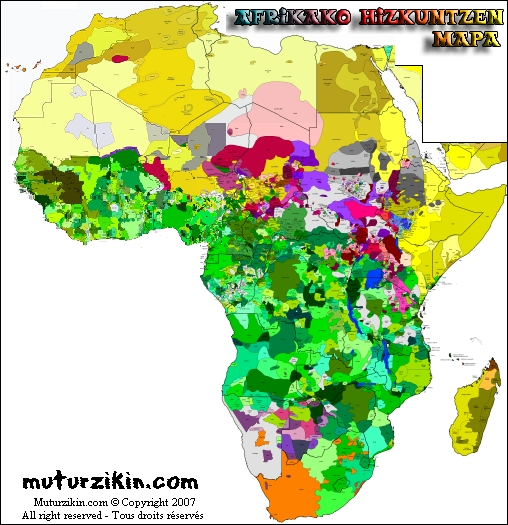
On the other end of the spectrum - that of "granularity" of linguistic data - there is a set of detailed maps of "Distribution of African Languages" on muturzikin.com (an image of these together as presented on their site is on the right). In some ways this impressive work addresses the need for more accurate maps, although it has no indications of level of use (per numbers of speakers). Also, since in multilingual Africa, language use overlaps and rarely if ever respects borders or boundaries, it would be useful to see some kind of layering feature, as well as the ability to zoom out and drop some detail in favor of aggregated data on more widely spoken languages.

The latter maps of course focus only on African languages, and without reference to the Europhone languages used in many countries in official capacity and/or as lingua francas (L2s). Another adaptation, therefore, could be on the continental level, to list the top most spoken languages (L1+L2) per country, including all tongues.

This would bring us back to the map of "second most spoken languages" in Africa proposed by Olivet Nazarene University. A more detailed look at that effort will be the subject of the next posting.

Tuesday, May 05, 2015

Applied linguistics for development workers?

In an article last January in The Guardian's Global Development Professionals Network, Maria May suggests "Six resolutions for aid workers" in 2015: 1. Be the best manager ever; 2. Read; 3. Write; 4. Spend more time in the field [i.e., don't let it slide down the list of priorities]; 5. Walk the walk [development "organizations need to exemplify the change that they are trying to make in society"]; and 6. Renew yourself.

I'd like to suggest a 7th resolution for 2015 - never too late to improve practice - which is particularly important in multilingual contexts commonly encountered in development work in Africa: "Be a little bit of a linguist." What I mean by that is to pay attention to what languages are used and might be used, and how, in all levels of development work - especially on the level of beneficiaries and their communities.

Language, of course, is key to communication, which is central to extension, learning, and collaborative planning and action. And when many languages are used in a community, communication in development becomes more complex, choice of languages becomes a factor, and several social and linguistic issues come into play:
  1. Participation: Who's talking? Who's not talking (or understanding)? These are issues even in monolingual communities, but where more than one language is spoken, try to observe what the use of or shift among languages means in terms of who does and doesn't participate fully - or at all. Typically use of an elite language or a language spoken by a majority in the community will favor people in leadership positions. Choice of language may reflect power as much as a desire to reach the most people. 
  2. Gender: Related to the previous point, what do women speak and not speak? Women tend not to have as many languages as men, due to lack of formal education of girls, as well as to the opportunities even unschooled men have to travel and interact with speakers of other languages in their region (and beyond). Try to get an idea of what languages women use in homes, community, and local markets, and what gaps there may be for their direct communication with government, extension agencies, development projects, school staff, etc.
  3. Interpretation: Where it is necessary to work across more than one language, what is the quality of rendition in the target language(s)? If you don't speak the target language you have to trust the interpreters who do, but don't do so blindly. You may have seen a spoof of movie subtitles where an actor speaks a long piece and the subtitle has one or two words - be alert to shortcut summaries and query the interpreter when s/he gives you one.* In 2010 I sat in on a training of community animal health workers in Moroto, Uganda, who requested a change of interpreter to one who had better command of relevant vocabulary in Karamojong language. If there had not been that alternative, what might have been lost in translation? Check to be sure of the interpreter's confidence in the technical topic(s) being discussed before putting them on the spot to translate for you.
  4. Translation: Can you bring talking points translated in the target language to the field? At its most basic level, interpretation is oral and translation written, but development work rarely involves the latter when "local languages" are involved. Yet "pre-translating" key concepts and terminology might be helpful as aids to ensure good interpretation and reduce "slippage" in conveying information. Translation is also a key to localizing ICT4D (see below).
  5. Local extension agents: What languages do they speak? I've remarked in the past that a US Peace Corps volunteer may get more language training in one week than the average local extension or development worker gets in an entire career. That may not seem to matter much if they speak the local languages, but even when they do, there is no support to assure the quality of technical expression in those tongues, and very likely such workers are not literate in them (if their formal education was uniquely in a Europhone official language). And often it is the case that local extension workers may be posted in a region of their country where a language(s) they are not so familiar with are spoken
  6. Local radio: What languages do they use? In my experience in West Africa, community radio stations split their programming among whatever languages are spoken by people living within their broadcast radius. With expertise across languages (including finding ways to express new concepts in them), the staff of a station in an area where you are working could be a valuable partner for both for understanding the sociolinguistic profile of the area and for messaging to reach all groups.
  7. ICT4D: Applications, software, and content that do not respond to the linguistic realities of the population will have a limited utility - or utility for a limited number of people. Localization (L10n) involves translation and adaptation to local culture and communication. Projects in information and communication technology for development (ICT4D) and efforts to develop L10n in the same countries would seem to be natural allies with complementary interests, but it may be up to the better funded ICT4D projects to reach out to make this connection.
One by one, such issues may make perfect sense, but even when taken together, the reasons for attention to language as a factor in development have not led to a real understanding of the role of languages in development, or what we might do better in multilingual contexts - and with less-resourced languages - to improve practice and outcomes.

The link between language and development is "largely ignored" according to Ekkehard Wolff. Robert Chaudenson has suggested that the subject of language is "taboo" in development work in Africa. And Birgit Brock Utne noted that foreign donors have a negative view of African multilingualism. This is a problem and we can do better.

* An episode of interpretation recorded on video in southern Afghanistan, with translated subtitles, is an example of shortcuts or just bad interpretation. There are other dynamics going on in the video, but the segment about midway through with the local elder is worth viewing.

On a similar topic: "Back again. Gates, Rockefeller & African languages" 14 Sep 2006.

Friday, May 01, 2015

Second most spoken languages in Africa

A news feature on the Olivet Nazarene University site presents a map showing "The Second Most Spoken Languages Around the World." This is an interesting effort to get below surface descriptions of language use. As a Washington Post feature last year on languages in the U.S. put it, "Top-line statistics often reveal little. But peel back the first set of layers, and you reveal a lot of diversity - and history."

Second most spoken languages in Africa. Source graduate.olivet.edu
However, when dealing with the complex linguistic landscape of Africa, this effort runs into problems. The first issue is assuming that "The most spoken language in any country is often obvious; usually, it’s the official language of the country." In Africa this often is not the case, if by "most spoken" one counts number of speakers. An example is Mali, whose linguistic profile was explored on this blog in discussing the long-tail of languages - Bambara is certainly more used than the official French.

Official language is a category that doesn't lend itself to ranking use of languages in Africa, beyond the (admittedly important) context of official use and its spillover to popular use. In the case of two countries at least, this runs into additional problems:
  • South Africa has 11 official languages (the Olivet site incorrectly lists only one of them - Zulu - as official). So one of the official languages will be second most spoken. Perhaps that is Xhosa as indicated, but the model focusing on official languages hasn't worked here.
  • Rwanda has three official languages (Kinyarwanda, French, and English), and Central African Republic two (Sango and French). Since the site doesn't consider these official languages in discussing second most widely spoken, it is reduced to stating that Swahili is "second" most used in Rwanda, and that indigenous languages are used in CAR - which doesn't tell us much.
  • Ethiopia has Oromo listed as the second most spoken language, but the detailed info notes that it is actually the first most spoken, with the official Amharic being second. So shouldn't Amharic be listed on this map instead of Oromo?
The type of situation in Ethiopia and Mali is probably the rule in African countries where one or two indigenous languages dominate (even when a Europhone language is official and therefore assumed to be the key linguistic descriptor for the countries).

A second issue is that in reading the individual country descriptions, it seems there may be a confusion between second most spoken language and most spoken second language (L2). This is a key distinction between numbers of L1+L2 speakers for the former (which will be predominately L1 for many languages), and just L2 speakers for the latter. When discussing English in many countries - one focus of the Olivet effort - almost all speakers will be L2, but that would be a special case within consideration of what language is second most used (per the title of the page). In the case of Liberia, however, where English is official, reference is then to local languages as "most common second language."

A minor issue is reference to "tribal languages" - not used in academic literature, and has negative messages in other contexts.

Another one is the coding used for languages - many of the two-letter abbreviations coincide with the standard two-letter ISO 639-1 codes, but others do not (Bambara would be "bm," not "ba"; Chichewa would be "ny" like Nyanja [same language]; "As" for Asante in Ghana would more appropriately be "Ak" for Akan. Where there is no ISO 639-1 code, then either an invented 2-letter code or better yet, a three-letter ISO 630-3 code could be used.

Despite issues mentioned above, this is an worthwhile effort that could potentially have use in education - of language learners, development practitioners, and policy makers. Some suggestions:
  1. Be clear that it is "second most spoken language" throughout and consistently
  2. Do not count official as the most spoken, especially in Africa - official may be most important on some levels, but not necessarily understood by most people. The story gets more interesting when one looks at most spoken languages (L1+L2 numbers) per country
  3. Do not refer to "tribal" languages - indigenous, local, or whatever, there are more or less better terms
  4. Use ISO 639-1 (and if necessary -3) codes
  5. Name the indigenous languages - Ethnologue of course is a prime reference for names and numbers
  6. Consider tracking third most spoken languages. Much of the work towards this will have been done anyway, in sorting through numbers to determine what is second most spoken.
  7. An additional resource to consult is Jacques Leclerc's L'aménagement linguistique dans le monde
  8. Keep in mind cross-border languages - Hausa and Swahili are well known, but Chewa and Nyanja are the same (as indicated above) and Bambara and Dioula (aka Jula) are mutually intelligible - could further development of this project include ranking regional (crossborder) languages?
See also the follow up more detailed analysis in Part 2.