Wednesday, November 26, 2014

Keeping African languages out of African schools?

Humiliation of Ugandan students who speak their mother tongue in school, and Malawi's recent decision to move to an English-only instruction policy, reflect the continued low status of African languages in African education. In much of Africa, the first languages of students are formally excluded from African schools by national policies, and/or accorded low or even negative value in school culture. In the extreme, this situation can be seen in terms of denial of human rights (per work by Tove Skutnabb-Kangas), but in any event seems to run contrary to ample research on the benefits of  learning in the mother tongue and of bilingual education.

"Why are schools punishing children for speaking African languages?"


Punishment for speaking Luganda at school.
Image from Facebook via ThisisAfrica.me.
A recent article by writer and lawyer Bwesigye bwa Mwesigire called attention to ongoing practices in some Ugandan schools of humiliating students who speak African languages. A particular example is requiring students caught speaking a language other than English to wear a sack, until they catch one of their peers transgressing the English-only rule, who will then have to wear the sack.

This is not a new linguistic human rights issue, nor a practice limited to one country. It extends back to colonial rule, though enforcement of "no vernacular" has evidently moved from corporal punishment by teachers to humiliation and enforcement by students. I previously mentioned this in a 2008 blog posting entitled "Burning textbooks, beating schoolchildren."

New "English-only" policy in Malawi


In a decision made last March by then Malawian Minister of Education, Lucious Kanyumba, changed Malawi's longstanding bilingual education policy to one where students will be taught in English only from day one of their schooling. The stated object of the change, which is now implemented, was to improve English language levels of students.

Previous language of instruction policy (per a 2000 paper by Henri G. Chilora) had all students learning in the national language Chichewa for the first four grades, and then shifting to English. However this policy, adopted in 1968, had the effect of eliminating other Malawian languages from schools (see Chilora's paper, and one by Misheck Dickson Issa and Shoko Yamada on perceptions of language of instruction policy).

The decision to move to English-only has been controversial, with arguments against it citing advantages of MTB/MLE, lack of teachers prepared to instruct in English, and questions about equating good English with good education. It elicited an early protest from students of Chancellor College. A good summary of the debate - which begins by acknowledging the students' action - is provided by Steve Sharra (a later version of this article was highlighted by Ndesanjo Macha in his blog).

A study by Helen Abadzi, Radhika Iyengar, Alia Karim and Florie Chagwira of Columbia University's Center on Globalization and Sustainable Development found that even if the goal of education was good English, it would make sense to begin teaching reading in children's first languages (which happen to be written with orthographies where letters have more consistent values than in English).

Language of instruction policy in Malawi has moved away from use of its children's first languages in stages - first using only Chichewa (national language, first language of a majority, and also a second language for some number) in the name of national unity, and now to only English (official language, first language of almost no one, and a second language for some number) in the name of better job opportunities.

Language of Instruction (LoI) in Uganda and Malawi


In the process of researching this blog post, I came across an article (actually a book chapter) that examines and compares language in education policies in the two countries mentioned above: Ismail S. Gyagenda and Wardah M. Rajab-gyagenda, "Examining Ugandan and Malawian Language of Instruction Policies From a Linguistic Human Rights Perspective," in Zehlia Babaci-Wilhite, ed., Giving Space to African Voices: Rights in Local Languages and Local Curriculum (SensePublishers, Rotterdam, 2014). For now I'll just pass on the reference, but one passage from the content available online leaves us with a relevant perspective and question:
"In the human rights approach [to language policy], language is a manifestation of one's identity and cannot be willy-nilly suppressed without deep educational consequences for the students as well as society in general. How do the LoI policies of Uganda and Malawi over the years fare within this human rights perspective?"

Tuesday, November 25, 2014

Writing Bambara right

How to compose text in the Latin-based orthography of the Bambara language of Mali? One question raised by an ebola poster in non-standard Bambara (see previous posting) is whether the modified letters (technically "extended characters") in the Bambara alphabet  discourage use of the standard orthography. There are two potential issues - fonts and keyboards - although noting use of standard Bambara in other materials, these are not the impediment they once were. I'll briefly discuss both below, after a quick intro to written Bambara.

Bambara orthography


The Bambara alphabet today includes the following characters:
a  b  c  d  e  ɛ  f  g  h  i  j  k  l  m  n  ɲ  ŋ  o  ɔ  p  r  s  t  u  w  y  z

Digraph consonants (two letters to represent one sound) have been phased out of use, such that "ny" is now "ɲ" (in Senegalese orthography this would be "ñ"). However, "sh" is still used - although the IPA borrowing for this sound - "ʃ" - is sometimes seen (just today noted it in an email by odd coincidence). Double vowels however are used, for words where the vowel sound is slightly prolonged.

Bambara is a tonal language. The two tones are rarely marked, but when they are, accent marks are used. (A change in the alphabet some years ago from "è" and "ò" to "ɛ" and "ɔ" permitted marking of tones with accents rather than underscores for low tone).

Fonts


Time was, the lack of fonts (and before Unicode became the dominant standard, character encoding behind the fonts and the lack of compatibility among different 8-bit fonts) presented the main problem for creating and sharing text in Bambara with the extended characters ɛ, ɲ, ŋ, and ɔ.

Font support for extended Latin characters is still uneven, though current operating systems can substitute a missing character from another font (all being encoded in Unicode). As I compose this posting, I note Blogger's default font lacking 3 of the 4 extended characters from the obvious substitution (per figure above from screenshot; background color added). On the other hand, the font for the published posting does include these characters. So no substitution is necessary.

Basically this means that most of the time, one can display the needed characters, but for aesthetic reasons, fonts that include all of those characters would be preferable. In finding fonts, it is helpful to know that the needed extended characters may be spread among several Unicode "blocks." For Bambara this means a font will have to have, in addition to the basic Latin blocks common to any font with Latin characters, the following extended blocks:
Latin Extended-A is fairly common in fonts, but not the other three above. (If needed, the "ʃ" and its capital form would be covered by the IPA and Extended-B ranges.)

Alan Wood's extensive list of "Unicode character ranges and the Unicode fonts that support them" is an excellent resource for finding fonts for specific Unicode ranges. (Sill looking for a resource that would allow one to choose several Unicode blocks and get a list of fonts that cover them.)

Keyboards


Since display of extended characters is no longer the impediment it used to be, the big issue now seems to be how to efficiently compose text with extended characters that are not supported by computer keyboards (i.e., not via inserting symbol in a wordprocessor or cutting and pasting characters from another source). This means use of alternative keyboard drivers or onscreen keyboards or character pickers.

In the latter category, there are a couple of websites worth noting. In both, one types from one's keyboard and then clicks on extended characters, producing text onscreen that can be copied and pasted elsewhere:
  • Lexilogos has a page for Bambara, featuring a window where one can type basic Lain characters and then click on the extended ones onscreen (and diacritics for accents).
  • Richard Ishida has a more complex IPA Character Picker enabling input of many more extended Latin characters.
Keyboard drivers enable one to use one's existing keyboard in any application. These generally use either Tavultesoft Keyman or Microsoft Keyboard Layout Creator (MSKLC). A short list of links to current keyboard drivers useful for composing in Bambara follows (with thanks to Valentin Vydrin, who shared this on the Translating Hope list). I'll add to this but encourage comments with additional information:
  • Via Mali Pense site (see under "ÉCRIRE LE BAMBARA - ka bamanankan sɛbɛn"). Note also a spell checker ("vérificateur orthographique"; see under "POUR ÉCRIRE SANS FAUTES - Fililatilennan sɛbɛnni na")
  • Via LLACAN site (see under "Saisir des caractères spéciaux sous windows.")

Monday, November 24, 2014

Does spelling matter in Bambara ebola materials?

International SOS ebola poster in Bambara
A Bambara version of an ebola information poster - one of a number of translations of an original done by International SOS - shows why review of technical health materials translated into or composed in African languages is necessary (per "2Ds & 4Rs"). While giving due credit for the translation, it is also important for the common ultimate goal of communicating about ebola in the most widely spoken language in Mali to offer constructive criticism towards improving this product and guiding similar efforts.

In the case of this poster, it is immediately apparent that the standard Bambara orthography is not used. This is important since the standard orthography is used in adult literacy, some primary education, and various publications including on ebola and other health related topics. In a previous posting on this blog - "More on standard orthographies of African languages"- I discussed in more detail the reasons to respect and make use of the alphabets and rules of spelling adopted in many African countries for writing their languages. In the case of critically important health information on a deadly virus, adherence to standard ways of writing, as well as to as much standard terminology as there may be, would seem obligatory.

The resolution of the poster available at this time (from an image accompanying a tweet embedded below, which also includes a French version) is not sufficient to review the content in detail, but is is possible to provide some tentative revisions to the headings (see below the embedded tweet).

Proposed revisions


Here are the original headings from the poster followed by tentative revisions. In this I have relied on my rusty knowledge of Bambara with reference to the online dictionary at Bambara.org. Any corrections or better renditions are invited:
  • EBOLA BAANA
  • EBOLA BANA
(NB- Doubled vowels are pronounced differently than single ones. "Baana" by itself may mean "rich person," although the context here would tell one that what is meant is "bana"=disease.)
  • EBOLA YE MOUBANAYE, ABE DJENSE TIOGODI?
  • EBOLA YE MUN BANA YE, A BƐ JƐNSƐN COGO DI?
(NB- Clear influence of French orthography - further comment below)
  • ABANA BE DON TIOGODI?
  • A BANA BƐ DƆN COGO DI?
(NB- Bambara has a 7 vowel system; "ɛ" and "ɔ" are different from "e" and "o")
  • KA EBOLA KOUNBEN ANI I BEN MUKE NI IBANA NA?
  • KA EBOLA KUNBƐN ANI I BƐ MUN KƐ NI I BANANA? [or ... N'I BANANA?]
(NB- Some issues with nasalized terminal vowels, which are indicated with an "n" following:  "bɛ" is generally not written with a terminal "n", but it may be that the writer hears the open-e ("ɛ") as nasalized; on the other hand, "mun" [what] is written with a terminal "n", though in common speech, the nasalization may not be heard. Also, "ni i" [if you] is often contracted as "n'i".)

Bambara in French orthography?


It is possible to write Bambara (or any language for that matter) in French orthography. The New York Times, for instance, used the French spelling of the Bambara and Manding term "jatigiya" (basically meaning hospitality)  - "diatiguiya" - in two recent stories on ebola in Mali (on Nov. 10 and Nov. 12). And it is true that Bambara speakers schooled only in French (which for long has been the general rule in Mali) may resort to orthographic rules of the latter when transcribing their first language - although it should be pointed out that this often results in different spellings based on the user's hearing and rendering of sounds. This juxtaposition of a language (Bambara) with a historically recent standardized written form, and a large number of the literate population taught only in a second language (French), raises legitimate questions about how best to render Bambara in print for ebola messaging.

However the fact that Mali has chosen a particular orthography (much like that used for similar Manding languages in neighboring countries in the region), and that people taught to read the language have been taught in this orthography, would support using this system rather than one based on French phonetics. Keep in mind that people taught to read Bambara in adult literacy classes or in mother tongue based bilingual schools would likely be in villages where they could read the material - aloud i necessary for any community members who cannot read it.

As an example of use of the Bambara orthography, note the translation of an ebola factsheet done by the Dokotoro Project and the Mali Health Organizing Project, which was highlighted in an earlier posting on this blog.

International SOS ebola poster in Yoruba
I also should note here that Bambara can also be written in the N'Ko alphabet, and that there are people literate in that instead or as well. Altogether this is a complicated situation similar to that in the rest of the multilingual West African region, but not one so complex as to make use of first languages and local lingua francas like Bambara in their written forms problematic for implementation.

Better localization also means pants


Translation also needs to be accompanied by attention to cultural appropriateness of the material and also, where images are involved, the visual literacy of the audience. Together, these considerations are part of full "localization" of material. It is worth noting in this context that when Translators Without Borders produced localizations of the same International SOS ebola posters in Nigerian languages, they added pants to the figures (which although abstract, appear in the original to be dressed only in t-shirts). A revised Bambara version should probably follow suit.

(For a discussion of technical aspects of producing text documents in Bambara, see the next posting: "Writing Bambara right." For two other translations of the same poster, which use standard Bambara, see:  "Two more ebola posters in Bambara." For a similar issue with a poster translated into the related Malinke language, see: "Does spelling matter in Malinke ebola materials?")

Thursday, November 06, 2014

Uganda ebola posters, in which languages?

Here are three ebola posters from Uganda - produced by the Health Promotion and Education Division of the Ministry of Health - for which I'm requesting help to identify the languages. Have had no luck with other channels so will post here and hope for input from a wider audience.

The three were part of a 3-page PDF document, which I converted into separate image files (these were also posted on Twitter):

1. Yega ebindi ebikwataine na EBOLA


2. Omanya ebikwete aha EBOLA


 3. Minya binene'bihambengene okwa EBOLA


There was a suggestion on Twitter by @IndigenousTweet that the language of the third one is Olukonzo.

Please feel free to add a comment if you can identify the languages of any of the three. 

Addendum (13 Nov. 2014)


A tweet from @IndigenousTweet offers tentative identification of the languages:

  • Rutooro is one of four closely related languages of southwestern Uganda, for which a common standardized version - Runyakitara - has been developed. It's worth checking whether the poster is actually in Runyakitara.
  • Lusoga is spoken in southern Uganda, to the east of the area where Luganda (to which it is closely related) dominates.
  • Olukonzo is also spoken in southwest Uganda and apparently also across the border in DRC.
A follow on question is whether these three posters are actually a subset of a larger number of translations with other Ugandan languages. (Am seeking more info, which I'll post when available.)

Tuesday, November 04, 2014

Time for a Krio Wikipedia?

According to a recent tweet, one of the speakers at the recently concluded Localization World Conference in Vancouver (29-31 Oct. 2014), pointed out a specific need in the area of African language Wikipedia editions:


The speaker was probably referring to Krio, a creole language that is the most widely spoken lingua franca in Sierra Leone. In my limited understanding, the pidgin forms of Liberian English spoken in Liberia, however, are not the same, even as they share some characteristics. None of the above are spoken significantly in Guinea, the third country in West Africa most impacted by the ebola epidemic.

Nevertheless, this raises an important issue, since Krio is a language with a written form that is said to be spoken by 90% of Sierra Leoneans. It is evidently already used in at least some kinds of ebola communication, and would be a logical immediate focus for developing and disseminating further information on ebola and other health topics.

A response to the above tweet informs us that there is already the foundation of a Wikipedia edition in Krio:


So the next question is how to encourage development of this nascent Krio Wikipedia? Perhaps starting with ebola and other health-related info via the WikiProject Medicine's Translation Task Force and the Ebola translation task force?

Friday, October 31, 2014

Translating Hope - Health Education in African Languages

In order to facilitate networking and resource sharing on ebola messaging in (West) African languages, a new online initiative is in the works, consisting of an email list, with a web-based platform for collaboration coming. Watch this space for more information.

Addendum (3 Nov. 2014)


The web-based platform is now up. It uses the BlackBoard system, and is hosted by the University of Alaska - Anchorage (UAA). This and the email list are intended to work in tandem.

I have the privilege of collaborating on this with Dr. Catherine Knott (UAA, Anthropology), who was a volunteer in Peace Corps/Mali at about the same time I was, and her colleagues at UAA.

Goals


The aims of Translating Hope (Health Education in African Languages) are described in the following (this list is posted on the BlackBoard site, and may be updated and changed there):

Understanding the importance of language in communication and learning, the necessity of good public education and health training for ebola in areas of West Africa affected by the ebola crisis, and the multilingual characteristics of societies in West Africa, this informal working group is established to facilitate communication across and about needs and initiatives for effective communication and learning in the languages of the region.

This includes, among other purposes:

  • networking across diverse organizations working on ebola and those able to provide assistance with African languages (specifically translation and composition)
  • facilitating access to existing information in African languages
  • facilitating use of African languages in messaging by organizations, especially international donors, technical agencies, and NGOs (including via composition and via translation)
  • facilitating review, storage, and reuse of materials on ebola in African languages, including standardized language names and use of approved orthographies
  • facilitating work with cross-border languages with goals of harmonizing messages and standardizing terminologies
  • considering best practices for use of technology to deliver content in African languages, from radio to mobile, and including links between technologies
  • applying best practices for culturally sensitive and community approved approaches to messaging in African languages
This group also:
  • recognizes the importance of the official and international languages of the region - English, French, and Portuguese - even as it focuses mainly on African languages
  • respects the prerogatives of African nations, organizations, communities, and individuals concerning the use of their languages
  • respects the role of the African Union's African Academy of Languages (ACALAN) in working on cross-border vehicular languages of the region 

Participating


If you can contribute to this effort, and/or if your work involves messaging on ebola in West Africa, you may join by subscribing to the Translating Hope email list. Subscribers can then be given access to the BlackBoard site.

Wednesday, October 29, 2014

Two issues in use of African languages in ebola messaging

A recent tweet highlights two issues about use of African languages in messaging about ebola in West Africa: nomenclature, the names and spellings of the languages; and re-use of material in one language variety (or dialect) in an area where another is spoken.
(NB- "FLOTRG" = First Lady of the Republic of Guinea.)

The reference is to two of the eleven language names for radio spots produced for the CDC (which have been mentioned previously on this blog). "Madingo" is actually a misspelling of "Mandingo," which may refer either to: (1) one of the Manding languages known to its speakers as Mandinka and spoken mainly in Senegambia; (2) the Mandingo "macrolanguage," a subgroup of Manding languages in the west of West Africa, including notably Mandinka, and Malinké (Maninkakan) of Guinea and neighboring countries; or (3) the entire range of Manding languages, per older usage (in English).

Misspellings happen - I also noted a couple on the Ebola Communication Network site (since corrected) - but they also make it hard to locate information in searches. But, the apparent imprecision on the Manding variety in which the radio spot is recorded is another issue: these languages have a significant degree of mutual intelligibility, but material in one of them on technical or sensitive topics will not necessarily be understood as intended by speakers of other varieties.

On the latter topic, Mary Crickmore, a high school classmate who later on took a different path to learning and working in Fula in Mali than I did, noted in correspondence how Fulfulde translations of sections of Where There is No Doctor ran into issues with some anatomy terms when tested in different parts of the country. I personally noted similar issues in shifting from Fulfulde in Mali to Pular in Guinea.

This is not to say that material developed for one variety of a language (or one of a group of close and mutually intelligible languages) cannot be used in others, but that attention to differences of expression and vocabulary is essential to being understood as one intends, so it is helpful to be clear about the specific language variety(ies) involved. (The flip-side of this issue is how materials and terminology developed separately in different varieties of a language can be compared and harmonized, which requires awareness about the relationships of languages.)

So possible re-use of the CDC radio spots in other countries where the languages are spoken (as suggested in the tweet above) would require review and likely a "localized" version to re-record. This in turn would benefit from access to scripts for such radio spots, or where these were not used or are not available, transcriptions, of the audio. (See 2Ds & 4Rs on this blog for further discussion.)

As for "Fullar," it is not a term I have encountered, but it clearly refers to "Fula" (or "Fulah" with that random or gratuitous "h") and "Pular" (the main endonym for the language in Guinea, Sierra Leone, and Guinea-Bissau). Fullar in any event is not a standard term, and as such, would likely not be found in searches. (The case of names used for Fula is complicated enough already, without adding another term!)

The CDC radio spot webpage also lists "Themne" for "Temne" - the former is a known alternative spelling, and seems to be another case of the "random/gratuitous h."

Non-standard terms or spellings pose the same problem for searches that misspellings do. So, as more work is done on ebola messaging in African languages by diverse governmental, intergovernmental, nongovernmental, and academic organizations, there will be a need to catch instances where corrections are needed. Recourse might be made to the coding and names in ISO-639, as an available set of standards.

Monday, October 27, 2014

Wikipedia, ebola, and African languages

MTP/TTF logo
An article in the New York Times, "Wikipedia Is Emerging as Trusted Internet Source for Information on Ebola" (26 Oct. 2014), mentions translations of a main article on ebola "into other languages" - from English being understood. Those translations are coordinated through the Medical Translation Project / Translation Task Force (MTP/TTF) of the WikiProject Medicine, the WikiProjectMed Foundation, and Translators Without Borders.

This post will briefly spotlight this translation effort, and what it has meant so far for African language editions of Wikipedia. First, however, I'd like to say that it is good to see the WikiProject Medicine and its head, Dr. James Heilman, receive this attention. Their current work on expanding available information about ebola is important and useful. I was also interested to learn from the article that the project was actually started a decade ago by Dr. Jacob de Wolff - making it a another lesson in the life cycle of ideas and their application.

The MTP/TTF began in 2011; I first learned of it at the 2012 WikiMania conference. According to its webpage, it has facilitated translation of over 600 articles into 100 languages. This is impressive, especially since these translations are the result of volunteer efforts.

However, progress on African languages* so far seems much less robust. The MTP/TTF monitors progress on translations under "full" articles and "short" (simplified) ones, and within each category (accessible via tabs on its homepage) there are several numbered groups (breaking the languages down into manageable numbers for display in table format).

Under progress on the "full" articles, only 10 of the 30 current African language editions of Wikipedia are included (in group 7) - Chichewa, Hausa, Igbo, Kinyarwanda, Luganda, Shona, Swahili, Xhosa, Yoruba, and Zulu - and of these Swahili has by far more translations than any other language (29 of 33 articles). Seven languages have nothing at all. (The article on ebola is not included for any language in this category.)

Under progress on the "short" (simplified) articles, African language editions feature in several groups (languages in italics are editions in "incubator," not full editions; there is some redundancy among the groups as accessed on 27 Oct. 2012):
Progress for most of these languages has been limited, though it is clear that there is a concerted effort for translation of articles on ebola.

However, it is also important to note that seven African language editions of Wikipedia - Afrikaans, Bambara, Ewe, Fula, Lingala, Sango, and Wolof ** - are not represented in any of the above lists. So it is good to note that Kasper Souren, who in 2005 played a pivotal role in getting the Bambara and Fula editions started, has just proposed an "Ebola translation task force" effort to promote translations in languages of West Africa, including facilitating an article on ebola in Bambara. Hopefully this initiative can, in addition to promoting translation of ebola-related information, also reinforce and expand the scope of the MTP/TTF to include all African language editions.


Ebola articles in African languages

Here's a list of African language editions of Wikipedia with ebola articles (26, by my count, as of 28 October): Afrikaans; Akan; Amharic; Bambara; Chichewa/Nyanja; Ewe; Fula; Hausa; Igbo; Kikuyu (Gikuyu); Kinyarwanda; Kirundi; Luganda; Oromo; Sesotho; Sesotho sa Leboa (N. Sotho); Setswana; Shona; Swahili; Swazi; Tigrinya; Tsonga; Venda; Xhosa; Yoruba; Zulu

AfrophoneWikis

Another resource of possible use in facilitating translation (and creation) of articles on ebola and related health and social issues for African language editions of Wikipedia is the "AfrophoneWikis" list. This was founded eight years ago, following the WikiMania 2006 conference, during which both Kasper and Martin Benjamin of Kamusi delivered presentations on support for Wikipedia development in African languages.


* Although Arabic is an African language, spoken natively in North Africa for centuries, it has resources and enjoys a level of support typical of world languages. For purposes of this blog post, I am not including it in the discussion.
** There is also a Wikipedia edition in the Twi language, which is generally considered part of Akan.  
NB- This article edited on 5 November to add the Lingala edition.

Wednesday, October 22, 2014

Languages & communication in Nigeria's ebola success

In a comment to my posting on possible roles of language and miscommunication in the tragic murder of 8 ebola campaign workers in Womey, Guinea, Charles Chukwuemeka Okolie commented on the Nigerian experience, noting that the "Ebola message was given in more than 100 languages including the tiny minority tongue[s] both in the print and electronic media." Now that Nigeria has been declared ebola-free, some more details are being reported about ebola messaging in Nigerian languages.

For example, an article entitled "Ebola-free: How did Nigeria and Senegal do it?" the Los Angeles Times today mentioned public awareness campaigns on ebola in Nigeria in which "Information was communicated in multiple languages via radio, television, social media, text messages and a large electronic billboard in the center of Lagos."

Another current article, "How Nigeria prevented an Ebola epidemic" in Medical News Today (MNT) mentioned language use in the context of the Nigerian authorities' quick response to the ebola threat: "House-to-house and local radio campaigns - using local dialects - explained the risks, how to take personal preventive measures and what was being done to control virus spread."

A recent article in the Globe and Mail, "Ebola: How Nigeria and Senegal stopped the disease ‘dead in its tracks’," explains further:
"In Nigeria, social mobilization teams went house-to-house to visit 26,000 families who lived within two kilometres of the Ebola patients. They explained Ebola’s warning signs and how to prevent the virus from spreading. Leaflets and billboards, in multiple languages, along with social-media messages, were used to educate the broader Nigerian population."
And an IRIN article last week, "Ebola and the media – Nigeria’s good news story," provides a different perspective, implying primarily English use on internet and mobile devices, with Nigerian languages prioritized on other media:
"Nigerians who do not have access to the Internet and mobile phones have not been left out of the Ebola campaign. Traditional mediums like radio, flyers, posters, village meetings and announcements by town criers are all being used. Priority is given to local languages.

"Comparing the traditional methods of campaigning to social media and SMS campaigns, Nwokedi Moses, better known as Big MO, a vernacular language broadcaster with Wazobia FM, said the two approaches worked well together. 'The social media Ebola campaign was massive, but it complemented the traditional media. This is due to social media’s limited reach within rural areas.'"

Not overnight


Nigeria's success in multilingual ebola messaging evidently benefited from existing capabilities, including those developed in anti-polio campaigns (according to the MNT article cited above). Also, according to Johns Hopkins Center for Communication Programs director Susan Krenn (as paraphrased by CNN in an article yesterday, "Using music to fight Ebola in Liberia"), there have been in the past various family planning and anti-malaria programs on the state and city levels in Nigeria, in its "four main languages" (these are not specified, but probably include English, Hausa, Yoruba, and Igbo).

Nigeria also has prepared specifically for messaging on ebola. For example, last April, Nigerian health minister Onyebuchi Chukwu was quoted in a Xinhua article, "Nigeria not safe from Ebola virus: health minister" as saying:
"So Nigeria is in danger but we have recently said fine that in addition to the leaflets that we are producing for lassa and other hemorrhagic fever, we will now emphasize Ebola fever. As I speak to you, we have already approved for jingles to be produced in various languages produced for Nigerian Center for Disease Control to be aired on Radio, Television and newspaper adverts,"

What now?


There are several questions:
  • Which languages were used in ebola messaging? 
  • How were health workers who went house-to-house trained for messaging in the languages they would encounter?
  • What kind of materials have been developed in these languages and how are they being stored and made available for other ebola efforts? These would include not only items published for distribution, but also scripts for broadcasting and materials for instruction.
  • Most of the above information apparently concerns official (different levels of government in Nigeria) response. To what extent did international partners also contribute to ebola messaging in Nigerian languages? (The collaboration between Translators Without Borders and the Nigerian Institute of Translators and Interpreters was mentioned in a previous post on this blog.)
  • Are there lessons from this experience for other countries in West Africa?
This brief article focuses on Nigeria's success, which is not to overlook that of Senegal. I hope to be able to post soon on how Senegal handled ebola messaging in its languages.

NB- Some additional edits were made to this article after posting, on the same day.

Tuesday, October 21, 2014

Economics of language and the “long tail” effect (part 2)

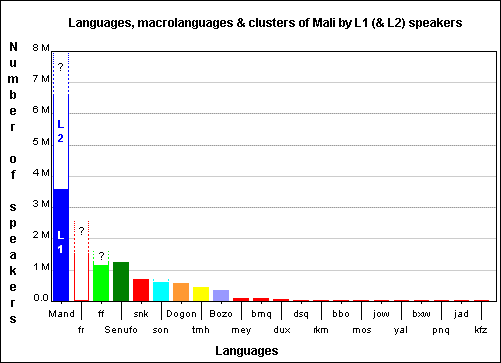
This is the second of two postings on the "long tail" and languages. The previous one took a general look at the long tail distribution in the contexts of the economics of languages and multilingual societies. This one, also reposted from a 2008 post in "Multildisciplinary perspectives," reflects a parallel discussion in the Wikinomics blog, and looks at what the long tail distribution of languages would look like in one country: Mali. A major point here - which I think is relevant for something like strategies for public education on ebola in rural West Africa - is that the long tail distribution of languages holds regardless of the geographic scale, and the languages at the head of the distribution (on the left of the graph) on more local scales may be totally different from those on the larger scales.


On the Wikinomics blog, Dan Herman responded to my discussion of use of the long tail model for languages (the date of that article was 11 April 2008). He raised some interesting points that I’ll come to in a moment.

Part of the reason I posted on the long-tail concept is that I believe it will be useful in various ways to analyzing the situation of less widely-spoken languages (LWSLs; previously I’ve used "MINELs" which says less about the size of the speaking community). I deliberately framed it in the context of the economics of language because I see the long tail as a model useful in the broader context of that field. In any event, we’re just beginning to explore this and it would be of interest to know of other efforts.

A clarification also needs to be made between what I’m seeing as two dynamics in the long tail of languages. Dan writes (referring to a previous Wikinomics posting by his colleague Paul Artiuch that I had referenced):
"As Paul highlights in his post there are several tools and applications that, in theory, facilitate learning, or given Don’s take, not leaving, the long-tail."
It seems to me that these are really two different, although related, things. On the one hand, Paul looked more at how the potential “consumer” of language learning would perceive minority languages. On the other hand, I’m mostly interested in the view from the points of view closer to where the language is spoken, from individuals, households and communities who speak the language, to regional and national entities that serve them - govt., business, NGOs, education. The latter are all a different kind of “consumer” than potential language learners. (Parenthetically, I think this difference reflects one that I’ve noted in events related to the International Year of Languages [2008]: some people and organizations are focusing more on language learning and others more on a nexus of issues relating to language rights, endangered languages, etc.)

All of these viewpoints are valid, of course, but when considering language development and indeed survival it is useful to know whether ICT’s effect of lowering barriers for doing various things in/for less widely-spoken languages down the long tail ultimately balances or outweighs other factors that either encourage speakers of less-widely spoken languages to focus uniquely on more widely-spoken languages at the head of the distribution. Which is to say in effect, that the long-tail effect makes production and use of content and products in a language somewhere down the tail - say Soninke (language spoken by about a million people in Mali, Senegal & Mauritania, which has a historical link to the Ghana empire) - easier and cheaper for Soninke speakers than it was previously. But how will this affect use and development of the language?

In his Wikinomics blog article, Dan is skeptical, posing the question this way:
"… in a world where the language of economics is conducted in one, perhaps two, and in the future maybe three languages, can a combination of technology, ethno-nationalism and culture trump trade and economics?"
I’m not sure we can answer either question but it might help to look at the long tail in different ways to see what’s involved. In his book, The Long Tail, Chris Anderson shows that if you zero in on a section of the long tail, you find … another long tail distribution (see p. 21). One could for instance do the same with languages based on populations of speakers, or, to consider the viewpoint from a country and its citizens, look at just the languages in that country. For example, the following graph uses figures from Ethnologue [15th ed., accessed in 2008] of first language (L1) speakers of languages of Mali :


This is another classic long-tail distribution. I’ve used color codes for very closely related tongues that are interintelligible (at least to some degree - this is a question that could be discussed at length another time). For instance, dark blue is used for the Manding tongues like Bambara, Jula, Malinke and Khassonke. The red color is for languages not in one of those groups. Soninke (snk) is one of these, with 700,000 speakers and 1 million or so overall - pretty significant in a particular region and fourth among the language categories Ethnologue lists for Mali.

Of course, in a multilingual societies people generally learn other languages no matter where their mother tongue may be in the distribution. So it makes more sense in terms of usage to plot out first & second (or additional) language speakers. In the following graph I plot out the combined figures for the closely related groups - whether they be called “language,” “macrolanguage,” or language cluster - and add estimated second language (L2) speakers above those:


There is some uncertainty about L2 speakership - estimates about the percentage of Mali’s 10+ million population that speak Bambara run from 65-80%; and for the official language of French, one probably low estimate is 15%. Fulfulde has historically been a lingua franca in central Mali.

And there are other ways we could graph out long tails of language as well. For instance on more local levels. Or, since there is a lot of trade and movement among countries of the West Africa region of which Mali is a part, and many of the language communities are divided by borders, one could do regional or subregional graphs.

What is the point? First, the dominant “two or three” languages when you narrow the geographical scale are not necessarily - and in fact usually are not - the same as one sees on the international level. English, Mandarin Chinese and Spanish may be the most significant worldwide, but none of them are major in Mali for instance. And languages that are relatively far down the tail in the international distribution may be at the top on a country or regional scale. Some languages specific to a country or region have some significant advantages in this context. And indeed, locally dominant languages do displace weaker languages to some degree. This may be the case with Bambara in Mali, or at least in much of the country, for instance.

Second, a language like Soninke which is pretty far down the tail in the international scale, has a higher profile nationally or subregionally (remembering it is a cross-border language).

The global distribution hides these realities. While it is true I think that the long-tail effect of advances in ICT generally lower the barriers and increase the potential for various kinds of work with LWSLs way down the tail (to the point where the main problems encountered are when the languages have few resources) - including for language learners (among whom the particular category of “heritage language learners” deserves special note) - it may be that the long tail distributions on more local levels are more informative for discussions of linguistic situations and language policy.

In other words, the significance of ICT’s effect on the potential to do various work (like publishing) in LWSLs may best be seen in reference to long tail distributions on country and regional levels.

Dan suggests that
"As countries migrate through the demographic transition, and subsequently become increasingly urbanized, there’s an inherent move towards common languages in order to facilitate the trade of services and goods."
Whether this means more a “trimming” of the tail or more an evolution of the language portfolios of multilingual speakers and communities is open to discussion. None of us are suggesting that speakers of LWSLs should abandon their languages in favor of languages of wider communication (LWCs), but the question is whether a combination of application of ICTs and good language and education policies can facilitate people keeping and developing their languages, even if their numbers be few.

Monday, October 20, 2014

Economics of language and the “long tail” effect (part 1)

In April 2008, I posted on my other blog, "Multidisciplinary Perspectives," two explorations of use of the "long-tail" distribution in understanding language use in multilingual societies. In subsequent years I have used this concept as a counterpoint to the more well known application of a "constellation" model for world languages.1 Without pretense as to its value, but with the thought that it is instructive to have alternative frames2 for understanding multilingual societies such as most of those in Africa, I'm reposting the first of those two efforts below (with minor modificatons and updates), and will follow later with the second.


“The economics of language has been neglected and deserves much greater attention,” wrote economist Donald Lamberton in a book he edited in 2002. That may not have been too much of a revelation at the time - only a few years earlier (1994) another economist, François Grin, wrote that this field was tolerated “as an intriguing fringe interest” by the discipline of economics. I’d like to briefly explore an intriguing idea on the fringe of that fringe: whether there are or could be “long-tail” dynamics that give some advantages to minority languages.

But first, what is “economics of language”? Grin, in the same article mentioned above defined it as covering the study of:
"…the effects of language on income (possibly revealing the presence of language-based discrimination), language learning by immigrants, patterns of language maintenance and spread in multilingual polities or between trading partners, minority language protection and promotion, the selection and design of language policies, language use in the workplace, and market equilibrium for language-specific goods and services."
Actually some of these issues are getting increased attention (another book on the topic by Barry R. Chiswick and Paul W. Miller was published in 2007 and released earlier this year in paperback, for instance), so I suspect that economics of language is becoming a little more mainstream. A good review of the subject under the title “The Economics of Multilingualism: Overview and Analytical Framework” was published by Grin and François Vaillancourt in 2009 (this apparently expands on an online version previously available on the World Bank website).

The "long tail" of languages


What does the “long tail” have to do with any of this? Well to begin with, the distribution of languages by number of speakers, if plotted out on a graph like the figure (modified from image on Wikipedia) to the right, is a long tail distribution. The question is whether this means anything with regard to the economics of languages - and in particular for minority or less-widely spoken languages (the ones I’ve liked to call MINELs3) which are in the long tail.

By way of explanation, the “long tail” refers to a distribution where a few categories have a lot of each (they would be the green-shaded area in the figure), and many categories have progressively fewer (the yellow-shaded part). It was popularized by Chris Anderson in a 2004 article, and then a 2006 book (revised and expanded in 2008), on new marketing strategies facilitated by the internet. As such, it is a kind of economic model.

How do languages fit this pattern? I plotted out a bar graph for the 50 languages with the most mother tongue speakers using figures from Wikipedia (accessed 2008; figures originally from Ethnologue) and an online utility at Shodor.org.

It’s “quick and dirty” but gives an idea of how the actual distribution compares to the long tail model. Needless to say, there is a very long and low “tail” to the right in this distribution after the first 50 languages.4

I got the idea of connecting the long tail concept with languages from Laurent Elder of IDRC. When I finally got to read up on the subject it began to make sense. At least partway…

Discussion


I have been among those suggesting that information and communication technologies make a lot of things possible or less expensive for MINELs that were impossible or too costly before. Desktop publishing or using webpages reduces barriers to producing and sharing text in any language - critical for languages with few resources and examples of a long tail effect. Cheaper communications via VOIP and expanded availability of cellphones facilitate dispersed members of a minority language community being able to speak their languages with each other. Community radio (a new use of an old technology) opens new ways of using the oral language. And so on. To be sure, dominant languages can use the same technologies, but the real advantage I think is for the non-dominant languages.

On the other hand - and here the application of the long-tail concept to language runs into problems perhaps similar to other attempts to apply economic analysis to languages - people don’t move “down the tail” to niche markets with language in the way they might with music or books (two of the examples in Anderson’s writing on the subject). With language, the most prominent fact is that people "live" in the long tail, as it were, and there are some incentives to move up the tail to dominant languages. Part of the issue is how the new technologies facilitate not abandoning the linguistic home in the long tail when dominant languages are learned and used. Most people after all learn more than one language.

In any event, the long tail seems to be a useful concept in looking at the present and future of world languages. When I did a little research on this in fall 2007, I came across an article on the Wikinomics blog that looked at the distribution of languages on the internet and posed questions re language learning. In other words, is there a long tail market for language services (mainly language learning)? This is a different take than mine above but also interesting. There may yet be others and perhaps, as the field of economics of language develops, more ambitious applications of the concept.


1. Per Abram de Swann, as elaborated in his 2001 Words of the World. I first encountered this "constellation" analogy in a 1999 work by Jean-Louis Calvet, Pour une écologie des langues du monde.
2. I take the concept of "(re)framing" from study of organizational development, and in particular a book by Lee G. Bolman and Terrence E. Deal entitled Reframing Organizations (in its 5th edition as of 2013). For complex issues, it is often useful to use more than one perspective or model in analysis.
3. "MINEL" is a proposed acronym that never caught on as a way of expressing non-global languages: Minority, Indigenous, National (in the sense used in some African countries), Endangered, Local.  
4. The top five are: Mandarin Chinese, Spanish, English, Hindi, and Arabic. The order when counting second-language speakers would be different, but still in a long tail distribution.

Friday, October 17, 2014

Balancing Act Africa media survey and languages

Yesterday evening I had the opportunity to meet and talk with a longtime virtual acquaintance, Russell Southwood of Balancing Act Africa. Russell and I have been in email contact since 2000 or so, when Balancing Act was establishing itself as an authoritative site on internet, media, and communications in Africa, and when I was developing the concept for Bisharat. And in 2001, the Balancing Act newsletter No. 69 featured an early article I wrote on support for African languages in text.

Russell and Balancing Act recently published the results of a 2013 "detailed market research study in seven Sub-Saharan countries [Ghana, Kenya, Nigeria, Senegal, and Tanzania] in the vanguard of adopting the Internet and social media," available via Balancing Act's issue No. 724 (19 September 2014). The report mentions languages in several parts, which I'll briefly touch on below. A key takeaway from the report is:
There is not a great deal of research on what language is used in relation to media in Sub-Saharan Africa: what does exist are largely academic studies from within the field of linguistics. (p. 6)

Overall, the report discusses trends in Africa that:
  • affect media and communication delivery
    • (5 areas) rise of social media; growth of feature & smartphone ownership; liberalization of media; mass media vs. niche audiences; and news
  • affect media and communication use
    • (4 "recurring patterns") urban vs. rural; education levels; income; and language
    • (5 country profiles) Ghana; Kenya; Nigeria; Senegal; and Tanzania
  • will affect communication and media over the next 5 years
    • (3 "known futures") more media & fragmentation; more devices; continuing growth of internet & social media
    • (6 "speculative futures") closing the rural media deficit; mobile media; edutainment; learning channels; public interest media; and online platforms with reliable info.
The subject of language(s) is touched on in several places. In discussion of "fragmentation" of radio and TV audiences, language specialization is mentioned as one possible characteristic of "niche" channels (another one is topical specialization).

In the context of what the report terms "the rural media deficit" (by comparison with urban areas), I read language as an implied factor. Likewise for education levels.

The importance of Africa languages is discussed at some length as one of four "recurring patterns" in a section entitled "Beyond Official Languages – Reaching People in Vernacular Languages." Here there are anecdotes concerning audience preference for or greater facility in use of what I'd call first languages and local lingua francas. It also mentions the role of media liberalization in facilitating formation of language specialized stations.

In discussing "known" future trends, an increase in African language broadcasting is foreseen. The possibility of social media platforms in major African languages is indicated as a possibility as social media use increases.

In general it is good to see the attention given to the linguistic dimension of media and communications in Africa. hopefully this will spur more interest in and research on the topic. A few quick comments bear mentioning:
  • The report cites the possible figure of 3000 languages in Africa. Indeed there are counts that go that high. However many groups of separately counted "languages" in such large figures may have high mutual intelligibility, and alternatively be considered by to be dialects or varieties of the same language. This is important for media in that often one language variety can be understood by speakers of close varieties in the broadcast radius. For example, when I worked in Djenné, Mali in the mid 1980s, I had Songhai-speaking co-workers originally from the Gourma-Rharous area of Mali who listened to the Zarma language broadcasts from neighboring Niger.
  • Further discussion of fragmentation of the media market and language-oriented niche stations would benefit from three perspectives:
    • the previous point about mutually intelligible languages;
    • the existence of so many cross-border languages in Africa (the previous point illustrates that too), which would add another dynamic to language specific broadcasts; and
    • the fact that many stations historically have divided their broadcast day among emissions in different languages of the audience (I've noted this on national level, official and commercial stations, as well as in community radio stations) - how might this approach blunt the "fragmentation" while serving different segments of clearly multilingual audiences?
  • The report uses the term "vernacular" in discussion of African languages. On one level this is technically correct, but on another, it is problematic, implying a lesser status form of speech. Personally I avoid it, especially after hearing a prominent African expert in African language policy criticizing another African for using the term (in French) to refer to African languages.
  • One gap for attention in future research is localization of content and software/apps in African languages. This relates to the mention in the report under social media futures of localized interfaces, as well as to wider use and usability of internet content for various purposes like education and extension as we move forward.

Wednesday, October 15, 2014

Two ebola info sites - almost no African language content

Several recent posts on this blog have highlighted various efforts to provide information about ebola in diverse African languages. Here I'd like to mention two important efforts to share material for communication on ebola, which include almost no information (yet) in African languages: the Ebola Communication Network (ECN), funded by USAID and run by the Center for Communications Programs at the Johns Hopkins Bloomberg School of Public Health; and "Ebola and C4D," a page on UNICEF's Communication for Development (C4D) website.

The purpose here is not to criticize but to help show the current language gap in messaging.

The ECN site has, according to the dropdown for "languages" on the search page, materials in the following languages (with number of items): English (133); French (17); Portuguese (2); Spanish (2); Krio (1); Pidgin (1); and Symbolic (1). Not counted in the total are the CDC's radio spots 11 African languages accessible via a link. To be fair, the ECN was only launched last week, and this is a significant collection as far as it goes.

The ECN site allows subscribed users to upload material, which would allow materials in more languages to be made available. Two questions for ECN are:
  1. How will review be handled for a wider range of languages?
  2. Will there be any proactive effort to develop the collection of materials in African languages in affected areas that might otherwise be overlooked?
The "Ebola and C4D" page, apparently launched in August, also has a significant collection. From perusal of the lists (organized under tabs for Fact Sheets, Social Mobilization, Planning Documents, and Other Tools & Resources), it appears that all linked materials are in English, French, or Portuguese, with one item in Khmer and one poster from Uganda in "Bantu" (which is a language family - may be Runyoro or Luganda - seeking to identify).

Here too, a means to submit materials is provided, so the above 2 questions may also be asked of UNICEF.

An effort should be made to upload existing material in African languages (with correct identification), as a necessary first step in helping to expand these collections.